



Fiber Optic Cable Market Revenue to Attain USD 49.76 Bn by 2035
Published: 20 Apr 2026
Author: Precedence Research



Fiber Optic Cable Market Revenue and Trends 2026 to 2035
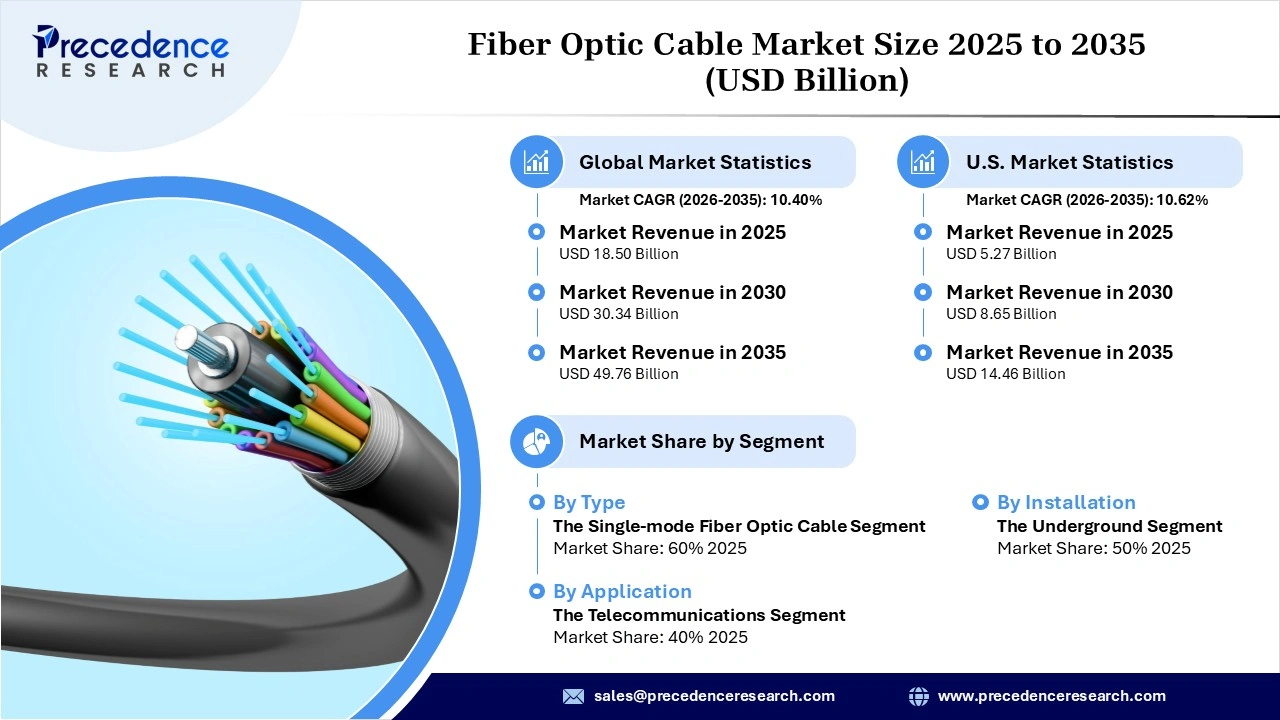
The global fiber optic cable market revenue surpassed USD 18.50 billion in 2025 and is predicted to attain around USD 49.76 billion by 2035, growing at a CAGR of 10.40%. The market is driven by the increasing demand for faster internet connections, increasing adoption of 5G networks, growing number of data centers, and increasing requirement for an effective communication network.
Fiber Optic Cable Market: Fueling the Next-Generation of High-Speed Connectivity
The fiber optic cable market involves the manufacturing, installation, and maintenance of cables that carry information using light beams through extremely thin glass or plastic threads. Optical fiber cables find a broad range of applications that include facilitating quick and dependable communication within telecom networks, broadband internet networks, and data centers. This market covers various kinds of cables, such as single-mode and multi-mode fibers, which are deployed within long-haul trunk lines, metro connections, and end-user links. Key players in the market are increasingly focusing on emerging growth opportunities, including 5G network expansion, smart infrastructure development, cloud computing ecosystems, and industrial automation systems.
What Drives the Fiber Optic Cable Market?
Technological Advancements
Recent advancements in the fiber optic cable market have focused on improving data transmission capacity, reliability, and deployment efficiency. The application of hollow-core fiber technology, which includes transmission through the air inside the fiber, allows for reducing latency and optimal signal transmission. Flexible bend-resistant and ultra-low-loss fibers facilitate high-speed information transfer despite tight cable installation.
- In 2026, Meta gave Corning Incorporated a supply contract worth up to USD 6 billion for the integration of advanced optical fiber cables, which will be used for expanding the capacity of data centers focused on AI applications.
Adoption of Fiber-to-the-Home (FTTH) Technology
The adoption of fiber-to-the-home (FTTH) technology has significantly promoted the construction of fiber optics networks because it allows for quicker internet transmission straight to homes and enterprises. FTTH has provided an effective solution for increasing broadband connectivity and promoting bandwidth-intensive use of the web, such as remote work, video streaming, and cloud computing. OTE Telecom, a major Greek telecom firm, connected 2 million homes by FTTH in the third quarter of 2025 and aimed to connect around 2.1 million homes by the end of 2025.
Government Broadband Initiatives and Fiber Expansion Programs
Government-sponsored broadband projects are the key contributors to the development of fiber infrastructures due to significant government expenditure on network expansion and provision of enhanced digital connectivity. Government broadband projects target the expansion of fiber networks in rural areas, government bodies, and isolated villages that have poor network connectivity. Such projects also contribute to private investment in the telecommunications industry and enhance the provision of broadband connections.
- In 2025, the Indian Government launched the BharatNet Project, which helped in the installation of approximately 694711 kilometers of optical fiber cable by October 2025, which provided broadband connection to more than 214000 gram panchayats in the country.
Capacity Enhancement of HFCL Optical Fiber Manufacturing Facilities
HFCL allotted a budget of INR 125 crore to expand its optical fiber manufacturing capability in 2025 and also plans to expand in 2026. The company intends to manufacture 1.73 million kilometers of fiber per annum to 19.01 million kilometers of fiber per annum. The company expects to achieve 42.36 million kilometers of fiber by 2026.
Market Segmentation Overview
- By Type: The single-mode fiber optic cable segment led the fiber optic cable market with a 60% share in 2025, owing to its ability to provide long-range, high-speed, and low-loss data transmission. This cable has been widely adopted in the telecom industry and data center interconnects.
- By Type: The multi-mode fiber optic cable segment held the second-largest market share of 40% in 2025, because of its affordability, ease of installation in shorter distances, and suitability for use in local area networks and data centers, and its usage in high bandwidth networks within a short distance range.
- By Application: The telecommunications segment dominated the market with 40% share in 2025, owing to its heavy reliance on fiber optics for fast data transfer over large distances, mobile networks, and broadband, which is due to the increasing demand for the internet, 5G technology, and expanding connectivity infrastructure worldwide.
- By Application: The data centers segment held the second-largest market share of 25% in 2025, owing to the rising need for high bandwidth, low-latency networks, and server connectivity for the growing demands for cloud computing, AI, and data storage solutions.
- By Installation: The underground segment led the fiber optic cable market with a 50% share in 2025, due to its ability to provide better protection against environmental factors, increased reliability, and longer life span of the networks, besides the preference for underground installations in cities owing to limited spaces.
- By Installation: The aerial segment held the second-largest share of 25% in 2025, owing to its cost-effective nature and faster deployment time compared to underground installations; thus, it is popular in rural and semi-urban settings where the presence of utility poles facilitates network expansion.
Regional Insights
North America dominated the fiber optic cable market with a 38% share in 2025, due to the early implementation of highly advanced communications technologies, significant presence of key telecom service providers, and cloud providers. The governments and private companies in this region have significantly invested in research for futuristic networking technologies, which facilitate constant innovation in fiber network infrastructure for increased capacity. North America is witnessing rapidly growing 5G networks and the development of data centers.
U.S led the market in North America on account of significant hyperscale investments in computing facilities along with fiber network infrastructure for cloud platforms and AI. Canada is a significant contributor to the market due to growing broadband network infrastructure and telecom development.
Asia Pacific is expected to expand at the highest CAGR during the forecast period, driven by rapid urbanization, expanding internet penetration, and substantial investments in 5G and broadband infrastructure. The region is witnessing strong demand from telecom operators and data service providers, supported by large-scale capacity expansion linked to ongoing digital transformation initiatives.
China leads the Asia Pacific fiber optic cable market, supported by extensive deployment of fiber networks, strong government backing for digital infrastructure development, and its dominant position in telecom equipment manufacturing and rollout. India is also experiencing notable growth, fueled by accelerated 5G deployment, rural connectivity expansion under initiatives such as the BharatNet Project, and increasing adoption of cloud-based services across industries.
Fiber Optic Cable Market Coverage
| Report Attribute | Key Statistics |
| Market Revenue in 2025 | USD 18.50 Billion |
| Market Revenue by 2035 | USD 49.76 Billion |
| CAGR from 2026 to 2035 | 10.40% |
| Quantitative Units | Revenue in USD million/billion, Volume in units |
| Largest Market | North America |
| Base Year | 2025 |
| Regions Covered | North America, Europe, Asia-Pacific, Latin America, and the Middle East & Africa |
Top Companies in the Fiber Optic Cable Market
Corning Incorporated, Prysmian Group, CommScope Holding Company Inc., and OFS Fitel LLC are key manufacturers of high-end optical fiber cables and integrated cable systems used in telecommunications and computing infrastructure. In Asia, companies such as Sumitomo Electric Industries Ltd., Furukawa Electric Co. Ltd., and LS Cable & System Ltd. play a significant role in producing optical fiber cables and related components for regional and global markets.
Meanwhile, Nexans S.A., Belden Inc., and Superior Essex specialize in copper and other specialized cabling solutions used across enterprise networks, industrial facilities, and broadband infrastructure. Additionally, Broadcom Inc. focuses on optical communication components such as lasers, photodetectors, and PHY devices that enable high-performance fiber optic transmission systems.
Segments Covered in the Report
By Type
- Single-Mode Fiber Optic Cable
- Multi-Mode Fiber Optic Cable
By Application
- Telecommunications
- Data Centers
- Military & Defense
- Utilities & Energy
- Broadcasting & Cable
- Others
By Installation
- Underground
- Aerial
- Submarine
- Others
By Region
- North America
- Latin America
- Europe
- Asia-pacific
- Middle and East Africa
Get this report to explore global market size, share, CAGR, and trends, featuring detailed segmental analysis and an insightful competitive landscape overview @ https://www.precedenceresearch.com/sample/8315
You can place an order or ask any questions, please feel free to contact us at sales@precedenceresearch.com |+1 804 441 9344