



Fiber Optic Cable Market Trends, Companies, Revenue / Sales Performance, Manufacturing Yield, Fab Capacity, Export & Import Dynamics, Supply Chain Analysis, Competitive Landscape, and Growth Forecast
Fiber Optic Cable Market (By Type: Single-Mode Fiber Optic Cable, Multi-Mode Fiber Optic Cable; By Application: Telecommunications, Data Centers, Military & Defense, Utilities & Energy, Broadcasting & Cable, Others; By Installation: Underground, Aerial, Submarine, Others) - Global Industry Analysis, Size, Trends, Leading Companies, Regional Outlook, and Forecast 2026 to 2035
Source: https://www.precedenceresearch.com/fiber-optic-cable-market
 Get a Sample
 Table Of Content


What is the Fiber Optic Cable Market Size in 2026?
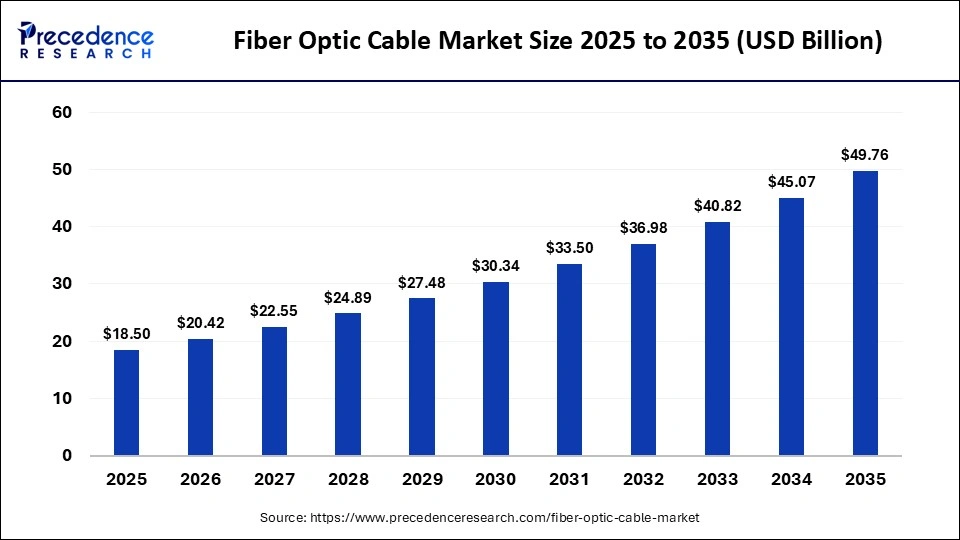
The global fiber optic cable market size accounted for USD 18.50 billion in 2025 and is predicted to increase from USD 20.42 billion in 2026 to approximately USD 49.76 billion by 2035, expanding at a CAGR of 10.40% from 2026 to 2035. The market is driven by growing demand for high-speed connectivity and next-generation communication technologies.
Key Takeaways
- North America dominated the fiber optic cable market with a 38% share in 2025.
- Asia Pacific is expected to grow at the fastest CAGR of 11% between 2026 and 2035.
- By type, the single-mode fiber optic cable segment held the highest market share of 60% in 2025.
- By type, the multi-mode fiber optic cable segment is the second-largest shareholder and is expected to grow at a CAGR of 9.5% during the forecast period.
- By application, the telecommunications segment dominated the market with a 40% share in 2025.
- By application, the data centers segment is expected to grow at a strong CAGR of 10.5% in the coming years.
- By installation, the underground segment held a major market share of 50% in 2025.
- By installation, the aerial segment is the second-largest shareholder and is expected to grow at a CAGR of 7.2% between 2026 and 2035.
Market Overview
The fiber optic cable market is evolving rapidly, driven by rising demand for high-speed, reliable internet and advanced communication technologies. As both businesses and consumers increasingly rely on seamless connectivity, the adoption of fiber optic solutions is gaining strong momentum. This growth is further supported by the expansion of smart cities and the Internet of Things (IoT), which require robust infrastructure to handle large volumes of data efficiently. At the same time, ongoing digital transformation across industries is encouraging greater investment in fiber optic networks.
Another key trend shaping the market is the growing focus on sustainability, with manufacturers adopting eco-friendly materials and production methods. This not only aligns with global environmental goals but also offers a competitive edge to companies prioritizing green practices. Overall, these factors are collectively strengthening market growth and shaping the future of fiber optic technology.
Impact of Artificial Intelligence on the Fiber Optic Cable Market
Artificial Intelligence is significantly impacting the fiber optic cable market by driving the need for high-speed, low-latency data transmission to support AI-intensive workloads such as machine learning, data analytics, and real-time processing. The rapid expansion of AI-enabled data centers and cloud infrastructure is increasing demand for advanced fiber optic networks capable of handling massive data volumes. Additionally, AI is being integrated into network management systems to optimize fiber network performance through predictive maintenance, fault detection, and automated traffic management. This dual role of AI, as both a demand driver and an operational enhancer, is accelerating innovation and investment in the fiber optic cable market.
Fiber Optic Cable Market Trends
- Growing Need for High-Speed Connectivity: The demand for faster internet is rising, driven by the rise in digital content consumption and the need for reliable connectivity across homes and businesses.
- Adoption in Smart Technologies: Fiber optics is increasingly being integrated with smart technologies, supporting the expansion of IoT devices and smart city projects that depend on efficient and high-capacity data transmission.
- Shift Toward Sustainability: There is a rapid shift toward environmentally friendly practices, with manufacturers focusing on eco-conscious materials and production methods to align with global sustainability goals.
Market Scope
| Report Coverage | Details |
| Market Size in 2025 | USD 18.50 Billion |
| Market Size in 2026 | USD 20.42 Billion |
| Market Size by 2035 | USD 49.76 Billion |
| Market Growth Rate from 2026 to 2035 | CAGR of 10.40% |
| Dominating Region | North America |
| Fastest Growing Region | Asia Pacific |
| Base Year | 2025 |
| Forecast Period | 2026 to 2035 |
| Segments Covered | Type, Application, Installation, and Region |
| Regions Covered | North America, Europe, Asia-Pacific, Latin America, and Middle East & Africa |
Market Dynamics
Drivers
Rise in Internet Penetration and Data Traffic
The fiber optic cable market is being driven by the rapid rise in internet penetration and growing data traffic worldwide. Increasing use of high-definition streaming, cloud computing, and IoT devices is creating strong demand for high-capacity data transmission. The rollout of 5G networks is further accelerating this need, as fiber optics plays a critical role in enabling fast and reliable connectivity. In addition, the development of smart cities and the expansion of data centers are boosting demand for advanced communication infrastructure. Significant investments by governments and telecom companies to improve broadband access are also supporting market growth.
Restraint
Limited Infrastructure Investments and Alternative Technologies
The fiber optic cable market faces challenges due to limited infrastructure investment, especially in emerging economies. High initial costs for deploying fiber networks, including cable installation and equipment, can slow adoption. Without sufficient funding, many regions continue to rely on outdated connectivity solutions, restricting the expansion of high-speed internet and delaying digital transformation.
Opportunity
Expanding 5G Communication Network
The rapid expansion of 5G networks presents a strong growth opportunity for the fiber optic cable market. Fiber infrastructure is essential for supporting high-speed data transmission and network reliability in 5G systems. As telecom providers invest in new base stations to stay competitive, demand for fiber optics is expected to increase significantly across both developed and emerging markets.
Segment Insights
Type Insights
Fiber Optic Cable Market Share, By Type, 2025-2035 (%)
| Type | 2025 | 2035 | CAGR (%) |
| Single-Mode Fiber Optic Cable | 60.00% | 62.00% | 10.8% |
| Multi-Mode Fiber Optic Cable | 40.00% | 38.00% | 9.5% |
The Single-Mode Fiber Optic Cable Segment Dominated the Market in 2025
The single-mode fiber optic cable segment dominated the fiber optic cable market with the highest share of 60% in 2025, driven by its superior performance in long-distance data transmission. Its single-core design enables the passage of one light mode, reducing signal loss and ensuring high data clarity. This makes it highly suitable for telecommunications, backbone networks, and long-haul applications. With higher bandwidth capacity and lower attenuation compared to other types, its high-speed communication infrastructure supports the growing demand for reliable and efficient data transfer.
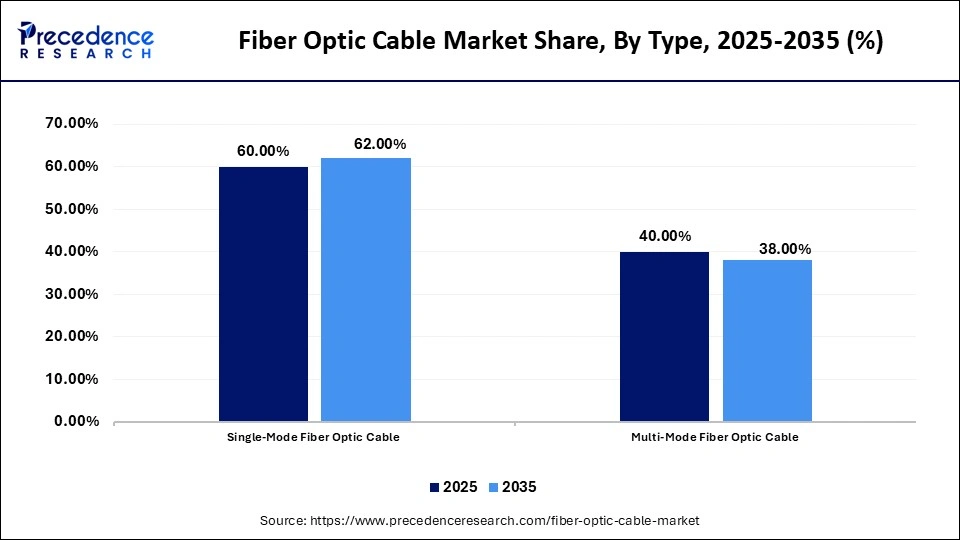
The multi-mode fiber optic cable segment held the second-largest market share of 40% in 2025 and is expected to grow at a significant CAGR of 9.5% during the forecast period. This is because of its widespread use in short-distance applications, particularly within buildings, campuses, and data centers. Its larger core size allows multiple light modes to pass through, making it cost-effective and easier to install compared to single-mode fibers. As demand for efficient data handling in confined spaces rises, multi-mode fiber is gaining traction as a practical and scalable solution
Application Insights
Fiber Optic Cable Market Share, By Application, 2025-2035 (%)
| Application | 2025 | 2035 | CAGR (%) |
| Telecommunications | 40.00% | 38.00% | 9.0% |
| Data Centers | 25.00% | 27.00% | 10.5% |
| Military & Defense | 10.00% | 12.00% | 11.0% |
| Utilities & Energy | 10.00% | 9.50% | 8.2% |
| Broadcasting & Cable | 8.00% | 7.00% | 7.5% |
| Others | 7.00% | 6.50% | 6.0% |
Why Did the Telecommunications Segment Led the Market in 2025?
The telecommunications segment dominated the fiber optic cable market with a 40% share in 2025, driven by rising demand for high-speed internet and 5G networks. Fiber optics enables fast, high-bandwidth, and low-loss data transmission, making it essential for long-distance connectivity and modern communication infrastructure.
The data centers segment held the second-largest market share of 25% in 2025 and is expected to grow at a CAGR of 10.5% in the coming years. The growth of the segment is driven by increasing demand for cloud computing, data storage, and high-speed networking. Fiber optic cables support faster data transfer, scalability, and efficient operations, making them critical for modern data center infrastructure.
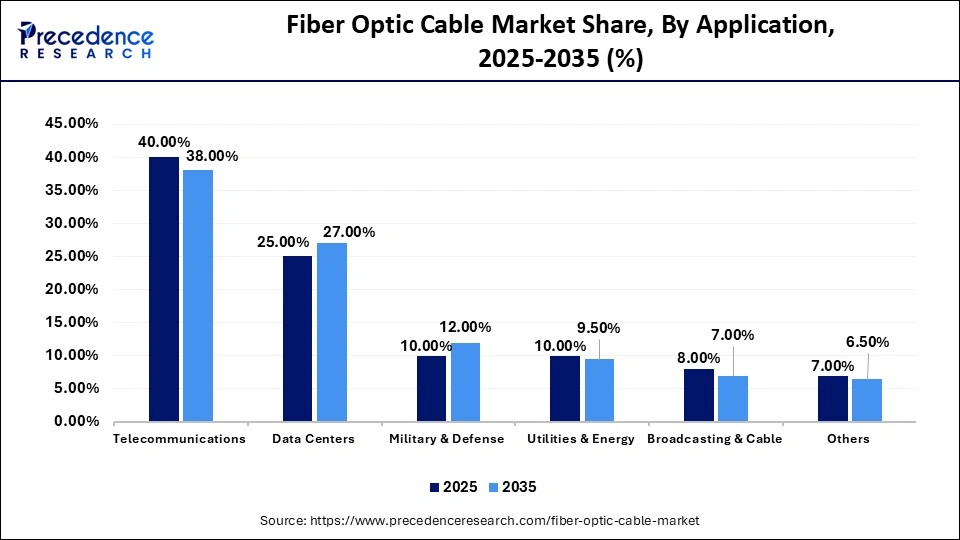
The military & defense segment held around 10% market share in 2025 and is projected to grow at the fastest CAGR of 11% over the forecast period. This is because fiber optics is crucial for secure, high-speed, and interference-free communication systems, supporting critical operations and handling large volumes of sensitive data efficiently.
The utilities & energy segment accounted for about 10% share of the market in 2025 and is expected to grow at a CAGR of 8.2% in the coming years. This is mainly due to the increasing adoption of smart grids, automation, and smart meters, which are driving demand for fiber optic cables in reliable and efficient power communication systems.
Installation Insights
Fiber Optic Cable Market Share, By Installation, 2025-2035 (%)
| Installation | 2025 | 2035 | CAGR (%) |
| Underground | 50.00% | 48.00% | 8.0% |
| Aerial | 25.00% | 26.00% | 7.2% |
| Submarine | 20.00% | 20.50% | 9.0% |
| Others | 5.00% | 5.50% | 6.5% |
The Underground Segment Held a 65% Share of the Market in 2025
The underground segment held a major market share of 50% in 2025, driven by its reliability and safety advantages. These installations are widely preferred in urban areas as they protect cables from environmental damage, accidents, and disruptions. They are especially critical for sectors like healthcare, transportation, finance, and government that require secure and uninterrupted connectivity. Reduced risk of outages and enhanced network stability make underground deployment ideal for mission-critical infrastructure.
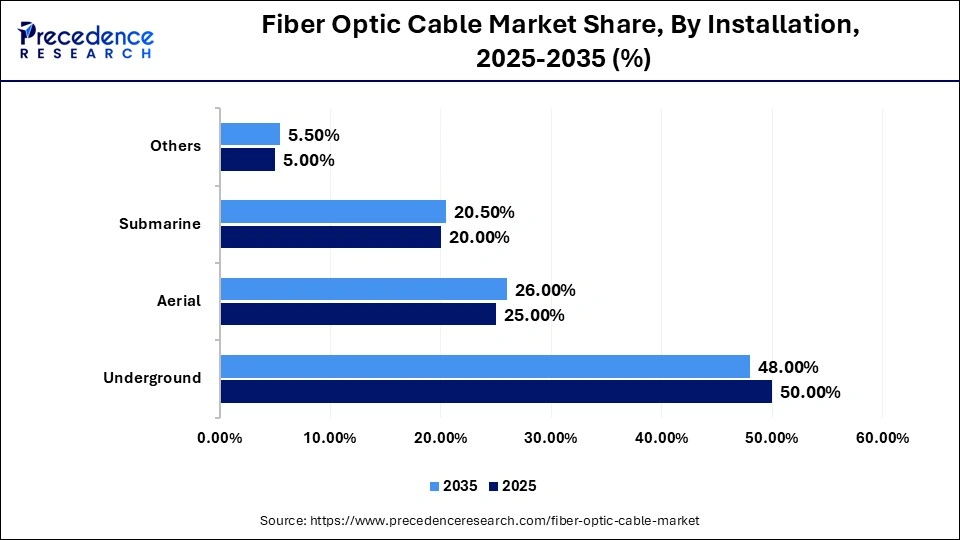
The aerial segment held the second-largest market share of 25% in 2025 and is expected to grow at a 7.2% CAGR between 2026 and 2035, supported by its cost-effectiveness and ease of deployment. It is commonly used in rural and suburban areas where underground installation is expensive. Aerial cables require less labor and materials, as they are installed on poles without extensive digging. They are also easier to maintain and upgrade, making them a practical solution for expanding network coverage efficiently.
The submarine segment held a 20% share of the market in 2025 and is expected to grow at the fastest CAGR of 9.0% during the projection period. This is because submarine fiber optic cables are essential for international data transmission and are growing with the increasing need for global connectivity.
Regional Insights
North America Fiber Optic Cable Market Size and Growth 2026 to 2035
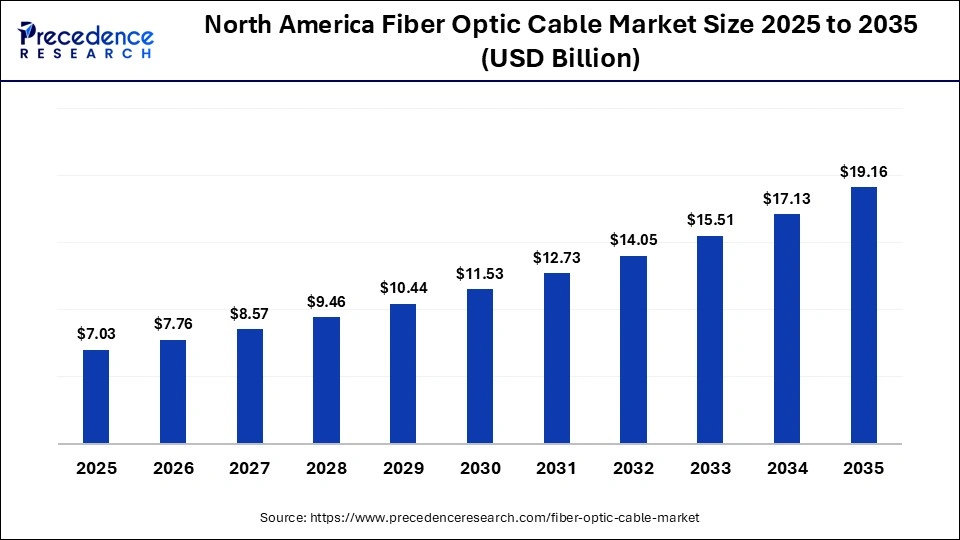
The North America fiber optic cable market size is estimated at USD 7.03 billion in 2025 and is projected to reach approximately USD 19.16 billion by 2035, with a 10.55% CAGR from 2026 to 2035.
Why Did North America Lead the Global Fiber Optic Cable Market in 2025?
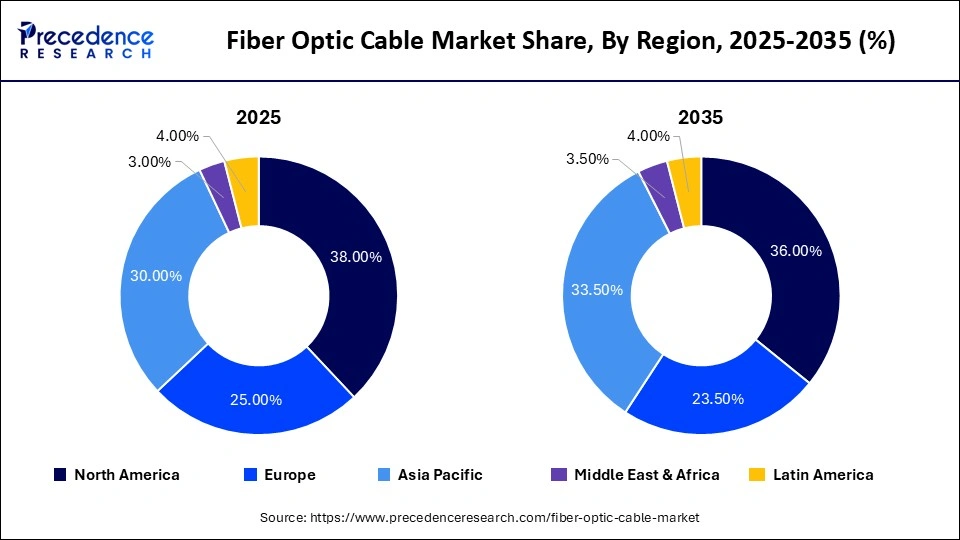
North America dominated the fiber optic cable market with a 38% share in 2025, driven by strong demand from telecommunications, 5G deployment, and expanding data centers. Growth is supported by the increasing need for high-speed internet, continuous telecom advancements, and government initiatives promoting broadband expansion. The U.S. dominates the region, with key players like Corning and CommScope leading innovation, while Canada focuses on strengthening its telecom infrastructure. Ongoing investments, technological progress, and strategic collaborations continue to reinforce the region's strong market position.
U.S. Fiber Optic Cable Market Size and Growth 2026 to 2035
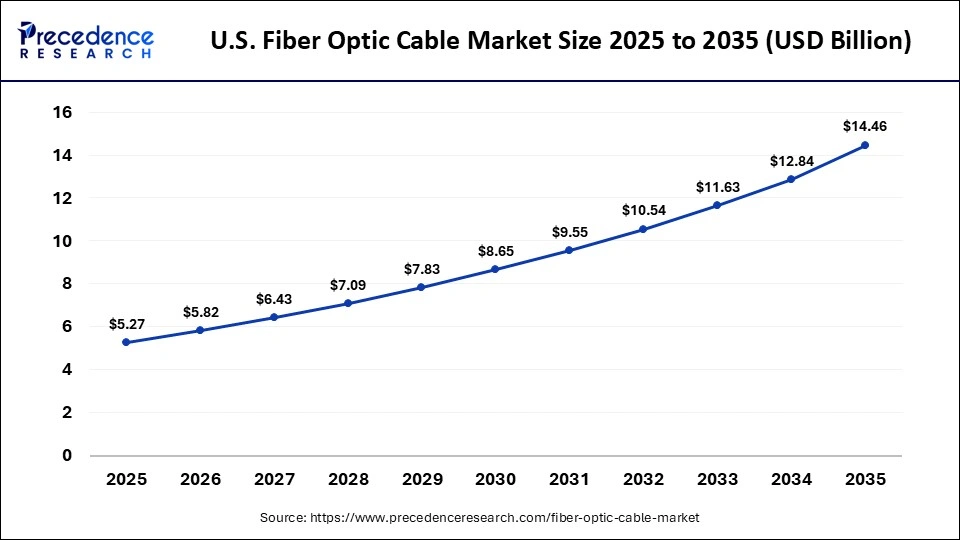
The U.S. fiber optic cable market size is calculated at USD 5.27 billion in 2025 and is expected to reach nearly USD 14.46 billion in 2035, accelerating at a strong CAGR of 10.62% between 2026 and 2035.
U.S. Fiber Optic Cable Market Analysis
The U.S. plays a key role in the North American fiber optic cable market, driven by expanding fiber broadband networks, rising cloud computing adoption, and government efforts to improve rural connectivity. Strong investments in networking infrastructure, along with increasing demand for smart city projects and advanced mobility solutions, are further supporting market growth. Continuous funding and innovation in telecommunications are strengthening the country's position as a leading hub for high-speed, reliable connectivity solutions.
Why is Asia Pacific Undergoing the Fastest Growth in the Fiber Optic Cable Market?
Asia Pacific accounted for around 30% market share in 2025 and is expected to grow at the fastest CAGR of 11%, supported by rapid urbanization, rising internet penetration, and strong telecom investments. Countries like China and India are leading growth through large-scale broadband expansion and digital infrastructure development. Increasing demand for high-speed connectivity, combined with government initiatives, is driving the adoption of fiber optics, while a mix of established companies and new entrants is fostering innovation across the region.
China Fiber Optic Cable Market Analysis
The market in China is growing rapidly due to strong government investment in advanced telecom infrastructure, including 6G and smart city projects. These initiatives require high-speed, reliable networks, increasing demand for fiber optics. Additionally, the expansion of AI-driven automation in manufacturing and technology sectors is further boosting the need for efficient data transmission, supporting sustained market growth.
India Fiber Optic Cable Market Analysis
India's fiber optic cable market is expanding quickly, driven by the nationwide rollout of 5G networks and ongoing infrastructure development. Increasing demand for high-speed communication, along with growing adoption of fiber-based surveillance systems in urban and industrial areas, is fueling growth. Government initiatives to strengthen digital connectivity and rising internet usage are also contributing to the country's rapidly evolving telecom landscape.
Why Is Europe Experiencing Notable Growth in the Market?
Europe held a 25% share of the market in 2025 and is expected to grow at a notable CAGR of 7.5% during the forecast period. The regional market growth is driven by strong government support, broadband initiatives, and ongoing 5G deployment. Programs like the European Digital Strategy are boosting investments in digital infrastructure and connectivity. Countries such as Germany, France, and the UK are leading adoption, while companies like Prysmian Group and Nexans drive innovation. A mix of established firms and startups is fostering a competitive, technology-focused market.
Middle East & Africa Market Analysis
Middle East & Africa held a 3% market share in 2025, supported by rising investments in telecom infrastructure and increasing demand for reliable data networks. Governments are actively promoting digital connectivity to support economic development. Countries like South Africa and the UAE are leading efforts through broadband expansion and network upgrades. The market is evolving with participation from both local and international players, focusing on innovative solutions to improve internet access. Growing infrastructure projects and digital transformation initiatives are positioning the region as an emerging market for fiber optic adoption.
South America Market Analysis
South America held a 4% market share in the fiber optic cable market in 2025, driven by expanding telecom services and rising internet demand. Countries such as Brazil and Argentina are investing in fiber infrastructure to support digital transformation. Increasing deployment of FTTx networks across sectors like smart agriculture, renewable energy, and cloud services is boosting demand. These industries rely on fast and reliable connectivity, encouraging further adoption of fiber optics. Continuous improvements in network infrastructure and growing digital initiatives are supporting steady market expansion across the region.
Top Companies in the Fiber Optic Cable Market
- Corning Incorporated
- Prysmian Group
- CommScope Holding Company, Inc.
- Sumitomo Electric Industries Ltd.
- Nexans S.A.
- Furukawa Electric Co., Ltd.
- Yangtze Optical Fibre and Cable Joint Stock Limited Company (YOFC)
- Hengtong Group Co., Ltd.
- LS Cable & System Ltd.
- Superior Essex
- Belden Inc.
- ZTT International
- OFS Fitel, LLC
- FiberHome Telecommunication Technologies Co., Ltd.
- Broadcom Inc.
Recent Developments
- On April 14, 2026, OMC, a pioneer in the design & manufacture of industrial fibre-optic datalinks and optical cable assemblies, recently completed production of a major optical link requirement for a leading energy distribution company. (Source: https://timestech.in)
- On March 13, 2026, NTT developed the world's highest-capacity 192-core submarine cable system using multicore optical fiber, enabling 4× higher transmission capacity without changing the submarine cable system.(Source: https://group.ntt)
- On Jan 28, 2026, Facebook parent Meta Platforms signed a deal worth USD 6 billion with Gorilla Glass maker Corning to provide fiber-optic cables for its AI data centers. Corning will supply advanced optical fibre, OFC cable, and connectivity products to Meta. The company is also expanding its manufacturing capacity in North Carolina, including a cable factory in Hickory, where Meta will be its prime customer.(Source: https://www.wirecable.in)
Segments Covered in the Report
By Type
- Single-Mode Fiber Optic Cable
- Multi-Mode Fiber Optic Cable
By Application
- Telecommunications
- Data Centers
- Military & Defense
- Utilities & Energy
- Broadcasting & Cable
- Others
By Installation
- Underground
- Aerial
- Submarine
- Others
By Region
- North America
- Latin America
- Europe
- Asia-pacific
- Middle and East Africa
For inquiries regarding discounts, bulk purchases, or customization requests, please contact us at sales@precedenceresearch.com
Frequently Asked Questions





Ask For Sample
No cookie-cutter, only authentic analysis – take the 1st step to become a Precedence Research client
 Get a Sample




 sales@precedenceresearch.com
 Schedule a Meeting
