



Dark Fiber Market Trends, Companies, Revenue / Sales Performance, Manufacturing Yield, Fab Capacity, Export & Import Dynamics, Supply Chain Analysis, Competitive Landscape, and Growth Forecast
Dark Fiber Market (By Fiber Type: Single-Mode Fiber, Multi-Mode Fiber; By Network Type: Metro Dark Fiber, Long-Haul Dark Fiber; By Material: Glass Fiber, Plastic Fiber; By Application: Backhaul Connectivity/Telecom, Data Center Interconnect, Enterprise & Private Networks, Other (Redundancy/Transport/Others; By End User: IT & Telecommunications, BFSI, Healthcare, Government & Public Sector, Others) - Global Industry Analysis, Size, Trends, Leading Companies, Regional Outlook, and Forecast 2026 to 2035
Source: https://www.precedenceresearch.com/dark-fiber-market
 Get a Sample
 Table Of Content


What is the Dark Fiber Market Size?
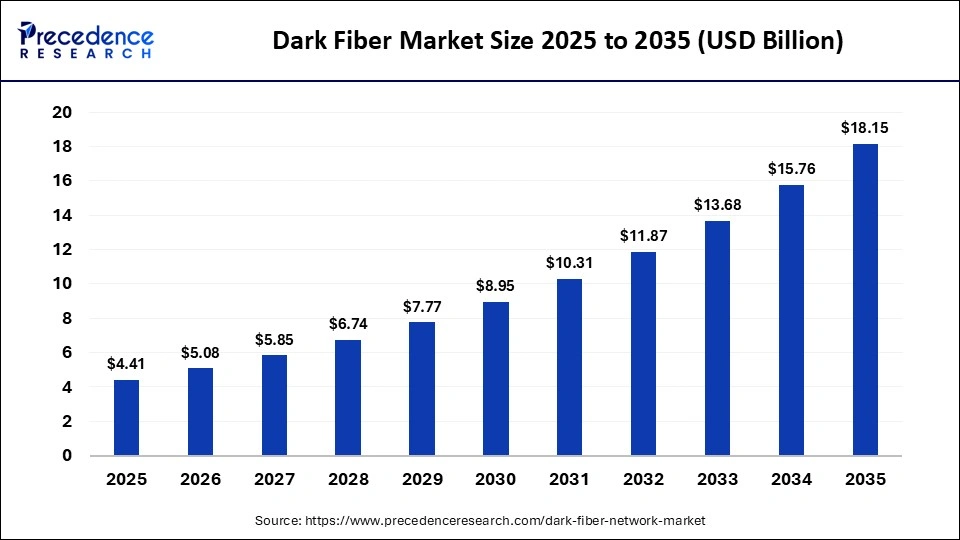
The global dark fiber market size was calculated at USD 4.41 billion in 2025 and is predicted to increase from USD 5.08 billion in 2026 to approximately USD 18.15 billion by 2035, expanding at a CAGR of 15.20% from 2026 to 2035.The market is primarily driven by the exponential growth in data traffic, fueled by cloud computing, 5G deployment, and hyperscale data centers that demand ultra-high bandwidth and low latency.
Market Highlights
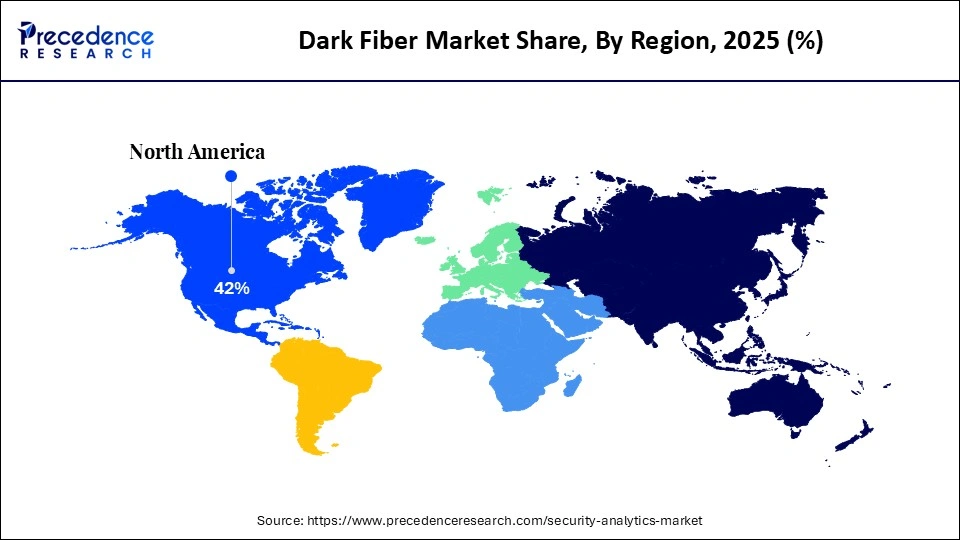
- North America held a dominant revenue share of approximately 42% in the market in 2025.
- Asia-Pacific is expected to host the fastest-growing market with a CAGR of 15.4% in the coming years.
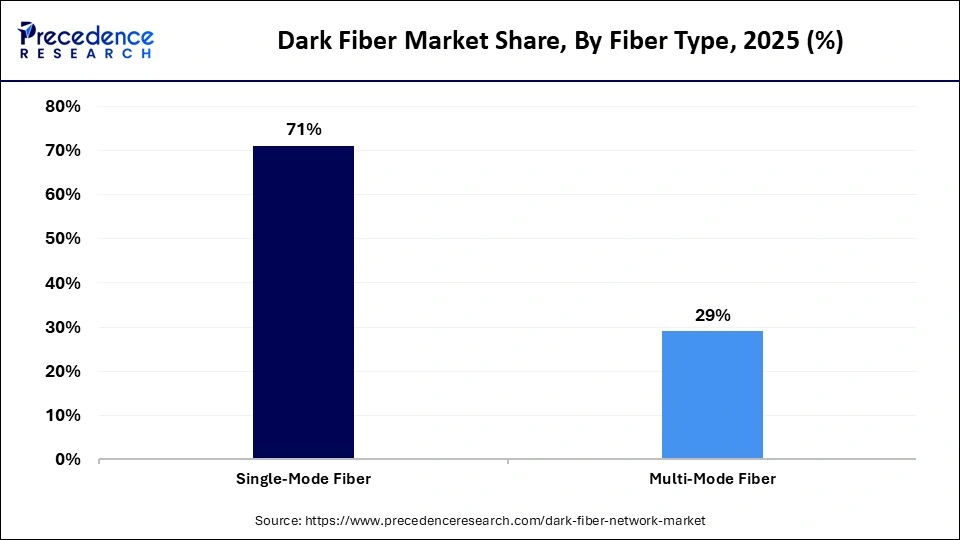
- By fiber type, the single-mode fiber segment registered its dominance over the global dark fiber market with a share of approximately 71% in 2025.
- By fiber type, the multi-mode fiber segment is expected to gain the highest share of the market with a CAGR of 13.4% between 2026 and 2035.
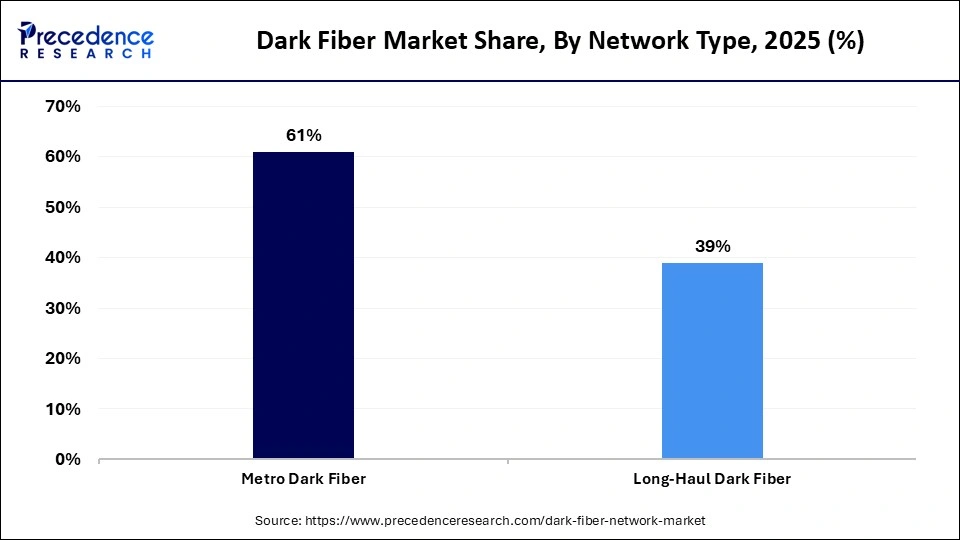
- By network type, the metro dark fiber segment contributed the biggest revenue share of approximately 61% in the market in 2025.
- By network type, the long-haul dark fiber segment is expected to witness the fastest growth in the market with a CAGR of 13.6% over the forecast period.
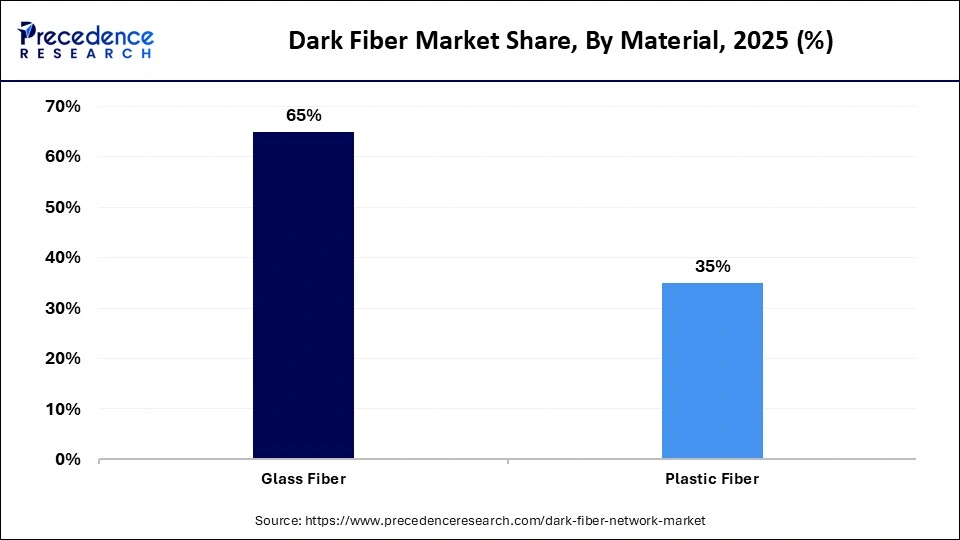
- By material, the glass fiber segment registered its dominance over the global dark fiber market with a share of approximately 65% in 2025, and is expected to expand rapidly in the market with a CAGR of 13.8% in the coming years.
- By application, the backhaul connectivity/telecom segment contributed the biggest revenue share of approximately 52% in the market in 2025.
- By application, the data center interconnect segment is expected to gain the highest share of the market with a CAGR of 14.0%between 2026 and 2035.
- By end user, the IT & telecommunications segment held the largest market share of approximately 50% in 2025 and is expected to grow at the fastest CAGR of 14.2% over the studied years.
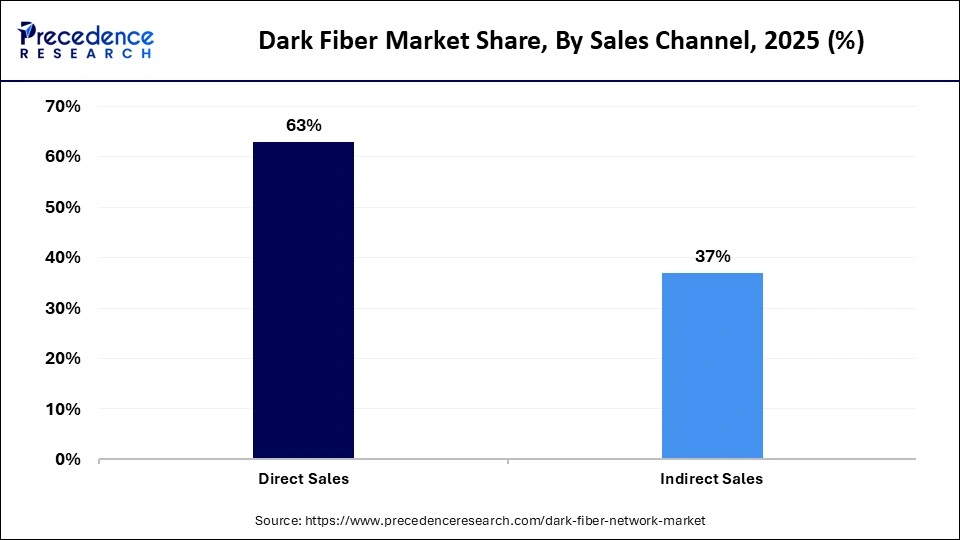
- By sales channel, the direct sales segment held a major revenue share of approximately 63% in 2025 and is expected to grow at the highest CAGR in the coming years.
Dark Fiber: Illuminating the Future of High-Capacity Networks
The dark fiber market is witnessing robust growth as organizations seek dedicated, secure, and scalable network infrastructure to support rising digital workloads. Unlike leased services, dark fiber enables end-users to customize network bandwidth and protocols based on evolving needs. The surge in data center interconnect, smart city initiatives, and enterprise networking is significantly expanding market adoption. Furthermore, favorable government investments in broadband expansion and fiber-to-the-home projects are accelerating market penetration.
How is Artificial Intelligence Reshaping Fiber Intelligence?
Artificial intelligence (AI) is playing a transformative role in optimizing dark fiber network planning, monitoring, and utilization. AI-driven analytics enable predictive maintenance, helping operators identify faults and performance bottlenecks before service disruptions occur. Machine learning algorithms also enhance traffic forecasting and capacity management, ensuring efficient bandwidth allocation across large-scale fiber networks. As AI workloads demand massive data transfer with ultra-low latency, dark fiber is becoming a critical infrastructure enabler for next-generation AI ecosystems.
Dark Fiber Market Trends
- Integration of AI-based Network Management: AI-based network management enhances the efficiency and effectiveness of network operations by automating tasks, analyzing data in real-time, and anticipating network issues before they become critical.
- IoT Ecosystems: IoT ecosystems refer to the interconnected network of devices, platforms, and applications that communicate and share data. These ecosystems consist of various components, including smart devices, sensors, cloud services, and data analytics tools.
- Digital Public Infrastructure: Digital public infrastructure represents the foundational technologies and systems that support the delivery of public services in a digital format. This includes online platforms for government services, digital identity verification systems, and data-sharing frameworks that facilitate efficient service delivery.
- High-Performance Networks: High-performance networks are advanced communication networks designed to support high-speed data transfer and low-latency connections. These networks are essential for applications requiring significant bandwidth, such as cloud computing, video conferencing, and real-time data analytics.
Market Scope
| Report Coverage | Details |
| Market Size in 2025 | USD 4.41 Billion |
| Market Size in 2026 | USD 5.08 Billion |
| Market Size by 2035 | USD 18.15 Billion |
| Market Growth Rate from 2026 to 2035 | CAGR of 15.20% |
| Dominating Region | North America |
| Fastest Growing Region | Asia Pacific |
| Base Year | 2025 |
| Forecast Period | 2026 to 2035 |
| Segments Covered | Fiber Type, Network Type, Material,Application, End User, and Region |
| Regions Covered | North America, Europe, Asia-Pacific, Latin America, and Middle East & Africa |
Segmental Insights
Fiber Type Insights
Why the Single-Mode Fiber Segment Dominated the Dark Fiber Market?
The single-mode fiber segment held the largest revenue share of approximately 71% in the market in 2025, because it is the best type of fiber that allows the transmission of data over long distances with minimal loss of the signal. It can handle very high bandwidth and low latency, and is suitable for telecom backhaul, hyperscale data centers, and cloud service providers.
The growing deployment of 5G and fiber-to-the-home networks has greatly boosted the demand for single-mode deployments. Businesses choose this type of fiber to use in network structures of the future and for scalability in capacity. Its interoperability with state-of-the-art optical technologies like DWDM is also a great boost to its acceptance. Increasing investments in upgrades of long-distance networks and metro networks are helping in extensive implementation.
The multi-mode segment is expected to be the fastest-growing during the forecast period, driven by its applicability for short-distance, speedy data transfer. It enjoys extensive use in data centers, enterprise campus networks, and building-level networks where source space constraints are small. The growing mode of edge data centers is increasing the requirements of multi-mode dark fiber installations.
Developments in laser-optimized multi-mode fiber have enhanced the bandwidth performance and the quality of the signal. Companies with cost-restricted networking demands prefer using this type of fiber for internal networking. There is an increase in the usage of cloud-based services that is leading to deployment within localized network environments.
Network Type Insights
How the Metro Dark Fiber Segment Dominated the Dark Fiber Market?
The metro dark fiber segment held a major revenue share of approximately 61% in the market in 2025, because it supports high-data traffic that is created by smart cities, enterprise networks, and regional data centers. Telecom providers use metro networks to facilitate the smooth 5G backhaul and enterprise connectivity services. Deployment is being reinforced by the growing concentration of hyperscale data centers in metropolitan areas. Metro dark fiber is preferred by businesses to have full control over network customization and performance. Modernization of urban infrastructure projects is also enhancing the growth of networks.
The long-haul dark fiber segment is expected to grow at the fastest CAGR of 13.6% in the market between 2026 and 2035, due to the growth of cloud services and content delivery networks putting pressure on intercity connectivity with high-capacity requirements. Hyperscale operators are investing in long-distance fiber routes to serve distributed computing architectures. Large-scale fiber is being increased due to cross-border digital infrastructure projects. Highly resilient mission-critical communications networks are made possible by long-haul networks. Developments in optical amplification technologies are enhancing the efficiency of transmissions across long distances.
Material Insights
What Made Glass Fiber the Dominant Segment in the Dark Fiber Market?
The glass fiber segment held a dominant position in the market with a share of approximately 65% in 2025 and is expected to grow rapidly at a CAGR of 13.8% in the foreseeable future, because it has outstanding optical performance and long-range transmission. It has low attenuation, is durable, and can be used with advanced transmission technology.
Telecom operators and data center providers are inclined to use glass fiber in backbone and even metro networks. The substance facilitates an increased information rate to suit contemporary communication systems. It is less susceptible to interference in the environment, thereby increasing network reliability. There is ongoing technological innovation in the production of glass fiber, enhancing scalability and performance.
Application Insights
Which Application Segment Led the Dark Fiber Market?
The backhaul connectivity/telecom segment led the market with a share of approximately 52%, driven by telecom operators' increased network capacity to accommodate the increasing data traffic. Dark fiber is widely applied to link base stations to core networks in a highly reliable manner. The use of a fast deployment of 5G infrastructure has placed considerable strain on backhaul. Dark fiber is preferred because operators can utilize it to control bandwidth scaling and latency optimization. High-capacity backhaul networks are needed to support mobile broadband and the IoT ecosystem. The demand is being sustained by increasing network densification.
The data center interconnect segment is expected to expand rapidly in the market with a CAGR of 14% in the coming years, because the rise of hyperscale and edge data centers has made dark fiber a vital solution for high-speed and secure data transfer between facilities located across various geographical areas. Cloud service providers utilize data center interconnectivity (DCI) to manage workload transfers and backups effectively.
The growing reliance on AI and big data analytics is significantly increasing bandwidth demands. Enterprises prefer dark fiber for inter-data centre connections, especially over short distances and for scalable networking options. This trend is being accelerated by rising investments in distributed computing architectures.
End User Insights
Why the IT & Telecommunications Segment Dominated the Dark Fiber Market?
The IT & telecommunications segment held the largest market share of approximately 50% in 2025 and is expected to account for the fastest growth with a CAGR of 14.2% in the coming years, driven by the increasing use of dark fiber to support mobile backhaul, core network expansion, and fiber broadband services. IT businesses embrace the use of dark fiber to support their own networks and to transmit data safely. The increasing demand for cloud services and digital transformation programs is creating high demand for bandwidth. Fiber is further being used with network virtualization and edge computing.
Sales Channel Insights
How the Direct Sales Segment Dominated the Dark Fiber Market?
The direct sales segment dominated the market with a share of approximately 63% in 2025 and is expected to rise at a rapid CAGR of 13.9% during the predicted timeframe, since big enterprises and telecom operators prefer customized network solutions. This channel helps providers to provide long-term leasing agreements and customized infrastructure. Direct involvement can control price, deployment, and maintenance easily.
Customers benefit from increased service reliability and customer-specific technical support. The rising requirement for large-scale fiber deployments is enhancing direct procurement models. The growth of channels is being expedited by the rise of alliances between fiber providers and businesses.
Regional Insights
How Big is the North America Dark Fiber Market Size?
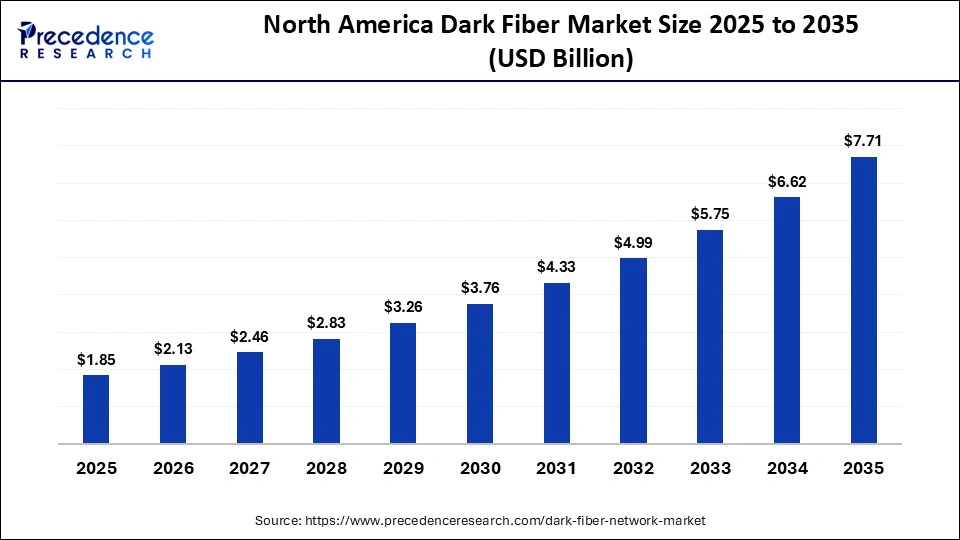
The North America dark fiber market size is estimated at USD 1.85 billion in 2025 and is projected to reach approximately USD 7.71 billion by 2035, with a 15.34% CAGR from 2026 to 2035.
Why North America Dominated the Dark Fiber Market?
North America dominated the market by holding a share of approximately 42% in 2025, due to its advanced digital infrastructure and early adoption of high-capacity networking technologies. The region hosts a high concentration of hyperscale data centers, cloud service providers, and telecom operators requiring dedicated fiber connectivity. Strong investments in 5G deployment and fiber-to-the-premises networks are driving extensive dark fiber leasing. Enterprises increasingly adopt private fiber networks to support secure data transmission and latency-sensitive applications.
What is the Size of the U.S. Dark Fiber Market?
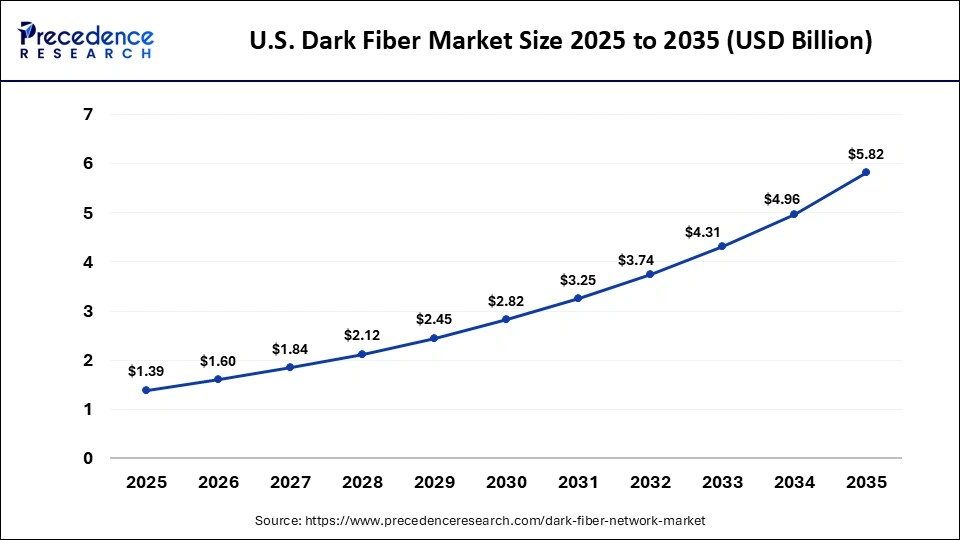
The U.S. dark fiber market size is calculated at USD 1.39 billion in 2025 and is expected to reach nearly USD 5.82 billion in 2035, accelerating at a strong CAGR of 15.40% between 2026 and 2035.
Country Level Analysis
At the country level, the U.S. holds the largest market share supported by extensive metro and long-haul fiber networks. The presence of major cloud providers and content delivery networks is accelerating demand for data center interconnect solutions. Telecom operators in the U.S. are expanding dark fiber assets to support 5G backhaul and edge computing.
How is Asia-Pacific Growing in the Dark Fiber Market?
Asia-Pacific is expected to host the fastest-growing market with a CAGR of 15.4% in the coming years, driven by high rates of urbanization and rapidly expanding digital transformation. The increased use of mobile data and cloud is creating a need to have scalable fiber infrastructure. Government organizations in the region are investing in smart cities and national broadband systems. The growth of the data centers and international subsea cables is also increasing regional growth. The increasing use of 5G technology is driving the demand for largely backhaul connectivity.
Country Level Analysis
On the country level, China is the industry leader with enormous investment into fiber networks and data center infrastructure. The high concentration of 5G and cloud services that the country is experiencing is enhancing the use of dark fibers. India is growing at a fast rate because of the rise in internet access and the growing demand for dark fiber by telecom operators and businesses.
Japan is also capitalizing on high-speed fiber infrastructure to justify the high-speed connectivity and new technologies. South Korea is still investing in ultra-low latency networks for 5G and AI uses. Australia is also developing metro fiber networks to enhance data center interconnectivity and enterprise connectivity.
Who are the Major Players in the Global Dark Fiber Market?
The major players in the dark fiber market include AT&T Inc, CenturyLink/Lumen Technologies, Comcast Corporation, Colt Technology Services Group Limited , Consolidated Communications, Crown Castle, euNetworks, FirstLight Fiber, Inc., GTT Communications, Inc., Retelit S.p.A,. Segra (U.S.), Uniti Group, Verizon Communications, Inc., Windstream Intellectual Property Services, LLC, FiberLight, LLC
Recent Developments
- In January 2026, Glo Fiber announced the launch of its new symmetrical 8 Gbps fiber internet service across several states, aiming to provide fast and reliable connectivity to residential and business customers. This service is designed to meet the growing demand for high-speed internet, supporting activities such as remote work, online gaming, and streaming.
- In October 2025, EonFibre launched a new data center connectivity service in New Zealand, offering low-latency, high-capacity dark fiber solutions to businesses. This initiative aims to enhance digital infrastructure in the region and support the growing demand for data traffic driven by cloud computing and other technologies.
Segments Covered in the Report
By Fiber Type
- Single-Mode Fiber
- Multi-Mode Fiber
By Network Type
- Metro Dark Fiber
- Long-Haul Dark Fiber
By Material
- Glass Fiber
- Plastic Fiber
By Application
- Backhaul Connectivity/Telecom
- Data Center Interconnect
- Enterprise & Private Networks
- Other (Redundancy/Transport/Others
By End User
- IT & Telecommunications
- BFSI
- Healthcare
- Government & Public Sector
- Others
By Region
- North America
- Europe
- Asia-Pacific
- Latin America
- Middle East & Africa
For inquiries regarding discounts, bulk purchases, or customization requests, please contact us at sales@precedenceresearch.com
Frequently Asked Questions
Tags





Ask For Sample
No cookie-cutter, only authentic analysis – take the 1st step to become a Precedence Research client
 Get a Sample




 sales@precedenceresearch.com
 Schedule a Meeting
