



Food Container Market Revenue to Attain USD 275.20 Bn by 2035
Published: 13 May 2026
Author: Precedence Research



Food Container Market Revenue and Trends 2026 to 2035
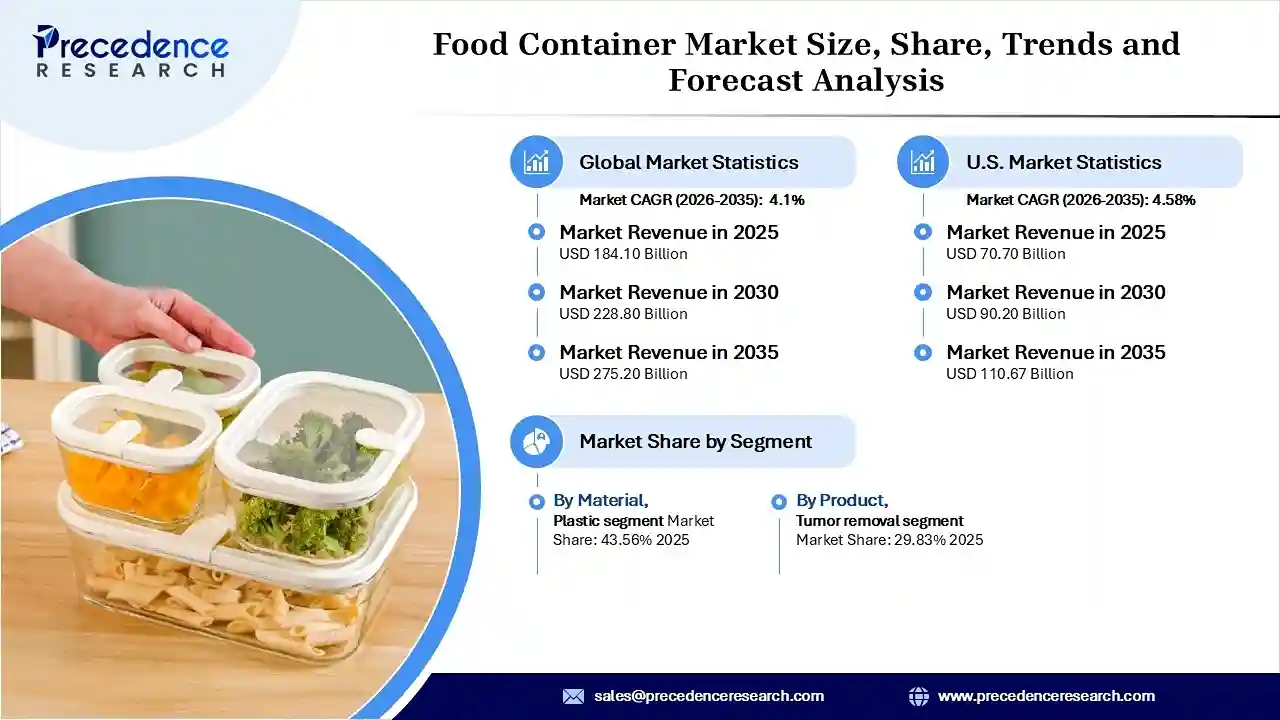
The global food container market revenue reached USD 184.10 billion in 2025 and is projected to increase from USD 192.40 billion in 2026 to approximately USD 275.20 billion by 2035, expanding at a CAGR of 4.1% from 2026 to 2035. The food container market has experienced significant growth and is expected to continue expanding over the coming years. Its increasing demand reflects the growing importance of secure and convenient packaging solutions in the food industry.
Market at a Glance
Market Forecast
Secondary Data
| Avoid Deterioration Parameters Want to Improve Parameters |
01. Weight of Moving Objects | 31. Object-Generated Harmful Factors | 36. Device Complexity |
| 10. Force | 08, 01 37, 18 |
13, 03 36, 24 |
26, 35 10, 18 |
| 14. Strength | 01, 08 40, 15 |
15, 35 22, 02 |
02, 13 15, 18 |
The diagram illustrates a technical contradiction matrix focused on designing food packaging that is easy to open and close while also preventing deterioration. It highlights conflicting parameters: improving the weight and strength of moving objects versus managing harmful factors and device complexity. Each parameter’s improvement is associated with potential challenges, such as the need for greater force or strength, indicating a balance must be achieved between convenience and the safety of the packaging, ensuring food quality without compromising user experience.
Segment Insights
Material Insights
Plastic has emerged as a dominant force in the food container market, because it is affordable, lightweight, highly durable, and can be produced on a large scale and used extensively. It is also versatile and enables manufacturers to make containers of different shapes and sizes to meet the packaging needs of homes and the foodservice industry. Plastic is also highly moisture-resistant and sealing, which can be used to increase the shelf life of perishable foodstuffs. The ever-increasing use of convenience foods and takeaway containers further enhances the popularity of plastic containers worldwide. Nevertheless, the growing environmental awareness and regulatory focus on single-use plastics are compelling manufacturers to consider recyclable and biodegradable alternatives to plastics.
The glass segment is the fastest-growing area within the food container market, as it is eco-friendly and non-toxic. Glass does not contain chemicals as plastic does, which is why it is the preferred option of health-conscious consumers. Its capacity to maintain food flavors and quality, and its re-use character is propelling its use both at home and in business set-ups. The need to have a sustainable packaging solution and the trend in Favor of environmental conservation is also accelerating the growth of glass containers. Also, glass packaging is becoming a trend with premium food brands aiming to attract more customers and to be environmentally friendly.
Product Insights
Bottles and jars have emerged as a dominant force in the food container market, as they are widely used in the packaging of beverages, sauces, condiments, and preserved foods. They have very high storage capacity and come in a wide range of materials such as plastic, glass, and this makes them very versatile. They are very strong in their sealing properties and therefore can preserve the product fresh and avoid contamination, which makes them suitable both in the industry and at home. The increasing popularity of packaged and processed food products in the world market is one of the reasons that can justify the superiority of the segment. Moreover, design and labelling technologies are also improving the functionality and aesthetics of bottles and jars.
The cups and tubs segment is the fastest-growing area within the food container market, due to the increased intake of ready-to-eat meals, dairy products, and takeaway food. They are highly convenient and portable containers that are used to package products like yogurt, desserts, instant noodles, and salads. The fact that the number of food delivery services and fast-food restaurants is rapidly growing is also contributing greatly to their high demand. Moreover, the new lightweight, microwave-safe, and recyclable materials are enhancing their use in a wide range of applications. The consumption of cups and tubs in the global market is also increasing because of consumer preference for on-the-go food consumption.
Regional Insights
Asia Pacific is the leading region in the food container market as it has a high population base and a fast-growing food and beverage sector. There is a great growth in packaged food consumption in countries like China and India due to urbanization and modification of lifestyles. The proliferation of supermarkets, hypermarkets, and online food delivery is also a booster to the demand for food containers in the area. Also, the availability of cheap production plants and raw materials promotes mass production. The market is also growing due to the increasing disposable incomes and the changing consumer preferences towards convenience foods. Government programs such as food safety and packaging standards enhance the control even more.
The food container market is growing most rapidly in North America due to the need to implement sustainable and innovative packaging solutions. In the region, there is a growing trend towards using environmentally friendly materials like glass and biodegradable plastics, which are motivating manufacturers to invest in developing sustainable products. The market is also growing with a high presence of organized retail and well-established food delivery services. Also, strict policies on food safety and quality packaging are driving the use of modern container technologies. The increasing popularity of meal prepping and storage among customers is also increasing the demand for reusable containers. The packaging design and the technological development that is still going on are likely to further fuel the growth in this region.
Top Companies in the Food Container Market
- Bemis Company Inc: A leading manufacturer of flexible packaging solutions, Bemis plays a critical role in food safety and shelf-life extension through innovative packaging technologies.
- Ball Corporation: Known for its sustainable aluminum packaging, Ball Corporation is essential in the beverage, food, and aerospace industries, focusing on recycling and environmental stewardship.
- Constar International UK Ltd: Specializing in plastic packaging, Constar is important for providing efficient and cost-effective solutions for various markets, including food and beverage.
- Anchor Glass Container Corporation: As a major glass container manufacturer, Anchor Glass is vital for producing high-quality glass packaging for the beverage and food sectors, focusing on sustainability and design.
- Crown: A global leader in metal packaging, Crown is significant in providing innovative can and container solutions, enhancing product shelf life and promoting recycling initiatives.
- Berry Plastics Corporation: Berry Plastics is crucial in offering a wide variety of plastic packaging products, focusing on sustainability and innovation to meet the diverse needs of its clients.
- Plastipak Holdings Inc: A prominent name in the rigid plastic packaging industry, Plastipak is important for its advanced manufacturing capabilities and commitment to sustainability in packaging solutions.
- Graphic Packaging International LLC: This company plays an essential role in providing paper-based packaging solutions, emphasizing eco-friendly practices and responsible sourcing in its production processes.
Segments Covered in the Report
By Material
- Plastic
- Glass
- Metal
- Others
By Product
- Bottles and Jars
- Cups and Tubs
- Cans
- Boxes
- Others
By Region
- North America
- Europe
- Asia Pacific
- Latin America
- Middle East & Africa
Get this report to explore global market size, share, CAGR, and trends, featuring detailed segmental analysis and an insightful competitive landscape overview @https://www.precedenceresearch.com/sample/1517
You can place an order or ask any questions, please feel free to contact us at sales@precedenceresearch.com |+1 804 441 9344