



GLP-1 Market Revenue to Attain USD 212.73 Bn by 2035
Published: 10 Jul 2026
Author: Precedence Research



GLP-1 Market Revenue and Trends 2026 to 2035
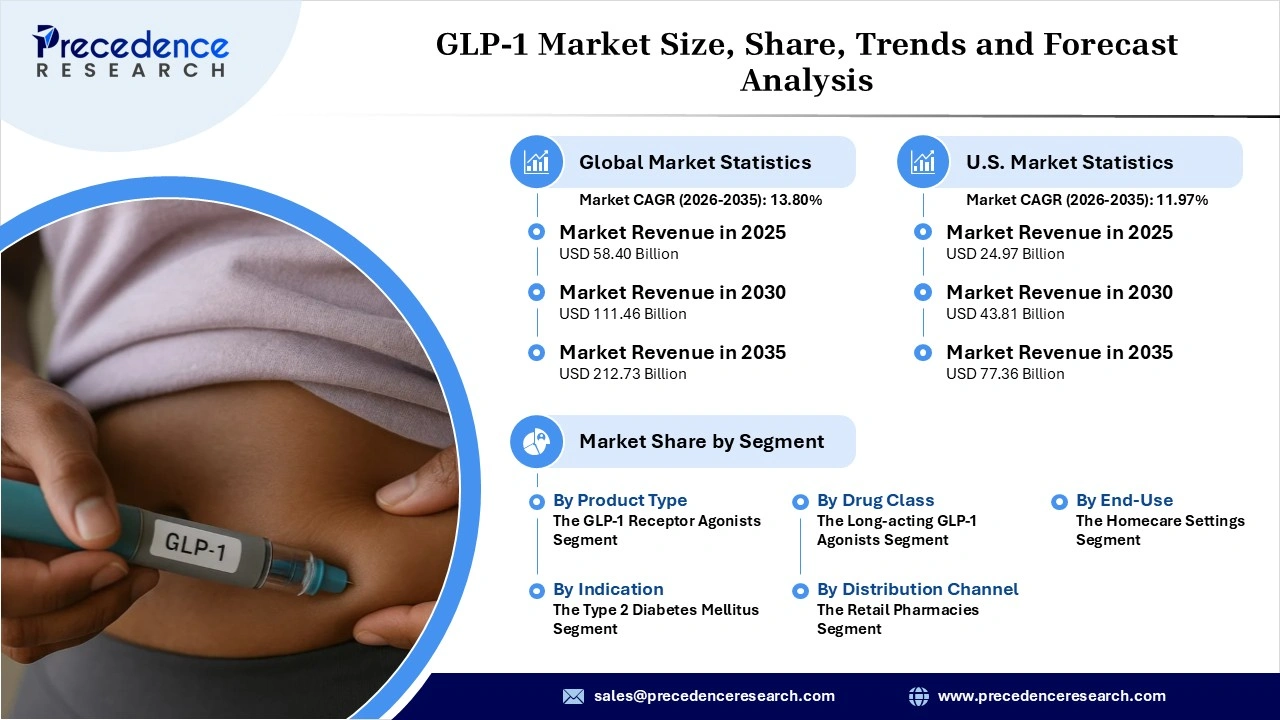
The global GLP-1 market revenue surpassed USD 58.40 billion in 2025 and is predicted to attain around USD 212.73 billion by 2035, growing at a CAGR of 13.80%. The market is driven by the increasing prevalence of obesity and type 2 diabetes throughout the world, the effectiveness of GLP-1 agonists in terms of significant weight loss and glucose management, and active consumer promotion campaigns and reimbursement coverage.
Advanced Treatments to Treat Obesity and High Blood Sugar
The GLP-1 market comprises glucagon-like peptide-1 (GLP-1) receptor agonist drugs, either in the form of orally available drugs, used mainly for the treatment of type-2 diabetes, obesity, and conditions such as heart ailments and chronic kidney ailments. The market is inclusive of branded GLP-1 products such as semaglutide (Ozempic, Wegovy, Rybelsus), tirzepatide (Mounjaro, Zepbound), liraglutide (Victoza, Saxenda), and dulaglutide (Trulicity).
There is also a pipeline of novel drug candidates, such as small-molecule, once-a-month injectable, and dual-triple GLP-1 agonists with the GIP and glucagon receptors. The market scope includes prescription drugs, compounding pharmacies, and direct-to-consumer digital health apps offering GLP-1 prescriptions and lifestyle support. These drugs find applications in endocrinology, cardiology, nephrology, and obesity medicine. This market has been adopted by hospitals, specialist clinics, retail pharmacies, and online pharmacies.
Modern Applications of GLP-1 Moving Beyond Diabetes
GLP-1 therapy options include new multi-target drugs incorporating GLP-1, GIP, and glucagon receptor signalling to provide weight reduction and glycemic regulation that mimic the outcomes achieved through surgery. Such futuristic therapeutics have been found to improve cardiovascular, renal, and metabolic disorders and can be used in patients who have issues besides diabetes and obesity. In the 2026 ADA Scientific Sessions, results from the Phase-3 TRANSCEND-T2D-1 study involving retatrutide, a triple agonist of GLP-1, GIP, and glucagon receptors, showed up to a 2% decrease in A1C and a 16.8% decrease in body weight over 40 weeks in patients with type 2 diabetes.
Competitive Pricing and Wider Reach Lead to Increased Adoption
Competitive pricing strategy and active consumer marketing in the GLP-1 market have resulted in increased penetration of GLP-1 therapies among premium as well as non-premium patients. Markets within domestic regions are experiencing substantial growth as more pharmaceutical companies enter the industry by providing alternative products at affordable costs. A new branded semaglutide drug named Poviztra was introduced in India by Emcure Pharmaceuticals in 2025 for USD 103 a month, well under the prices offered by competing drugs, ranging between USD 165 and 324.
National Coverage Policies Enhance Accessibility to Innovative Obesity Drugs
Several nations have implemented major national policies regarding reimbursement and coverage of GLP-1 receptor agonists for the treatment of obesity. The policies include expansion of the national public insurance coverage and regulation of controlled and subsidised access among high-risk patients. In 2026, the French Minister of Health declared that France is going to become the first country within the EU to reimburse costs related to obesity drugs Wegovy and Mounjaro. The policy became active starting from June 15, 2026. It comes after June 2025 policy changes that allow any doctor, not necessarily an expert, to prescribe these drugs.
Novo Nordisk Sees USD 21.9 Billion in GLP-1 Sales in 2025
The GLP-1 portfolio from Novo Nordisk earned USD 21.9 billion in 2025, growing by 56% compared to last year, with U.S. sales rising by 65% to USD 16.4 billion. Wegovy brought in USD 7.1 billion in revenue globally, whereas Ozempic sales stood at approximately USD 15.4 billion. The daily oral Wegovy saw 26,100 prescriptions in the third week after launch, which is a 42% week-to-week rise.
Market Segmentation Overview
- By product type, the GLP-1 receptor agonists segment led the GLP-1 market with an 86% share in 2025, due to the continued adoption of diabetes management and weight loss. GLP-1 receptor agonists are gaining clinical significance across multiple indications, potentiating their widespread demand.
- By product type, the oral GLP-1 therapies segment is expected to expand at the highest CAGR of 21.8% during the forecast period because of its better efficacy in glycemic and weight control than the injectable counterpart. Oral therapies can be easily swallowed and administered to patients of all age groups.
- By indication, the type-2 diabetes mellitus segment dominated the market with a 58% share in 2025, due to the fact that it is the largest indication of GLP-1 treatments with an extensive number of patients that have been steadily increasing because of high levels of obesity and sedentary lifestyles.
- By indication, the obesity and weight management segment is expected to grow at the fastest CAGR of 18.6% from 2026 to 2035, because there is an epidemic level of prevalence of obesity throughout the world. This segment benefits from the recent approval of GLP-1 treatments and the obesity indication for drugs.
- By drug class, the long-acting GLP-1 agonists segment led the GLP-1 market with a 63% share in 2025 because they have one important feature: they are administered only once per week. It makes patients feel more comfortable using these drugs and increases their compliance. These drugs are the first choice for doctors and patients for treating diseases such as diabetes and obesity.
- By drug class, the triple agonists (pipeline) segment is expected to expand at the highest CAGR of 29.4% during the forecast period, as it has a highly effective tri-fold effect targeting three receptors that result in weight reduction and glucose control that is far more effective than current therapy options. This explains why it is being exhaustively researched and adopted by doctors and patients.
- By distribution channel, the retail pharmacies segment dominated the market with a 54% share in 2025, as they remain the most convenient mode for buying prescription drugs, whereby GLP-1 users get their prescriptions refilled from the nearest retail pharmacy during their regular health check-ups. This is the most prevalent channel, considering that there is insurance coverage, pharmacy benefit management, and patient preference towards retail pharmacies.
- By distribution channel, the online pharmacies segment is expected to grow at the fastest CAGR of 20.8% from 2026 to 2035, since they provide greater convenience, privacy, and even low prices to patients purchasing GLP-1-based treatments, especially for weight loss, where a patient may not want to visit a physical pharmacy and purchase the drug discreetly.
- By end user, the homecare settings segment led the market with a 64% share in 2025 and is expected to expand at the highest CAGR of 15.1% during the forecast period, due to the trend towards self-administration of injectables in GLP-1 and the availability of user-friendly delivery systems like prefilled pens and auto-injectors that facilitate the use of the treatment.
- By end user, the hospitals segment held the second-largest market share of 19% in 2025 because they represent the major environment in which GLP-1 therapy initiation in complicated patients takes place. This is because of the fact that most complicated patients are treated in the departments of endocrinology and cardiology in hospitals.
Regional Analysis
North America led the GLP-1 market with a 57% share in 2025, due to the high prevalence of obesity and type 2 diabetes, alongside a healthcare system where there is early access to new medications via the FDA’s fast-track pathway and extensive insurance that makes such expensive medications accessible to millions of patients. The U.S. dominated the market in North America owing to direct-to-consumer marketing practices, a rapidly growing population of commercially insured patients with high spending power, and the presence of the world’s leading pharmaceutical companies. Canada witnessed notable market growth as its public healthcare systems offer GLP-1 coverage through provincial drug programs, strong clinical adoption through the guidelines set by endocrinologists, and the growth of private insurance that has made access to these medicines possible for weight management.
Asia-Pacific is expected to expand at the highest CAGR of 18.2% during the forecast period, due to the fact that it has the biggest population and significant prevalence of diabetes and obesity, resulting from the high rate of urbanization, changes in diets, and the aging of the population. China led the market in Asia-Pacific owing to the huge number of patients in the country, the positive health policy of the government aimed at decreasing the burden of chronic diseases, and the fast development of manufacturing, which is lowering the prices of GLP-1 therapies. India is a significant contributor to the market as there is a big and growing number of diabetics, increased awareness of weight management, and access to cheaper generic and biosimilar versions of these drugs.
Europe held the second-largest market share of 23% in 2025, due to the prevalence of diabetes and obesity in the region, established healthcare systems that ensure wide prescription of medication, and a regulatory framework that makes the approval and reimbursement of GLP-1 drugs easier. Germany dominated the market in Europe owing to the presence of many endocrinology and obesity specialists, a healthcare insurance system that covers GLP-1 drugs, and the presence of the pharmaceutical industry that has adopted these drugs for diabetes as well as obesity. The U.K. witnessed notable market growth since the NHS concentrates on the development of innovative treatments for chronic diseases, the use of GLP-1 for the treatment of diabetes, and its relatively recent adoption of GLP-1 drugs in weight management.
GLP-1 Market Coverage
| Report Attribute | Key Statistics |
| Market Revenue in 2025 | USD 58.40 Billion |
| Market Revenue by 2035 | USD 212.73 Billion |
| CAGR from 2026 to 2035 | 9.65% |
| Quantitative Units | Revenue in USD million/billion, Volume in units |
| Largest Market | North America |
| Base Year | 2025 |
| Regions Covered | North America, Europe, Asia-Pacific, Latin America, and the Middle East & Africa |
Top Companies in the GLP-1 Market
Eli Lilly and Company, Novo Nordisk A/S, AstraZeneca, Pfizer Inc., and Sanofi S.A. are some of the key players that are actively developing new GLP-1 agonists. Viking Therapeutics, Terna Pharmaceuticals, Eccogene, and Veru Inc. are the emerging biotechnology firms developing GLP-1-based drugs to treat obesity and diabetes. Madrigal Pharmaceuticals, Structure Therapeutics, and Carmot Therapeutics focus on oral small-molecule GLP-1 agonists.
Segments Covered in This Report
By Product Type
- GLP-1 Receptor Agonists
- Semaglutide
- Liraglutide
- Dulaglutide
- Exenatide
- Lixisenatide
- Tirzepatide (Dual GIP/GLP-1 Agonist)
- Other GLP-1-based Therapies
- Oral GLP-1 Therapies
- Injectable GLP-1 Therapies
By Route of Administration
- Injectable
- Once Daily
- Once Weekly
- Oral
By Indication
- Type 2 Diabetes Mellitus
- Obesity & Weight Management
- Cardiovascular Risk Reduction
- Non-Alcoholic Steatohepatitis (NASH)/MASH
- Chronic Kidney Disease (CKD)
- Other Metabolic Disorders
By Drug Class
- Short-acting GLP-1 Agonists
- Long-acting GLP-1 Agonists
- Dual Incretin Agonists
- Triple Agonists (Pipeline)
By Distribution Channel
- Hospital Pharmacies
- Retail Pharmacies
- Online Pharmacies
By End User
- Hospitals
- Specialty Clinics
- Homecare Settings
- Ambulatory Care Centers
By Age Group
- Adults
- Geriatric
- Pediatric
By Payer Type
- Public Insurance
- Private Insurance
- Out-of-Pocket
By Region
- North America
- Latin America
- Europe
- Asia-pacific
- Middle and East Africa
Get this report to explore global market size, share, CAGR, and trends, featuring detailed segmental analysis and an insightful competitive landscape overview @ https://www.precedenceresearch.com/sample/8542
You can place an order or ask any questions. Please feel free to contact us at sales@precedenceresearch.com |+1 804 441 9344