



Hemophilia Market Revenue to Attain USD 23.46 Bn by 2035
Published: 18 May 2026
Author: Precedence Research



Hemophilia Market Revenue and Trends 2026 to 2035
The global hemophilia market revenue reached USD 12.50 billion in 2025 and is predicted to attain around USD 23.46 billion by 2035 with a CAGR of 6.50%. The market is expanding with the improvement in detection at a much earlier stage, the growing life expectancy of hemophilia patients, easier access to treatments, and special therapies like extended half-life biologics and gene therapy, and evolving international care standards.
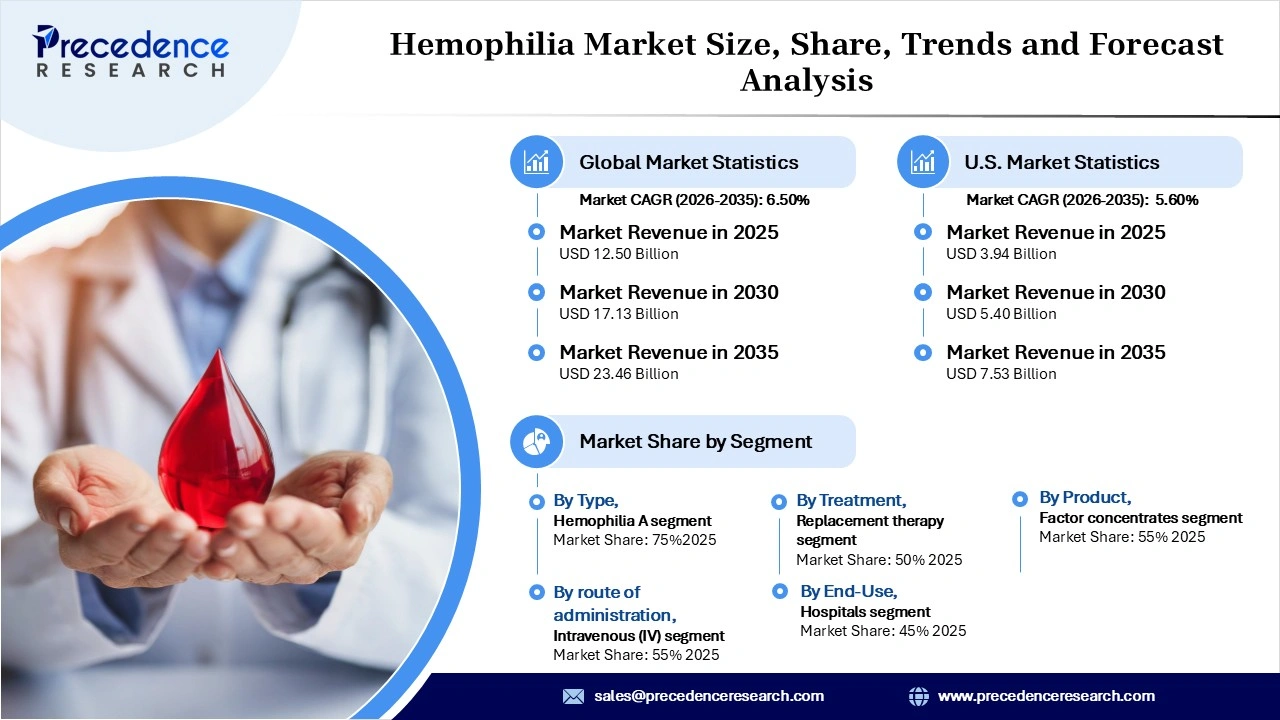
Market at a Glance
The hemophilia market is an integral part of the global healthcare system, focused on the diagnosis, treatment, and management of hemophilia. The disease results from a low level of clotting factors, causing hemophilia. This industry includes factor concentrates derived from recombinant and plasma sources, as well as non-factor therapies and gene therapies; diagnostic tools, infusion devices, and specialized healthcare services.
The growth of this market is tied to increased diagnosis rates and better accessibility to healthcare and clinical outcomes, and continued innovations to prevent bleeding events. This market comprises preventive care, on-demand treatment, and diagnostic technologies alongside home care infusion support systems and specialized distribution networks that offer new gene-based treatments from countries with developed technology and emerging demand.
Market Forecast for the Hemophilia Market
- Gene Therapy Is Turning Lifetime Care into One-Time Treatment: The strongest growth lever now comes from gene therapy. HEMGENIX received U.S. FDA approval for adults with Hemophilia B and is administered as a single intravenous infusion. This marks a structural shift from recurring factor replacement toward premium, one-time interventions with long-term benefit. As more payers adopt reimbursement models, high-value therapy revenues are expected to expand.
- New Non-Factor Drugs are Expanding the Treatable Population: In 2025, the FDA approved Qfitlia (fitusiran) for Hemophilia A or B patients aged 12+, including those with or without inhibitors. In clinical studies, the therapy reduced annualized bleeding rates by 90% versus control arms. This opens fresh commercial space where conventional factor products were less efficient.
Expanding Treatment Options in the Hemophilia Market
- The U.S. FDA approved Qfitlia, Sanofi’s new hemophilia therapy, adding a fresh commercial entrant to a market once ruled mainly by factor replacement drugs. New launches typically widen treatment spending and boost premium therapy adoption.
- Qfitlia is priced at $642,000 annually for most patients, highlighting the high-value economics of rare disease medicines and their ability to lift total market revenue even with smaller patient populations.
- The therapy is administered once every two months, a major shift from frequent injections. Reduced dosing burden may improve adherence, helping manufacturers retain long-term patient demand.
- In clinical studies, Qfitlia delivered a 90% reduction in annualized bleeding rates versus control groups, signaling strong physician interest and faster adoption potential.
- The U.S. CDC estimates around 33,000 males live with hemophilia in the United States, giving companies a stable diagnosed treatment base for specialty therapies.
- Reuters noted gene therapies such as Hemgenix and Roctavian are already approved, showing the market is shifting toward high-cost, long-duration treatment models rather than volume-driven sales.
Market Segmentation Overview
- By type, the Hemophilia A segment dominated the hemophilia market with a 75% market share in 2025 and is expected to maintain its leading position with a CAGR of 6% in the coming years, due to its position as the most commonly diagnosed form of the disorder, which sustained higher treatment demand worldwide. Expanded access to advanced factor replacement therapies and a growing focus on personalized medicine for Hemophilia A patients further strengthened its larger historical revenue share.
- By treatment, the replacement therapy segment dominated the market with a 50% market share in 2025, as it remained the traditional standard of care for most patients suffering from hemophilia. This was due to an increased use of clotting factor concentrates and the broader use of home-based therapies and self-administration practices, playing a key role in its prominence in the market.
- By treatment, the gene therapy segment is expected to grow at the fastest CAGR of 12.5% in the market between 2026 and 2035, due to its potential to deliver long-term remission with limited dosing. An increasing number of gene therapy approvals and rising investment in advanced genetic platforms are likely to fuel rapid commercial adoption.
- By product, the coagulation factor concentrates segment dominated the hemophilia market with a 55% market share in 2025 and is expected to maintain its leading position with a CAGR of 7% in the coming years, because they are widely used in hemophilia treatment. Rising demand for personalized treatment protocols and growing use of recombinant factor concentrates supported their historically dominant share of global revenues.
- By route of administration, the intravenous (IV) segment held a major revenue share of 55% in the market in 2025, as it remained the conventional route for factor replacement therapy across hospitals and specialty clinics. Its proven efficacy in controlling acute bleeding episodes and established treatment infrastructure maintained strong usage across patient populations.
- By route of administration, the subcutaneous (SC) segment is steadily growing with a CAGR of 9% in the market between 2026 and 2035, due to increasing patient demand for minimally invasive treatment options. The increasing accessibility of subcutaneous factor formulations, along with an enhanced inclination towards home care and self-administration, is expected to significantly accelerate adoption rates.
- By end-use, the hospitals segment accounted for a considerable revenue share of 45% in the market in 2025, due to their concentration of specialized hematology services, emergency care access, and comprehensive treatment support. Demand for advanced hemophilia therapies, monitoring, and multidisciplinary management helped hospitals retain the largest historical share.
- By end-use, the research institutes segment is expected to expand rapidly in the market with a CAGR of 8% in the coming years, as clinical trials for novel hemophilia therapies continue to expand. Stronger research funding, government support, and increasing collaboration between pharmaceutical companies and academic centers are likely to boost segment growth.
Regional Analysis
North America held a major revenue share of 42% in the hemophilia market in 2025, as the region has a top healthcare network, generous reimbursement structures, and the provision of cutting-edge gene-based therapies effectively. Raised awareness about the disease and regular diagnostics enabled earlier therapeutic interventions, and specialized centers for hemophilia offered better long-term management of patients. The United States emerged as the leader in regional revenues driven by substantial adoption of biologics, comprehensive insurance coverage, and swift regulatory approvals.
Asia-Pacific held a market share of 18% in 2025 and is expected to grow at the fastest CAGR of 9.5% in the market during the forecast period, due to advancements in healthcare infrastructure within emerging economies, coupled with steadily improving access to treatments. There is a growing number of diagnosed cases in large population countries such as China and India, and coupled with enhanced awareness-raising activities, it is bringing the overall number of patients to formal care systems. The demand for clotting factor replacement therapies is also increasing as the affordability of care improves in these areas. In China, this will likely be from modernization through modernizing hospitals and broader insurance coverage.
Hemophilia Market Coverage
| Report Attribute | Key Statistics |
| Market Revenue in 2025 | USD 12.50 Billion |
| Market Revenue by 2035 | USD 23.46 Billion |
| CAGR from 2026 to 2035 | 6.50% |
| Quantitative Units | Revenue in USD million/billion, Volume in units |
| Largest Market | North America |
| Base Year | 2025 |
| Regions Covered | North America, Europe, Asia-Pacific, Latin America, and the Middle East & Africa |
Top Companies in the Hemophilia Market
Bayer, Novo Nordisk, Pfizer, Sanofi, and others have been constantly making products of recombinant factors, preventive treatments, and advanced biologics. Both the pharma giants (Pfizer and Novo Nordisk) have recently expanded their offerings and therapies with new approvals. Plasma-derived products and specialty biologics, especially from companies like Grifols, CSL Behring, Octapharma, and Kedrion Biopharma, remain critical, since they already produce clotting factor concentrates and offer immunology-related products tailored for a hospital environment. Moreover, recent companies like Ferring Pharmaceuticals, Hematologic Technologies, Sobi, Medi-Pharm, and Biogen contribute competitive advantages via specialized research initiatives, unique formulations, advancements in coagulation science, and active participation in regional markets.
Segments Covered in the Report
By Type
- Hemophilia A
- Hemophilia B
- Hemophilia C
By Treatment
- Replacement Therapy
- Gene Therapy
- Desmopressin Therapy
- Immunotherapy
By Product
- Coagulation Factor Concentrates
- Recombinant Factor
- Plasma-derived Factor
- Others
By Route of Administration
- Intravenous (IV)
- Subcutaneous (SC)
- Oral
By End-Use
- Hospitals
- Specialty Clinics
- Homecare
By Region
- North America
- Latin America
- Europe
- Asia-pacific
- Middle and East Africa
Get this report to explore global market size, share, CAGR, and trends, featuring detailed segmental analysis and an insightful competitive landscape overview @ https://www.precedenceresearch.com/sample/8416
You can place an order or ask any questions. Please feel free to contact us at sales@precedenceresearch.com |+1 804 441 9344