



Hospital Acquired Infection Control Market Revenue to Attain USD 42.65 Bn by 2035
Published: 13 May 2026
Author: Precedence Research



Hospital Acquired Infection Control Market Revenue and Trends 2026 to 2035
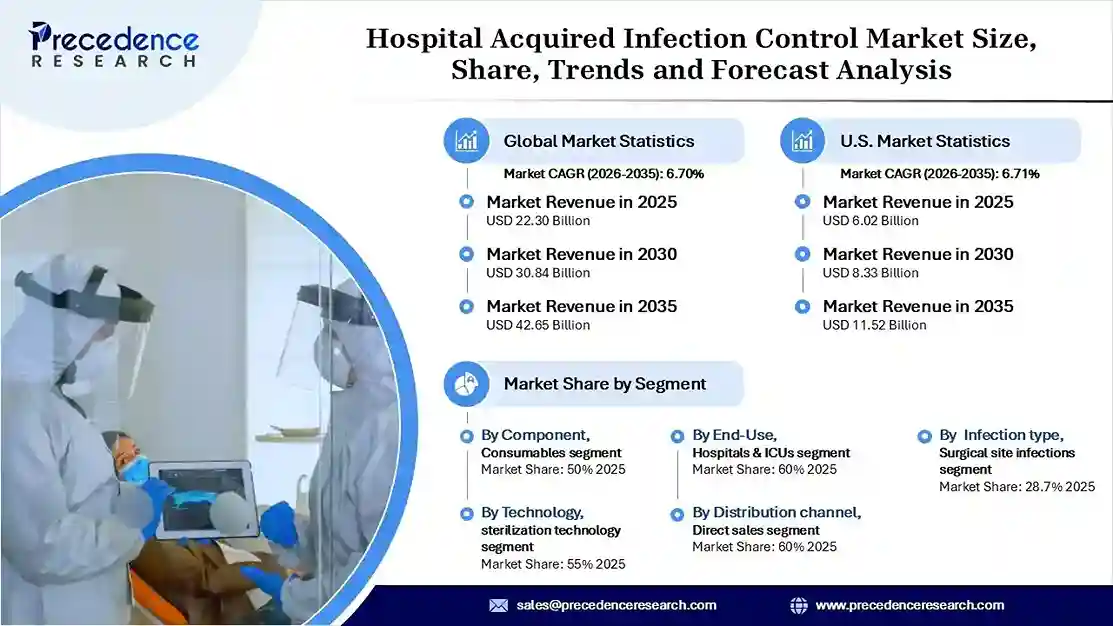
The global hospital acquired infection control market revenue reached USD 22.30 billion in 2025 and is predicted to attain around USD 42.65 billion by 2035 with a CAGR of 6.70%. The hospital acquired infection control market is booming as hospitals ramp up investments in infection prevention technology and patient-friendly healthcare systems that are needed to prevent infections.
Market at a Glance
The hospital acquired infection control market includes a variety of products, technologies, and clinical practices to prevent infections aimed at preventing infections that patients may acquire during healthcare treatment. These include sterilization systems, disinfectants, personal protective equipment (PPE), hand hygiene products, infection monitoring software, waste management systems, and surface decontamination technologies.
HAI control systems are used across acute care hospitals, outpatient facilities, laboratories, and elderly care centers. They support infection prevention efforts across the entire care cycle, from early detection and outbreak monitoring to containment and sterilization. The market also includes disposable medical products, digital surveillance tools, and outsourced infection control services designed to improve operational efficiency and patient safety.
Forecast of the Hospital Acquired Infection Control Market
The market is primarily driven by the rising incidence of hospital-acquired infections and the growing emphasis on patient safety and regulatory compliance. Increasing HAI cases, particularly in intensive care and surgical units, are pushing healthcare facilities to invest in advanced sterilization systems, disinfectants, PPE, and infection monitoring technologies to reduce preventable infections and associated healthcare costs.
Another key factor is the strengthening of government regulations and hospital accreditation standards related to infection prevention. Regulatory bodies and healthcare authorities across regions are enforcing strict hygiene protocols and reporting requirements, which is encouraging hospitals to adopt advanced infection control solutions and surveillance systems to ensure compliance and improve clinical outcomes.
Persistent HAI Burden in the U.S. Driving Market Growth
- On any given day, approximately 1 in 31 hospital patients in the United States has at least one healthcare-associated infection, reinforcing the continuous need for infection prevention systems such as sterilizers, PPE, and hygiene monitoring tools.
- The Centers for Disease Control and Prevention (CDC) estimates around 687,000 HAIs occur annually in U.S. acute care hospitals, highlighting the ongoing infection burden.
- Approximately 72,000 hospitalized patients with HAIs die during their hospital stay, emphasizing the critical importance of infection control measures for patient safety and cost reduction.
- In 2024, acute care hospitals reported an 11% decline in Clostridioides difficile infections and a 10% reduction in catheter-associated urinary tract infections (CAUTIs), demonstrating the effectiveness of sustained investment in infection control technologies.
- All 50 U.S. states showed improvements in at least two infection categories, reflecting broader adoption of surveillance systems, standardized hygiene protocols, and advanced prevention technologies across healthcare networks.
Market Segmentation Overview
- By component, the consumables segment led the hospital acquired infection control market with a 50% share in 2025, as healthcare facilities heavily use consumables such as gloves, masks, gowns, disinfectants, wipes, sterilization wraps, and test kits. Because of the short lifecycle of these products, they are in high and recurring demand across several locations like wards, operating theaters, and ICUs.
- By component, the services segment held a market share of 20% in 2025 and is expected to grow at the fastest CAGR in the market between 2026 and 2035, as healthcare facilities increasingly outsource sterilization, infection audits, training, and compliance management.
- By end-use, the hospitals & ICUs segment held the largest revenue share of 60.0% in the hospital acquired infection control market in 2025. This dominance is attributed to high patient volumes, frequent invasive procedures, and a greater risk of infection transmission in critical care environments. Continuous requirements for sterilization, infection monitoring, and protective barriers make these facilities the primary contributors to infection control spending.
- By end-use, the ambulatory surgery centers segment held a market share of 25.0% in 2025 and is expected to grow at the fastest CAGR in the coming years. The shift toward same-day surgical procedures outside traditional hospitals is driving demand for compact and efficient infection control solutions. High patient turnover and the need to maintain hospital-grade hygiene standards further support market growth.
- By infection type, the surgical site infections segment accounted for a considerable revenue share of 28.7% in the market in 2025. This is due to the high global volume of surgical procedures, which require strict pre-operative sterilization, sterile instruments, wound care, and post-operative infection prevention. The high cost of post-surgical complications further encourages healthcare providers to invest in preventive measures.
- By infection type, the bloodstream infections segment held a market share of 20.0% in 2025 and is expected to expand rapidly in the coming years, due to increasing catheter use, ICU admissions, oncology treatments, and dialysis procedures. Hospitals are increasingly adopting antimicrobial dressings, line-care bundles, and advanced monitoring systems to reduce severe infection risks.
- By technology, the sterilization technology segment accounted for a revenue share of 55.0% in 2025, driven by its essential role in decontaminating reusable surgical instruments, endoscopes, and medical devices. Core hospital investments in autoclaves, ethylene oxide systems, and low-temperature sterilizers have reinforced its dominant position in infection control infrastructure.
- By technology, the disinfection technology segment held a market share of 45.0% in 2025 and is expected to grow at the fastest CAGR in the coming years. This segment’s growth is supported by increasing adoption of UV-C disinfection robots, fogging systems, antimicrobial coatings, and automated cleaning solutions. Rising emphasis on environmental hygiene and faster room turnover is further driving demand.
- By distribution channel, the direct sales segment held a major revenue share of 60.0% in the hospital acquired infection control market in 2025, because hospitals often prefer direct procurement from manufacturers due to benefits such as pricing control, technical training, maintenance support, and assured product quality. Large institutional contracts and long-term supply agreements further strengthen this channel.
- By distribution channel, the distributors segment held a market share of 40.0% in 2025 and is expected to grow at the fastest CAGR in the market between 2026 and 2035, driven by increasing demand from smaller hospitals, clinics, and regional healthcare centers that rely on distributors for faster delivery, wider product access, and localized supply support. Their ability to manage inventory and serve remote locations enhances market penetration.
Regional Analysis
North America dominated the global hospital acquired infection control market with a market share of 36% in 2025. The region’s dominant position is driven by advanced healthcare infrastructure, strict regulatory frameworks, high healthcare expenditure, and early adoption of infection control technologies. The U.S. plays a major role in the market due to strong CDC-driven infection prevention programs and large-scale hospital procurement. Moreover, Canada contributes to the market by expanding public healthcare services and rising geriatric care needs.
Asia Pacific held a 22.0% market share in 2025 and is expected to grow at the fastest CAGR during the forecast period. The regional market growth is driven by expanding healthcare infrastructure, rising surgical volumes, and increasing focus on infection prevention in emerging economies. China is expected to lead regional growth through hospital modernization initiatives and investments in medical device manufacturing, while India is witnessing rising demand due to private hospital expansion and medical tourism, which is improving hygiene and sterilization standards.
Hospital Acquired Infection Control Market Coverage
| Report Attribute | Key Statistics |
| Market Revenue in 2025 | USD 22.30 Billion |
| Market Revenue by 2035 | USD 42.65 Billion |
| CAGR from 2026 to 2035 | 6.70% |
| Quantitative Units | Revenue in USD million/billion, Volume in units |
| Largest Market | North America |
| Base Year | 2025 |
| Regions Covered | North America, Europe, Asia-Pacific, Latin America, and the Middle East & Africa |
Top Companies in the Hospital Acquired Infection Control Market
Leading companies prioritize safety, regulatory compliance, and operational efficiency, making them key contributors to the industry. Major players such as 3M, Getinge, STERIS, Midmark Corporation, and ASP (Advanced Sterilization Products) provide a wide range of infection prevention solutions, including protective consumables, sterilization systems, and reprocessing equipment. In addition, Sterigenics U.S., LLC, a subsidiary of Sotera Health, strengthens the market through outsourced sterilization services. Other notable contributors, including MMM Group and W&H, further enhance the ecosystem by supplying advanced sterilization equipment, infection control systems, and clinical hygiene solutions widely used in healthcare facilities globally.
Segments Covered in the Report
By Component
- Consumables
- Equipment
- Services
By End-Use
- Hospitals & ICUs
- Ambulatory Surgical Centers
- Clinics & Others
By Infection Type
- Surgical Site Infections
- Urinary Tract Infections
- Bloodstream Infections
- Others
By Technology
- Sterilization Technology
- Disinfection Technology
By Distribution Channel
- Direct Sales
- Distributors
By Region
- North America
- Latin America
- Europe
- Asia-pacific
- Middle and East Africa
Get this report to explore global market size, share, CAGR, and trends, featuring detailed segmental analysis and an insightful competitive landscape overview @ https://www.precedenceresearch.com/sample/8400
You can place an order or ask any questions. Please feel free to contact us at sales@precedenceresearch.com |+1 804 441 9344