



Hydrodesulfurization Catalyst Market Revenue to Attain USD 8.26 Bn by 2035
Published: 10 Apr 2026
Author: Precedence Research



Hydrodesulfurization Catalyst Market Revenue and Trends 2026 to 2035
The global hydrodesulfurization catalyst market revenue surpassed USD 4.70 billion in 2025 and is predicted to attain around USD 8.26 billion by 2035, growing at a CAGR of 5.80%. The market is growing steadily, driven by stringent fuel sulfur regulations, increasing processing of heavy crude oils, and the rising demand for cleaner transportation fuels.
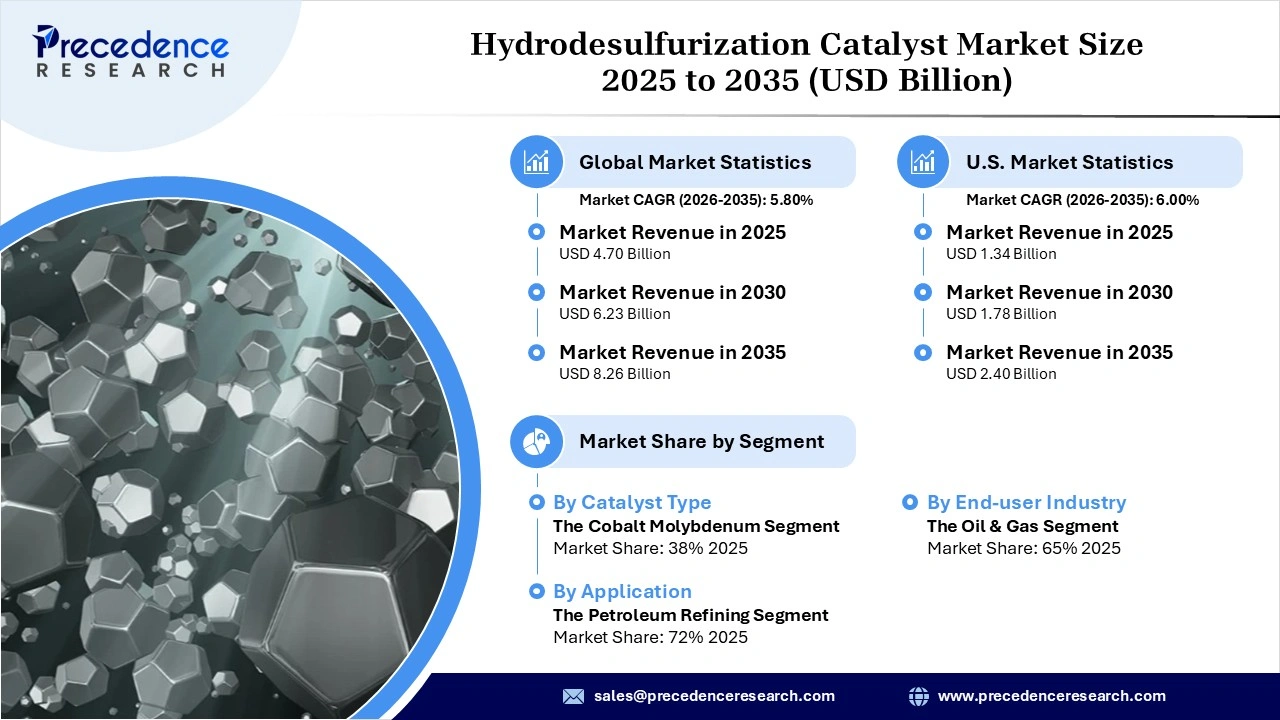
Market at a Glance
The hydrodesulfurization catalyst market focuses on specialized chemical agents, primarily metal-based formulations, that facilitate the removal of sulfur from petroleum fractions during refining. These catalysts operate under high-pressure hydrogen conditions, converting sulfur compounds into hydrogen sulfide for easy separation. The market encompasses catalyst design, production, regeneration, and application across fuels such as diesel, gasoline, and naphtha.
The market is bolstered by the rising demand for ultra-low sulfur fuels driven by stringent emission regulations, where even marginal efficiency improvements can deliver significant impact. Additionally, continuous refinery upgrades, capacity expansions, and the need for improved operational efficiency are accelerating the demand for advanced hydrodesulfurization catalysts.
Future Market Prospects
- Expanding Demand for Clean Fuels Beyond Automotive Applications: The need for ultra-low sulfur fuels is extending beyond the automotive sector into marine fuels and petrochemical feedstocks, where sulfur contamination can hinder emissions control and downstream catalyst performance. For example, effective naphtha treatment is essential to prevent fouling in petrochemical processes, thereby increasing the reliance on hydrodesulfurization (HDS) catalysts.
- Rising Need for Advanced Catalysts with Heavier Crude Processing: As refiners increasingly process heavier and more complex crude oils, conventional catalysts lose efficiency more rapidly, creating demand for advanced formulations with higher sulfur removal efficiency and longer lifespans. While this transition may appear gradual, it is fundamentally driven by operational necessity, making technological advancement critical rather than optional.
- Expansion into Petrochemicals and Marine Fuels: Beyond transportation fuels, HDS catalysts are increasingly used in naphtha treatment and marine fuels, widening the applications of hydrodesulfurization catalysts.
Market Segmentation Overview
- By catalyst type, the cobalt molybdenum (CoMo) segment held a 38% share in the hydrodesulfurization catalyst market in 2025, driven by its reliability, cost-effectiveness, and versatility across diverse feedstocks. Its stability under high-pressure conditions and strong performance in diesel desulfurization have made it a preferred choice among refineries worldwide.
- By catalyst type, the nickel molybdenum (NiMo) segment held the second-largest share of 32% in 2025. This is mainly due to its higher hydrogenation activity, which makes it suitable for deeper desulfurization and processing heavier feedstocks. However, its adoption involves relatively higher operational costs and sensitivity considerations compared to CoMo catalysts.
- By application, the petroleum refining segment held the largest share of 72% in the market in 2025, as sulfur removal has become a regulatory necessity rather than an optional process. The requirement to desulfurize diesel, gasoline, and jet fuel streams has made hydrodesulfurization catalysts an integral part of refinery operations.
- By application, the chemical production segment is the second-largest shareholder, holding an 18% market share in 2025 due to the need to remove sulfur from feedstocks used in producing fine chemicals, petrochemicals, and specialty products, ensuring product quality and protecting downstream catalysts. Additionally, increasing demand for high-purity outputs and compliance with environmental regulations is driving the adoption of hydrodesulfurization catalysts in chemical processing.
- By end-user industry, the oil & gas segment led the hydrodesulfurization market with a major share of 65% in 2025, driven by its extensive use in refining and gas processing operations. Demand in this sector is consistent, supported by throughput capacity requirements and strict regulatory compliance, making catalyst usage essential rather than optional.
- By end-user industry, the chemicals segment was the second-largest shareholder, holding a 20% share in 2025. The demand in this sector is primarily driven by petrochemical processes and production chains that are sensitive to sulfur content. Catalyst use in this industry is more targeted but is steadily growing due to environmental regulations impacting chemical manufacturing practices.
Regional Analysis
North America dominated the hydrodesulfurization catalyst market with a share of 38% in 2025 due to strict regulatory standards mandating ultra-low sulfur levels in fuels, particularly in the U.S. Extensive refinery upgrades and modernization efforts across the U.S. and Canada increased demand for advanced catalysts to ensure compliance and efficient desulfurization. Additionally, coordinated policies and investments in oil sands processing in Canada, along with Mexico’s refinery modernization, reinforced the region as a steady, high-demand market for hydrodesulfurization catalysts.
Europe was the second-largest shareholder, holding a 28% market share of the hydrodesulfurization catalyst market in 2025, driven by stringent environmental regulations. Countries such as Germany, the UK, and France heavily use high-performance catalysts to meet strict emission standards and fuel quality requirements. While Italy and Spain focused on incremental refinery improvements, Eastern Europe experienced slower but steady adoption, with demand emphasizing efficiency, sustainability, and technological advancement over sheer output.
Hydrodesulfurization Catalyst Market Coverage
| Report Attribute | Key Statistics |
| Market Revenue in 2025 | USD 4.70 Billion |
| Market Revenue by 2035 | USD 8.26 Billion |
| CAGR from 2026 to 2035 | 5.80% |
| Quantitative Units | Revenue in USD million/billion, Volume in units |
| Largest Market | North America |
| Base Year | 2025 |
| Regions Covered | North America, Europe, Asia-Pacific, Latin America, and the Middle East & Africa |
Top Companies in the Hydrodesulfurization Catalyst Market
Companies like Albemarle Corporation, BASF SE, and Clariant AG are major market players, leading in catalyst portfolios and heavily focused on R&D. Johnson Matthey PLC and Haldor Topsoe A/S stand out for their advanced formulations and expertise in catalyst regeneration technologies. Additionally, Honeywell UOP, Chevron Phillips Chemical Company LLC, and ExxonMobil Chemical Company integrate catalyst chemistry with refining processes, often offering licensed solutions to build long-term refinery partnerships. Shell Global Solutions International B.V. and Saudi Aramco further strengthen this approach through internal refining ecosystems that develop and deploy proprietary catalyst systems.
Segments Covered in the Report
By Catalyst Type
- Cobalt Molybdenum (CoMo)
- Nickel Molybdenum (NiMo)
- Platinum Group Metals (PGM)
- Others
By Application
- Petroleum Refining
- Diesel Desulfurization
- Gasoline Desulfurization
- Jet Fuel Desulfurization
- Chemical Production
- Production of Fine Chemicals
- Production of Specialty Products
- Others
- Environmental Control
By End-User Industry
- Oil & Gas
- Oil Refining
- Natural Gas Processing
- Chemicals
- Petrochemicals
- Specialty Chemicals
- Energy
- Power Plants
- Others
- Environmental Protection
By Region
- North America
- Latin America
- Europe
- Asia-pacific
- Middle and East Africa
Get this report to explore global market size, share, CAGR, and trends, featuring detailed segmental analysis and an insightful competitive landscape overview @ https://www.precedenceresearch.com/sample/8285
You can place an order or ask any questions, please feel free to contact us at sales@precedenceresearch.com |+1 804 441 9344