



Intracranial Pressure Monitor Market Revenue to Attain USD 4.29 Bn by 2035
Published: 30 Apr 2026
Author: Precedence Research



Intracranial Pressure Monitor Market Revenue and Trends 2026 to 2035
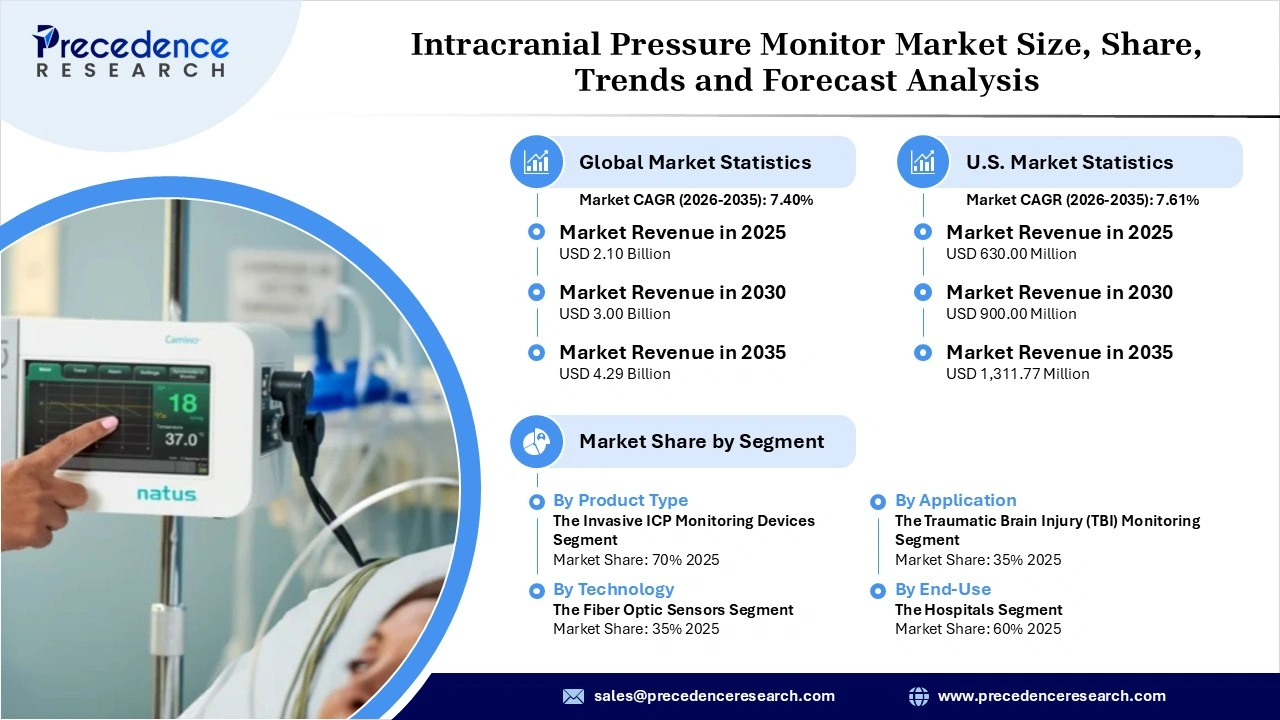
The global intracranial pressure monitor market revenue reached USD 2.10 billion in 2025 and is predicted to attain around USD 4.29 billion by 2035 with a CAGR of 7.40%. The market is driven by the growing need to monitor intracranial pressure accurately and to facilitate decision-making in cases of severe neurological disorders and head trauma.
Market Overview
The intracranial pressure monitor market comprises medical equipment that can measure the pressure levels within the skull, which is helpful in the diagnosis and treatment of neurological diseases. This includes invasive and non-invasive devices that can be utilized in intensive care units, neurosurgery, and emergency care facilities. This equipment is useful where the patient is suffering from brain injury, bleeding inside the skull, hydrocephalus, and other similar conditions.
The pressure inside the skull is measured using devices like high-end sensors, catheters, optical fibers, and digital tools. These technologies have been well-integrated into the neurocritical care processes to ensure prompt response and to increase the effectiveness of monitoring of the patients. Continuous technological developments in sensors and data analysis have continued to make intracranial pressure monitoring more efficient and accurate.
What are the Major Trends Influencing the Market?
Development of Non-Invasive Intracranial Pressure Monitors
The market is benefiting from the development of non-invasive techniques to measure intracranial pressure through waveform analysis. This is done by recording pulsations of the skull without placing any device inside the brain. This technique measures slight movements of the skull resulting from cardiac activity and analyzes waveforms that correspond to variations in brain pressure and intracranial compliance.
- In 2025, a clinical study was conducted for the Brain4care system, where non-invasive waveform characteristics such as P2/P1 ratio and time to peak demonstrated a strong relationship with invasive intracranial pressure parameters, demonstrating accuracy levels of sensitivity reaching 92%.
Clinical Adoption of Near-Infrared Spectroscopy (NIRS)
The NIRS technique facilitates non-invasive monitoring of brain pressure, and its current applications are in neurocritical care units, trauma centers, and high-end research hospitals. This technique facilitates continuous monitoring of brain physiology without resorting solely to invasive catheter methods. This technology relies on indirect estimation of brain pressure by measuring brain oxygenation and physiological parameters using sensors affixed to the scalp.
- In 2025, a clinical research study by a leading biomedical engineering journal was conducted to assess NIRS as an external monitoring tool for brain injuries. The results concluded that externally collected optical signals are significantly correlated with pressure changes measured using invasive methods.
FDA Device Designation for Neurotechnology Brain Implant
The U.S Food and Drug Administration (FDA) has taken the initiative to enhance medical research by launching the Breakthrough Designation program. This is an innovative effort aimed at the accelerated development and approval of advanced medical devices. This initiative facilitates the fast-tracked introduction of neuro-monitoring devices in the market due to an accelerated approval procedure.
- In 2025, the FDA conferred the Breakthrough Device Designation to PathMaker Neurosystems’ Myoregulator neuromodulation system, which is developed for neurological functional recovery purposes.
Effect of Brain Pressure Monitoring on Spontaneous Intracerebral Hemorrhage
In a meta-analysis conducted in 2025 involving 551 patients in 5 observational studies, the effects of invasive intracranial pressure (ICP) monitoring on the outcome of surgically managed spontaneous intracerebral hemorrhage were assessed. It was found that ICP monitoring was linked to a substantially reduced frequency of adverse outcomes (OR=0.27; 95% CI: 0.15-0.46) and decreased hospital stay on average by 3.9 days.
Global Trends Driving Growth in Intracranial Pressure Monitoring
- Traumatic brain injury (TBI) has remained the number one consequence of brain trauma, affecting over 55 million individuals worldwide in 2024-2025, out of which over 27 million individuals are newly diagnosed every year, which is increasing demand for intracranial pressure (ICP) monitoring in acute care units.
- The U.S. FDA regulatory document shows that numerous intracranial pressure (ICP) monitoring systems were given a 510(k) clearance in 2024, including the CereLink ICP Monitor, one of the many Class II medical devices that are still in current clinical use, which highlights ongoing regulatory clearance of advanced neuromonitoring technologies.
- Data related to global neurosurgical workforce research reveal that approximately 22. 6 million patients are neurosurgically consulted annually, and a high percentage of those patients have to advance to surgery, which will drive the demand for critical care in terms of perioperative ICP and monitoring in high-acuity cases during 2024-2026.
- Data indexed in PubMed show that pediatric hydrocephalus comprises almost 400,000 overall cases annually across the globe, with more occurring in low- and middle-income nations in 2024-2025.
Market Segmentation Overview
- By Product Type: The invasive ICP monitoring devices segment led the intracranial pressure monitor market with a 70% share in 2025, since they have proven clinical accuracy records, have the capacity to provide constant, reliable measurements, and have widespread adoption among physicians to manage brain injuries and intracranial hypertension.
- By Product Type: The non-invasive ICP monitoring devices segment is expected to expand at the highest CAGR during the forecast period, due to their ability to offer a safer and faster approach to measure brain pressure without surgery, thus becoming more popular among hospitals and patients.
- By Technology: The fiber optic sensors segment dominated the market with a 35% share in 2025, because they provide very accurate and continuous monitoring of intracranial pressure with minimum distortion of the signals, as well as significant immunity to electromagnetic interference.
- By Technology: The microelectromechanical systems (MEMS) segment is expected to grow at a 9.5% CAGR from 2026 to 2035, owing to their high potential to offer very small, inexpensive, and portable devices for measuring intracranial pressure with the help of minimally invasive techniques.
- By Application: The traumatic brain injury (TBI) monitoring segment led the intracranial pressure monitor market with 35% share in 2025, because it is one of the most prevalent and serious neurologic disorders which necessitates constant ICP monitoring to avoid any secondary brain injuries.
- By Application: The intracerebral hemorrhage monitoring segment held the second-largest market share of 20% in 2025, since it is one of the leading reasons for sudden neurological decline that demands persistent measurements of intracranial pressure.
- By End-Use: The hospitals segment dominated the market with a 60% share in 2025, because they deal with the greatest number of patients suffering from complicated neurological disorders and traumatic injuries, necessitating constant ICP monitoring and treatment in hospitals that have advanced infrastructure with neurocritical care experts.
- By End-Use: The neurosurgery centers segment held the second largest share of 15% in 2025, as they handle a large number of complex surgeries involving the brain, where there is a need for accurate intracranial pressure monitoring.
Regional Insights
North America led the intracranial pressure monitor market with a 40% share in 2025, because of its well-developed healthcare industry, widespread use of neuro-critical care technologies, and a significant prevalence of intensive care units that cater to brain injury patients. The U.S. dominated the market in North America due to a significant incidence rate of brain trauma cases, a mature hospital network, and early adoption of sophisticated intracranial pressure monitoring devices. Canada witnessed significant market growth owing to its advanced healthcare sector and government efforts to enhance neuro-critical care facilities.
Asia Pacific is expected to expand at the highest CAGR during the forecast period, owing to rapid development in healthcare infrastructure, rising awareness about neurocritical care, and increasing demand for monitoring technology solutions in acute-care settings. China led the market in Asia Pacific due to a large patient base, advancements in hospital infrastructure, and increased utilization of advanced neuro-monitoring solutions. India is a notable contributor to the market because of increased healthcare spending, rising prevalence of trauma incidents, and critical care facility expansion.
Intracranial Pressure Monitor Market Coverage
| Report Attribute | Key Statistics |
| Market Revenue in 2025 | USD 2.10 Billion |
| Market Revenue by 2035 | USD 4.29 Billion |
| CAGR from 2026 to 2035 | 7.40% |
| Quantitative Units | Revenue in USD million/billion, Volume in units |
| Largest Market | North America |
| Base Year | 2025 |
| Regions Covered | North America, Europe, Asia-Pacific, Latin America, and the Middle East & Africa |
Top Companies in the Intracranial Pressure Monitor Market
Medtronic plc, Codman Neuro (Johnson & Johnson), and Integra LifeSciences Corporation are key market players recognized for their external ventricular drains (EVDs) and microtransducer-tipped catheters. Raumedic AG, Spiegelberg GmbH & Co. KG, and Gaeltec Devices Ltd. specialize in solid-state and pneumatic intracranial pressure (ICP) sensors.
SophySA SA and Neuromedex GmbH focus on the development of advanced wireless ICP monitoring systems. Meanwhile, Smiths Medical (ICU Medical Inc.) and Ad-Tech Medical Instrument Corporation manufacture invasive ICP monitoring catheters and depth electrodes, enabling integrated pressure and electroencephalography (EEG) monitoring.
Segments Covered in This Report
By Product Type
- Invasive ICP Monitoring Devices (External Ventricular Drain, Intraparenchymal Sensors, Subdural Screws)
- Non-invasive ICP Monitoring Devices (Transcranial Doppler, Optic Nerve Sheath Diameter Systems, Tympanic Membrane Displacement Devices)
By Technology
- Fiber Optic Sensors
- Strain Gauge Sensors
- Microelectromechanical Systems (MEMS)
- Telemetric ICP Monitoring Systems
By Application
- Traumatic Brain Injury (TBI) Monitoring
- Intracerebral Hemorrhage Monitoring
- Hydrocephalus Management
- Stroke Monitoring
- Other Neurological Disorders
By End-Use
- Hospitals
- Neurosurgery Centers
- Ambulatory Surgical Centers (ASCs)
- Trauma Centers
- Research & Academic Institutes
By Region
- North America
- Latin America
- Europe
- Asia-pacific
- Middle and East Africa
Get this report to explore global market size, share, CAGR, and trends, featuring detailed segmental analysis and an insightful competitive landscape overview @ https://www.precedenceresearch.com/sample/8354
You can place an order or ask any questions, please feel free to contact us at sales@precedenceresearch.com |+1 804 441 9344