



Multichannel Order Management Market Revenue to Attain USD 13.01 Bn by 2035
Published: 29 Apr 2026
Author: Precedence Research



Multichannel Order Management Market Revenue and Trends 2026 to 2035
The global multichannel order management market revenue was valued at USD 3.90 billion in 2025 and is expected to attain around USD 13.01 billion by 2035, growing at a CAGR of 12.80% during forecast period. The multichannel order management market is growing rapidly due to the rise of omnichannel retail, increasing e-commerce adoption, and the need for real-time inventory synchronization and efficient order fulfillment across multiple sales channels.
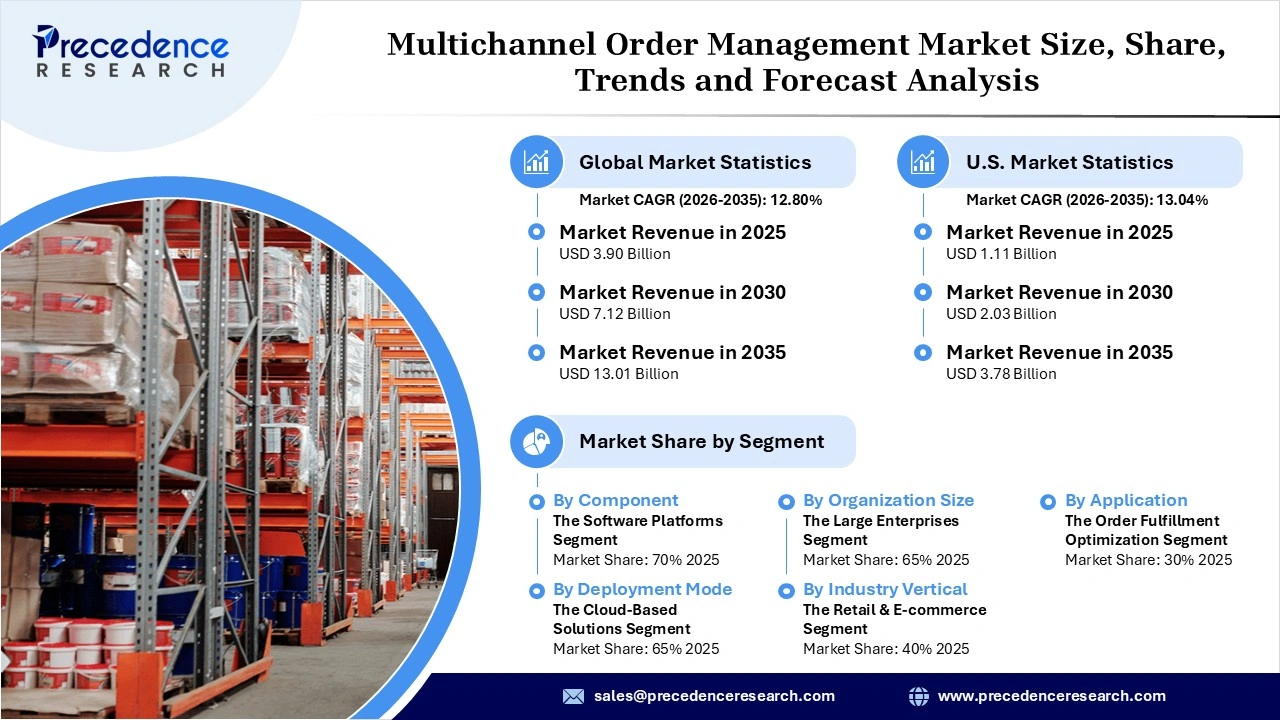
Market at a Glance
Multichannel order management is a system that helps businesses manage orders coming from different sales channels like online stores, marketplaces, physical stores, and mobile application. It centralizes order processing so that inventory, payments, and fulfillment are coordinated in one place. This ensures that stock levels are accurate and orders are routed to the best location for delivery. Overall, it helps businesses operate more efficiently and provide a smoother customer experience across all channels.
What are the Major Trends Influencing the Multichannel Order Management Market?
- Shift to Omnichannel and Unified Commerce: Businesses are moving from separate sales channels to fully integrated omnichannel systems where online, offline, and mobile orders are managed together. This requires OMS platforms to act as a single source of truth for inventory, pricing, and order tracking across all touchpoints.
- Rise in Adoption of OMS Platforms: Businesses are adopting Order Management Systems (OMS) not for convenience, but to reduce costly issues such as inventory mismatches, stockouts, overstocking, and delayed fulfillment. The growing need for real-time inventory visibility across multiple channels is now a key driver of adoption across industries.
- AI-Driven Automation and Predictive Analytics: Artificial intelligence is being used to forecast demand, automate order routing, and optimize fulfillment decisions in real time. This shifts OMS platforms from passive order processors to intelligent systems that actively decide how orders should be fulfilled.
- Integration with Logistics and Third-Party Ecosystems: OMS platforms are increasingly integrated with logistics providers, ERP systems, and CRM tools to enable end-to-end automation. This improves delivery speed, reduces operational errors, and creates a more connected fulfilment ecosystem.
Market Segmentation Overview
- By component, the software platforms segment dominated the multichannel order management market with a 70% share in 2025 and is expected to maintain its leading position in the coming years, as businesses increasingly adopt centralized solutions for order orchestration and real-time visibility into inventory management to effectively navigate complex omnichannel operations.
- By deployment mode, the cloud-based solutions segment held the largest share of 65% in the market in 2025, because of their scalability, faster deployment, lower upfront costs, and the ability to integrate effortlessly with e-commerce and ERP systems. For many organizations, cloud is not a strategy; it is the only way to keep pace with constantly shifting order volumes.
- By deployment mode, the hybrid solutions segment is expected to grow at the fastest CAGR of 12% in the market between 2026 and 2035. This growth is driven by organizations that are balancing legacy systems with modern cloud-based capabilities rather than replacing infrastructure entirely. Businesses are increasingly adopting hybrid models to layer flexibility over existing systems, creating environments that combine stability with modernization.
- By organization size, the large enterprises segment led the multichannel order management market with a 65% share in 2025 due to their complex supply chains and high transaction volumes. These organizations also have the financial capacity to invest in advanced Order Management Systems (OMS), making structured orchestration essential for managing operational complexity.
- By organization size, the small & medium enterprises segment is expected to expand rapidly in the market with a CAGR of 15.5% in the coming years. This growth is driven by increasing digital adoption, expansion of e-commerce, and the availability of affordable cloud-based OMS solutions, allowing smaller businesses to access capabilities once limited to large enterprises.
- By industry vertical, the retail & e-commerce segment accounted for a major revenue share of 40% in the market in 2025. This dominance is driven by the need for seamless omnichannel experiences, real-time inventory visibility, and efficient order fulfillment across multiple sales channels.
- By industry vertical, the electronics & appliances segment is expected to expand at a CAGR of 13.5% in the coming years. High product turnover, globally distributed supply chains, and increasing online sales adoption make structured order management essential for operational efficiency in this sector.
- By application, the order fulfilment optimization segment accounted for a revenue share of 30% in the multichannel order management market in 2025, as businesses focused on faster deliveries, reduced operational costs, and improved customer satisfaction. This reflects the shift from basic order processing to strategic optimization of fulfillment networks.
- By application, the omnichannel customer experience management segment is expected to grow at the fastest CAGR of 14.5% in the market between 2026 and 2035. This growth is driven by rising consumer expectations for seamless integration between online and offline shopping experiences, emphasizing consistency across all touchpoints.
Regional Insights
North America dominated the global multichannel order management market with a share of 38% in 2025, driven by strong technological infrastructure, an advanced retail ecosystem, and early adoption of omnichannel strategies. Large U.S. retailers played a central role by implementing highly integrated OMS platforms, creating a deeply connected order management network ahead of other regions. Meanwhile, Canada and Mexico contributed to growth by expanding cross-border digital commerce and improving retail automation capabilities.
Asia Pacific held a market share of 25% in 2025 and is expected to grow at the fastest CAGR of 15.5% during the forecast period. This growth is fueled by the expansion of e-commerce, rising smartphone penetration, and rapid digital transformation across industries. China leads the market due to the expansion of platform-based commerce ecosystems. Moreover, India is accelerating growth through mobile-first retail adoption and expanding digital infrastructure.
Multichannel Order Management Market Coverage
| Report Attribute | Key Statistics |
| Market Revenue in 2025 | USD 3.90 Billion |
| Market Revenue by 2035 | USD 13.01 Billion |
| CAGR from 2026 to 2035 | 12.80% |
| Quantitative Units | Revenue in USD million/billion, Volume in units |
| Largest Market | North America |
| Base Year | 2025 |
| Regions Covered | North America, Europe, Asia-Pacific, Latin America, and the Middle East & Africa |
Top Companies in the Multichannel Order Management Market
The multichannel order management market is led by major enterprise technology providers that integrate OMS capabilities into broader digital ecosystems. Companies such as IBM Corporation, Oracle Corporation, and SAP SE dominate the space by embedding order management within cloud, ERP, and AI-driven enterprise platforms used by large organizations.
Salesforce, Inc. extends OMS functionality into customer experience and CRM-driven commerce workflows, focusing on end-to-end customer journey integration. Meanwhile, Manhattan Associates and Blue Yonder Group emphasize supply chain-centric order orchestration, optimizing fulfillment and logistics decisions. Additionally, Infor Inc. and HCL Technologies Limited operate in integration and customization layers, enabling OMS functionality within complex enterprise IT environments.
Segments Covered in the Report
By Component
- Software Platforms
- Services
By Deployment Mode
- Cloud-based Solutions
- On-premise Solutions
- Hybrid Solutions
By Organization Size
- Large Enterprises
- Small and Medium Enterprises (SMEs)
By Industry Vertical
- Retail and E-commerce
- Consumer Goods and FMCG
- Healthcare and Pharmaceuticals
- Manufacturing
- Automotive
- Electronics and Appliances
- Others
By Application
- Order Fulfillment Optimization
- Inventory and Warehouse Synchronization
- Omnichannel Customer Experience Management
- Returns and Reverse Logistics Management
- Demand Forecasting and Order Analytics
By Region
- North America
- Latin America
- Europe
- Asia-pacific
- Middle and East Africa
Get this report to explore global market size, share, CAGR, and trends, featuring detailed segmental analysis and an insightful competitive landscape overview @ https://www.precedenceresearch.com/sample/8349
You can place an order or ask any questions, please feel free to contact us at sales@precedenceresearch.com |+1 804 441 9344