



Multiple Sclerosis Therapeutics Market Revenue to Attain USD 66.80 Bn by 2035
Published: 28 May 2026
Author: Precedence Research



Multiple Sclerosis Therapeutics Market Revenue and Trends 2026 to 2035
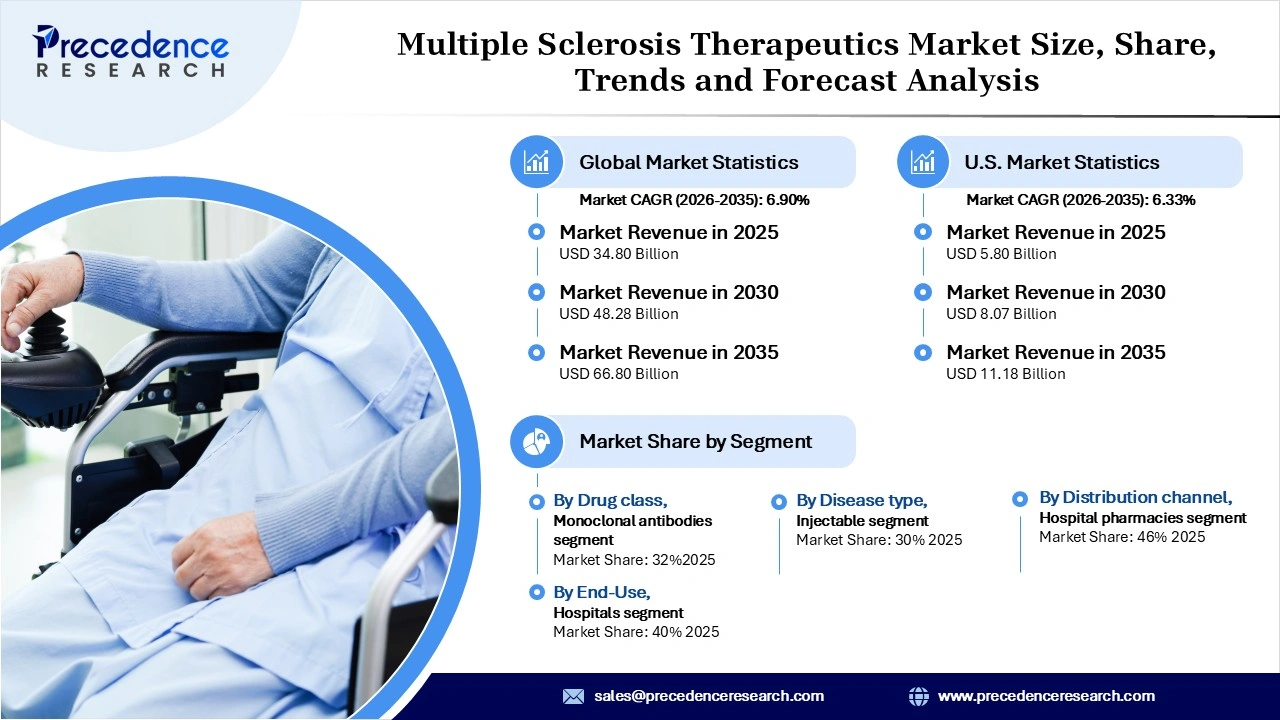
The global multiple sclerosis therapeutics market revenue surpassed USD 34.80 billion in 2025 and is predicted to attain around USD 66.80 billion by 2035, growing at a CAGR of 6.90%. The market is fueled by rising rates of diagnosis, prolonged lifespan of patients, and a plethora of efficacious biologic treatments and therapies for progressive MS. These neurological therapies are evolving the paradigm of care away from solely relapses to long-term disability.
Market at a Glance
The multiple sclerosis therapeutics market represents a vast spectrum of drugs and therapies focused on treatment strategies designed to minimize nerve damage, reduce the recurrence rate, and address progressive disability associated with this chronic autoimmune condition that impacts both the brain and spinal cord. It’s one of a mix of injectable treatments, oral medications, monoclonal antibodies, corticosteroids, and future neuroprotective drugs.
The growth in this area correlates to earlier diagnoses combined with greater access to advanced biologics and an increasing clinical focus on preventing permanent disability rather than responding to inflammatory episodes alone. This market is everything from drugs for relapse control to advanced therapies aimed at preventing profound long-term neurological decline. It includes biologic agents in combination with oral immunotherapies and symptomatic relief options, as well as pipeline innovations directed to progressive forms of MS. Advances in diagnostic and personalized intervention are incrementally expanding the commercial potential as well as clinical reach across these treatments.
Market Forecast for the Multiple Sclerosis Therapeutics Market
Rising Global Patient Pool Continues to Sustain Demand
Multiple sclerosis now affects more than 2.9 million people globally, while healthcare systems are diagnosing the condition earlier through wider MRI access and improved neurological screening. Longer survival rates, chronic treatment dependence, and increasing use of premium biologics are steadily lifting long-term therapeutic spending across North America, Europe, and parts of the Asia-Pacific.
Demand for New Investigational Drugs
Drugmakers are increasingly targeting progressive forms of MS because treatment options remain limited despite the rising disability burden worldwide. Roche described fenebrutinib as the first investigational medicine in more than a decade to demonstrate meaningful disability reduction in PPMS, an area historically associated with weak therapeutic success rates.
Secondary Data
- Roche stated that more than 400,000 people globally have been treated with OCREVUS, showing how rapidly high-efficacy biologics are becoming embedded in long-term MS care pathways.
- The company reported that patients receiving OCREVUS experienced approximately one relapse every 16 years in predefined analyses, reflecting how modern therapies are shifting the market toward long-duration disease suppression rather than short-cycle relapse management.
- Roche confirmed that nearly 85% of multiple sclerosis patients globally are diagnosed with relapsing forms of the disease, sustaining great recurring demand for disease-modifying therapies and biologic interventions.
- Multiple sclerosis currently affects over 2.9 million people worldwide, while most patients experience their first symptoms between the ages of 20 and 40, creating a commercially important population requiring decades of continuous neurological treatment.
- Reuters reported that OCREVUS generated nearly 6.7 billion Swiss francs in 2024 revenue, reinforcing the commercial weight biologic MS therapies now carry within large pharmaceutical portfolios.
Market Segmentation Overview
- By drug class, the monoclonal antibodies segment dominated the multiple sclerosis therapeutics market with a 32% market share in 2025 and is expected to maintain its leading position with a CAGR of 10.5% in the coming years, due to the rising adoption of highly effective disease-modifying biologics. Expanding approvals of targeted MS therapies also strengthened their clinical presence, while growing demand for relapse reduction and progression control is likely to accelerate uptake, particularly in progressive forms of multiple sclerosis.
- By disease type, the relapsing-remitting multiple sclerosis (RRMS) segment accounted for a considerable revenue share of 64% in the market in 2025, because the majority of diagnosed patients historically entered treatment through the RRMS pathway. There was a high presence of disease-modifying drugs and increasing rates. Early diagnosis and treatment being provided led to sustained commercial demand among alternative therapeutic categories such as injectable, oral, and biologic options.
- By disease type, the primary progressive multiple sclerosis (PPMS) segment is expected to grow at the fastest CAGR of 9.5% in the market between 2026 and 2035, due to increasing awareness regarding progressive neurological disorders. Expanding approvals of therapies specifically targeting PPMS, along with growing research activity focused on neuroprotection, are gradually transforming into a major commercial opportunity.
- By route of administration, the oral segment dominated the market with a 44% market share in 2025 and is expected to maintain its leading position with a CAGR of 9.2% in the coming years, due to the preference for convenient long-term oral medication regimens that lessen reliance on hospital-based treatments. Recent market openings for oral disease-modifying medications not only increased the availability of treatment options but also resulted in increased patient compliance for treatments. Neurologists also sought therapies that could efficiently trade off efficacy versus daily life handling of the condition.
- By distribution channel, the hospital pharmacies segment held a major revenue share of 46% in the multiple sclerosis therapeutics market in 2025, because advanced biologics and infusion-based therapies were primarily administered through supervised clinical settings. An increase in the availability of specialty neurological drugs for patients and increased client interest in supervised delivery emphasized the important role of hospital pharmacy networks in facilitating the management of patients with multiple sclerosis.
- By distribution channel, the online pharmacies segment is steadily growing with a CAGR of 11.8% in the market between 2026 and 2035, due to the ever-growing adoption of digital healthcare services and e-pharmacy used for chronic disease control approaches. Patients are also becoming more accustomed to home delivery for long-term medications. Breakthroughs in telemedicine and electronic prescription systems lead to improved access to and delivery of neurological treatments.
- By end-use, the hospitals segment accounted for a considerable revenue share of 40% in the market in 2025, due to high patient inflow for advanced MS treatment. The wider availability of biologics and infusion therapies and multidisciplinary neurology departments further strengthened hospital-centered treatment delivery.
- By end-use, the home care settings segment is expected to expand rapidly in the market with a CAGR of 10.5% in the coming years, as patients increasingly shift toward oral and self-administered therapies and a growing preference for home-based chronic disease management. Expanding telehealth infrastructure, remote patient monitoring, and growing adoption of oral and subcutaneous treatments are likely to accelerate this transition beyond traditional hospital environments.
Regional Analysis
North America dominated the global multiple sclerosis therapeutics market with a market share of 42% in 2025, due to the high prevalence and diagnosis of multiple sclerosis and the extensive use of advanced biologics and monoclonal antibodies. Robust reimbursement policies facilitated long-term access for patients to expensive disease-modifying therapies, and continued investment of money in research on neuroimmunology further optimized disease treatments for progressive MS. The United States emerged as the primary revenue source, driven by adoption rates of biologics and specialized neurology networks.
Asia-Pacific held 18% of the market share in 2025 and is expected to grow at the fastest CAGR of 10.8% in the market during the forecast period, due to increasing diagnosis rates and awareness regarding multiple sclerosis. Increased healthcare investments, improved access to biologics, and growing investment in neurology infrastructure are expected to improve the availability of treatment in this area. China is expected to see major expansion driven by broader pharmaceutical distribution channels and greater access to innovative therapies.
Multiple Sclerosis Therapeutics Market Coverage
| Report Attribute | Key Statistics |
| Market Revenue in 2025 | USD 34.80 Billion |
| Market Revenue by 2035 | USD 66.80 Billion |
| CAGR from 2026 to 2035 | 6.90% |
| Quantitative Units | Revenue in USD million/billion, Volume in units |
| Largest Market | North America |
| Base Year | 2025 |
| Regions Covered | North America, Europe, Asia-Pacific, Latin America, and the Middle East & Africa |
Top Companies in the Multiple Sclerosis Therapeutics Market
Novartis AG has expanded its reach to self-administered B-cell therapies designed to improve medication adherence in the long term. F. Hoffmann-La Roche Ltd maintained a leading position in the biologics market, especially for its progressive treatment of multiple sclerosis with Ocrevus. In this regard, Sanofi S.A. and Merck KGaA have increased investment in neuroinflammation and oral immunotherapy studies, indicating growing industry focus on disability progression management. Bristol Myers Squibb and Johnson & Johnson have increased their neurological research by building immunology pipelines and also through strategic clinical program expansion. Pfizer Inc., TG Therapeutics, and EMD Serono are also progressively focusing on immune system-targeted innovation as they move into the specialty neurology space.
Segments Covered in the Report
By Drug Class
- Immunomodulators
- Interferons
- Glatiramer Acetate
- Immunosuppressants
- Monoclonal Antibodies
- Corticosteroids
- Sphingosine-1-Phosphate (S1P) Receptor Modulators
- Others
By Disease Type
- Relapsing-Remitting Multiple Sclerosis (RRMS)
- Secondary Progressive Multiple Sclerosis (SPMS)
- Primary Progressive Multiple Sclerosis (PPMS)
- Progressive-Relapsing Multiple Sclerosis (PRMS)
By Route of Administration
- Oral
- Injectable
- Intravenous (IV) Infusion
By Distribution Channel
- Hospital Pharmacies
- Retail Pharmacies
- Online Pharmacies
By End-use
- Hospitals
- Specialty Neurology Clinics
- Homecare Settings
- Rehabilitation Centers
By Region
- North America
- Latin America
- Europe
- Asia-pacific
- Middle and East Africa
Get this report to explore global market size, share, CAGR, and trends, featuring detailed segmental analysis and an insightful competitive landscape overview @ https://www.precedenceresearch.com/sample/8432
You can place an order or ask any questions. Please feel free to contact us at sales@precedenceresearch.com |+1 804 441 9344