



Next-Gen Aircraft Propulsion System Market Revenue to Attain USD 23.37 Bn by 2035
Published: 02 Apr 2026
Author: Precedence Research



Next-Gen Aircraft Propulsion System Market Revenue and Trends 2026 to 2035
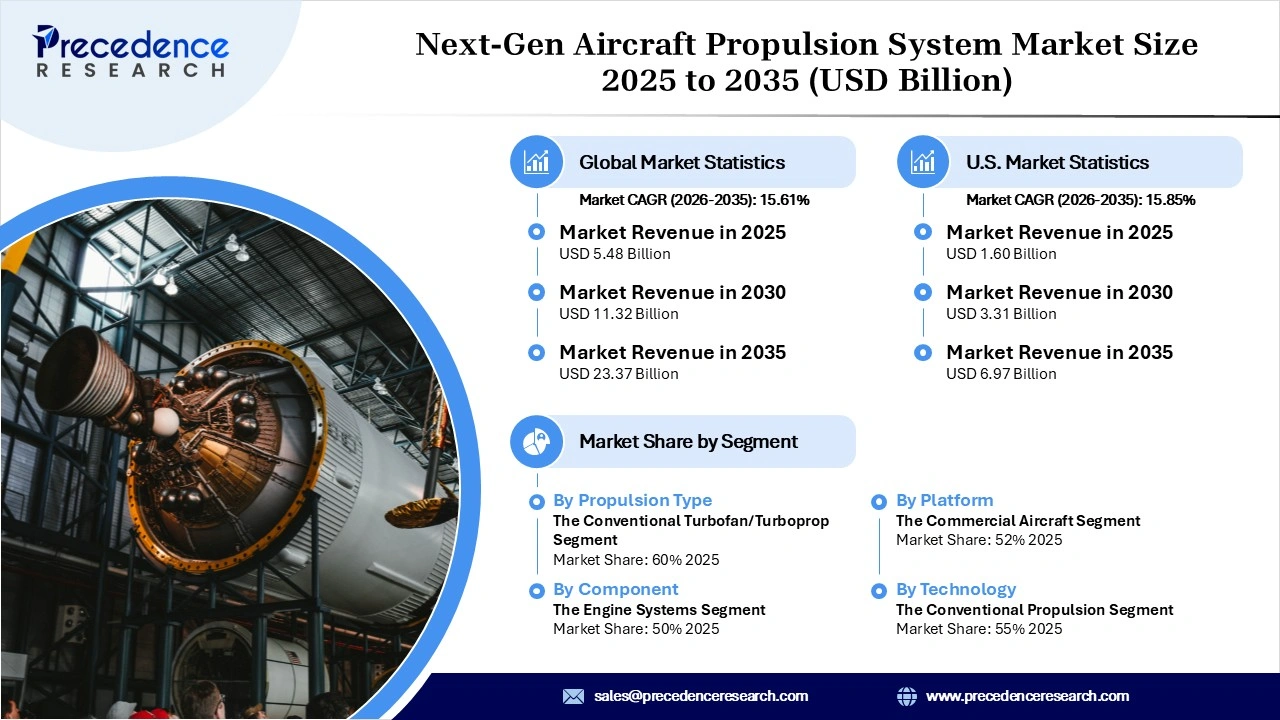
The global next-gen aircraft propulsion system market revenue surpassed USD 5.48 billion in 2025 and is predicted to attain around USD 23.37 billion by 2035, growing at a CAGR of 15.61%. The market is driven by the increasing modernization of aircraft with cleaner, smarter, and electric engines.
Market at a Glance
The next-generation aircraft propulsion system market includes hybrid-electric systems, fully electric systems, hydrogen fuel systems, and highly efficient turbine technologies, along with essential components such as energy storage and power electronics. This market spans commercial and military platforms as well as emerging aircraft systems, reflecting a growing shift toward sustainable and high-performance aviation solutions.
The market also goes far beyond the traditional engine technologies, covering things like electric powertrains as well as hydrogen fuel and the latest technology in turbine design. This comprehensive approach combines improvements in existing components with design strategies for integrating or retrofitting current fleets across commercial airlines, defense, and eVTOL industries, with a strong emphasis on efficiency throughout the development process.
What Drives the Growth of the Next-Gen Aircraft Propulsion System Market?
- Commercial Adoption Is Accelerated by Airlines Commitments: Airlines are increasingly embracing next-generation fuels, with initiatives like American Airlines’ pledge to purchase 100 hydrogen-electric engines from ZeroAvia for regional aircraft. These engines are designed to achieve near-zero in-flight emissions and are expected to be operational by the late 2020s, transforming pilot projects into viable commercial opportunities.
- Advancements in Propulsion Systems: Future airliner fleets are being designed with highly advanced propulsion systems to improve efficiency and sustainability. For example, Airbus single-aisle models are expected to achieve 20-30% better fuel efficiency, feature hydrogen-compatible designs, and incorporate aerodynamic enhancements by the late 2030s. While full-scale hydrogen deployment may take decades, strong demand for cleaner, alternative propulsion and transitional hybrid technologies ensures a robust market outlook.
Evolving Trajectories in Next-Generation Aviation Technologies
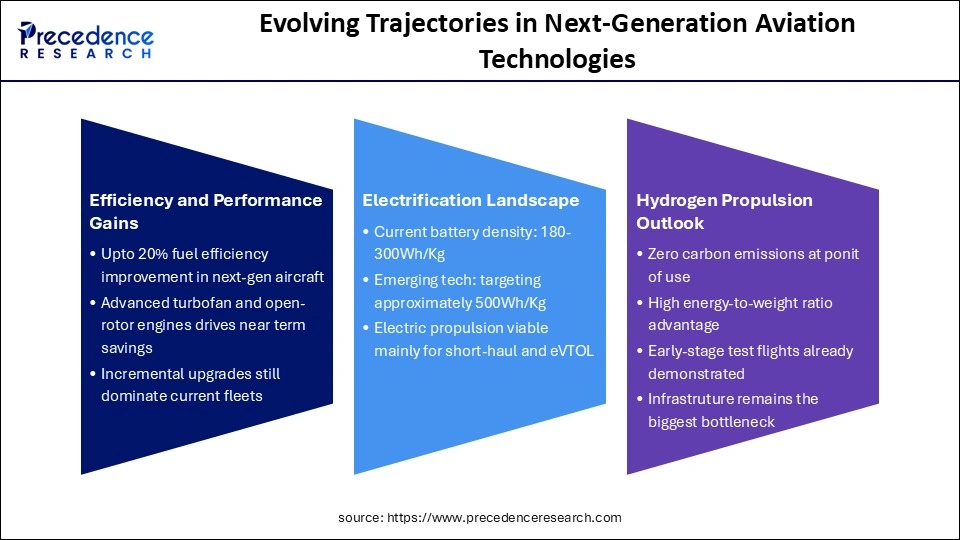
The diagram depicts a market evolving along three distinct trajectories rather than a single linear path. On one end, efficiency improvements of up to 20% are being realized from established engine systems, extending the relevance of current fleets. In the middle, electrification is gaining traction but remains constrained by battery limitations and is suitable primarily for shorter trips. At the other end, hydrogen offers a promising pathway for cleaner aviation, though widespread adoption is currently challenged by significant infrastructure requirements.
Market Segmentation Overview
- By propulsion type, the conventional turbofan/turboprop segment held a major market share of 58.0% in 2025, primarily due to their solid reliability and practice of maintenance in current fleets. Their status is supported by improvements in fuel efficiency, allowing operators to improve performance without investing in new propulsion technologies.
- By propulsion type, the hybrid-electric propulsion segment is expected to grow at the highest CAGR in the market during the studied years, driven by the aviation industry’s focus on reducing emissions and improving fuel efficiency. Government incentives and supportive policies for sustainable aviation are accelerating the adoption of these systems as attractive alternatives to traditional, fully electric, or hydrogen-based engines.
- By component, the engine systems segment led the global next-gen aircraft propulsion system market with a share of 50% in 2025, as they are the backbone of aircraft propulsion. Continuous innovation has improved the efficiency and performance of these systems. Despite electrification trends, core engine technologies continue to evolve, ensuring compatibility with new fuels and hybrid configurations while maintaining operational reliability.
- By component, the power electronics segment is expected to grow at the fastest rate in the market between 2026 and 2035, due to an increasing demand for efficient power conversion solutions and sophisticated control mechanisms. As electric propulsion technology advances, there is a growing necessity for high-performance converters, inverters, and control units that are becoming essential components of next-generation propulsion frameworks.
- By platform, the commercial aircraft segment held a major share of 52% in 2025, supported by strong international demand for fuel-efficient fleets. Commercial airlines are modernizing fleets, encouraging manufacturers to develop propulsion systems that reduce costs while meeting stringent environmental regulations.
- By platform, the urban air mobility segment is expected to grow at the highest CAGR between 2026 and 2035, driven by the rapid development of eVTOL aircraft and evolving urban transport needs. Short-range, high-frequency operations are creating new opportunities for innovative propulsion solutions in the aviation sector.
- By technology, the conventional propulsion segment held a major revenue share of 55.0% in the market in 2025, owing to its well-established infrastructure and proven reliability. Their predictability and operational familiarity allow airlines to scale efficiently while gradually integrating incremental technological improvements.
- By technology, the hybrid propulsion segment is expected to expand rapidly in the market in the coming years, combining conventional engines with electric assistance to deliver a balance of performance and sustainability. It offers operators a lower-risk transition to reduce emissions while leveraging existing propulsion infrastructure.
Regional Insights
North America dominated the next-gen aircraft propulsion system market with a major share of 39.0% in 2025. This is mainly due to the presence of leading aircraft manufacturers and propulsion innovators that place the region at the forefront of technological progress. Significant R&D investment has enabled early-stage testing of advanced systems, from hybrid-electric prototypes to hydrogen initiatives. The U.S. leads through substantial defense and commercial aviation funding, while Canada contributes with targeted innovations in sustainable aviation technologies and regional aircraft development.
Asia Pacific is expected to grow at the fastest CAGR in the market during the forecast period, driven by the expansion of the aviation industry, growing air passenger traffic, and modernization of existing fleets. Governments throughout this region are actively promoting cleaner propulsion technologies via supportive policies and funding programs. China is advancing its domestic aircraft and engine development programs, while India continues to invest heavily in modernizing aviation infrastructure. Meanwhile, Japan is concentrating on the development and adoption of electric and hybrid propulsion solutions, positioning itself as a leader in sustainable aviation technologies.
Next-Gen Aircraft Propulsion System Market Coverage
| Report Attribute | Key Statistics |
| Market Revenue in 2025 | USD 5.48 Billion |
| Market Revenue by 2035 | USD 23.37 Billion |
| CAGR from 2026 to 2035 | 15.61% |
| Quantitative Units | Revenue in USD million/billion, Volume in units |
| Largest Market | North America |
| Base Year | 2025 |
| Regions Covered | North America, Europe, Asia-Pacific, Latin America, and the Middle East & Africa |
Top Companies in the Next-Gen Aircraft Propulsion System Market
General Electric (GE Aerospace) and Rolls-Royce Holdings plc remain at the forefront with next-generation turbine innovations and bold advances in hydrogen and hybrid propulsion. Meanwhile, Pratt & Whitney (RTX Corporation) and Safran S.A. are driving efficiency improvements through advanced engine architectures. Honeywell International Inc. and MTU Aero Engines AG are shaping the electrification layer, concentrating on power systems and seamless integration with next-gen engines.
Segments Covered in the Report
By Propulsion Type
- Conventional Turbofan/Turboprop
- Hybrid-Electric Propulsion
- Fully Electric Propulsion
- Hydrogen Propulsion
By Component
- Engine Systems
- Energy Storage Systems
- Power Electronics
- Thermal Management Systems
By Platform
- Commercial Aircraft
- Military Aircraft
- Urban Air Mobility (UAM)
- General Aviation
By Technology
- Conventional Propulsion
- Electric Propulsion
- Hybrid Propulsion
By Region
- Asia Pacific
North America
Europe
South America and MEA
Get this report to explore global market size, share, CAGR, and trends, featuring detailed segmental analysis and an insightful competitive landscape overview @ https://www.precedenceresearch.com/sample/8266
You can place an order or ask any questions, please feel free to contact us at sales@precedenceresearch.com |+1 804 441 9344