



Project and Portfolio Management Software Market Revenue to Attain USD 18.22 Bn by 2035
Published: 19 May 2026
Author: Precedence Research



Project and Portfolio Management Software Market Revenue and Trends 2026 to 2035
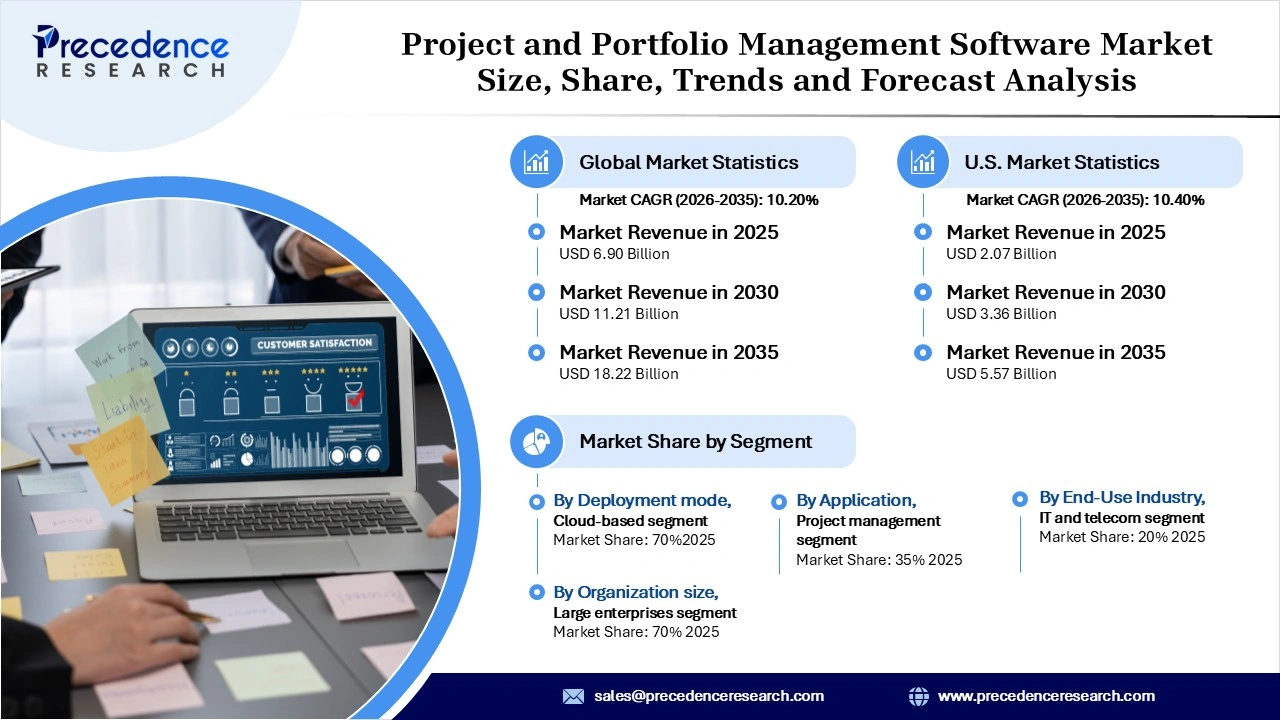
The global project and portfolio management software market revenue was valued at USD 6.90 billion in 2025 and is expected to attain around USD 18.22 billion by 2035, growing at a CAGR of 10.20% during forecast period. The market is witnessing increasing growth as organizations are moving from fragmented use of spreadsheets to more centralized, data-driven solutions that can be responsive to evolving project dynamics, optimize resources in real-time, and ensure that strategic priorities do not get lost or neglected as the project continues to be implemented.
Market at a Glance
The project and portfolio management software market refers to the industry of digital solutions, which are provided to companies and businesses to manage tasks within large multi-project scenarios for a greater scope. That is a market that structures complex work environments around aligning resources, costs, and scheduling with a strategic business vision. The rise in the trend toward integrated systems of work instead of fragmented tracking of data is also pushing the pressure to enhance visibility, accountability, and decision-making across linked-up projects at a strategic level.
This market comprises applications for all aspects of the project from the initial planning, scheduling, and execution stages, to the resource allocation, budgeting, and performance evaluation, and is the basis for a holistic approach for managing projects across the project lifecycle. A mix of cloud and on-premise offerings for multiple categories of applications, such as IT services, construction, banking, financial services, insurance (BFSI), and healthcare businesses, to align multiple projects in line with the enterprise project management vision.
Market Forecast for the Project and Portfolio Management Software Market
- Cloud Adoption is Driving the Market: Cloud-based PPM systems are becoming the default deployment model as organizations seek real-time collaboration and global accessibility. Companies like Oracle emphasize unified cloud PPM systems that act as a “single source of truth” across project financials, scheduling, and execution.
- AI and Automation Emerging as Core Growth Driver: AI-enabled portfolio tools are being embedded to automate forecasting, risk identification, and resource allocation. ServiceNow highlights AI integration as a key enabler for predictive analytics and smarter portfolio decision-making across enterprises.
Enterprises' Usage Trends in Project and Portfolio Management Solutions
- Enlyft’s analysis showed that more than 389,000 companies around the world use Project Portfolio Management (PPM) tools, and that large numbers were found in sectors as diverse as IT, BFSI (Banking, Financial Services, and Insurance), manufacturing, and telecommunications.
- In the latter case, about 1,263 companies use CA PPM as the specific application in this ecosystem, showing that it is used in a narrow yet well-established user base among the enterprises.
- The industry is led by large enterprises; more than 1,000 employees make up approximately 58 percent of users. This indicates the preference for advanced portfolio governance management systems over basic handling of tasks.
- Nearly 57% of PPM deployments are from companies with revenue exceeding $1 billion. This figure demonstrates the high uptake in high-budget digital transformation initiatives.
- IT services dominate the industry at roughly 25%, which is closely followed by financial services and banking industries, where effective multi-project coordination is critical.
- The PPM software landscape is still heterogeneous, and as major tools such as Asana and Trello make up a significant portion of this market, enterprise-grade PPM platforms offer targeted solutions for niche-specific but profitable applications.
Market Segmentation Overview
- By deployment mode, the cloud-based segment dominated the project and portfolio management software market with a 70% share in 2025 and is expected to maintain its leading position with a CAGR of 13% in the coming years, as companies demand scalable, flexible, and economical deployment solutions. Moreover, growing demand has been supported by the adoption of SaaS project management platforms, real-time data access, and collaborative workflows. In particular, SMEs have quickened their implementation because of their lower up-front cost than traditional on-premise alternatives.
- By application, the project management segment accounted for a considerable revenue share of 35% in the market in 2025, as enterprises used tooling for milestone tracking, planning, and scheduling, while growth metrics in project pipelines increased, and the focus increased on optimizing for efficiency. The shift into Agile methodologies and Scrum practices increased adoption rates even further and required far more visibility into the project, disciplined processes, and capabilities to communicate across departments.
- By application, the financial management segment is expected to grow at the fastest CAGR of 10% in the market between 2026 and 2035, due to a growing demand for more financial transparency across project portfolios, and a growing focus on organizational budgetary discipline and profitability, especially around wealth accumulation in portfolios. There is a strong market demand for tools that improve cost management and budgeting processes, provide detailed financial reporting models, and aid integrated planning: project budgets are now subject to enhanced management control.
- By end-use industry, the IT and telecom segment dominated the project and portfolio management software market with a 20% market share in 2025 and is expected to maintain its leading position with a CAGR of 9.5% in the coming years, due to a rising demand for project and portfolio management software, with this growing demand being encouraged by the rise of software delivery pipelines and outsourced IT services. As transformation initiatives grow more intricate, organizations need enhanced visibility into their portfolios. Adopting agile operating models means accelerating tool use, while ongoing pressure to shorten release cycles and enhance milestone accuracy sustains investment momentum.
- By organization size, the large enterprises segment held a major revenue share of 70% in the market in 2025, due to the wide-scale adoption of integrated, organization-wide project management platforms. This was supported by greater complexities of projects and the expansion of global operations. Furthermore, a greater investment in digital solutions has resulted in lowering the friction of operation with closer control over budgets, timelines, and shared resources.
- By organization size, the small and medium enterprises (SMEs) segment is steadily growing with a CAGR of 13% in the market between 2026 and 2035, due to the higher penetration of affordable cloud-based solutions with strong demand over time for software for project planning and execution. The need to further improve project efficiency, automation capabilities, and resource optimization will increase utilization, especially for SMEs to scale with automation in their processes.
Regional Analysis
North America dominated the global project and portfolio management software market with a share of 40% in 2025, due to the rapid adoption of cloud-based software solutions across the region to augment project execution and portfolio governance. Big companies spent heavily to streamline their budgets, timelines, and resources; at the same time, the IT and healthcare sectors ramped up investments in advanced planning platforms. Further, the shift toward agile delivery required real-time collaboration tools. Large companies led the charge, with digital transformation initiatives taken from the ground up in the United States.
Asia-Pacific held a market share of 20% in 2025 and is expected to grow at the fastest CAGR of 12% in the market during the forecast period, because the rate of industrialized expansion of the business of Asia-Pacific is driving both industrialization and business expansion, and the demand for structured project management systems. SMEs increasingly adopt portfolio management tools for better visibility, cost management, and business scale. These systems are anticipated to demand a robust boost across the manufacturing, construction, and IT sectors, and demand for e-commerce will drive increased demand for resource planning capabilities. China should lead the charge in industrial digitization in tandem with smart manufacturing initiatives.
Project and Portfolio Management Software Market Coverage
| Report Attribute | Key Statistics |
| Market Revenue in 2025 | USD 6.90 Billion |
| Market Revenue by 2035 | USD 18.22 Billion |
| CAGR from 2026 to 2035 | 10.20% |
| Quantitative Units | Revenue in USD million/billion, Volume in units |
| Largest Market | North America |
| Base Year | 2025 |
| Regions Covered | North America, Europe, Asia-Pacific, Latin America, and the Middle East & Africa |
Top Companies in the Project and Portfolio Management Software Market
Microsoft retains a strong pull with integration into Microsoft 365 and enterprise-optimized planning ecosystems. In contrast, Oracle remains prominent through its Primavera suite and cloud-based portfolio solutions that are particularly favored by industries reliant on heavy infrastructure. Meanwhile, Wrike, monday.com, and Asana have experienced explosive growth in providing visually concise cloud-based services that appeal to medium-sized businesses and large enterprises that need a more rapid implementation. ClickUp, Teamdeck, Zoho Projects, Trello (Atlassian), and Clarizen all cater to various operational requirements, from resource allocation and team capacity management to streamlined collaboration and cost-effective project monitoring.
Segments Covered in the Report
By Deployment Mode
- Cloud-based
- On-premise
By Application
- Project Management
- Portfolio Management
- Resource Management
- Time and Expense Management
- Financial Management
- Risk Management
By End-use Industry
- IT and Telecom
- Healthcare
- Manufacturing
- BFSI
- Retail
- Construction
- Government
- Energy and Utilities
By Organization Size
- Large Enterprises
- Small and Medium Enterprises
By Region
- North America
- Latin America
- Europe
- Asia-pacific
- Middle and East Africa
Get this report to explore global market size, share, CAGR, and trends, featuring detailed segmental analysis and an insightful competitive landscape overview @ https://www.precedenceresearch.com/sample/8419
You can place an order or ask any questions. Please feel free to contact us at sales@precedenceresearch.com |+1 804 441 9344