



Remote Neurological Monitoring Market Revenue to Attain USD 9.69 Bn by 2035
Published: 15 Jun 2026
Author: Precedence Research



Remote Neurological Monitoring Market Revenue and Trends 2026 to 2035
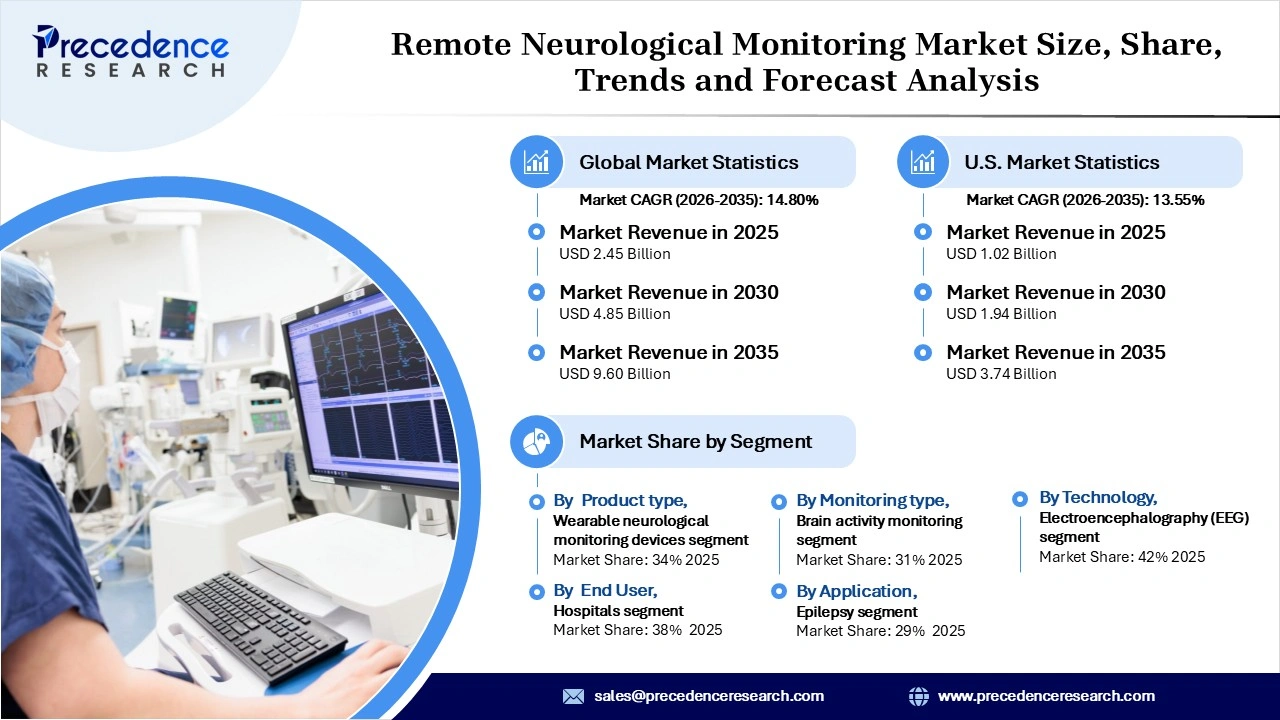
The global remote neurological monitoring market revenue was valued at USD 2.45 billion in 2025 and is expected to attain around USD 9.69 billion by 2035, growing at a CAGR of 14.80% during forecast period. The market is driven by the increasing cases of chronic neurological diseases like epilepsy, Parkinson’s disease, and multiple sclerosis, along with the rising need for continuous patient monitoring that can be carried out at home, minimizing the need for hospital visits.
Remote Continuous Care of Neurological Patients
The remote neurological monitoring market involves all technologies, devices, and software used to remotely monitor, analyze, and manage neurological diseases. This market includes wearable devices such as EEG headsets, tremor detection devices, and movement detectors, telemedicine software with neurological assessment solutions, and cloud computing for interpreting patient physiological information into medical conclusions. It encompasses epilepsy, seizure monitoring and prediction, tremor and gait analysis, tracking fatigue and mobility, and monitoring during stroke recovery.
This market involves collecting remote patient outcomes, medication compliance, and AI-driven alerts for changes in symptoms or complications. This market has been adopted in neurology departments, home health organizations, nursing homes, and consumers through direct-to-consumer devices. This market provides hardware, software subscriptions, data hosting, and professional interpretation of results.
AI-Enabled Wearable Earpiece to Detect Epileptic Seizures Before They Occur
The latest trend in the remote neurological monitoring market is the usage of AI-enabled wearable technologies to predict epileptic seizures. Non-invasive sensors are used to monitor brain activities and physiological information in a continuous manner, which is then analyzed using advanced AI algorithms that detect any pattern indicating a risk of seizures and provide timely alerts. In 2025, Neuraxpharm and mjn-neuro revealed their intention to develop EPISERAS, an AI-enabled wearable earpiece that detects epileptic seizures in their early stages.
Industry Investment to Boost Private Dwellings Neurological Monitoring
The remote neurological monitoring market is experiencing increasing investment in home-based devices by medical technology companies as the market moves towards making diagnosis possible not only in hospitals but also outside them. Long-term video EEG technology used at home is being incorporated into product lines in response to the growing consumer need for home-based epilepsy detection. In 2025, Cadwell Industries made a strategic investment in Seer Medical, an Australian company providing home-based services for diagnosing epilepsy. The flagship product of Seer Medical is called Seer Home, which incorporates cloud, AI, and video EEG technology to detect brain activity in order to detect epilepsy faster without visiting a hospital.
Government Investments Speed Up Rollout of Remote Neurological Monitoring Platforms
Governments across the globe have introduced funding programs for tele-neurology and remote neurological patient monitoring. It helps to cope with an increasing burden of rising incidences of neurological diseases and inadequate access to specialists. These programs are aimed at introducing wearable EEGs, AI-enabled seizure detection, and teleconsultation technologies into medical practice, especially among remote and aging populations. In 2025, under the German Innovation Fund, the TENEAM project was commenced, which seeks to provide about 200 family doctor facilities in Brandenburg and Mecklenburg-Western Pomerania with tele-neurology devices. The objective of this project is to enhance accessibility of neurological services among populations residing in remote areas through virtual consultations and monitoring of chronic neurological ailments.
Epiminder Makes Progress with First U.S. Implant of Minder Continuous EEG
In 2026, Epiminder revealed that it has developed the first U.S. implant of its Minder continuous EEG monitoring system under the DETECT clinical trial in drug-resistant epilepsy. The DETECT study intends to recruit up to 210 patients at 25 medical sites in the U.S. and prove that the Minder is better than the current standard care. The system features real-time seizure detection and wireless data delivery, allowing clinicians to change therapy remotely without hospital admission of patients.
Market Segmentation Analysis
- By product type, the wearable neurological monitoring devices led the market with 34% share in 2025, and are expected to expand at the highest CAGR of 17.2% during the forecast period, because it enables uninterrupted monitoring of the patient through real-time data collection in their usual environment. This facilitates the identification of intermittent conditions such as seizures and movements compared to occasional clinical evaluations.
- By product type, the remote EEG monitoring systems segment held the second largest market share of 29% in 2025, since it offers clinically proven and highly accurate data about the activities of the brain, which are necessary to confirm and manage cases of epilepsy that consumer-grade wearable products have not been able to do yet. Nevertheless, due to its high price tag, professional installation process, and reduced patient mobility, it has been confined mainly for prescribed use at home.
- By monitoring type, the brain activity monitoring segment dominated the remote neurological monitoring market with 31% share in 2025, because it provides information about the electrical activity behind most neurological disorders, including epilepsy, stroke, and sleep disorders, whereas no such information can be gleaned from movement and vital signs monitoring. Furthermore, the development of dry electrodes and compact amplifiers has made remote home EEG feasible.
- By monitoring type, the Parkinson’s disease monitoring segment is expected to grow at the highest CAGR of 16.7% from 2026 to 2035, because patients suffering from Parkinson’s disease need constant monitoring of their motor function variations such as tremor, gait, and bradykinesia, which fluctuate during the day and are difficult to track through conventional clinic visits.
- By technology, the electroencephalography (EEG) segment led the market with 42% share in 2025, owing to its ability to measure brain electrical activity directly and in real-time, and therefore serves as the definitive diagnosis method for conditions like epilepsy and sleep disorders. EEG can be used at home due to the development of dry electrode headsets, coupled with wireless communication abilities.
- By technology, the AI-enabled neurological analytics segment is expected to expand at the highest CAGR of 20.4% during the forecast period, because AI and machine learning are capable of picking up minute patterns from the continuous EEG, accelerometry, and video feeds, which often go unnoticed by human analysts.
- By end-user, the hospitals segment dominated the remote neurological monitoring market with 38% share in 2025, owing to its status as the initial centers for diagnosis of epilepsy, stroke, and movement disorders, in which professional EEG and video-based monitoring is first diagnosed by a neurologist prior to being considered for any home-based monitoring. Hospitals have well-established payment structures, skilled technical personnel, and necessary legal rights to diagnose and alter treatment strategies.
- By end-user, the home care settings segment is expected to grow at the fastest CAGR of 19.5% from 2026 to 2035, since patients choose to stay within their home surroundings in terms of constant supervision, thus ensuring high compliance rates. It also reduces the stress on hospital beds and medical facilities by decreasing the number of patients in hospitals.
- By application, the epilepsy segment led the market with 29% share in 2025, due to the fact that it is one of the most frequently encountered neurological conditions, which requires consistent and extended observation for identification of sporadic episodes of seizures. Home monitoring using remote EEG and wearable seizure detection devices provides accurate diagnosis and adjustment of the medication regimen.
- By application, the Alzheimer’s disease and dementia segment is expected to expand at the highest CAGR of 17.4% during the forecast period, owing to the increasing prevalence of dementia worldwide along with the growing interest in the early diagnosis and therapy in the condition. The remote monitoring solutions, including cognitive tests using smartphones and wearables as well as home monitoring devices, are suitable for collecting information on memory, functioning, and behavior for a significant amount of time.
Regional Analysis
North America led the remote neurological monitoring market with 39% share in 2025, due to its well-developed health care system, significant presence of advanced telemedicine technologies, and early approval of non-invasive EEG devices and seizure monitoring technologies. The U.S. dominated the market in North America because of extensive government funding by the National Institutes of Health (NIH) on neurology research, expedited FDA approvals for brain monitors, and an abundant patient pool of those with epilepsy and Parkinson’s disease desiring easy home-based solutions. Canada witnessed notable market growth owing to its publicly-funded health care system that facilitates pilot projects for remote monitoring and a robust neuroscience research network within academia.
Asia-Pacific is expected to expand at the highest CAGR of 18.2% during the forecast period, due to the presence of the world’s largest and aging population, resulting in high incidence rates of neurologic disorders among the elderly, including strokes, Parkinson’s disease, and dementia. China led the market in Asia-Pacific owing to a high number of neurological patients, government backing to establish advanced technologies for healthcare needs, and extensive adoption of tele-neurology services. India is a significant contributor to the market because of a significant number of patients with movement disorders and epilepsy, and increasing impetus given by health systems on cost-saving methods and improving the accessibility of specialists to patients.
Europe held the second-largest market share of 27% in 2025, owing to a favorable landscape in terms of a strong public healthcare system that enables reimbursement of tele-neurology services, along with a high incidence of diseases such as epilepsy and Parkinson’s, which are driving the need for home patient monitoring solutions. Germany led the market in Europe due to the presence of a robust digital health ecosystem, rapid adoption of wearable EEG devices, and telemedicine initiatives funded by government agencies such as TENEAM. France witnessed notable market growth due to its national e-health initiatives, the significant presence of various clinical trials for subcutaneous electroencephalography (EEG) implant technology, and associations between research hospitals and medical technology startups targeting Alzheimer’s disease and epilepsy.
Remote Neurological Monitoring Market Coverage
| Report Attribute | Key Statistics |
| Market Revenue in 2025 | USD 2.45 Billion |
| Market Revenue by 2035 | USD 9.69 Billion |
| CAGR from 2026 to 2035 | 14.80% |
| Quantitative Units | Revenue in USD million/billion, Volume in units |
| Largest Market | Asia Pacific |
| Base Year | 2025 |
| Regions Covered | North America, Europe, Asia-Pacific, Latin America, and the Middle East & Africa |
Top Companies in the Remote Neurological Monitoring Market
Medtronic and Neuropace are some of the key players that are at the forefront of the development of implantable remote monitoring devices for the nervous system. Natus Medical, Compumedics, Philips, and GE Healthcare provide in-clinic and ambulatory EEG devices that are equipped with remote data transmission features. BioSerenity, Ceribell, and Empatica provide remote monitoring devices that are equipped with advanced digital technologies for neurological diseases. Brain Scientific, Wearable Sensing, and Advanced Brain Monitoring offer dry-electrode EEG headsets and remote monitoring devices.
Segments Covered in This Report
By Product Type
- Wearable Neurological Monitoring Devices
- Remote EEG Monitoring Systems
- Implantable Neurological Monitoring Devices
- Mobile Neurological Monitoring Platforms
- Others
By Monitoring Type
- Brain Activity Monitoring
- Epilepsy Monitoring
- Sleep Disorder Monitoring
- Parkinson's Disease Monitoring
- Cognitive & Neurodegenerative Disease Monitoring
By Technology
- Electroencephalography (EEG)
- Electromyography (EMG)
- Intracranial Pressure Monitoring
- Neurostimulation-based Monitoring
- AI-enabled Neurological Analytics
By End User
- Hospitals
- Neurology Clinics
- Home Care Settings
- Ambulatory Surgical Centers
- Research Institutes
By Application
- Epilepsy
- Parkinson's Disease
- Alzheimer's Disease & Dementia
- Sleep Disorders
- Stroke Rehabilitation
- Others
By Region
- North America
- Latin America
- Europe
- Asia-pacific
- Middle and East Africa
Get this report to explore global market size, share, CAGR, and trends, featuring detailed segmental analysis and an insightful competitive landscape overview @ https://www.precedenceresearch.com/sample/8480
You can place an order or ask any questions. Please feel free to contact us at sales@precedenceresearch.com |+1 804 441 9344