



Remote Neurological Monitoring Market Size, Share, Trends, Companies, and Forecast 2026-2035
Remote Neurological Monitoring Market (By Product Type: Wearable Neurological Monitoring Devices, Remote EEG Monitoring Systems, Implantable Neurological Monitoring Devices, Mobile Neurological Monitoring Platforms, Others; By Monitoring Type: Brain Activity Monitoring, Epilepsy Monitoring, Sleep Disorder Monitoring, Parkinsons Disease Monitoring, Cognitive & Neurodegenerative Disease Monitoring; By Technology: Electroencephalography (EEG), Electromyography (EMG), Intracranial Pressure Monitoring, Neurostimulation-based Monitoring, AI-enabled Neurological Analytics; By End User: Hospitals, Neurology Clinics, Home Care Settings, Ambulatory Surgical Centers, Research Institutes; By Application: Epilepsy, Parkinsons Disease, Alzheimers Disease & Dementia, Sleep Disorders, Stroke Rehabilitation, Others) - Global Industry Analysis, Size, Trends, Leading Companies, Regional Outlook, and Forecast 2026 to 2035
Source: https://www.precedenceresearch.com/remote-neurological-monitoring-market
 Get a Sample
 Table Of Content


Remote Neurological Monitoring Market Size and Forecast 2026 to 2035
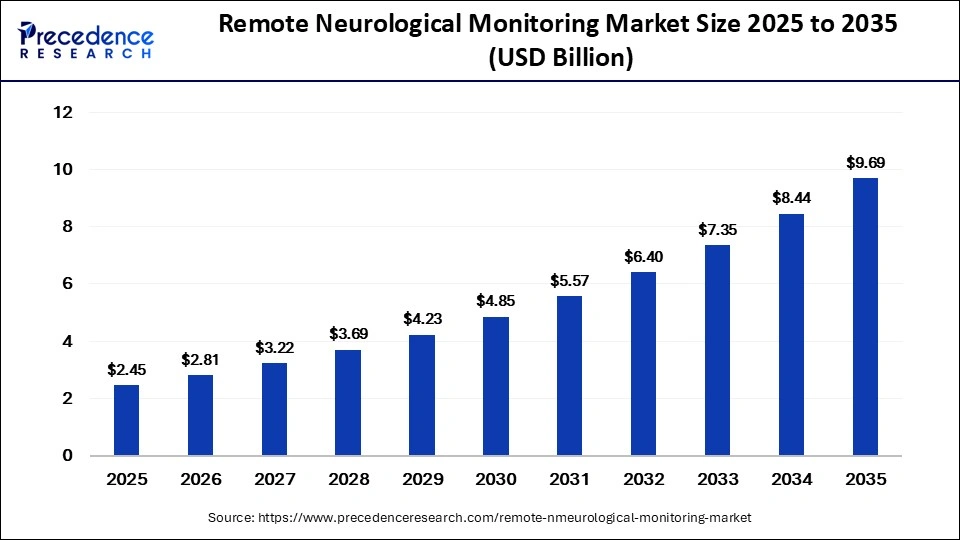
The global remote neurological monitoring market size is predicted to increase from USD 2.81 billion in 2026 to approximately USD 9.69 billion by 2035, expanding at a CAGR of 14.80% from 2026 to 2035. The market is driven by the rising integration of artificial intelligence (AI) and cloud analytics, which enable real-time predictive care and also early detection of neurodegenerative diseases outside traditional hospital settings.
Key Takeaways
- North America dominated the global remote neurological monitoring market with a share of 39% in 2026.
- Asia-Pacific is expected to grow at the fastest CAGR of 18.2% during the forecast period.
- By product type, the wearable neurological monitoring devices segment led the global market with a share of 34% in 2026 and is expected to grow at the fastest CAGR of 17.2% during the forecast period.
- By product type, the remote EEG monitoring systems market held the second-largest market share of 29% in 2026.
- By monitoring type, the brain activity monitoring segment accounted for a revenue share of 31% in the market in 2026.
- By monitoring type, the Parkinson's disease monitoring segment is expected to grow at a 16.7% CAGR between 2026 and 2035.
- By technology, the electroencephalography (EEG) segment accounted for a revenue share of 42% in the remote neurological monitoring market in 2026.
- By technology, the AI-enabled neurological analytics segment is expected to grow at the fastest CAGR of 16% between 2026 and 2035.
- By end user, the hospitals segment accounted for a revenue share of 38% in the market in 2026.
- By end user, the home care settings segment is expected to grow at the fastest 19.5% CAGR between 2026 and 2035.
- By application, the epilepsy segment accounted for a revenue share of 29% in the market in 2026.
- By application, the Alzheimer's disease and dementia segment is expected to grow at the fastest CAGR of 17.4% between 2026 and 2035.
Market Overview
The remote neurological monitoring industry refers to the industry of medical devices, software, and services utilized to track nervous system function outside of a traditional hospital room or to offer remote oversight by specialists during procedures. It encompasses several distinct clinical and commercial sectors. The main driver for the market is the surging prevalence of chronic neurological disorders, for example, epilepsy, dementia, and stroke, coupled with an exponential expansion in the global aging population.
How is AI Influencing the Remote Neurological Monitoring Industry?
Artificial intelligence is transforming the market by allowing continuous tracking of brain activity and physiological markers from home. By using machine learning algorithms, these platforms determine massive datasets from wearables and EEGs, accelerating the early detection of conditions such as Alzheimer's and epilepsy while alleviating strain on clinical staff. AI-powered nerve, along with brain monitoring systems, are stepping in during surgeries to assist hospitals in maintaining patient safety despite a critical shortage of specialized neurophysiologists. Moreover, AI integration makes it possible to synthesize heterogeneous clinical data to personalize treatment pathways, moving away from trial-and-error methodologies.
Remote Neurological Monitoring Market Trends
- Patients and providers increasingly prefer compact, non-invasive wearable sensors, such as ambulatory EEG devices, over bulky traditional systems.
- The integration of AI algorithms into monitoring systems is a major trend. This enables real-time data interpretation, early detection of anomalies, and predictive insights for conditions such as epilepsy.
Market Dynamics
Drivers
Rising Prevalence of Chronic Neurological Disorders
The rising prevalence of chronic neurological disorders such as Alzheimer's, Parkinson's, epilepsy, and stroke acts as the main driver for the market. It necessitates continuous, real-time tracking of brain activity along with physical symptoms while assisting healthcare systems in managing resource shortages and scaling care beyond hospital walls. Moreover, increasing age is the most significant risk factor for neurodegenerative diseases. With a rapidly aging demographic, remote tracking solutions enable elderly patients to age in place while decreasing the burden on physical care facilities and caregivers.
Restraint
High Upfront Equipment Costs
High upfront equipment costs restrain the market because purchasing, installing, and servicing advanced neuro-telemetry and imaging systems require massive capital investment. This massive financial burden restricts acceptance in emerging markets, smaller clinics, and independent surgical centers, which lack the budget for sophisticated neuro-electronics.
Opportunity
AI-enabled Diagnostics
AI-enabled diagnostics present a massive opportunity in the market by transforming neurological care from episodic, hospital-driven evaluation to continuous, proactive management. It solves major neurological workforce shortages along with diagnostic delays by automatically translating massive datasets into actionable clinical intelligence.
Market Segmentation Analysis
Product Type Insights
The Wearable Neurological Monitoring Devices Segment Held the Largest Market Share of 34% in 2026
The wearable neurological monitoring devices segment dominated the remote neurological monitoring market with a share of 34% in 2026, owing to the growing user acceptance of wearable healthcare devices and technological advancements in sensor miniaturization. Innovations in lightweight, low-cost sensors and cloud-based systems enable patients to wear devices discreetly, without tying them to bulky, fixed clinical machines.
The mobile neurological monitoring platforms segment held a 14.00% share of the market in 2026 and is expected to grow at the fastest CAGR of 16.5% during the projection period. This is mainly due to growing remote monitoring adoption, the growth of cloud-based neurological analytics, and rising patient engagement initiatives. Mobile applications and sensors seamlessly sync with telehealth platforms, giving providers access to remote health tracking along with digital neuro biomarkers for personalized treatment plans without requiring in-person visits.
The remote EEG monitoring systems segment held 29% share of the market in 2026 and is expected to grow at a CAGR of 13.8% during the projection period. This is due to the growing epilepsy diagnosis requirements and increased usage of home-based EEG testing. Artificial intelligence algorithms and cloud computing have automated data interpretation, significantly enhancing early diagnostic accuracy and enabling doctors to review continuous data remotely. The shift to remote care optimizes hospital infrastructure, removing the need for prolonged inpatient stays while providing patient-centric, cost-effective alternatives.
Monitoring Type Insights
The Brain Activity Monitoring Segment Held the Largest Market Share of 31% in 2026
The brain activity monitoring segment dominated the remote neurological monitoring market with a share of 31% in 2026, owing to the increasing prevalence of neurological disorders and the growing demand for real-time brain assessment. The continuous improvement of reliable, high-performance microsensors and AI-enabled headsets enables compact, non-invasive, and highly accurate brain tracking. This technological progress enables patients to use affordable, mobile monitoring systems.
The Parkinson's disease monitoring segment held a 14% share of the market in 2026 and is expected to grow at the fastest CAGR of 16.7% during the projection period. This is mainly due to the expansion of AI-driven symptom monitoring, the rising adoption of wearable sensors, and the demand for personalized disease management. Smartphone applications and wearable technologies enable passive, continuous tracking of motor fluctuations, tremors, and thus, gait abnormalities in a patient's natural living environment.
The epilepsy monitoring segment held a 27% share of the market in 2026 and is expected to grow at a CAGR of 15.6% during the projection period. This is due to the rising need for continuous seizure tracking, increasing adoption of remote EEG systems, and growth of home monitoring programs. Patients and neurologists increasingly prefer non-invasive wearable gadgets and also mobile app interfaces over prolonged, costly hospital stays. Remote systems empower patients with independence while enabling physicians to proactively track seizure patterns and personalize medication.
Technology Insights
Why Did the Electroencephalography (EEG) Segment Lead the Remote Neurological Monitoring Market?
The electroencephalography (EEG) segment held a dominant position in the market with a share of 42% in 2026, driven by the gold-standard neurological monitoring technology and increasing need for epilepsy diagnosis. The post-pandemic surge in telemedicine thus heavily favored EEG technology. Patients can now wear non-invasive devices at home, and even neurologists can remotely monitor brainwave patterns and determine data via cloud-based AI.
The AI-enabled neurological analytics segment held a 16% share of the market in 2026 and is expected to grow at the fastest CAGR of 20.4% during the projection period. This is mainly due to the increasing usage of predictive analytics, the growing need for automated interpretation, the expansion of digital neurology platforms, and improved clinical decision support. With the rise in remote patient monitoring (RPM) initiatives, AI-enhanced analytics facilitate continuous tracking, which thus lowers long-term hospitalization costs and improves patient outcomes.
The electromyography (EMG) segment held an 18% share of the market in 2026 and is expected to grow at a CAGR of 13.4% during the projection period. This is due to the rising neuromuscular disorder diagnosis and increasing rehabilitation. EMG technology delivers structural and functional data with a precision that usually outperforms traditional imaging modalities such as Magnetic Resonance Imaging (MRI) for specific pathologies. It captures biological micro-voltages instantly, thus making it the gold standard for tracking neuromuscular conditions such as Amyotrophic Lateral Sclerosis (ALS), peripheral neuropathy, and muscular dystrophy.
End User Insights
What Made the Hospitals Dominant Segment in the Remote Neurological Monitoring Market?
The hospitals segment dominated the global market with the largest share of 38% in 2026. This is due to the availability of advanced neurology departments, strong adoption of monitoring technologies, and the expansion of remote care programs. Neurological monitoring is mainly essential in emergency departments, surgical units, and even intensive care units (ICUs) where patients with head injuries, seizures, or altered consciousness demand constant, real-time observation.
Remote Neurological Monitoring Market Share, By End User, 2026-2035 (%)
| End User | 2026 | 2035 | CAGR (%) |
| Hospitals | 38.00% | 33.00% | 12.8% |
| Neurology Clinics | 24.00% | 23.00% | 14.1% |
| Home Care Settings | 23.00% | 30.00% | 19.5% |
| Ambulatory Surgical Centers | 8.00% | 7.00% | 12.4% |
| Research Institutes | 7.00% | 7.00% | 13.6% |
The home care settings segment held a 23% share of the market in 2026 and is expected to grow at the fastest CAGR of 19.5% during the projection period. This is mainly due to the expansion of remote patient monitoring reimbursement and improved digital health connectivity. Patients prefer receiving neurological care, post-operative recovery, along with therapy from the comfort of their own homes, while physicians track data and even intervene when abnormalities arise.
The neurology clinics segment held a 24% share of the market in 2026 and is expected to grow at a CAGR of 14.1% during the projection period. This is due to increasing specialization in neurological care and growing outpatient monitoring needs. Clinics have widely adopted digital health platforms and telemedicine to provide remote consultations. This allows neurologists to efficiently manage and even monitor patients without needing in-person visits.
Application Insights
What Made the Epilepsy Dominant Segment in the Remote Neurological Monitoring Market?
The epilepsy segment dominated the global market with the largest share of 29% in 2026. This is due to the high requirement for seizure monitoring, growing adoption of remote EEG solutions, and increasing prevalence of epilepsy. Advancements in AI-enabled algorithms and mobile EEG headsets enable patients to receive care in the comfort of their homes. This reduces the demand for costly hospital visits while empowering individuals with continuous monitoring.
The Alzheimer's disease and dementia segment held a 16% share of the market in 2026 and is expected to grow at the fastest CAGR of 17.4% during the projection period. This is mainly due to the growing demand for cognitive assessment tools, the increasing dementia burden, and the expansion of remote neurological evaluations. The increasing adoption of smart wearables, mobile health applications, and AI-driven speech or typing analysis enables continuous monitoring of high-risk individuals. This continuous data flow provides a much more accurate trajectory of disease progression than sporadic clinical appointments.
The Parkinson's disease segment held a 19% share of the market in 2026 and is expected to grow at a CAGR of 16.8% during the projection period. This is due to the growing use of wearable movement tracking devices and the growth of personalized neurological care. Patients often face significant barriers, which include limited mobility and a lack of access to neurologists in rural or distant locations.
Market Regional Analysis: North America, Europe, Asia-Pacific
Which Factors Drive the Remote Neurological Monitoring Market in North America?
North America led the market by holding a major share of 39% in 2026. This is due to a high acceptance of remote patient monitoring technologies, rising prevalence of neurological disorders, and strong reimbursement support for digital health solutions. Rapid advancements in wearable EEG devices and non-invasive technologies have made it easier for doctors to track brain activity outside traditional hospital settings.
U.S. Remote Neurological Monitoring Market Size and Growth 2026 to 2035
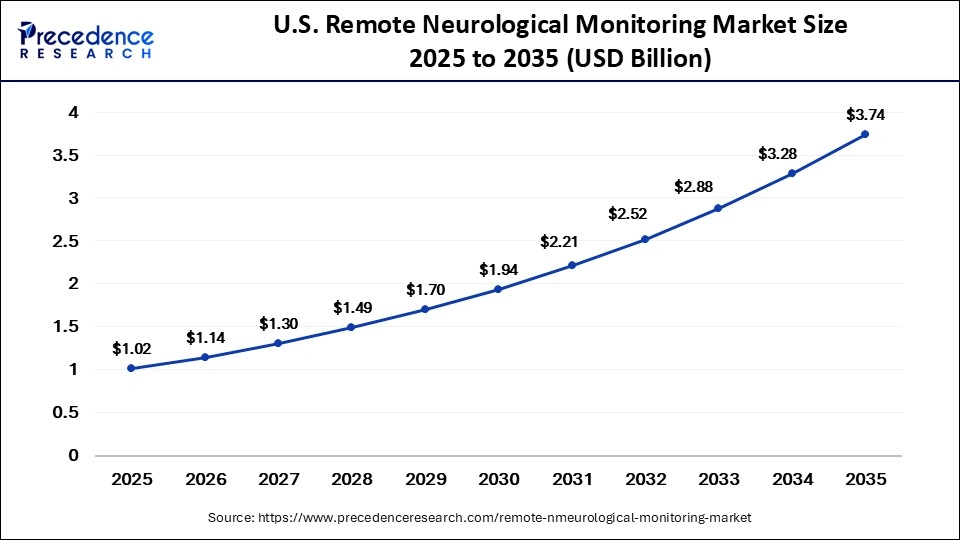
The U.S. remote neurological monitoring market size was evaluated at USD 1.14 billion in 2026 and is projected to reach around USD 3.74 billion by 2035, growing at a CAGR of 13.55% from 2026 to 2035.
U.S. Market Analysis
The U.S. market is driven by an aging population along with chronic illnesses; the neurological subset is advancing rapidly as cloud-driven wearables and artificial intelligence (AI) enable at-home EEG testing and also real-time brainwave tracking.
Europe: The Second-Largest Market
Europe held the second-largest share at 27% in 2026 and is expected to grow at a notable CAGR of 13.8% during the projection period, driven mainly by the growth of telehealth ecosystems, rising healthcare digitization initiatives, and strong regulatory support for remote monitoring. National healthcare systems are changing toward data-driven, connected health systems. Initiatives such as Germany's Digital Healthcare Act (DVG) have made it remarkably easier for digital health applications to be reimbursed, driving broad adoption.
UK Market Analysis
The UK market is accelerating due to the NHS's push for community-based care and digital procurement models. Major drivers include a surging number of patients with neurological conditions, wearable technology adoption, and the rising need for continuous, at-home patient tracking.
Asia Pacific: The Fastest-Growing Region
Asia-Pacific held a 24% share of the market in 2026 and is expected to grow at the fastest CAGR of 18.2% during the projection period, driven by a large neurological patient population and increasing healthcare expenditure. Consumer acceptance of smartwatches (featuring ECG and blood-oxygen sensors) combined with AI-based neurological algorithms has pushed brain monitoring beyond hospital walls. To decrease healthcare costs and hospital admissions, healthcare providers are thus increasingly leveraging remote physiologic monitoring, which enables physicians to track patient vitals and brain activity in real-time at home.
China Market Analysis
China's market is driven by AI-driven telemedicine platforms, an escalating elderly demographic, and massive government-backed digital healthcare initiatives.
What Drives the Remote Neurological Monitoring Market in Latin America?
Latin America held a 6% share of the market in 2026 and is expected to grow at a significant CAGR of 14.1% during the projection period, driven by increasing healthcare modernization, rising knowledge of neurological diseases, growing telehealth adoption, and the growth of remote patient monitoring programs. Remote solutions allow physicians to continuously track physiological data, lowering hospital readmission rates and avoiding unnecessary clinical trips.
Brazil Market Analysis
The Brazilian market is driven by tele-neurology adoption, an aging population, and increasing chronic neurological conditions; it provides significant growth opportunities for localized, cloud-driven, and wearable medical innovations.
Will the Middle East and Africa Grow in the Remote Neurological Monitoring Market?
The Middle East and Africa held a 4% share of the market in 2026 and are expected to grow at a notable CAGR of 13.9% during the projection period, driven by the increasing demand for remote care solutions and the rising prevalence of chronic neurological conditions. Massive regional investments in digital health networks, IoT, and smart cities, mainly in the UAE and Saudi Arabia, have improved healthcare accessibility, enabling patients to use advanced at-home monitoring systems without frequent clinical visits.
UAE Market Analysis
The UAE market is driven by a high chronic disease rate; this expansion is dominated by healthcare networks in Dubai and Abu Dhabi, as patients need continuous monitoring solutions that reduce hospital readmissions.
Market Competitive Landscape: Leading Companies and Strategies
The remote neurological monitoring market is moderately consolidated, with established medical device firms and digital health firms competing via innovation, partnerships, and regulatory approvals. Major players include Medtronic, NeuroPace, Empatica, BioSerenity, and Ceribell. Companies are aiming for AI-enabled analytics, wearable sensors, cloud-driven platforms, and real-time patient monitoring to enhance diagnostic accuracy and clinical outcomes. Strategic partnerships with hospitals, research institutions, and telehealth providers are expanding market reach. The growing need for home-based care and continuous neurological assessment is accelerating competition and even encouraging product differentiation across the industry.
Remote Neurological Monitoring Market Companies
- Medtronic
- NeuroPace
- Natus Medical
- Compumedics
- Masimo
- Philips
- GE HealthCare
- BioSerenity
- Ceribell
- Empatica
- Brain Scientific
- Wearable Sensing
- Neurable
- Advanced Brain Monitoring
- T&W Engineering
Recent Developments Remote Neurological Monitoring Market (2025-2026)
- In June 2026, NordicNeuroLab signed a comprehensive software license along with a distribution agreement with GE HealthCare. The agreement establishes a long-term global framework for the integration, distribution, and even support of NordicNeuroLab's advanced neuroimaging software within GE HealthCare's MRI ecosystem.(Source: https://www.itnonline.com)
- In September 2025, Philips and Masimo are extending their partnership in patient monitoring, with a new multi-year agreement programmed to accelerate the adoption of advanced wearable sensors and expand the usage of artificial intelligence (AI) in bedside and remote monitoring technologies. (Source: https://www.medicaleconomics.com)
Segments Covered in the Report
By Product Type
- Wearable Neurological Monitoring Devices
- Remote EEG Monitoring Systems
- Implantable Neurological Monitoring Devices
- Mobile Neurological Monitoring Platforms
- Others
By Monitoring Type
- Brain Activity Monitoring
- Epilepsy Monitoring
- Sleep Disorder Monitoring
- Parkinson's Disease Monitoring
- Cognitive & Neurodegenerative Disease Monitoring
By Technology
- Electroencephalography (EEG)
- Electromyography (EMG)
- Intracranial Pressure Monitoring
- Neurostimulation-based Monitoring
- AI-enabled Neurological Analytics
By End User
- Hospitals
- Neurology Clinics
- Home Care Settings
- Ambulatory Surgical Centers
- Research Institutes
By Application
- Epilepsy
- Parkinson's Disease
- Alzheimer's Disease & Dementia
- Sleep Disorders
- Stroke Rehabilitation
- Others
By Region
- North America
- Latin America
- Europe
- Asia-Pacific
- Middle East and Africa
For inquiries regarding discounts, bulk purchases, or customization requests, please contact us at sales@precedenceresearch.com
Frequently Asked Questions





Ask For Sample
No cookie-cutter, only authentic analysis – take the 1st step to become a Precedence Research client
 Get a Sample
.webp)



 sales@precedenceresearch.com
 Schedule a Meeting
