



Radiation Treatment Planning Solutions Market Size, Companies, Share, Patient Volume, Treatment Adoption Rates, Pricing Analysis, Regulatory Landscape, Competitive Positioning, and Demand Forecast
Radiation Treatment Planning Solutions Market (By Product Type: Software, Services; By Application: Prostate Cancer, Breast Cancer, Lung Cancer, Head and Neck Cancer, Others; By End-User: Hospitals, Cancer Treatment Centers, Research Institutes, Others) - Global Industry Analysis, Size, Trends, Leading Companies, Regional Outlook, and Forecast 2026 to 2035
Source: https://www.precedenceresearch.com/radiation-treatment-planning-solutions-market
 Get a Sample
 Table Of Content


What is the Radiation Treatment Planning Solutions Market Size in 2026?
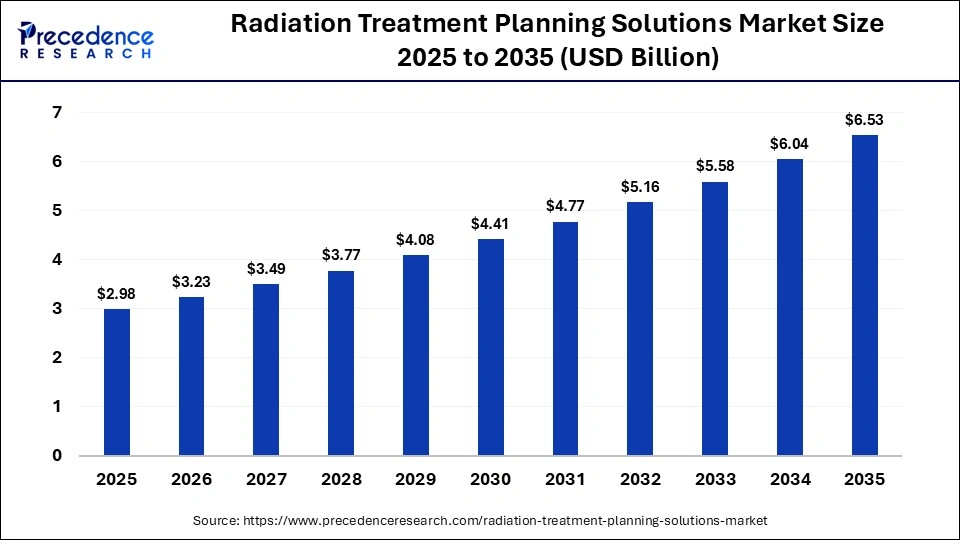
The global radiation treatment planning solutions market size was calculated at USD 2.98 billion in 2025 and is predicted to increase from USD 3.23 billion in 2026 to approximately USD 6.53 billion by 2035, expanding at a CAGR of 8.15% from 2026 to 2035. The market is rapidly growing due to the increasing cancer cases worldwide, creating a high, sustained demand for effective radiation therapy. Moreover, rising adoption of advanced technology in radiotherapy and integration of AI and machine learning to analyze complex data and improve dosage accuracy contribute to market growth.
Key Takeaways
- By region, North America held the largest market share in 2025.
- By region, Asia Pacific is expected to grow at the fastest CAGR during the foreseeable period.
- By product type, the software segment held the largest market share in 2025.
- By product type, the services segment is expected to grow at the fastest CAGR during the forecast period.
- By application, the prostate cancer segment held the largest market share in 2025.
- By application, the breast cancer segment is expected to grow at a significant CAGR during the foreseeable period.
- By end-user, the hospitals segment held the largest market share in 2025.
- By end-user, the cancer treatment centers segment is expected to grow at the fastest CAGR between 2026 and 2035.
Market Overview
The global radiation treatment planning solutions market comprises advanced software platforms used to design, simulate, and optimize radiation therapy for cancer patients, ensuring precise dose delivery to tumors while minimizing exposure to surrounding healthy tissues. There is a rapid shift toward AI-driven, personalized oncology. This growth is underpinned by the increasing integration of high-precision hardware, such as linear accelerators and proton therapy, with sophisticated software designed to optimize therapeutic efficacy while minimizing collateral tissue damage.
The rising geriatric demographic and the rapid adoption of image-guided (IGRT) and intensity-modulated (IMRT) therapies, which offer non-invasive alternatives to traditional surgery, are driving the market. The market is also being driven by AI-enhanced treatment planning, which significantly improves clinical throughput and patient survival rates across the global healthcare landscape.
How is AI Influencing the Radiation Treatment Planning Solutions Market?
The integration of AI, particularly machine learning, is transforming radiation treatment planning from manual, labor-intensive processes to AI-augmented, high-speed workflows. By automating critical tasks such as auto-contouring and knowledge-based dose calculations, healthcare providers are compressing clinical planning timelines from days to mere minutes. This shift not only facilitates real-time adaptive radiotherapy for enhanced anatomical precision but also addresses chronic staffing shortages by reducing inter-observer variability and boosting operational throughput.
Radiation Treatment Planning Solutions Market Trends
- There is a high adoption of adaptive radiation therapy (ART) in clinics to facilitate real-time plan recalibration, allowing for dynamic adjustments based on daily anatomical shifts. This real-time responsiveness significantly enhances dose conformity, ensuring therapeutic accuracy even as tumors shrink or patient morphology changes.
- The shift toward cloud-SaaS architecture is reducing dependence on capital-intensive on-premise infrastructure, making advanced planning tools more accessible.
- There is a strategic shift toward MRI-centric simulation and synthetic CT generation to eliminate redundant imaging steps. This approach optimizes soft-tissue visualization while concurrently reducing ionizing radiation exposure, streamlining the patient pathway from diagnosis to delivery.
- Trends like hypofractionation and stereotactic body radiotherapy are driving demand by enabling higher radiation doses in fewer sessions with improved clinical outcomes.
Market Scope
| Report Coverage | Details |
| Market Size in 2025 | USD 2.98 Billion |
| Market Size in 2026 | USD 3.23 Billion |
| Market Size by 2035 | USD 6.53 Billion |
| Market Growth Rate from 2026 to 2035 | CAGR of 8.15% |
| Dominating Region | Asia Pacific |
| Fastest Growing Region | North America |
| Base Year | 2025 |
| Forecast Period | 2026 to 2035 |
| Segments Covered | Product Type, Application, End-User, and Region |
| Regions Covered | North America, Europe, Asia-Pacific, Latin America, and Middle East & Africa |
Segment Insights
Product Type Insights
Why Did the Software Segment Lead the Radiation Treatment Planning Solutions Market?
The software segment led the market by holding the largest share in 2025. This is because of a strong emphasis on reducing planning timelines while enhancing diagnostic accuracy. Software supports the delivery of highly personalized care, allowing clinicians to optimize complex dosages for IMRT and proton therapy to meet the needs of a surging global cancer patient base. Its ability to improve treatment accuracy, reduce planning time, enhance workflow efficiency, and integrate with various hardware systems makes software the dominant product type in the market.
The services segment is expected to grow at the fastest CAGR during the foreseeable period due to increasing demand for support, maintenance, training, and consulting to ensure optimal utilization of complex planning software and hardware systems. Services such as installation, system upgrades, workflow optimization, and technical support help healthcare providers maximize treatment accuracy, minimize downtime, and improve operational efficiency. Additionally, the rising adoption of AI-driven and cloud-based planning solutions creates a need for specialized service offerings, driving the growth of this segment.
Application Insights
Why Did the Prostate Cancer Segment Dominate the Radiation Treatment Planning Solutions Market?
The prostate cancer segment dominated the market with a major share in 2025, as it is one of the most common cancers worldwide, requiring precise and consistent radiation therapy to preserve healthy tissue while effectively targeting tumors. The rapid shift toward high-precision therapies, such as SBRT and HDR brachytherapy, also bolstered the segment's growth. The integration of AI and advanced imaging into treatment planning allows for unprecedented tumor segmentation and dose optimization. The high incidence of prostate cancer, combined with increasing awareness, routine screening, and adoption of minimally invasive radiotherapy techniques, has driven strong demand for treatment planning solutions in this application.
The breast cancer segment is expected to grow at the fastest CAGR during the foreseeable period due to the high global incidence of breast cancer and a strategic shift toward hypofractionated and accelerated partial breast irradiation (APBI) protocols. With the rising adoption of high-dose-rate brachytherapy and proton therapy, the industry is transitioning toward high-precision, outpatient-focused oncology that prioritizes both clinical efficacy and rapid patient recovery.
End-User Insights
Why Did the Hospitals Segment Hold the Highest Market Share?
The hospitals segment held the largest share of the market in 2025, as hospitals often have high-patient volumes and integrated infrastructure to deploy sophisticated, multi-modality treatment planning systems. As central hubs for comprehensive oncology, from MRI diagnostics to complex delivery, these facilities drive the demand for AI-enhanced, regulatory-compliant software that synchronizes fragmented clinical workflows. Additionally, hospitals often have the financial resources to adopt advanced software, AI-driven planning tools, and adaptive radiotherapy technologies, further consolidating their dominant position in the market.
The cancer treatment center segment is expected to grow at the fastest CAGR during the projection period because these specialized facilities focus exclusively on oncology care, offering advanced radiotherapy technologies and expert clinical teams. They increasingly adopt AI-driven and adaptive planning solutions to deliver precise, personalized treatment while improving workflow efficiency and patient outcomes. Rising patient preference for specialized cancer care, early diagnosis programs, and expanding access to state-of-the-art treatment centers are further driving the growth of this segment.
Regional Analysis
What Made North America the Dominant Region in the Radiation Treatment Planning Solutions Market?
North America registered dominance in the market by holding the largest share in 2025. This is mainly due to high healthcare expenditure and a well-established infrastructure of specialized cancer centers capable of implementing advanced, high-cost technologies. The region is a global leader in AI and machine learning integration in oncology, and favorable reimbursement policies for IMRT and proton therapy further encourage the early adoption of sophisticated treatment planning software.
Strategic M&A activities, such as GE HealthCare's acquisition of MIM Software, along with strong collaborations between industry leaders like Varian and Elekta, are strengthening North America's position in the market. High cancer incidence and supportive FDA policies continue to dominate the market.
U.S. Radiation Treatment Planning Solutions Market Analysis
The market in the U.S. is growing due to AI-driven automation and the adoption of MR-Linac systems, which offer superior soft-tissue contrast for real-time adaptive radiotherapy (ART). Rapid expansion of SBRT and proton therapy enables precise treatment of complex cases, such as oligometastatic disease. Additionally, the shift toward cloud-based planning ecosystems and strategic consolidations, like Varian's acquisition of Aspekt Solutions, is streamlining clinical workflows and expanding access to standardized, high-quality oncology care.
Why is Asia Pacific Rapidly Expanding in the Radiation Treatment Planning Solutions Market?
Asia Pacific is expected to grow at the fastest CAGR during the foreseeable period due to the rapid adoption of AI-enabled LINACs and proton beam therapy, supported by strategic partnerships like Accuray's collaboration with China Isotope and Radiation Corporation (CIRC). Government-backed infrastructure upgrades and a regional shift toward hypofractionated treatments are enabling scalable, high-precision oncology solutions to address the growing needs of the aging populations in China, India, and Japan.
China Radiation Treatment Planning Solutions Market Analysis
In China, the market is evolving as AI is increasingly integrated into planning software to enhance contouring accuracy, dose optimization, and reduce planning time. Rapid adoption of high-precision therapies, including intensity-modulated radiation therapy (IMRT) and proton therapy, is further driving demand. Supportive government policies and rising investment in healthcare infrastructure are expanding access to advanced radiotherapy, fueling overall market growth.
How is the Opportunistic Rise of the MEA in the Radiation Treatment Planning Solutions Market?
The Middle East & Africa (MEA) is expected to witness steady growth in the market, driven by significant government investment in advanced oncology infrastructure. Rapid adoption of IMRT and IGRT, increasingly supported by AI and machine learning, is helping address shortages of skilled personnel. Additionally, the expanding private healthcare sector and rising incidence of breast and prostate cancers are accelerating the shift toward high-precision, digital workflows that enhance clinical accuracy and patient access.
Why is the South American Radiation Treatment Planning Solutions Market Growing?
The market in South America is growing due to the rising cancer burden, with an estimated 1.7 million new cases diagnosed annually, driving demand for effective therapies. Government-led radiotherapy expansion initiatives are increasing access to modern treatment technologies, boosting the need for sophisticated planning software. Additionally, the regional shift from traditional 2D, low-energy treatments to advanced modalities necessitates advanced 3D planning tools to ensure precise tumor targeting and improved clinical outcomes.
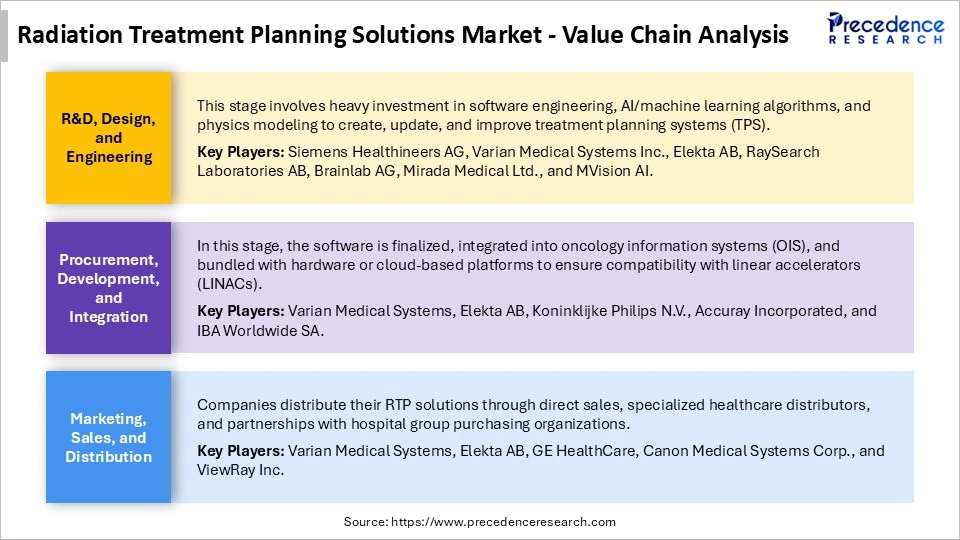
Radiation Treatment Planning Solutions Market Value Chain Analysis
Radiation Treatment Planning Solutions Market Companies
- Varian Medical Systems
- Philips Healthcare
- Elekta AB
- RaySearch Laboratories
- Prowess Inc.
- MIM Software Inc.
- Brainlab AG
- ViewRay Inc.
- Accuray Incorporated
- IBA Group
- Siemens Healthineers
- Mevion Medical Systems
- Mirada Medical
- Sun Nuclear Corporation
- iRT Systems GmbH
Recent Developments
- In January 2026, Elekta announced that its Elekta Evo* CT-Linac received U.S. FDA 510(k) clearance, making the system available to radiation oncology professionals in the U.S. The system features AI-enhanced Iris high-definition imaging designed to provide clinicians with clearer views of tumors and organs-at-risk for every treatment fraction. (Source: https://ir.elekta.com)
- In September 2025, Accuray Incorporated introduced the Accuray Stellar™ Solution, an "all-in-one" adaptive radiotherapy system for the U.S. market, designed to standardize adaptive techniques. The system integrates various tools, enabling clinical teams to switch between IMRT, SBRT, and SGRT delivery modalities within a single workflow.(Source: https://investors.accuray.com)
- In May 2025, GE HealthCare announced a major expansion of its radiation oncology portfolio, headlined by the introduction of the MR Contour DL™ and a strategic move to acquire Spectronic Medical AB's software capabilities. These developments are designed to transition the industry toward an AI-enabled, MR-only workflow, significantly reducing the time from diagnosis to treatment.(Source: https://investor.gehealthcare.com)
- In September 2025, Philips introduced the Rembra RT and Areta RT CT platforms and the latest helium-free BlueSeal RT 1.5T MR system to advance precision cancer care. These innovations focus on AI-native workflows, sustainability, and ultra-fast reconstruction to manage increasing clinical complexity. Read the full details from Philips.(Source: https://www.biospace.com)
Segments Covered in the Report
By Product Type
- Software
- Services
By Application
- Prostate Cancer
- Breast Cancer
- Lung Cancer
- Head and Neck Cancer
- Others
By End-User
- Hospitals
- Cancer Treatment Centers
- Research Institutes
- Others
By Region
- North America
- Europe
- Asia-Pacific
- Latin America
- Middle East & Africa
For inquiries regarding discounts, bulk purchases, or customization requests, please contact us at sales@precedenceresearch.com
Frequently Asked Questions





Ask For Sample
No cookie-cutter, only authentic analysis – take the 1st step to become a Precedence Research client
 Get a Sample
.webp)



 sales@precedenceresearch.com
 Schedule a Meeting
