


Rapid STI Testing Market Size, Key Companies, Company Market Share, Patient Volume, Treatment Adoption Rates, Pricing Analysis, Regulatory Landscape, Competitive Positioning, and Demand Forecast
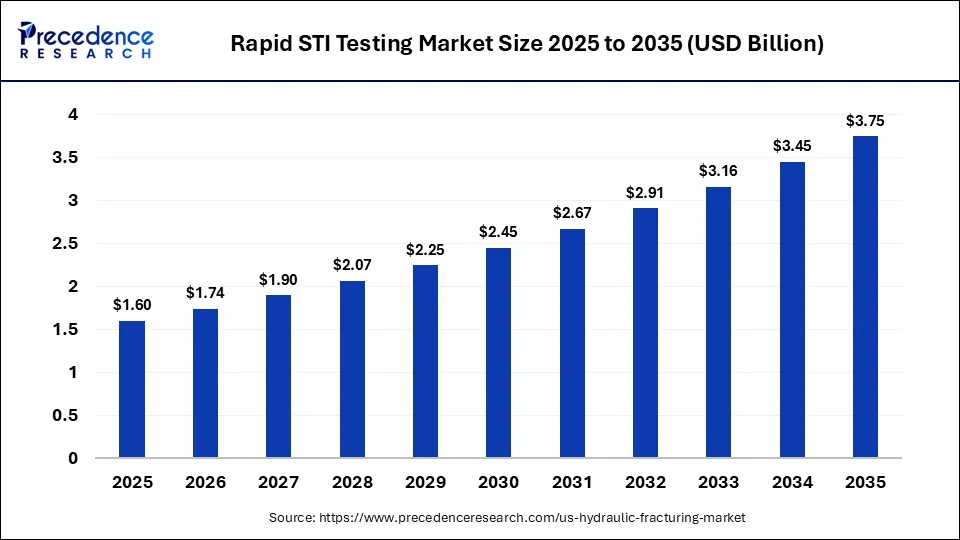
The global rapid STI testing market is estimated at approximately USD 1.74 billion in 2026 and is projected to grow to approximately USD 3.75 billion by 2035, reflecting an estimated CAGR of 8.9%. The market growth is driven by increased STI screening, asymptomatic infections, decentralized and near-patient testing, and advances in molecular diagnostics.Â
Source: https://www.precedenceresearch.com/rapid-sti-testing-market
 Get a Sample
 Table Of Content


Rapid STI Testing Market Size, Share, Trends, and Growth Forecast 2035
The rapid STI testing market is forecasted to expand from USD 1.74 billion in 2026 to USD 3.75 billion by 2035, growing at a CAGR of 8.9% from 2026 to 2035. Development is driven by expanded screening of asymptomatic populations, more frequent testing among high-risk groups, wider availability of near-patient diagnostics, and increasing consumer demand for convenient, confidential testing.
Our expert analysis indicates that market expansion is driven by two interconnected dynamics: rising testing volumes and a move toward faster, decentralized technologies. Molecular diagnostics/NAAT accounts for approximately half of market revenue, while North America generates more than 40% of global revenue, highlighting the dominance of molecular testing and the concentration of current commercial demand. Syphilis remains a major testing category due to its use in antenatal, public-health, and community screening programs.
In our view, the central strategic shift is moving diagnosis from the laboratory into the patient encounter. Opportunities are changing across clinical, public-health, pharmacy, community, telehealth, and consumer settings, creating distinct growth pathways for point-of-care, laboratory, and home-testing models. As a result, turnaround time, ease of use, specimen flexibility, multiplexing, digital connectivity, and testing economics are becoming increasingly important alongside analytical performance.
The report provides a detailed analysis of historical market performance from 2021 to 2025 and forecasts for 2026 to 2033. It examines revenue and volume by pathogen, technology, specimen type, testing setting, and geography. Forecast scenarios also assess how reimbursement, regulatory approvals, public-health spending, lower molecular-test costs, and consumer adoption could shape future market advancement.
Key Takeaways
- By technology, the molecular diagnostics/NAAT segment dominated the market with a share of 50% in 2025.
- By application, the diagnostic testing segment held the largest market share of 67.85% in 2025.
How is Rapid Molecular Testing Reshaping the Economics and Growth Trajectory of STI Diagnosis?
The global rapid STI testing market is estimated to be worth approximately USD 1.7 billion in 2025 and is projected to grow to approximately USD 3.75 billion by 2035. This represents an estimated 8.9% CAGR and an incremental revenue opportunity of approximately USD 1.3 billion. Demand is driven by the substantial global STI burden: more than 1 million curable STIs are acquired each day. Molecular diagnostics/NAAT contributes roughly half, making molecular testing the largest technology segment.
Our analysis indicates that the market is transitioning structurally from centralized laboratory diagnosis to decentralized, encounter-based testing. High rates of asymptomatic infection, combined with the need for timely treatment, increase the commercial value of actionable results delivered during the patient visit rather than after laboratory processing. In our assessment, turnaround time, ease of use, specimen flexibility, multiplexing and digital connectivity are increasingly important differentiators alongside analytical accuracy. Syphilis remains a particularly important testing category given its role in antenatal, public-health and community screening programs.
In our view, the most significant implication is that rapid molecular testing is expanding the addressable value pool beyond the diagnostic test itself, enabling faster clinical decisions and treatment delivery. Competitive edge focuses on workflow economics, testing setting, and the ability to convert epidemiological burden into actual testing volumes. The opportunity varies across point-of-care, laboratory, and home-testing models, as well as across pathogen and specimen categories.
What is Driving the Rapid STI Testing Market Toward Approximately USD 3.75 Billion by 2035?
The global rapid STI testing market is estimated at USD 1.7 billion in 2025, rising to USD 1.6 billion in 2026 and USD 3.75 billion by 2035. This implies an 8.9% CAGR and a USD 1.3 billion revenue opportunity from 2026 to 2035. Growth reflects higher testing volumes and technology aspects, as screening expands among asymptomatic and high-risk populations and accessible, near-patient, confidential consumer testing grows.
Market expansion depends on multiple factors: patient population, testing penetration and frequency, pathogen and technology mix, average selling price, and geographic implementation. Through 2033, geographic differences in testing penetration and technology adoption will remain main to where incremental value is generated. More frequent testing and broader decentralized access can expand the addressable market, while technology shifts can prefer higher-value or faster-adopting platforms.
In our view, the key strategic implication is that market participants need to distinguish between volume-led and technology-led growth. Reimbursement conditions, regulatory approvals, lower molecular-test costs, and consumer preference determine the pace and composition of market expansion. Scenario analysis is therefore especially useful for evaluating potential upside and downside around the USD 2.9 billion 2033 forecast.
Which Test Formats and Technologies Are Most Likely to Capture the Next Wave of Rapid STI Testing Growth?
Molecular diagnostics/NAAT account for about 50% of rapid STI testing revenue, while syphilis contributes 28%, reflecting the scale of rapid serological screening. Single-pathogen tests generate over 60% of revenue, but multiplex STI testing expands about 12% annually, versus 9.10% for swab-based testing. This move suggests the market is expanding access toward maximizing diagnostic information per patient encounter.
Our analysis indicates that the most important structural shift is the convergence of molecular accuracy, multiplexing, and decentralized specimen collection. Approximately 12% growth in multiplex testing suggests providers increasingly value detecting multiple pathogens from one specimen, particularly when symptoms overlap or infections are asymptomatic. Faster growth in swab-based testing signals rising acceptance of self-collection and less invasive workflows. Together, these trends may shift competitive advantage from individual high-volume pathogen tests to platforms offering broader diagnostic coverage with simpler workflows.
The greatest opportunities combine 15–30-minute results, molecular-level performance, multiplex detection and minimal infrastructure at prices viable for public-health programs and emerging markets. Speed alone will not distinguish next-generation rapid STI tests. Same-day diagnosis can reduce repeat visits, loss to follow-up and empirical treatment by shortening time from specimen collection to treatment. But molecular tests remain costlier and more complex than lateral-flow tests, forcing a trade-off between affordability and performance.
Could OTC Molecular Testing Shift Regulation From a Compliance Requirement Into a Competitive Growth Lever?
Rapid STI testing is shifting from professional diagnostics toward OTC and consumer-accessible molecular tests, potentially extending the market from clinics and labs to pharmacies, communities, and homes. As a result, clinical validation, labeling, usability, specimen collection, and confirmatory testing are becoming commercially important. Regulatory accessibility may shape market reach alongside analytical performance: products authorized for consumer use can reach demand inaccessible to professional-only platforms.
Fragmented reimbursement is likely to deepen a two-speed market: clinical and public-health channels remain sensitive to reimbursement, procurement budgets and screening costs. The growing aim at direct-to-consumer models prioritizes convenience, privacy and willingness to pay. OTC molecular test economics therefore depend not only on diagnostic performance, but also on regulatory pathways, testing and distribution costs, and links from positive results to confirmation or treatment. The greatest opportunity lies in platforms combining molecular-level performance, simple workflows and low operating costs for decentralized use.
Sustainability is represented as a design constraint in its own right, rather than a standalone ESG consideration. Single-use cartridges, plastics and packaging can increase waste per test, while decentralized testing can reduce specimen transport, laboratory handling and related logistics. Our analysis suggests that successful product architectures will increasingly need to balance regulatory accessibility, affordability, usability and environmental impact, predominantly as testing moves closer to the patient.
Which Customer and Application Segments Are Reshaping Demand Across Clinical, Public-Health and Consumer Testing?
The diagnostic testing segment dominated with a market share of 67.85% in 2025. The market serves three demand pools: clinical providers, public-health organizations, and consumers. Clinical buyers prioritize analytical performance, speed, workflow integration, and reimbursement. Consumers prioritize privacy, convenience, simplicity, rapid results, and fewer clinic visits. Public-health programs value low cost per screened patient, coverage, reliability, and scalability.
Our analysis indicates that the most significant structural shift is toward decentralized, consumer-led testing, particularly when testing is integrated with telehealth, digital consultations, and treatment delivery. This shift reframes testing from a standalone diagnostic procedure as part of a broader, digitally enabled care pathway. In our assessment, channels that combine convenient sample collection, rapid results, and digital access to clinical services are well positioned to meet demand that traditional facility-based testing may not effectively capture.
In our view, this segmentation creates distinct commercial priorities across applications. Clinical providers can compete on workflow efficiency and diagnostic performance. Public health programs can focus on scalable screening economics and population reach through consumer and telehealth channels. The strategic implication is that market opportunities should be assessed not only by testing volume but also by care setting, patient group, testing purpose, specimen type, and distribution channel, since these factors shape purchasing behavior and approval potential.
Expert's Insights
The rapid STI testing market is developing as healthcare providers and public-health organizations seek faster diagnoses, wider screening access, and stronger links between testing and treatment. The projected increase from USD 1.7 billion in 2025 to USD 2.9 billion by 2035 points to a commercial opportunity driven by rising testing volumes and technology adoption.
Our analysis suggests that molecular diagnostics, especially NAAT-based approaches, are strategically important because they can detect pathogens while supporting decentralized testing. Commercial adoption is influenced by affordability, turnaround time, workflow compatibility, regulatory requirements, and reimbursement conditions.
In our view, the market's growth will depend on how effectively manufacturers and service providers meet the distinct needs of clinical settings, population-screening programs, and consumers. Solutions that balance diagnostic performance with accessibility and practical testing economics may be well positioned to serve a broader range of use cases.
Our Experts
Our market research specialists assess the rapid STI testing industry by integrating analysis of market size, epidemiology, technology adoption, customer demand, regional developments, and competitive positioning. They link disease prevalence and screening requirements to commercial indicators, including testing volumes, average selling prices, technology mix and revenue contribution.
This integrated perspective supports strategic planning for diagnostic manufacturers, healthcare providers, global investors, and other stakeholders assessing market entry, portfolio development, geographic expansion, and emerging testing applications.
The research examines how advances in molecular diagnostics, decentralized testing, at-home solutions and digital healthcare services shape market opportunities. It considers the effects of reimbursement policies, regulatory approvals, public-health initiatives and changes in testing accessibility.
Segments Covered in the Rapid STI Testing Market Report
By Technology
- Molecular Diagnostics
- Nucleic Acid Amplification Tests (NAAT)
- Immunoassay
- Rapid Antigen Tests
- Other Technologies
By Application
- Screening
- Diagnostic Testing
- Antenatal Screening
- High-Risk Population Screening
- Follow-Up Testing
For inquiries regarding discounts, bulk purchases, or customization requests, please contact us at sales@precedenceresearch.com
Frequently Asked Questions





Ask For Sample
No cookie-cutter, only authentic analysis – take the 1st step to become a Precedence Research client
 Get a Sample
.webp)



 sales@precedenceresearch.com
 Schedule a Meeting