



Recycled Thermoplastics Market Size, Key Companies, Company Market Share, Production Capacity, Raw Material Pricing, Export & Import Analysis, Manufacturing Cost, Competitive Positioning, and Demand Forecast
Recycled Thermoplastics Market (By Form: Flakes, Pellets, Granules; By Technology: Extrusion, Injection Molding, Blow Molding, Others (Thermoforming, 3D Printing); By Product: Polyethylene, Polyethylene Terephthalate, Polypropylene, Polystyrene, Polyvinyl Chloride, Others; By Application: Packaging, Automotive, Consumer Goods, Medical, Building & Construction, Electrical And Electronics, Others) - Global Industry Analysis, Size, Trends, Leading Companies, Regional Outlook, and Forecast 2026 to 2035
Source: https://www.precedenceresearch.com/recycled-thermoplastics-market
 Get a Sample
 Table Of Content


What is the Recycled Thermoplastics Market Size?
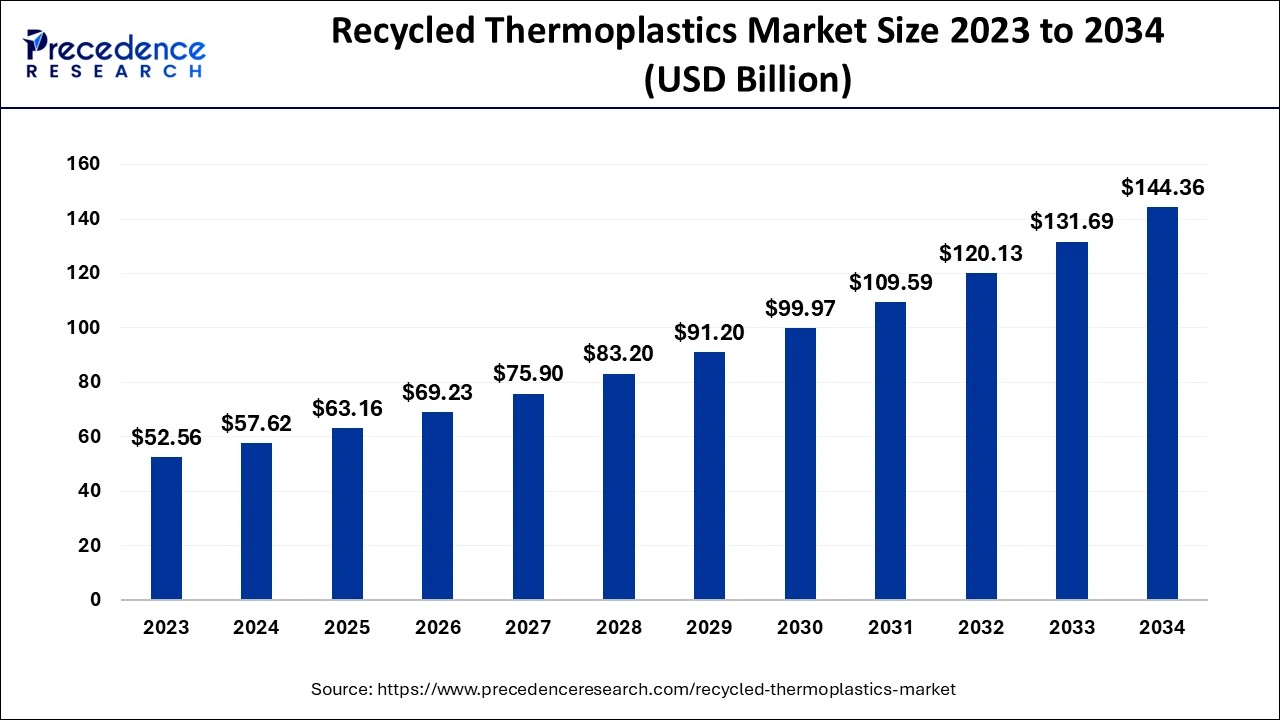
The global recycled thermoplastics market size is calculated at USD 63.16 billion in 2025 and is predicted to increase from USD 69.23 billion in 2026 to approximately USD 156.29 billion by 2035, expanding at a CAGR of 9.48% from 2026 to 2035. The demand for this product is initially being driven by corporate ESG commitments, strong government regulations, and user demand for sustainable products.
Recycled Thermoplastics Market Key Takeaways
- In terms of revenue, the global recycled thermoplastics market is valued at USD 69.23 billion in 2026.
- It is projected to reach USD 156.29 billion by 2035.
- The market is expected to grow at a CAGR of 9.48% from 2026 to 2035.
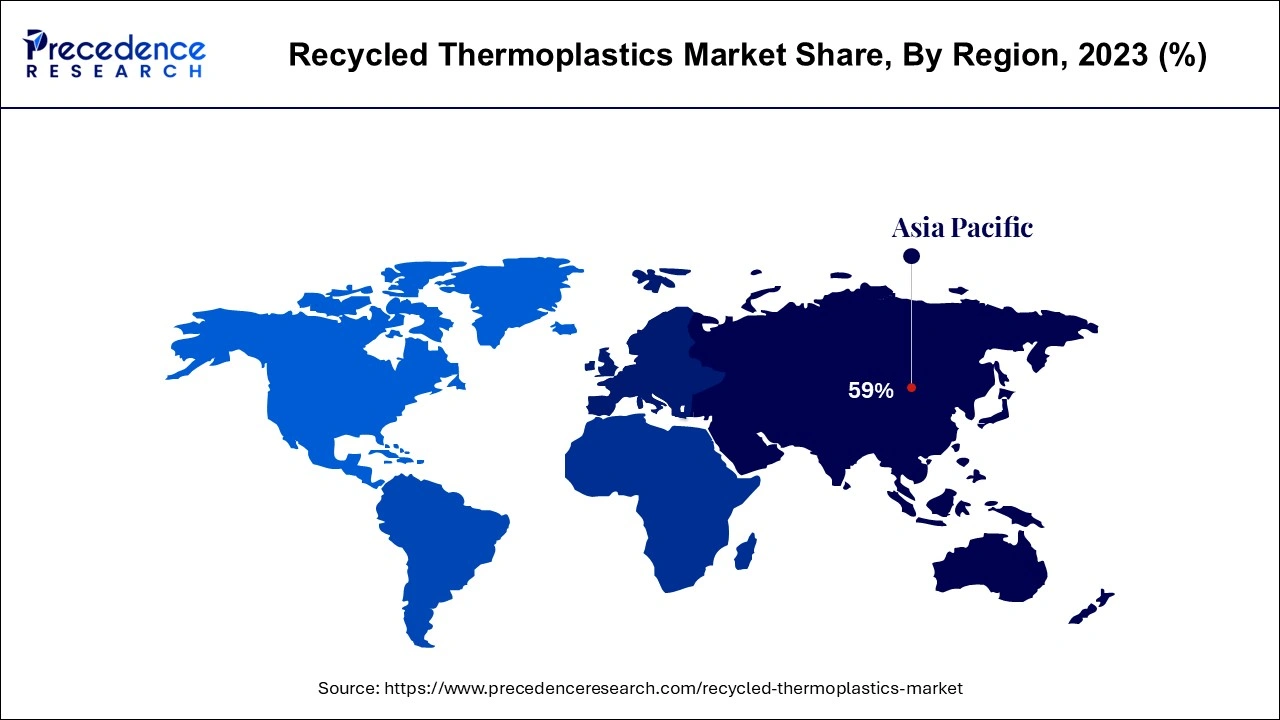
- Asia Pacific dominated the recycled thermoplastics market with the highest market share of 59% in 2025
- North America is anticipated to witness the fastest growth in the market during the forecasted years.
- By form, the flakes segment contributed the biggest market share of 51% in 2025.
- By form, the granule segment is projected to witness the fastest growth in the market during the forecast period.
- By technology, the extrusion segment accounted for the highest market share of 37% in 2025.
- By technology, the blow molding segment is projected to witness the fastest growth in the market during the forecast period.
- By product, the polyethylene segment generated the largest market share of 34% in 2025.
- By product, the polyethylene terephthalate (PET) segment is projected to witness the fastest growth in the market during the forecast period.
- By application, the packaging segment recorded the highest market share of 31% in 2025.
- By application, the granule segment is projected to witness the fastest growth in the market during the forecast period.
What are recycled Thermoplastics?
Recycled thermoplastics are plastics that have been melted down and reshaped into new products. Thermoplastics are quite reusable because the material does not lose its properties after it has been melted and formed once again. They also constitute items that can be easily sorted for recycling using automated recycling tools. Thermoplastics are fully reversible and can be recycled efficiently; they can be used to make new products. This is due to their capacity to be melted and frozen several times without a loss of their properties. However, the probability of recycling thermoplastics depends on other economic and logistical factors related to collection systems, existing infrastructure, and the social trends of consumers.
What is the significance of AI in the recycled thermoplastics industry?
Plastic sorting and processing are well done by AI-enabled robots with accurate predictions of mechanical failures for a seamless service flow in the recycled thermoplastics market. AI technologies add value in the optimization, sorting, and processing of the recycling process, resulting in better quality materials being recycled. Automation tightens processes, cutting off labor costs and speeding up the production process. Some of these technologies are useful in enhancing the efficiency of recycling plants.
Recycled Thermoplastics Market Growth Factors
- Increasing environmental awareness: Consumer and corporate consciousness on sustainability is on environmentally friendly products significance a higher adoption of recycled thermoplastics.
- Regulatory support: Regulations and requirements that limit the utilization of plastic waste and laws that require the utilization of recycled materials.
- Technological advancements: Developments in recycling techniques and technology increase the quality and variety of recycled thermoplastics.
- Rising plastic waste concerns: The use of plastics is rising and the problem has led to increased demand for recycled thermoplastics for more environmentally friendly solutions.
Recycled Thermoplastics Market Outlook
- Industry Growth Overview: The recycled thermoplastics market is expected to experience a strong upturn from 2025 to 2030, driven by sustainable alternative options, as the demand for recycled thermoplastics is developing, which creates opportunities for product growth and innovation. Main industries such as packaging, automotive, and construction are actively accepting such materials, which include a circular economy.
- Sustainability Trends: As recycled thermoplastics can be remelted, they can be mechanically reused and recycled. They are even convenient to recycle, and they can be reprocessed and reshaped by heating. This creates crucial material for circular economy programs and the use of recycled materials.
- Global Expansion: The recycled thermoplastics are witnessing strong development globally, with main investment from North America, specifically in Canada and the United States, which is being driven by strict environmental regulations. In Europe, Germany, the U.K., and France are on top due to their sturdy sustainability initiatives.
- Major Investors: Within a period of seven months, after raising Euro 51.5 million and fixing the rigid commercial request in the U.S and France, Fairmat has developed a further Euro 10 million in equity from a Circular Plastics Fund, which is tracked by Infinity Recycling (Rotterdam, Netherlands), a European investor in the transformation of the circular economy.
- Startup Ecosystem: The plastic recycling startup named Novoloop is partnered with the main producer that generates its upcycled thermoplastic polyurethane at a commercial scale, called TechCrunch, which is newly learned. Startups that rely on hardware are specifically susceptible to setbacks in the valley and have a fearful moment when they have proved their initial technology.
Market Scope
| Report Coverage | Details |
| Market Size by 2035 | USD 156.29 Billion |
| Market Size in 2025 | USD 63.16 Billion |
| Market Size in 2026 | USD 69.23 Billion |
| Market Growth Rate from 2026 to 2035 | CAGR of 9.48% |
| Largest Market | North America |
| Base Year | 2025 |
| Forecast Period | 2026 to 2035 |
| Segments Covered | Form, Technology, Product, Application, and Regions |
| Regions Covered | North America, Europe, Asia-Pacific, Latin America and Middle East, & Africa |
Market Dynamics
Driver
Rising Concerns About Plastic Growth
Growing concern over environmental problems and the consequences of plastic waste has encouraged a demand for sustainable materials. Using the recycled thermoplastics market products can help decrease waste and carbon footprints, leading to increased demand. There has been an increase in momentum towards a circular economy in which materials are reused and recycled. Thermoplastics are more cost-effective than virgin materials, particularly as fossil fuel prices fluctuate. Recycled thermoplastics offer a more economical option compared to new materials. Businesses might recycle materials to lower expenses and achieve sustainability objectives.
Restraint
Quality issues
The variation in the quality of the recycled thermoplastics makes it difficult to use them in more challenging applications. Variability is due to several reasons, such as the origin of materials, the cycles of the recycling methodology, and interferences. Automotive and aerospace industries, in particular, demand heavy-duty and durable parts that have specific characteristics of their own. Further, lack of coordination in the regulation can lead to complications in the way business entities venture into new markets to diversify their operations and work around the peculiarities of the different regulation systems.
Opportunity
Adopt eco-friendly practices
The recycled thermoplastics market is an exciting one, especially with the industry focusing more and more on its environmental impact. Rising concern about environmental impacts among consumers and companies makes recycled thermoplastics the favorable substitute for virgin plastics. Also, there are enhanced quality and diversities of recycled thermoplastics due to enhancements in recycling technologies, which provide competitive challenges to virgin materials in their respective applications. Therefore, it's becoming a theme that ‘go green' not only promotes a sustainable environment but also opens up a market with high possibilities for growth. Thermoplastics are a versatile and eco-friendly substitute for traditional plastics.
Segment Insights
Form Insights
Why Did the Flakes Segment Hold the Largest Share of the Recycled Thermoplastics Market in 2025?
The flakes segment contributed the biggest share of the recycled thermoplastics market in 2025. Plastic waste has to be washed before it is shredded into pellets and then processed to form flakes that can be used in the manufacture of other goods. Flakes are widely used and employed in products such as plastic products such as bottles and containers, as well as textiles and fabrics. Flake-form recycled thermoplastics are relatively produced and, therefore, are affordable and competitive in large-scale recycling facilities.
The granule segment is projected to witness the fastest growth in the recycled thermoplastics market during the forecast period. Recycled plastic granules are small pellets made of recycled plastic waste material. They are generally recycled plastics because they are intermediate outputs of recycled products that act as raw materials for new plastic goods. Particles provide better control, are less likely to produce variations, and are commonly used in automotive, electronics, and packing industries. These recycled granules are much easier to work and pack, allowing manufacturers.
Technology Insights
Why Did the Extrusion Segment Lead the Global Recycled Thermoplastics Market in 2025?
The extrusion segment led the global recycled thermoplastics market in 2025. Extrusion especially facilitates the production of long, tough, almost all-plastic products used in construction, packaging, and the agricultural industry. Also, the push for decreasing carbon footprints in the construction industry boosts builders to embrace recycled materials, enhancing demand for extruded recycled thermoplastics that are cost-effective and environmentally friendly.
The blow molding segment is projected to witness the fastest growth in the recycled thermoplastics market during the forecast period. Blow molding is particularly suitable for using lightweight, thin-shelled products like bottles and jars. Blow-molded articles are produced with recycled thermoplastics due to changing customer demand for environment-friendly packaging and the increasing dominance of recycling standards. Blow molding plastics is a manufacturing process where air is blown into a mold cavity to manufacture a hollow product. It is widely applied in manufacturing various parts for construction, industrial use, automobile, medical, and packaging industries, among others.
Product Insights
What Is Driving the Rapid Growth of the PET Segment in the Recycled Thermoplastics Market?
The Polyethylene segment recorded the highest share of the recycled thermoplastics market in 2025. Polyethylene is commonly used in products such as plastic bags, films, and shrink wraps and is critical in the food, retail, and e-commerce industries. Companies are increasingly being forced to limit their impacts on the environment; there is an increasing need to use polyethylene that has been recycled from other uses. Polyethylene is a thermoplastic polymer that has a crystalline structure that is more variable, although it is used in all industries. Polymer Shapes is one of the largest independently owned distributors of polyethylene plastics, providing sheets, rods, and tubes.
The Polyethylene Terephthalate (PET) segment is projected to witness the fastest growth in the recycled thermoplastics market during the forecast period. PET is the material used to make plastic bottles. It is in high demand among the companies that plan to combat plastic waste and build a circular economy. Polyethylene terephthalate (PET) polymers are a type of polyester. This compound is semi-crystalline in a stable form. This one is recyclable and has impact resistance, water resistance, and resistance to alcohols and solvents.
Application Insights
Why Did the Packaging Segment Hold the Largest Share of the Recycled Thermoplastics Market in 2025?
The packaging segment accounted for the largest share of the recycled thermoplastics market in 2025. Recycled thermoplastics are recycled polyethylene and polypropylene, and their application is in food packing materials, carrying cases for shipment, and retail bags. Thermoplastics are recycled and used mostly in bottle making, containers, and films to meet the regulatory requirements and the ever-increasing demand for environmentally friendly packaging. The recycled content in food and beverage packaging has been on the rise in recent years.
The granule segment is projected to witness the fastest growth in the recycled thermoplastics market during the forecast period. These materials can provide lightweight and high durability to the vehicles, thus ensuring that manufacturers meet stringent environmental regulations and improve vehicle performance. There is a desire for recycled thermoplastics in the automotive industry due to the development of EVs and the demand for sustainable processes. Automotive applications of recycled plastics include the manufacture of bumpers, dashboards, interior trims, and others. The benefits include reducing vehicle weight, improving fuel efficiency, and lowering emissions.
Regional Insights
Asia Pacific Recycled Thermoplastics Market Size and Growth 2026 to 2035
The Asia Pacific recycled thermoplastics market size is evaluated at USD 37.26 billion in 2026 and is projected to be worth around USD 93.17 billion by 2035, growing at a CAGR of 9.06% from 2026 to 2035.
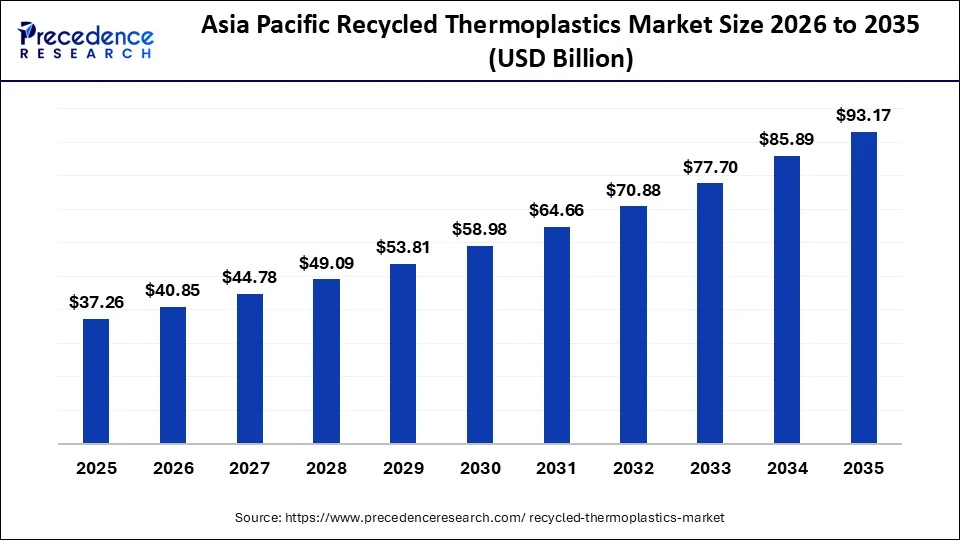
Asia Pacific accounted for the largest share of the recycled thermoplastics market in 2025. The demand for consumer goods and especially imports of consumer electronics, has grown significantly in the recent past owing to increased urbanization and disposable income, hence putting pressure on the thermoplastic recycling industry to become more responsive to the environment, promoting the effectiveness of recycling systems due to accelerated economic development and urbanization process in those countries such as China and India.
North America is anticipated to witness the fastest growth in the recycled thermoplastics market during the forecasted years. The United States and Canada contribute most to the region with innovation factors, while market progress is driven by governments and strategic investments. The region aids from well-established supply chains and increasing consumer inclinations. As countries develop more and more industries, there is a growing emphasis on the disposal of waste and, thus, a higher market for recycled thermoplastics.
Why did Europe hold a Significant Share of the Recycled Thermoplastics Industry?
Europe held a significant share of the market. The rising use of high-quality thermoplastics in the automotive sector across numerous countries, including Germany, France, Italy, the UK, Denmark, and some others, has driven the market expansion. Additionally, rapid investment by market players for opening up new recycling centers is expected to accelerate the growth of the recycled thermoplastics market in this region.
What made Latin America hold a Considerable Share of the Recycled Thermoplastics Market?
The Middle East and Africa held a notable share of the market. The increasing adoption of PVC in the healthcare sector across numerous countries, including the UAE, Qatar, South Africa, and others, has driven the market growth. Moreover, the rapid expansion of the construction sector, along with technological advancements in the packaging industry, is expected to drive the growth of the recycled thermoplastics market in this region.
Government Initiatives Taken For Recycled Thermoplastics
- India's EPR framework, which comes under the Plastic Waste Management Rules, 2016, began in 2022 and is one of the most impactful plastic governance models in the world. Importers, producers, and Brand owners (PIBO) are legally accountable for recycling and collecting a percentage of their respective plastic waste.
- The “National Strategy to Protect Plastic Pollution” delivers a strategy for lowering and recovering plastics and other materials, and, on the other hand, it prevents plastic pollution from compromising the environment and human health. (Source: https://www.epa.gov)
- A bottle deposit initiative makes a financial incentive program for recycling beverage containers such as soda bottles, PET water bottles, glass bottles, and aluminium cans. Consumers officially pay a refundable price at the time of purchase, and the deposit is refunded when they recycle an empty beverage container at an easy location. (Source: https://plasticsrecycling.org)
- EPA Administrator Lee Zedien has been accused of avoiding public feedback and, in March 2025, revealed sweeping deregulation efforts that have changed 31 surrounding preventions, which Zedien has called "the most consequential day of deregulation in American history”. (Source: https://www.earthday.org)
Supply Chain Analysis – Recycled Thermoplastics Market
- Feedstock Procurement: Feedstock procurement for recycled thermoplastics involves navigating a highly fragmented supply network. Raw materials, such as rPET, rHDPE, and rPP, are procured from trusted sources to maintain the high quality of products.
Key Players: Vanden Recycling, iSustain Recycling, Plastship, and Uberplas. - Chemical Synthesis and Processing: Pyrolysis heats the plastics in the absolute absence of oxygen, which breaks down the long polymer chains into gases, oil, and waxes. Such results can be updated, or those that have high adequate factors, such as feedstocks for current plastics.
Key Players: BASF, Eastman Chemical Company, Evonik Industries, and SK Chemicals. - Quality Testing and Certification: Recycled polyethylene (PE) testing includes an analytical process to check the characteristics, quality, and confirmation of PE materials being upcycled from waste. This necessary testing makes sure recycled PE aligns with sector standards such as UNE-EN 15344, which are suitable for use in films, packaging, pipes, and bottles.
Key Players: UL Solutions, Applus+ Laboratories, and SGS SA - Packaging and Labelling: Centers have officially notified amendments to the Plastic Waste Management Rules, which make it compulsory for importers, manufacturers, and brand owners to use recycled plastics in packaging and include marking and labelling that shows the application of recycled content.
Key Players: Pashupati Group, Lucro Plastecycle, BeriCap, and ThePackHub
Recycled Thermoplastics Market Companies
- B. Schoenberg & Co.: B. Schoenberg & Co. is a North American plastic recycling and trading company based in Yorktown, New York, that buys and sells a wide variety of plastic materials and also manufactures flexible PVC and black color concentrates. The company has a large operational footprint, with ten branch offices, two manufacturing plants, and various warehouse facilities, and is recognized for its strong payment history to suppliers.
- Clear Path Recycling: Clear Path Recycling was a joint venture between Shaw Industries and DAK Americas to recycle post-consumer PET bottles into Recycled PET (RPET) flake. The operation, which began in 2010, was designed to recycle approximately 280 million pounds of plastic bottles annually, conserving landfill space and saving energy equivalent to powering 18,000 U.S. homes per year.
- Custom Polymers: Custom Polymers is a global company that specializes in recycling and reprocessing plastic scrap, both post-industrial and post-consumer. This company has been buying, processing, and selling commodity and engineering-grade plastics, with services including grinding, shredding, pelletizing, and densifying.
- Envision Plastics: Envision Plastics is a leading North American supplier of recycled polyolefin resins, known for its high-quality post-consumer recycled (PCR) plastic, including proprietary food-grade, color-sorted, and fragrance-free HDPE. This company uses advanced recycling technologies to purify post-consumer plastic waste.
- Fresh Pak Corporation: Fresh Pak Corporation, founded in 1992 and based in Houston, Texas, is a private company that manufactures and supplies sustainable plastic packaging products, such as slip sheets and roll stock. It has a global presence with sales offices in the United States, Latin America, Asia, and Europe.
- KW Plastics: KW Plastics is the world's largest recycler of plastics and a leading supplier of high-quality recycled high-density polyethylene (HDPE) and polypropylene (PP) resins. It uses proprietary technology to process plastic scrap into resins that can be used in up to 100% concentration for diverse applications like automotive parts, packaging, and containers.
- Plastipak Holdings: Plastipak Holdings is a global plastic packaging and recycling company founded in 1967 and headquartered in Plymouth, Michigan. The company designs and manufactures rigid plastic containers for industries such as food, beverage, and consumer products.
Other Major Key Players
- RJM International Inc.
- Suez
- United plastic recycling
- Veolia
- B&B Plastics
Recent Developments
- In July 2026, HRC, China's top overall composite solution server, officially revealed CirVia as its latest brand for recycled and green products. The name integrates “Cir,” which means circularity, and "Via", which means path, and has the main mission of transforming the material value and progressing a path in terms of the green circular economy. (Source: https://www.jeccomposites.com)
- In July 2026, the Saudi petrochemicals producer named Sabic revealed its newest LNP Elcrin DCOO51RC1 compound, which is accessible globally and has 75% post-consumer recycled materials (PCR). This is Sabic's primary PCR-dependent carbon-fibre -reinforced compound. (Source: https://www.jeccomposites.com)
- In November 2025, Struktol Company of America revealed two tailored additives that are crafted to solve one of the biggest challenges in recycled plastics: an unwanted odor that can affect product quality and restrict the application of recycled content. (Source: https://www.plasticstoday.com)
- In October 2025, Schneider Electric partnered with Evonik. This partnership is for opening a thermoplastic processing unit in Germany. (Source: www.indianchemicalnews.com)
- In August 2025, Circularix LLC inaugurated a new PET recycling plant in Florida. This new plant is inaugurated to increase the recycling of thermoplastics for the end-users of the U.S. (Source: www.plasticsnews.com)
- In March 2025, OMV announced it to open a ReOil plastics recycling plant in Austria. This recycling plant is inaugurated to expand the recycling of thermoplastics across this nation. (Source: www.chemengonline.com)
Segments Covered in the Report
By Form
- Flakes
- Pellets
- Granules
By Technology
- Extrusion
- Injection Molding
- Blow Molding
- Others (Thermoforming, 3D Printing)
By Product
- Polyethylene
- Polyethylene Terephthalate
- Polypropylene
- Polystyrene
- Polyvinyl Chloride
- Others
By Application
- Packaging
- Automotive
- Consumer Goods
- Medical
- Building & Construction
- Electrical And Electronics
- Others
By Geography
- North America
- Asia Pacific
- Europe
- Latin America
- Middle East and Africa
For inquiries regarding discounts, bulk purchases, or customization requests, please contact us at sales@precedenceresearch.com
Frequently Asked Questions





Ask For Sample
No cookie-cutter, only authentic analysis – take the 1st step to become a Precedence Research client
 Get a Sample




 sales@precedenceresearch.com
 Schedule a Meeting
