



Robotic Arm Market Size, Key Companies, Company Market Share, Chip Production Volume, Wafer Capacity, Technology Adoption, Pricing Trends, Competitive Positioning, and Demand Analysis
Robotic Arm Market (By Kinematic Configuration: Articulated, SCARA, Cartesian / Gantry, Parallel / Delta, Cylindrical, Polar / Spherical; By Operational Mode: Industrial (Fenced/Traditional), Collaborative (Cobots); By Number of Axes: 1 to 3 Axes, 4-Axis, 5-Axis, 6-Axis, 7-Axis and Above; By Payload Capacity: Ultra-Light (<5 kg), Light (5-20 kg), Medium (21-60 kg), Heavy (61-200 kg), Super Heavy (>200 kg); By Reach / Range: Short (<500 mm), Medium (500-1,500 mm), Long (1,501-3,000 mm), Extended (>3,000 mm); By Component: Robotic Arm Structure, End Effectors / Grippers, Control Systems & Software, Drive Units & Motors, Sensors & Vision Systems; By Application; By End-Use Industry) - Global Industry Analysis, Size, Trends, Leading Companies, Regional Outlook, and Forecast 2026 to 2035
Source: https://www.precedenceresearch.com/robotic-arm-market
 Get a Sample
 Table Of Content


What is the Robotic Arm Market Size?
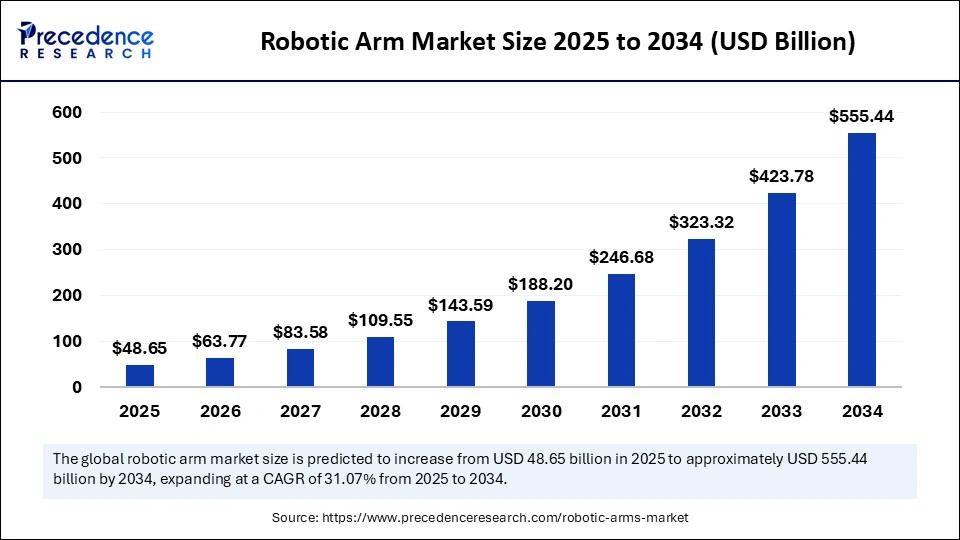
The global robotic arm market size accounted for USD 17.12 billion in 2025 and is predicted to increase from USD 18.25 billion in 2026 to approximately USD 36.20 billion by 2035, expanding at a CAGR of 7.91% from 2026 to 2035. The global robotic arm market is experiencing robust growth, driven by increasing demand for industrial automation, the emergence of Industry 4.0, the rapid expansion of the manufacturing sector, and advancements in technology, including the integration of AI and collaborative robots (cobots).
Market Highlights
- Asia-Pacific accounted for 53.0% of the total revenue share in 2025. The region represents the largest market for robotic arms.
- North America accounted for 22.0% of the total revenue share in 2025. The region represents a significant share of the robotic arm market.
- By kinematic configuration, the articulated segment accounted for 67.70% of the total revenue share in 2025.
- By kinematic configuration, the SCARA segment is expected to grow during the forecast period.
- By operational mode, the industrial (fenced/traditional) segment accounted for 83.00% of the total revenue share in 2025.
- By operational mode, the collaborative robots (cobots) segment is expected to grow during the forecast period.
- By number of axes, the 6-axis segment accounted for 47.80% of the total revenue share in 2025.
- By number of axes, the 4-axis segment is expected to grow during the forecast period.
- By payload capacity, the ultra-light (<5 kg) segment accounted for 30.30% of the total revenue share in 2025.
- By payload capacity, the light payload (5–20 kg) segment is expected to grow during the forecast period.
- By reach/range, the medium range (500–1,500 mm) segment accounted for 54.00% of the total revenue share in 2025.
- By reach/range, the long-range (1,501–3,000 mm) segment is expected to grow during the forecast period.
- By component, the robotic arm structure segment accounted for 42.00% of the total revenue share in 2025.
- By component, the control systems and software segment is expected to grow during the forecast period.
- By application, the material handling segment accounted for 28.70% of the total revenue share in 2025.
- By application, the assembly and disassembly segment is expected to grow during the forecast period.
- By end-use industry, the automotive segment accounted for 40.80% of the total revenue share in 2025.
- By end-use industry, the electrical and electronics segment is expected to grow during the forecast period.
Market Size and Forecast
- Market Size in 2025: USD 17.12 Billion
- Market Size in 2026: USD 18.25 Billion
- Forecasted Market Size by 2035: USD 36.20 Billion
- CAGR (2026-2035): 7.91%
- Largest Market in 2025: Asia Pacific
What Are Robotic Arms?
The growing demand for automation in logistics, manufacturing, and assembly lines to enhance productivity and significantly reduce operational costs is expected to drive the demand for robotic arms during the forecast period. Moreover, labor shortages, the increasing application of robotic arms in complex manufacturing processes, and advancements in robotic arm technology are anticipated to accelerate the market's expansion in the coming years. A robotic arm is a programmable mechanical device designed to perform tasks or activities swiftly, accurately, and effectively, much like a human arm. A robotic arm is generally the most identifiable piece of robotic machinery in industrial settings, enabling the quick and consistent accomplishment of heavy and repetitive processes. They are gaining immense popularity in the industries of industrial production, manufacturing, machining, and assembly.
AI Shifts in the Robotic Arm Market
As technology continues to evolve, the integration of Artificial Intelligence emerges as a game-changer, holding potential for growth in robotic arms. The integration of Artificial Intelligence is making robotic arms smarter, autonomous, adaptable, and capable of handling complex tasks without human intervention. AI enables robotic arms to learn from experience, efficiently analyze large datasets to optimize performance, and improve their operations over time. By leveraging the power of machine learning algorithms, robotic arms are capable of learning from data, adapting to new tasks, and working collaboratively with humans. AI-powered robotic arms have applications across various industries, including healthcare, manufacturing, logistics, automotive, electronics, and others. The rapid automation of tasks enables industries to enhance productivity, reduce operational costs, and address labor shortages with high efficiency and quality.
Robotic Arm Market Outlook
- Industry Growth Overview: Between 2025 and 2030, the industry is expected to experience accelerated growth due to rapid industrialization, a growing demand for Industry 4.0 solutions, favorable government initiatives promoting automation, and a surge in demand for high-precision robotic arms for tasks such as assembly, welding, and material handling. As the emerging market continues to grow, the market is experiencing substantial demand for robotic arms in diverse applications across various sectors such as healthcare, electronics,
- Global Expansion: Leading players are expanding their geographical presence. For instance, in March 2025, Flexiv, a global leader in general-purpose robotics solutions, announced the expansion of its operations in Singapore. As a country committed to adopting cutting-edge technology to enhance efficiency, reduce waste, and improve productivity, Singapore is a key market for Flexiv. (Source: https://www.flexiv.com)
- Major Investors: Private equity and strategic investors are actively investing in the market to gain a competitive edge and strengthen their presence. For instance, in February 2025, Nomagic, a Polish company that develops AI-powered robotic arms for logistics, secured USD 44 million in funding. The European Bank for Reconstruction and Development led the round, with EIB and previous investors also contributing to it. (Source: https://en.ain.ua)
Major Investment in the Robotic Arm Market
- In September 2025, HumRo, the robotics arm of BSE-listed Affordable Robotic and Automation (ARAPL), announced a proposed investment of USD 8–10 million to support its expansion into global markets. (Source: https://www.techcircle.in)
- In July 2025, a robotics company in Salmon Arm secured USD 40 million from investors. 4AG Robotics is expanding with the addition of a 32,000-square-foot facility. The funding positions 4AG to meet the surging global demand for its robotic harvesting platform, which is already in use across Canada, Ireland, and Australia, with new deployments soon to be underway in the Netherlands and the United States. (Source: https://www.campbellrivermirror.com)
- According to an article published in July 2025, the EU is preparing to invest €180 million in cutting-edge digital technologies and research. This investment will benefit projects related to Artificial Intelligence, robotics, and new materials, supporting Europe's transition to a digital, sustainable, and inclusive future. A total of 28 projects were selected in March 2023 following a peer review evaluation process. They aim to bring cutting-edge technologies to places where they can make a real difference. (Source: https://digital-strategy.ec.europa.eu)
- SAMARTH Udyog Bharat 4.0 is an Industry 4.0 initiative of the Ministry of Heavy Industries and Public Enterprises, Government of India, under its scheme for Enhancing Competitiveness in the Indian Capital Goods Sector. SAMARTH Udyog comprises manufacturers, vendors, and customers as its primary stakeholders. The experiential and demonstration centres for Industry 4.0 have been proposed toraised awareness about Industry 4.0 among Indian manufacturing industries. Such initiatives of the Indian government are likely to accelerate the demand for robotic arms in manufacturing industries. (Source: https://heavyindustries.gov.in)
Market Scope
| Report Coverage | Details |
| Market Size in 2025 | USD 17.12 Billion |
| Market Size in 2026 | USD 18.25 Billion |
| Market Size by 2035 | USD 36.20 Billion |
| Market Growth Rate from 2026 to 2035 | CAGR of 7.91% |
| Dominating Region | Asia Pacific |
| Base Year | 2025 |
| Forecast Period | 2026 to 2035 |
| Segments Covered | Kinematic Configuration, Operational Mode, Number of Axes, Payload Capacity, Reach / Range, Component, Application, End-Use Industry, and Region |
| Regions Covered | North America, Europe, Asia-Pacific, Latin America, and Middle East & Africa |
Segmental Insights
Kinematic Configuration Insights
The Articulated Segment Dominated the Market with a 67.7% Share in 2025
The articulated segment dominated the global robotic arm market with a share of 67.7% in 2025, driven by its superior flexibility, multi-axis movement, and extensive deployment across automotive, electronics, and heavy industries. These robots are highly preferred for complex tasks such as welding, assembly, and material handling, where precision and adaptability are critical. Increasing automation in manufacturing and the need for versatile robotic systems further strengthened the segment's leadership.
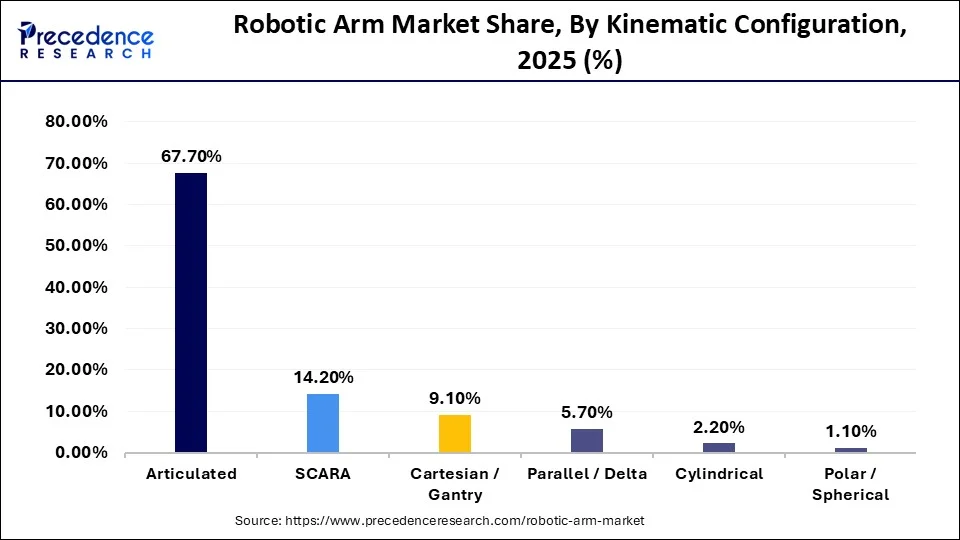
The SCARA segment held the second-largest market share of 14.2% in 2025, supported by its high-speed performance in assembly and pick-and-place applications, particularly in electronics manufacturing. Cartesian/gantry robots followed with a share of 9.1%, benefiting from their precision and cost-effectiveness in linear movement applications.
Operational Mode Insights
The Industrial (Fenced/Traditional) Segment Dominated the Market with a 83.0% Share in 2025
The industrial robots segment dominated the market with a share of 83.0% in 2025, primarily due to widespread adoption in large-scale manufacturing environments requiring high payload capacity and continuous operation. These systems are extensively used in automotive production lines and heavy industries where safety fencing and high-speed automation are essential. Strong investments in industrial automation across emerging economies further reinforced this segment's dominance.
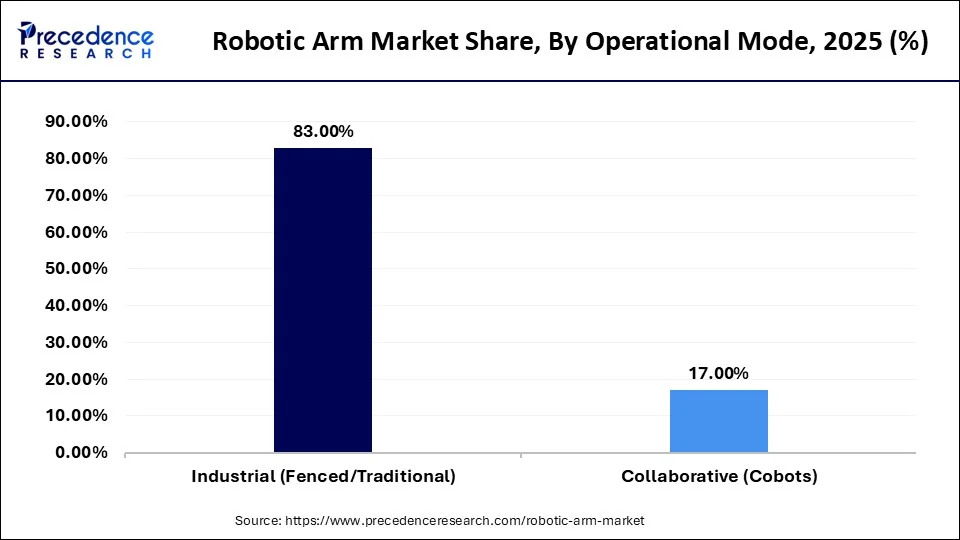
The collaborative robots (cobots) segment held the second-largest share of 17.0% in 2025, driven by increasing demand for human-robot collaboration in SMEs and flexible production setups. Their ease of deployment, safety features, and lower cost of integration are accelerating adoption across diverse industries.
Number of Axes Insights
The 6-Axis Segment Dominated the Market with a 47.8% Share in 2025
The 6-axis segment dominated the market with a share of 47.8% in 2025, owing to its ability to perform complex and multi-directional tasks with high precision and flexibility. These robots are widely used in applications such as welding, painting, and assembly, where advanced articulation is required. The growing demand for automation in intricate manufacturing processes significantly contributed to segment growth.
The 4-axis segment accounted for the second-largest share of 21.5% in 2025, supported by its efficiency in palletizing and material handling operations. The 5-axis segment followed with a 15.2% share, driven by its use in specialized industrial applications requiring moderate flexibility.
Robotic Arm Market Share, By Number of Axes, 2025 (%)
| By Number of Axes | 2025 |
| 1 to 3 Axes | 5.50% |
| 4-Axis | 21.50% |
| 5-Axis | 15.20% |
| 6-Axis | 47.80% |
| 7-Axis and Above | 10.00% |
Payload Capacity Insights
The Ultra-Light Segment (<5 kg) Dominated the Market with a 30.3% Share in 2025
The ultra-light payload segment dominated the market with a share of 30.3% in 2025, driven by strong demand in electronics, semiconductor, and precision manufacturing industries. These robots are ideal for delicate and high-speed operations, particularly in compact production environments. Increasing miniaturization of components and rising automation in electronics further fueled segment growth.
The light payload segment (5–20 kg) held the second-largest share of 25.1% in 2025, supported by its versatility across multiple industrial applications. The medium payload segment (21–60 kg) followed with 18.2%, driven by its use in general manufacturing and assembly operations.
Robotic Arm Market Share, By Payload Capacity, 2025 (%)
| By Payload Capacity | 2025 |
| Ultra-Light (<5 kg) | 30.30% |
| Light (5–20 kg) | 25.10% |
| Medium (21–60 kg) | 18.20% |
| Heavy (61–200 kg) | 14.00% |
| Super Heavy (>200 kg) | 12.40% |
Reach / Range Insights
The Medium Range Segment (500–1,500 mm) Dominated the Market with a 54.0% Share in 2025
The medium-range segment dominated the market with a share of 54.0% in 2025, as it provides an optimal balance between reach and operational efficiency across a wide range of industrial applications. These robots are widely used in assembly lines, packaging, and material handling tasks. Their adaptability to different workspace requirements contributed significantly to their dominance.
The short-range segment (<500 mm) held the second-largest share of 22.0% in 2025, driven by compact and precision-focused applications. The long-range segment (1,501–3,000 mm) followed with 18.0%, supported by demand in large-scale manufacturing setups.
Robotic Arm Market Share, By Reach / Range, 2025 (%)
| By Reach / Range | 2025 |
| Short (<500 mm) | 22.00% |
| Medium (500–1,500 mm) | 54.00% |
| Long (1,501–3,000 mm) | 18.00% |
| Extended (>3,000 mm) | 6.00% |
Component Insights
The Robotic Arm Structure Segment Dominated the Market with a 42.0% Share in 2025
The robotic arm structure segment dominated the market with a share of 42.0% in 2025, owing to its significant contribution to overall system cost and functionality. The structural framework forms the backbone of robotic systems, supporting payload, movement, and durability requirements. Increasing demand for robust and high-performance robots further boosted this segment.
The control systems and software segment held the second-largest share of 22.0% in 2025, driven by advancements in AI-driven automation and motion control technologies. End effectors and grippers followed with 18.0%, supported by their critical role in enabling task-specific operations.
Robotic Arm Market Share, By Component, 2025 (%)
| By Component | 2025 |
| Robotic Arm Structure | 42.00% |
| End Effectors / Grippers | 18.00% |
| Control Systems & Software | 22.00% |
| Drive Units & Motors | 12.00% |
| Sensors & Vision Systems | 6.00% |
Application Insights
The Material Handling Segment Dominated the Market with a 28.7% Share in 2025
The material handling segment dominated the market with a share of 28.7% in 2025, driven by increasing automation in logistics, warehousing, and manufacturing operations. Robots are widely used for tasks such as lifting, moving, and sorting materials, improving efficiency and reducing labor costs. The rapid growth of e-commerce further accelerated demand for automated material handling solutions.
The welding and soldering segment held the second-largest share of 24.3% in 2025, supported by extensive use in automotive and heavy industries. Assembly and disassembly followed with 18.1%, driven by rising automation in electronics and precision manufacturing.
Robotic Arm Market Share, By Application, 2025 (%)
| By Application | 2025 |
| Material Handling | 28.70% |
| Welding and Soldering | 24.30% |
| Assembly and Disassembly | 18.10% |
| Painting and Coating | 11.40% |
| Picking, Packing, Palletizing | 10.20% |
| Quality Inspection and Testing | 4.80% |
| Surgery and Medical | 2.50% |
End-Use Industry Insights
The Automotive Segment Dominated the Market with a 40.8% Share in 2025
The automotive segment dominated the market with a share of 40.8% in 2025, owing to high levels of automation in vehicle manufacturing processes such as welding, painting, and assembly. Automotive manufacturers continue to invest heavily in robotics to enhance productivity, precision, and safety. The shift toward electric vehicles further strengthened demand for robotic automation.
The electrical and electronics segment held the second-largest share of 19.2% in 2025, driven by increasing demand for precision manufacturing. Metal and machinery followed with 13.7%, supported by automation in heavy industrial processes.
Robotic Arm Market Share, By End-Use Industry, 2025 (%)
| By End-Use Industry | 2025 |
| Automotive | 40.80% |
| Electrical & Electronics | 19.20% |
| Metal & Machinery | 13.70% |
| Food & Beverages | 8.10% |
| Healthcare & Pharma | 7.00% |
| Logistics & Warehousing | 5.20% |
| Aerospace & Defense | 3.10% |
| Chemicals & Plastics | 2.90% |
Regional Insights
Asia Pacific Robotic Arm Market Size and Growth 2026 to 2035
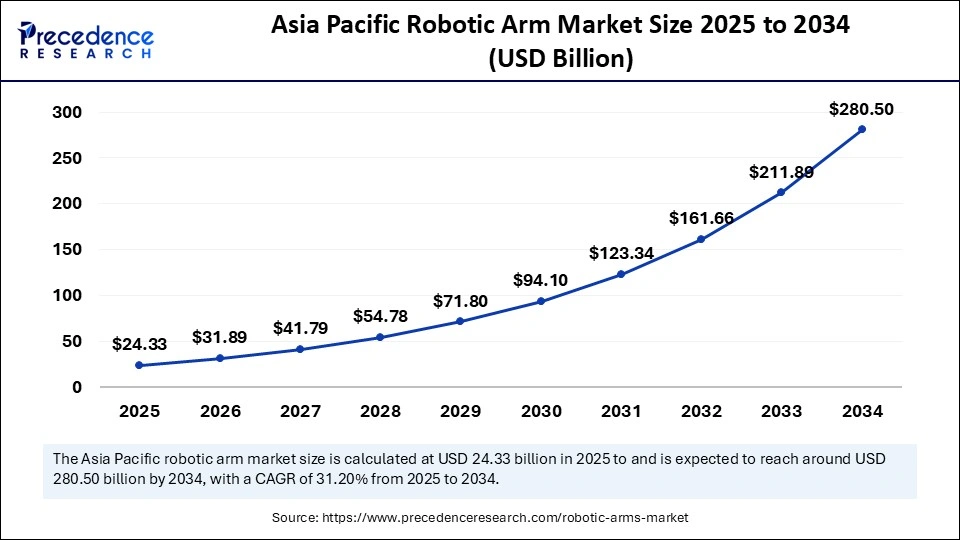
The Asia Pacific robotic arm market size was estimated at USD 9.07 billion in 2025 and is projected to be worth around USD 19.37 billion by 2035, growing at a CAGR of 8.01% from 2026 to 2035.
Asia-Pacific Is Dominating the Robotic Arm Market With the Majority of the Market Share
Asia-Pacific accounted for 53.0% of the total revenue share in 2025, making it the largest market for robotic arms globally. The region's dominance is supported by strong manufacturing ecosystems across countries such as China, Japan, South Korea, and India, where industrial automation is widely adopted. High production volumes in the automotive and electronics industries, along with continuous investments in smart factories and Industry 4.0 initiatives, are sustaining demand. Additionally, the presence of major robotics manufacturers and favorable government policies promoting automation further strengthen the region's market position.
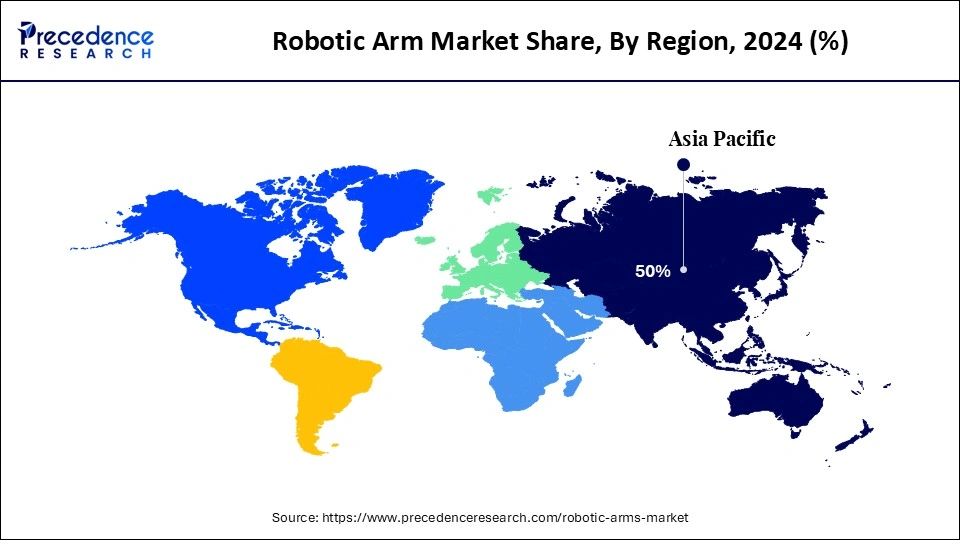
North America accounted for 22.0% of the total revenue share in 2025, representing a significant portion of the global robotic arm market. Growth in the region is driven by increasing adoption of advanced automation technologies across industries such as automotive, aerospace, and electronics. The United States leads regional demand, supported by strong investments in AI-integrated robotics, reshoring of manufacturing, and a focus on improving operational efficiency. Furthermore, the rising use of collaborative robots in small and medium-sized enterprises is contributing to steady market expansion across North America.
Country-Level Investments in the Robotic Arm Market
- In April 2025, JAKA Robotics Japan, a company specializing in the development and production of collaborative robots for use in the manufacturing industry. The company announced the establishment of a robot assembly and inspection plant, as well as a showroom, in Toyohashi City, Aichi. The nearly 2,000? The facility will focus on intelligent robotics applications, the development of automated solutions, and technical services, thereby enhancing localized support and market agility across Japan and the Asia-Pacific region. (Source: https://www.jetro.go.jp)
- In February 2025, Delta Electronics, a Taiwan-based provider of power and thermal management solutions, launched its D-Bot Series Collaborative Robots (Cobots) and new products for the smart manufacturing market in India at ELECRAMA 2025, Greater Noida, NCR. The robots are tailored for smart factory automation and have advanced safety mechanisms. The company announced a USD 500 Million Investment in India. (Source: https://analyticsindiamag.com)
- ABB Robotics has invested in California-based LandingAI to accelerate the transformation of vision AI, making it faster, more intuitive, and accessible to a broader range of users. This first-of-its-kind collaboration will integrate LandingAI's vision AI capabilities, such as LandingLens, into ABB Robotics' own software suite, marking another milestone in ABB's journey toward truly autonomous and versatile robots. (Source: https://www.abb.com)
Breakthroughs in the Robotic Arm Market
| Key player | Date | Breakthrough |
| ABB Robotics | In September 2025 | In September 2025, ABB Robotics launched OmniCoreEyeMotion, which enables any OmniCore-powered robot to recognize its surroundings using any third-party camera or sensor and adapt in real time, even in complex applications. An intelligent and hardware-agnostic vision system gives ABB robots the power to see and adjust in real time with advanced perception skills, through any camera or sensor. (Source: https://www.abb.com) |
| Stäubli Robotics | In March 2025 | Stäubli Robotics, in collaboration with a prominent pharmaceutical company, has developed a mobile robot for use in Grade A, B, C, and D cleanrooms. A cross-functional team comprising experts from both companies collaborated on product development, resulting in a new technology that automates production in sensitive environments. (Source: https://cleanroomtechnology.com) |
| Flexiv | In June 2025 | Flexiv, a global leader in general-purpose robotics solutions, announced the release of the Flexiv-Isaac Bridge App, bringing high-fidelity force-control simulation to NVIDIA's Isaac Sim. This partnership enables robotics developers and end-users to program, model, test, and deploy complex, force-controlled, AI-empowered robotics applications in simulated environments that closely mimic real-world conditions with high contact densities. (Source: https://www.flexiv.com) |
| Accenture and Schaeffler AG | In April 2025 | In April 2025, Accenture is collaborating with Schaeffler AG to reinvent industrial automation by integrating physical AI and robotics. At Hannover Messe 2025, companies demonstrate how to optimize various work scenarios, ranging from human-centric to human-robot collaboration and full automation, utilizing the latest simulation, AI, and data technologies from NVIDIA and Microsoft. These scenarios include industrial automation systems, autonomous mobile robots (AMRs), Schaeffler's mobile manipulator cobot EMMA, and general-purpose humanoid robots such as Agility Robotics' Digit and Sanctuary AI's Phoenix. (Source: https://newsroom.accenture.com) |
Top Key Players in the Robotic Arm Market & Their Offerings:
- ABB: ABB Robotics is one of the world's leading robotics suppliers, offering a comprehensive and integrated portfolio that includes industrial and collaborative robots, autonomous mobile robots (AMRs), controllers, application solutions, services, and equipment.
- JAKA Robotics Co., Ltd. is a global leader in the development of general intelligent robots, driven by a mission to boost productivity for a better world. JAKA continuously advances the perception, decision-making, and operational capabilities of its collaborative and general intelligent robots, delivering smarter, more adaptive partners that enable businesses and people to thrive. With tens of thousands of robots deployed across nearly 100 countries, JAKA's solutions deliver sustained value worldwide. They are trusted by industry leaders such as Toyota, Schneider Electric, CRRC, Luxshare Precision, and SAIC Motor.
- Flexiv Robotics Inc.: Flexiv is a deep-tech company committed to developing and manufacturing general-purpose adaptive robots that redefine intelligent automation. By combining advanced robotics and artificial intelligence with human-centered design, Flexiv's robots enable businesses to automate complex tasks with ease and flexibility, thanks to intuitive and user-friendly interfaces.
- Stäubli Robotics: Stäubli is a global provider of industrial and mechatronic solutions, with four dedicated Divisions: Electrical Connectors, Fluid Connectors, Robotics, and Textile, serving customers who aim to increase productivity in various industrial sectors. Stäubli currently operates in 28 countries, with agents in 50 countries on four continents. Its global workforce of 6,000 shares a commitment to partnering with customers in nearly every industry to provide comprehensive solutions with long-term support.
Other Companies in the Robotic Arm Market
- Doosan Robotics
- DENSO Corporation
- FANUC
- KUKA
- Yaskawa Electric Corporation
- Universal Robots
- Epson Robots
- Kawasaki Heavy Industries
- Comau
- Nachi-Fujikoshi Corporation
- Mitsubishi Electric Corporation
- Omron Corporation
- Techman Robot
- AUBO Robotics
- EFORT Intelligent Equipment
- Estun Automation
- Siasun Robot & Automation
Recent Developments
- In December 2024, Oxipital AI, a developer of machine vision technologies for robotic automation and product inspection, partnered with Stäubli Robotics. Formerly known as Soft Robotics, Oxipital is targeting the food processing, agriculture, and consumer goods industries for its technology. This partnership with Stäubli solidifies our joint efforts in helping manufacturers overcome some of the most difficult challenges in food processing by utilizing AI-enabled vision solutions paired with hygienic, high-speed robotic solutions. (Source: https://www.therobotreport.com)
- In December 2024, NEOM, the sustainable region emerging in northwest Saudi Arabia, signed a landmark investment agreement with GMT Robotics, one of Europe's leading innovators in advanced construction technology. Led by NEOM's strategic investment arm, the NEOM Investment Fund (NIF), the investment will accelerate the delivery of the region's expansive capital project program through the use of construction robotics. (Source: https://www.neom.com)
- In June 2025, Flexiv, a global leader in general-purpose robotics, unveiled its latest adaptive robot technology at Automatica 2025, at Messe München in Germany. Flexiv invites visitors to experience firsthand how adaptive robotics enables the automation of tasks that were previously too complex or cost-prohibitive for traditional position-based systems. (Source: https://www.flexiv.com)
Segments Covered in the Report
By Kinematic Configuration
- Articulated
- SCARA
- Cartesian / Gantry
- Parallel / Delta
- Cylindrical
- Polar / Spherical
By Operational Mode
- Industrial (Fenced/Traditional)
- Collaborative (Cobots)
By Number of Axes
- 1 to 3 Axes
- 4-Axis
- 5-Axis
- 6-Axis
- 7-Axis and Above
By Payload Capacity
- Ultra-Light (<5 kg)
- Light (5–20 kg)
- Medium (21–60 kg)
- Heavy (61–200 kg)
- Super Heavy (>200 kg)
By Reach / Range
- Short (<500 mm)
- Medium (500–1,500 mm)
- Long (1,501–3,000 mm)
- Extended (>3,000 mm)
By Component
- Robotic Arm Structure
- End Effectors / Grippers
- Control Systems & Software
- Drive Units & Motors
- Sensors & Vision Systems
By Application
- Material Handling
- Welding and Soldering
- Assembly and Disassembly
- Painting and Coating
- Picking, Packing, Palletizing
- Quality Inspection and Testing
- Surgery and Medical
By End-Use Industry
- Automotive
- Electrical & Electronics
- Metal & Machinery
- Food & Beverages
- Healthcare & Pharma
- Logistics & Warehousing
- Aerospace & Defense
- Chemicals & Plastics
By Region
- Asia-Pacific
- North America
- Europe
- Latin America
- Middle East & Africa
For inquiries regarding discounts, bulk purchases, or customization requests, please contact us at sales@precedenceresearch.com
Frequently Asked Questions
Tags





Ask For Sample
No cookie-cutter, only authentic analysis – take the 1st step to become a Precedence Research client
 Get a Sample




 sales@precedenceresearch.com
 Schedule a Meeting
