



Robotic Refueling System Market Trends, Companies, Revenue / Sales Performance, Manufacturing Yield, Fab Capacity, Export & Import Dynamics, Supply Chain Analysis, Competitive Landscape, and Growth Forecast
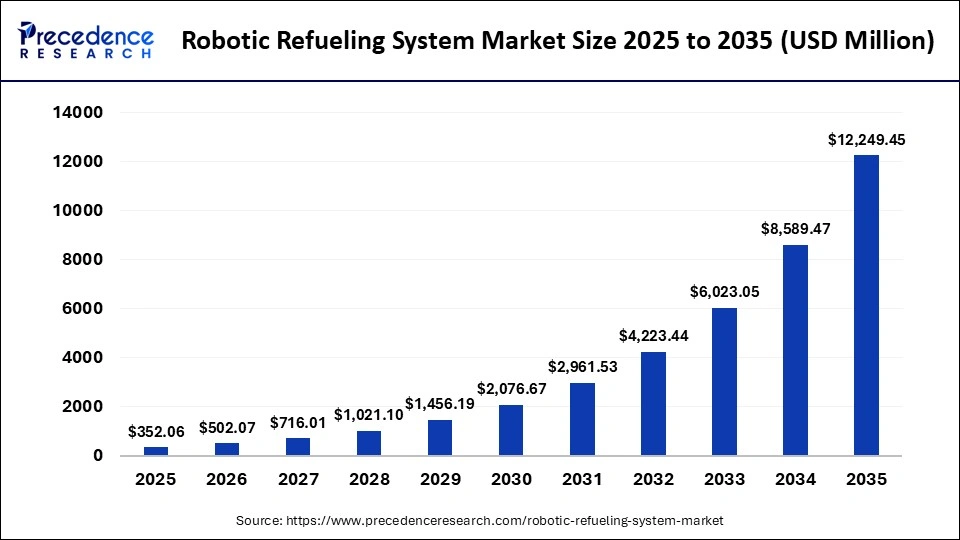
According to semiconductor and electronics specialist Laxmi Narayan, the robotic refueling system market is valued at USD 502.07 million in 2026 and is forecast to reach USD 12,249.45 million by 2035, reflecting a CAGR of 42.61%. Leading robotic refueling system market companies, including ABB Ltd. (Switzerland), KUKA AG (Germany), Rotec Engineering B.V. (Netherlands), Fuelmatics AB (Sweden), Liebherr Group (Switzerland), are strengthening their presence across key segments such as By System Type, By Fuel Type, By Application, By End Use.
Source: https://www.precedenceresearch.com/robotic-refueling-system-market
 Get a Sample
 Table Of Content


What is the Robotic Refueling System Market Size in 2026?
The global robotic refueling system market size was calculated at USD 352.06 million in 2025 and is predicted to increase from USD 502.07 million in 2026 to approximately USD 12,249.45 million by 2035, expanding at a CAGR of 42.61% from 2026 to 2035. The market is growing rapidly due to rising demand for automation in fueling operations, safety enhancement, labor cost reduction, and adoption in airports, military, and commercial fuel stations.
Key Takeaways
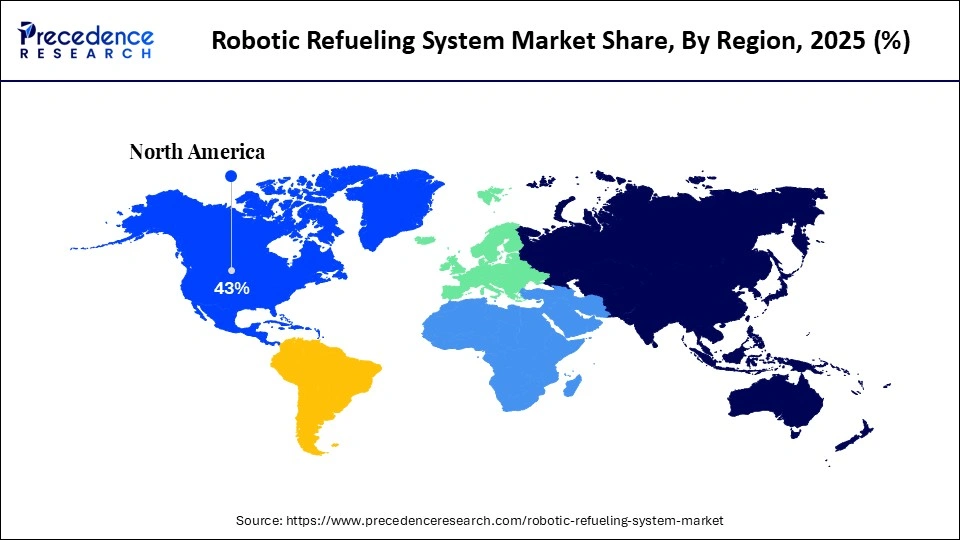
- North America accounted for the highest market share of 43% in 2025.
- Asia Pacific is expected to grow at the fastest CAGR during the forecast period.
- By fuel type, the hydrogen segment held the largest share of the market in 2025.
- By fuel type, the electricity segment is expected to expand with the highest CAGR during the forecast period.
- By system type, the fully automated systems segment dominated the market in 2025.
- By system type, the semi-automated systems segment is expected to grow with the fastest CAGR during the forecast period.
- By application, the aerospace segment led the market in 2025.
- By application, the marine segment is expected to grow with the highest CAGR during the forecast period.
- By end use, the commercial segment led the market in 2025.
- By end use, the military segment is expected to expand with the fastest CAGR during the forecast period.
Market Overview
The robotic refueling system market deals with companies that are engaged in developing high-quality automated refueling solutions across the world. A robotic refueling system is an advanced solution that uses sensors, robotic arms, and computer vision to refuel various vessels or vehicles without human intervention. These systems are designed to perform in dangerous situations to protect workers from hazardous fumes and explosive atmospheres. The increasing adoption of semi-automated refueling systems by the military sector has driven market growth. The rising adoption of robotics and automation across industries is likely to support market growth.
How is AI Impacting the Robotic Refueling System Market?
AI plays a transformative role in the robotic refueling system market. AI helps the robotic arm to align the nozzle with the fuel port of the electric vehicles accurately, along with detecting early fire risks, including smoke or oil leaks, quickly, and enabling emergency shutoffs. AI is deployed in the military aviation sector for autonomous ground refueling (AGR) to improve speed and safety on the refueling procedure. AI is further used for marine vessels to optimize fuel delivery routes and detect fuel requirements.
- In March 2026, NextNRG launched an AI-driven platform. This AI-based interface is designed to enhance automated refueling of EVs.
Robotic Refueling System Market Trends
- Opening of Autonomous Refueling Stations: The petroleum brands are investing significantly in establishing autonomous refueling centers in developed nations, such as China and Japan.
- Product Launches: The market players are engaged in developing a wide range of automated refueling solutions for end-users.
- Rapid Expansion of the Autonomous Fleets: The growing adoption of autonomous vehicles by fleet operators to reduce dependency on manual drivers has increased the demand for robotic refueling systems.
- Government Initiatives: Governments of several nations are launching numerous initiatives to deploy automated solutions to enhance the safety of workers.
Market Scope
| Report Coverage | Details |
| Market Size in 2025 | USD 352.06 Million |
| Market Size in 2026 | USD 502.07 Million |
| Market Size by 2035 | USD 12,249.45 Million |
| Market Growth Rate from 2026 to 2035 | CAGR of 42.61% |
| Dominating Region | North America |
| Fastest Growing Region | Asia-Pacific |
| Base Year | 2025 |
| Forecast Period | 2026 to 2035 |
| Segments Covered | System Type, Fuel Type, Application, End Use, and Region |
| Regions Covered | North America, Europe, Asia-Pacific, Latin America, and Middle East & Africa |
Market Dynamics
Drivers
Increasing Sales of EVs
Increasing sales of electric vehicles (EVs) are driving the robotic refueling system market as automated charging and refueling solutions are needed to handle higher volumes efficiently and safely. Additionally, EV adoption encourages the deployment of advanced robotics to reduce human intervention, speed up refueling or charging operations, and ensure consistent service at stations. According to the Statbase Organization, around 1200000 electric vehicles were sold in the U.S. during 2024.
Restrain
High Deployment and Maintenance Costs
The initial investment for advanced robotics, infrastructure, and integration is substantial, especially for small and medium-sized fuel stations. Ongoing maintenance, software updates, and skilled personnel requirements further increase operational expenses, limiting adoption in cost-sensitive regions.
Opportunity
Development of Dual-Arm Refueling Robots
The development of dual-arm refueling robots creates opportunities in the market by enabling simultaneous handling of multiple fuel nozzles, which increases refueling speed and operational efficiency. These advanced robots also enhance safety and precision, making them attractive for high-volume fuel stations, airports, and industrial applications where efficiency and reliability are critical.
Segment Insights
Fuel Type Insights
Why Did the Hydrogen Segment Dominate the Robotic Refueling System Market?
The hydrogen segment dominated the market with the largest share in 2025. This is because hydrogen fueling requires precise, automated handling to ensure safety and prevent leaks due to its highly flammable nature. Robotic systems provide consistent, accurate, and secure refueling, which is critical for hydrogen-powered vehicles and infrastructure. Additionally, the growing adoption of hydrogen fuel cell vehicles and supportive government initiatives for clean energy are driving the demand for advanced robotic refueling solutions in this segment.
The electricity segment is expected to expand with the highest CAGR during the forecast period. This is mainly due to the increasing demand for electric vehicles, coupled with the surging investment by charging solution providers in establishing automated charging solutions, which increases the demand for automated and efficient charging solutions. Robotic charging systems reduce human intervention, enhance safety, and enable faster, more reliable energy delivery at commercial and public charging stations. Additionally, the integration of smart grid technologies and IoT-enabled monitoring supports optimized charging operations, further driving the segment's growth.
System Type Insights
What Made Fully Automated Systems the Leading Segment in the Robotic Refueling System Market?
The fully automated systems segment led the market in 2025, owing to their capacity to provide safe and contactless fueling operations to end users. These systems use high quality sensors and advanced robotics to detect fuel ports and the positioning of nozzles without human intervention. These systems help in reducing human errors, lowering labor costs, and improving safety in end user industries.
The semi automated systems segment is expected to grow with the fastest CAGR during the forecast period. This is due to their ability to balance between automation and operational efficiency in charging solutions. These systems are capable of automating numerous tasks, including fuel nozzle alignment and charge dispensing. Nowadays, fleet operators are deploying semi automated charging systems to minimize manual efforts for EV charging.
Application Insights
What Made Aerospace the Dominant Segment in the Robotic Refueling System Market?
The aerospace segment dominated the market in 2025. This is due to the surging demand for efficient charging solutions from the aviation sector to automate complex refueling operations. Advanced robotic refueling systems are highly deployed in military airbases, airports, and aerospace maintenance centers. Additionally, the high volume of refueling operations and the need for rapid turnaround times make robotics a preferred solution in the aerospace sector.
The marine segment is expected to expand with the highest CAGR during the forecast period, owing to the complexity and risk associated with fuel refueling operations in the maritime sector. Vessel operators are deploying fully automated refueling systems to enhance precise nozzle positioning and deliver controlled fuel flow in modern ships.
End Use Insights
Why Did the Commercial Segment Dominate the Robotic Refueling System Market?
The commercial segment dominated the robotic refueling system market in 2025, owing to the surging demand for scalable refueling solutions across the commercial sector. Robotic refueling systems are widely deployed in commercial operations, such as ride hailing, logistics, and public transportation. These systems are useful in fleet depots and high-traffic charging stations to reduce human error.
The military segment is expected to expand with the highest CAGR during the forecast period. This is due to the rising use of advanced refueling systems in the military and defense sectors. Automated refueling systems are used to refuel various types of equipment, such as military vehicles, naval carriers, and military aircraft. Also, these systems are deployed in warfare zones to minimize the involvement of armed forces and enhance the overall safety in the military sector.
Regional Insights
North America Robotic Refueling System Market Size and Growth 2026 to 2035
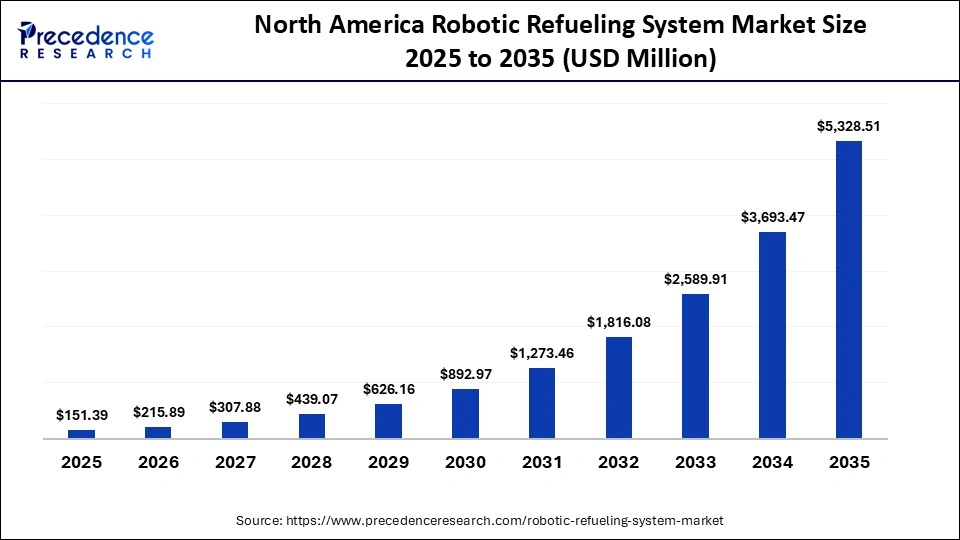
The North America robotic refueling system market size is estimated at USD 151.39 million in 2025 and is projected to reach approximately USD 5,328.51 million by 2035, with a 42.77% CAGR from 2026 to 2035.
Why Did North America Dominate the Robotic Refueling System Market?
North America dominated the robotic refueling system market by capturing the largest share in 2025. This is mainly due to the surging deployment of autonomous refueling drones for operating remote tasks, along with the growing investment by the government in strengthening the defense sector. This region is home to numerous market players, such as Textron, General Atomics, and Raytheon Technologies.
These companies are engaged in the research and development of robotic refueling systems to cater to the needs of the end users. In addition, the growing adoption of BEVs, coupled with the rapid expansion of the hydrogen refueling infrastructure, has driven the market expansion. According to the American Petroleum Institute, around 1,239,560 BEVs were sold in the U.S. during 2025.
U.S. Robotic Refueling System Market Size and Growth 2026 to 2035
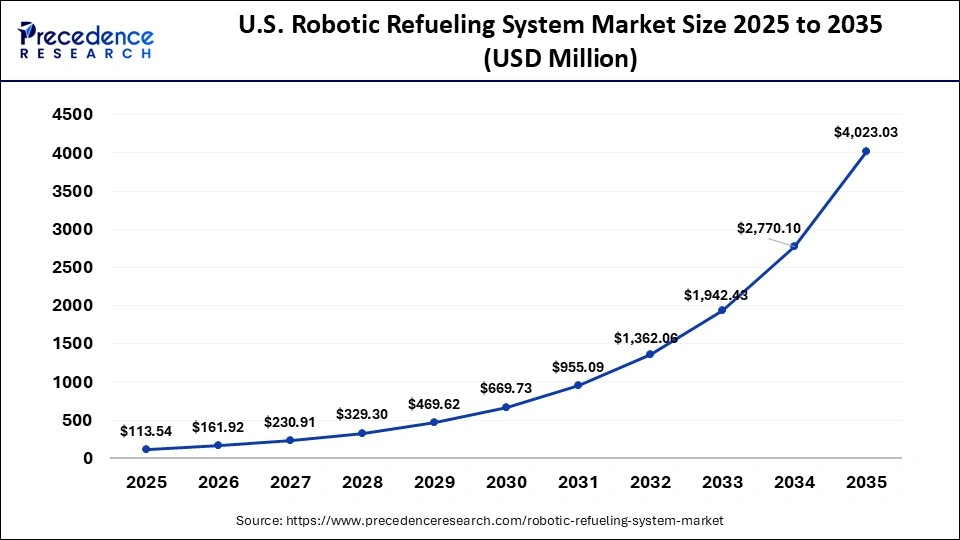
The U.S. robotic refueling system market size is calculated at USD 113.54 million in 2025 and is expected to reach nearly USD 4,023.03 million in 2035, accelerating at a strong CAGR of 42.87% between 2026 and 2035.
U.S. Robotic Refueling System Market Analysis
The U.S. is the major contributor to the North American market due to the rapid adoption of advanced automation technologies in airports, military bases, and commercial fuel stations. Strong government support for clean energy, safety regulations, and investments in hydrogen and electric vehicle infrastructure further drives demand. Additionally, the presence of leading technology providers and a well established industrial and aviation ecosystem enables faster deployment and innovation in robotic refueling solutions.
Why is Asia Pacific Expanding with the Fastest CAGR in the Robotic Refueling System Market?
Asia Pacific is expected to expand with the fastest CAGR during the forecast period, owing to the increasing adoption of robotic solutions by the refueling centers, along with the surging adoption of fuel cell vehicles by logistics operators. Numerous government initiatives aimed at developing the mining sector, as well as the scarcity of the labor force in Malaysia and Singapore, contribute to the industrial growth. The growing deployment of fully automated refueling systems by the aviation companies, such as Akasa Air, Singapore Airlines, and Air India, coupled with the rapid expansion of the oil & gas industry, is boosting the market expansion.
China Robotic Refueling System Market Analysis
China leads the market within Asia Pacific, owing to the increasing adoption of battery electric vehicles by fleet operators to reduce emissions, coupled with the rapid deployment of automated solutions in the industrial sector. Moreover, the rising development of the marine transportation sector, as well as the modernization of the military sector, is driving market growth.
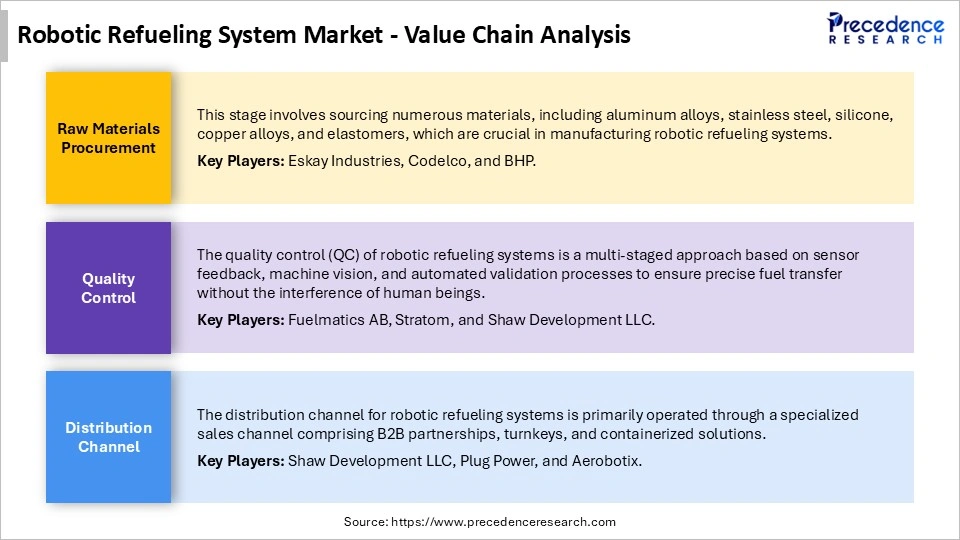
Robotic Refueling System Market Value Chain Analysis
Robotic Refueling System Market Companies
- ABB Ltd. (Switzerland)
- KUKA AG (Germany)
- Rotec Engineering B.V. (Netherlands)
- Fuelmatics AB (Sweden)
- Liebherr Group (Switzerland)
- Komatsu Ltd. (Japan)
- Hitachi Construction Machinery (Japan)
- Airbus SE (Netherlands)
- FANUC Corporation (Japan)
- Sandvik AB (Sweden)
Recent Developments
- In September 2025, Astroscale launched REFLEX-J. REFLEX-J is a refueling spacecraft that is equipped with robotics and computer vision to operate chemical refueling in low Earth orbit. (Source: https://www.astroscale.com)
- In September 2025, Galnaftogaz opened a new refueling station in Lviv, Ukraine. This refueling station includes a staff-free facility to reduce dependence on manual labor.(Source: https://www.pvknowhow.com)
- In April 2025, Boeing launched a new generation of aerial refueling systems. These aerial refueling systems are designed for the U.S. Air Force.(Source: https://www.boeing.com)
Segments Covered in the Report
By System Type
- Fully Automated Systems
- Semi-Automated Systems
- Manual Systems
By Fuel Type
- Hydrogen
- Natural Gas
- Liquefied Petroleum Gas
- Electricity
- Biofuels
By Application
- Aerospace
- Military
- Industrial
- Marine
- Automotive
By End Use
- Commercial
- Military
- Research and Development
By Region
- North America
- Latin America
- Europe
- Asia-pacific
- Middle and East Africa
For inquiries regarding discounts, bulk purchases, or customization requests, please contact us at sales@precedenceresearch.com
Frequently Asked Questions





Ask For Sample
No cookie-cutter, only authentic analysis – take the 1st step to become a Precedence Research client
 Get a Sample




 sales@precedenceresearch.com
 Schedule a Meeting
