



Semiconductor Chemicals Market Size, Key Companies, Company Market Share, Chip Production Volume, Wafer Capacity, Technology Adoption, Pricing Trends, Competitive Positioning, and Demand Analysis
Semiconductor Chemicals Market (By Type: High-performance Polymers, Acid & Base Chemicals, Adhesives, Solvents, Others; By End-use: Integrated Circuits, Discrete Semiconductor, Optoelectronics, Sensors) - Global Industry Analysis, Size, Trends, Leading Companies, Regional Outlook, and Forecast 2026 to 2035
Source: https://www.precedenceresearch.com/semiconductor-chemicals-market
 Get a Sample
 Table Of Content


What is the Semiconductor Chemicals Market Size?
The global semiconductor chemicals market size accounted for USD 16.69 billion in 2025 and is predicted to increase from USD 18.70 billion in 2026 to approximately USD 51.07 billion by 2035, expanding at a CAGR of 16.69 % from 2026 to 2035. The growing demand for consumer electronics significantly boosts the demand for semiconductor chemicals, thus propelling market growth.
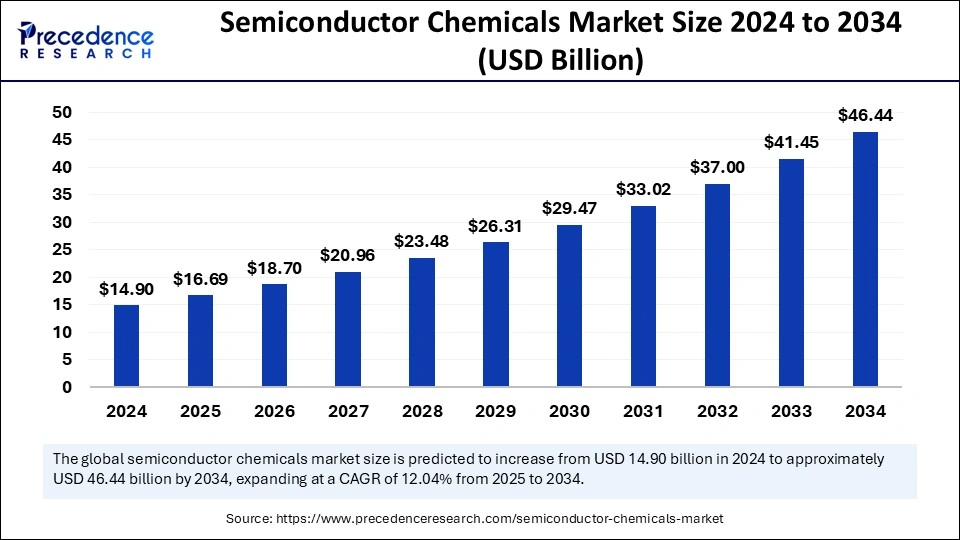
Semiconductor Chemicals Market Key Takeaways
- Asia Pacific led the global market with the largest market share of 35% in 2025.
- North America is anticipated to experience rapid CAGR during the forecast period.
- By type, the acid and base chemicals segment held the largest market share of 40% in 2025.
- By type, the high-performance polymers segment is expected to grow at a significant rate in the coming years.
- By end-use, the integrated circuits (ICs) segment contributed the biggest market share of 38% in 2025.
- By end-use, the discrete semiconductors segment is projected to witness significant growth over the studied period.
Role of AI in Semiconductor Chemical Manufacturing Processes
Artificial intelligence has transformed many industries by offering reliable, efficient, and cost-saving solutions. AI can potentially change the dynamics of the semiconductor chemicals market. AI technologies play an important role in semiconductor chemical manufacturing. Integrating AI technologies in semiconductor chemical manufacturing can greatly improve production efficiency and reduce production costs. AI also optimizes chemical processes like deposition, lithography, and etching, which further helps improve the quality of chemicals and minimize waste. AI-driven tools help with supply chain optimization, predictive maintenance, quality control, and streamlining processes.
With AI-driven predictive maintenance, sensor data from manufacturing equipment can be analyzed to identify possible failures, which helps minimize sudden downtimes or disruptions. Discovering new materials becomes easier with AI. AI and ML algorithms can help accelerate the discovery of new materials and processes by analyzing huge amounts of data to eliminate unlikely combinations. These algorithms also help reduce the cost, resources, and time required to develop new materials..
Strategic Overview of the Global Semiconductor Chemicals Industry
Semiconductor chemicals find applications across different industries, such as electronics, automotive, agriculture, healthcare, construction, and energy. The semiconductor chemicals market is witnessing rapid growth due to the increasing demand for consumer electronics. For instance, every individual is expected to contribute to contribute a volume of 1.1 pieces to the consumer electronics market in 2025. The volume is estimated to reach 9 billion pieces by 2029.
A rise in the complexity of semiconductors' fabrication processes requires high-performance chips. This, in turn, boosts the demand for high-performance chemicals. Advancements in manufacturing methods have increased the demand for these chemicals for wafer cleaning, deposition, etching, and other vital processes. The increasing production of automobiles worldwide boosts the demand for semiconductors, ultimately contributing to market growth. The rising government support to increase the production of semiconductors further influences the market.
- In February 2025, the Semiconductor Industry Association (SIA) announced that global semiconductor sales hit USD 627.6 billion in 2024, an increase of 19.1% compared to the 2023 total of USD 526.8 billion. Additionally, fourth-quarter sales of USD 170.9 billion were 17.1% more than the fourth quarter of 2023, and 3.0% higher than the third quarter of 2024. Regionally, yearly sales were up in the Americas (44.8%), China (18.3%), and Asia Pacific/All Others (12.5%).
Semiconductor Chemicals Market Growth Factors
- The increasing demand for consumer electronics across the world significantly boosts the growth of the semiconductor chemicals market.
- The rapid expansion of the automobile industry, along with the rising sales of vehicles, is propelling market growth.
- Advancements in lithography techniques further contribute to the growth of this market.
- The increasing utilization of advanced technologies, such as the Internet of Things (IoT) and AI-driven systems, support market growth since semiconductors play a crucial role in the smooth operations of these technologies.
- The increasing investments in semiconductor research are expected to fuel the growth of the market.
Market Outlook
- Market Growth Overview: The semiconductor chemicals market is expected to grow significantly between 2025 and 2034, driven by the high demand for consumer electronics, emerging technologies, and government initiatives and investments.
- Sustainability Trends: Sustainability trends involve transition to green chemistry, water conservation, and wastewaters treatment, and supplier accountability and sustainable procurement.
- Major Investors: Major investors in the market include BASF, Merck KGaA, JSR Crop, Tokyo Ohka Kogyo, Linde, Air Liquide, and JSR.
- Startup Economy: The startup economy is focused on high capital investment, complex R&D and long cycles, and strict regulatory compliance.
Market Scope
| Report Coverage | Details |
| Market Size by 2035 | USD 51.07 Billion |
| Market Size in 2025 | USD 16.69 Billion |
| Market Size in 2026 | USD 18.70 Billion |
| Market Growth Rate from 2026 to 2035 | CAGR of 11.83% |
| Dominating Region | Asia Pacific |
| Fastest Growing Region | North America |
| Base Year | 2025 |
| Forecast Period | 2026 to 2035 |
| Segments Covered | Type, End-use, and Regions. |
| Regions Covered | North America, Europe, Asia-Pacific, Latin America, and Middle East & Africa |
Market Dynamics
Drivers
Increasing Demand for Semiconductors and EVs
The demand for semiconductors is increasing in various industries, such as electronics, automotive, aerospace, energy, and healthcare, which is a key factor driving the growth of the semiconductor chemicals market. As the demand for semiconductors increases, so does the need for semiconductor chemicals. Moreover, the rise in production and sales of electric vehicles is another major factor driving the growth of the market. Semiconductor components are essential in electric vehicles manufacturing. This translates into increased demand for semiconductor chemicals used in wafer fabrication, testing, and packaging. The increased awareness amongst people about environmental sustainability boosts EV sales across the world.
For instance, in the U.S., the EV sales increased by 7.3% in 2024 compared to 2023, with approximately 1.3 billion EVs being sold in 2024.
Restraint
Concerns About Waste Management
The increasing concerns about the management of chemical waste are a major factor limiting the growth of the semiconductor chemicals market. There is no suitable method for the proper management and disposal of chemicals. Semiconductor chemicals negatively impact the environment as well as human health. If this waste is not managed properly, it can pollute the water, air, and even soil, harming the communities and the ecosystem. Thus, it is necessary to properly manage the chemical waste. Market players must focus on developing waste management solutions to overcome this challenge.
Opportunity
Focus on Development of Sustainable Materials
With the growing awareness about environmental sustainability across the world, there is a strong focus on the development of sustainable and environmentally friendly semiconductor chemicals, which create immense opportunities in the market. Key players are increasingly investing in research and development activities to discover new eco-friendly materials that can help develop sustainable chemical solutions. Technological innovations like AI can aid in material discovery that is better suited for the environment. With the rising emphasis on environmental protection and sustainability, green electronics are gaining traction, which require eco-friendly semiconductors. This, in turn, boosts the demand for sustainable semiconductor chemicals.
Segment Insights
Type Insights
The acid & base chemicals segment dominated the semiconductor chemicals market in 2024. This is mainly due to the increased production of semiconductors. Acid & base chemicals are vital in semiconductor manufacturing. They have wide applications for different purposes like cleaning, doping, and etching. Hydrofluoric acid is regularly used for silicon wafer etching, while sulfuric acid is used for removing organic contaminants and cleaning microprocessor chip surfaces. These acids play a crucial role in accurately fabricating and modifying semiconductor materials. This allows intricate circuit patterns and structures. Such advantages further bolstered the segment's growth.
The high-performance polymers segment is predicted to grow at a significant rate during the forecast period. These polymers offer chemical resistance, mechanical strength, and thermal stability, making them suitable for various applications in the semiconductors industry. They are widely used as insulation in semiconductor devices due to their excellent electrical insulation properties.
End-use Insights
The integrated circuits (ICs) segment led the semiconductor chemicals market in 2024. This is mainly due to the increased production of electronic devices. ICs are essential in electronic devices. ICs consist of multiple interconnected semiconductors or microprocessor chips, like diodes, resistors, and transistors, that are manufactured on a singular microprocessor chip wafer. These circuits find applications across various industries. Advancements in IC technology have improved the efficiency and performance of ICs, boosting their demand.
- In March 2025, Taiwan Semiconductor Manufacturing (TSMC) announced its plan to invest USD 100 billion into bolstering chip manufacturing in the U.S.
The discrete semiconductors segment is expected to grow at a significant rate over the studied period. Discrete semiconductors are microprocessor chips utilized in different applications requiring specific functionalities, like switching circuits and power amplifiers. The increasing demand for these semiconductors in the energy and power sector further supports segmental growth.
Regional Insights
What is the Asia Pacific Semiconductor Chemicals Market Size?
Asia Pacific semiconductor chemicals market size was exhibited at USD 5.84 billion in 2025 and is projected to be worth around USD 18.19 billion by 2035, growing at a CAGR of 12.03% from 2026 to 2035.
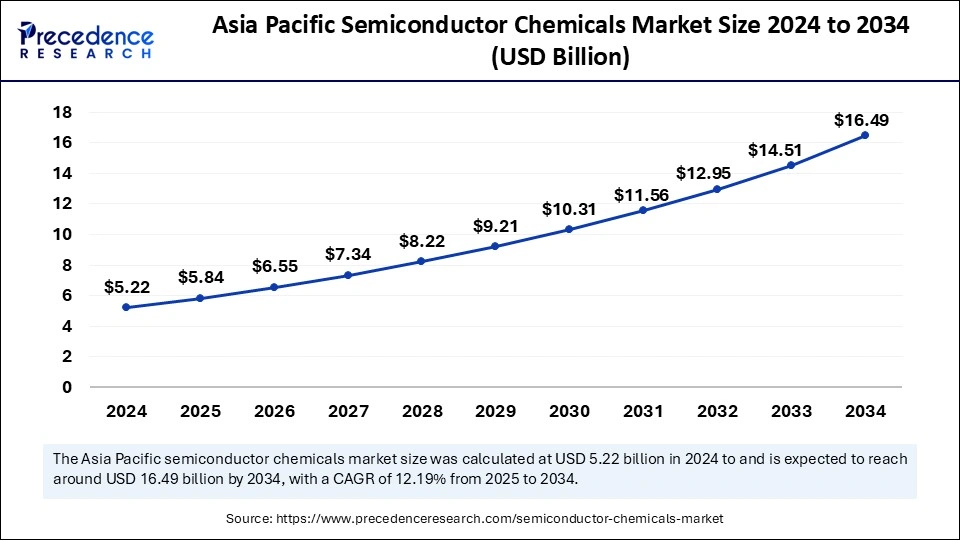
Asia Pacific dominated the semiconductor chemicals market with the largest share in 2024. The region boasts a well-established semiconductor industry, supporting regional market growth. The exponential growth of the consumer electronics and automobile industries in the region also contributes to the growth of the market. Governments around the region have established favorable policies and initiatives to support the growth of semiconductor manufacturing in the region.
India & China Semiconductor Chemicals Market Trends
India and China play a major role in the Asia Pacific semiconductor chemicals market. These countries are known as manufacturing hubs of electronics. With the increasing production of electronic devices, the demand for semiconductors is rising. China has a well-established microprocessor chips manufacturing industry. The country is also the world's largest producer of EVs. Moreover, the rising government initiatives to increase the production of semiconductors support market expansion.
- According to the data published by the Observatory of Economic Complexity (OEC), China exported US$48.4 billion worth of semiconductor devices in 2024, with the key destinations being Hong Kong (US$9.1 billion), the Netherlands (US$4.8 billion), India (US$3.8 billion), Brazil (US$2.7 billion), and Pakistan (US$2 billion).
- For instance, in July 2024, the Indian Government approved the Semicon India program, with a total outlay of INR 76,000 crore for the development of the semiconductor and display manufacturing ecosystem in the country. The program aims to provide financial support to companies investing in semiconductor manufacturing.
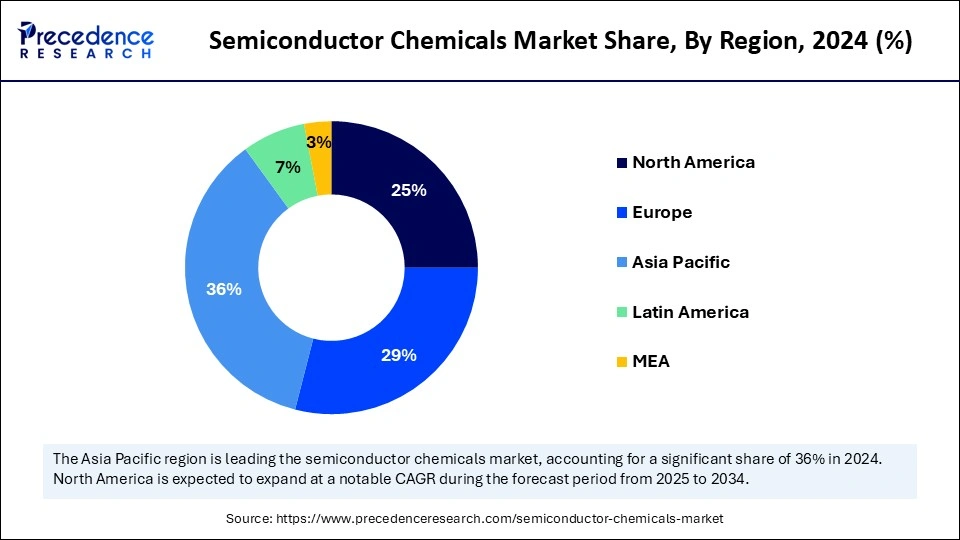
North America was the second-largest market shareholder in 2025 and is expected to witness rapid growth during the forecast period. The presence of well-known microprocessor chip manufacturing hubs in the region and the increasing adoption of smart technologies are major factors boosting regional market growth. The U.S. is expected to have a stronghold on the North American semiconductor chemicals market. The country has various fabrication plants that are necessary for microprocessor chip manufacturing. The increasing demand for consumer electronics and automobiles further supports market growth.
U.S. Semiconductor Chemicals Market Trends
The U.S. government's support and funding are boosting domestic manufacturing, rising demand for chemical inputs, growing demand for AI, 5G, IoT, and automotive electronics is fueling the market growth. Rising demand for advanced nodes and high-performance chips in AI, 5G, automotive, and data center applications is increasing consumption of specialty chemicals used in etching, cleaning, deposition, and photolithography processes.
Europe is expected to witness a notable growth rate in the coming years. Numerous research and development centers focusing on chemistry and material science and the increasing number of semiconductor manufacturing facilities contribute to the growth of the market in the region. European governments are providing financial support to attract international semiconductor companies and boost the production of semiconductors. Germany is anticipated to play a key role in the European semiconductor chemicals market. This is mainly due to the presence of well-established research and development centers for microprocessor chips, along with robust manufacturing facilities.
Our Expert's Opinion: What's Next for Semiconductor Chemicals Industry?
Through the lens of our experts, Precedence Research has redefined how the semiconductor chemicals sector can grow in the upcoming period. Considering major countries such as China, Taiwan, India, and the United States, the overall semiconductor sector witnessed a major shift in recent times while covering the fluctuations observed during the COVID-19 pandemic. While having a look at the largest potential of the industry, building local and regional production capabilities for critical semiconductor chemicals can reduce dependence on overseas suppliers and ensure faster delivery times. For example, in India, Gujrat has become a hub of chemical production along with a stable supply chain.
As of the current situation in 2024, the semiconductor industry is increasingly focusing on sustainable manufacturing processes, driven by both regulatory pressures and the demand for environmentally friendly practices. Chemical manufacturers are working to develop green chemistry solutions that reduce hazardous waste, minimize energy consumption, and lower the carbon footprint of semiconductor production. Additionally, non-toxic and biodegradable photoresists, recyclable chemicals, and water-based processes are a few industry trends that are observed to be followed on a large scale
Value Chain Analysis of the Semiconductor Chemicals Market
- Raw Material & Basic Chemical Supply
This foundational stage involves extracting and processing basic materials, such as silicon and various bulk chemicals.
Key Players: BASF SE, Dow Inc., Mitsubishi Chemical Corporation, Solvay S.A., and Honeywell International Inc. - Specialty Chemical Manufacturing & Formulation
In this stage, basic chemicals are transformed into high-purity, application-specific products like photoresists, developers, etchants, and cleaning agents.
Key Players: Fujifilm Holdings Corporation, JSR Corporation, Kanto Chemicals Co. Inc., and DuPont. - Distribution & Logistics
This stage focuses on the precise and timely delivery of these sensitive and high-purity chemicals to fabrication plants (fabs) worldwide.
Semiconductor Chemicals Market Companies
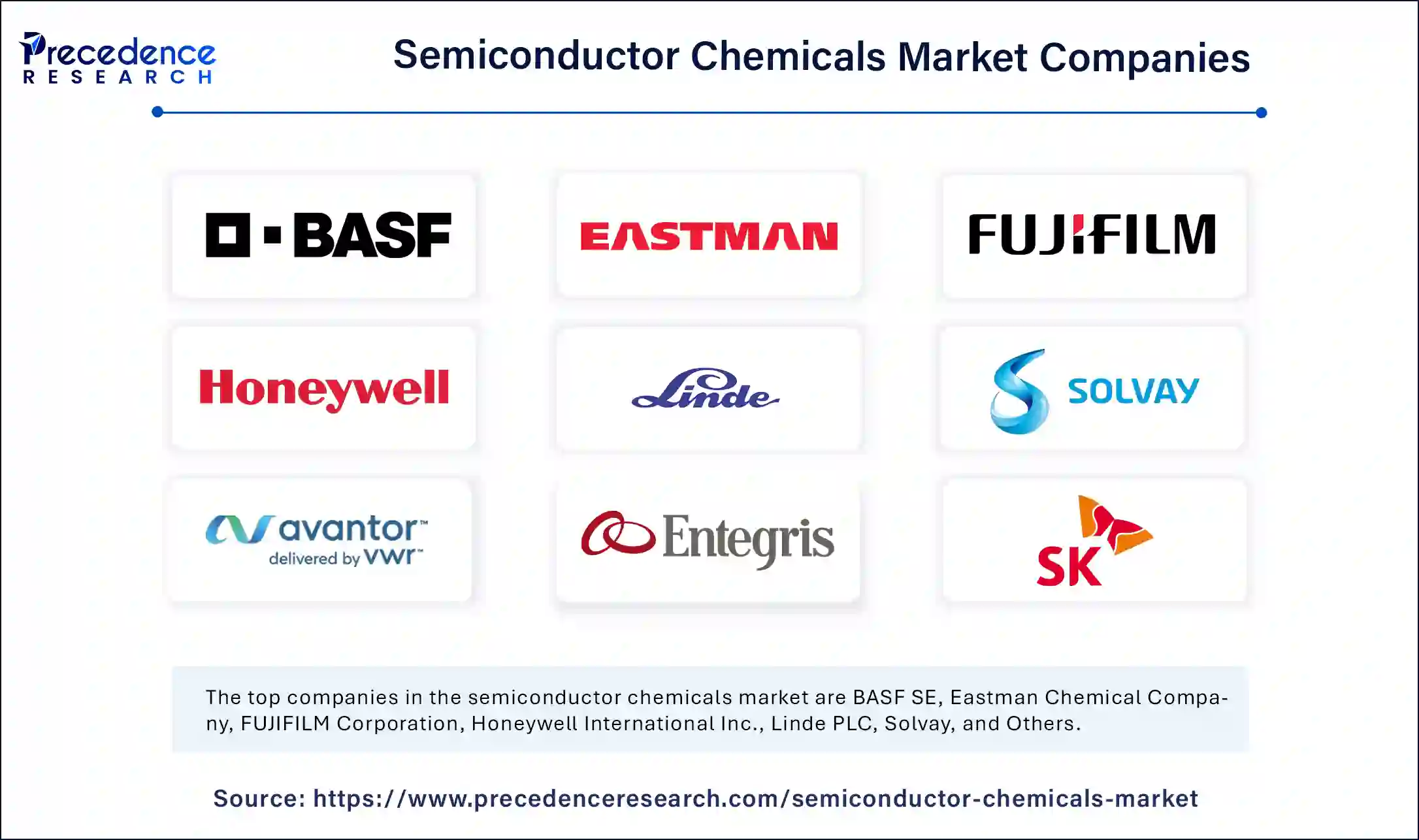
- Taiwan Semiconductor Manufacturing Company (TSMC): primarily contributes indirectly by being the world's leading pure-play foundry, driving the immense demand and technological requirements for high-purity semiconductor chemicals.
- BASF SE: contributes to the semiconductor chemicals market by providing a broad portfolio of essential process chemicals, including high-purity wet chemicals, specialty chemicals, and materials for chemical mechanical planarization (CMP).
- Eastman Chemical Company: focuses on providing critical material inputs and specialty chemical solutions tailored for the semiconductor industry, with a strong emphasis on meeting the high purity and performance demands of advanced chip fabrication.
- FUJIFILM Corporation: contributes significantly to the market through its advanced photoresists and polyimides, essential for defining the intricate patterns on semiconductor wafers during the photolithography process.
- Honeywell International Inc.: provides a range of high-performance materials and process solutions crucial for semiconductor production, including materials for planarization (CMP pads) and highly specialized electronic chemicals.
- Linde PLC (now a part of Linde): is a major supplier of the essential industrial and specialty gases required for nearly every step of semiconductor manufacturing, from etching to deposition.
Other Major Key Players
- Solvay
- VWR International, LLC.
- Entegris
- SK Inc.
Recent Developments
- In March 2025, Mitsubishi Chemical Group, one of Japan's largest integrated chemical companies, announced plans to expand its footprint in India by entering the country's semiconductor and electric vehicle (EV) supply chains. The company aims to collaborate with local partners to capitalize on India's rapidly growing demand in these sectors.
- In November 2024, Merck KGaA, Darmstadt, Germany, a leading science and technology company, and Intel Corporation, one of the world's largest semiconductor designers and manufacturers, began the implementation of the new academic research program in Europe announced last year for more sustainable solutions in semiconductor manufacturing.
- In March 2025, Ainos, Inc., a leader in AI-driven scent digitization, announced a strategic collaboration with Advanced Semiconductor Engineering, Inc. (ASE), the world's largest provider of semiconductor packaging and testing services. This partnership aims to revolutionize semiconductor manufacturing by leveraging Ainos' patented AI Nose technology to analyze airborne chemicals into "Smell IDs", enhancing process efficiency, environmental safety, and environmental, social, and governance (ESG) compliance.
- In March 2025, leading Japanese company Mitsubishi Chemical Group announced its plans to expand its footprint in India. The company plans to enter India's semiconductor and electric vehicle supply chains through collaborations with local partners.
- In February 2025, Fujifilm unveiled its plans to invest €25 million in a semiconductor materials capacity in Belgium. This plan aligns with their proactive investments for expansion in the semiconductor materials industry.
- In November 2024, Tosoh Corporation developed a gallium nitride (GaN) sputtering target. GaN is a thin film semiconductor material used in LED lighting and miniature rapid charger components.
- In October 2024, an established Taiwanese semiconductor chemical company, Sunlit Chemical, announced the launch of its first manufacturing plant, set to open in North Phoenix, Arizona, U.S.
Segments Covered in the Report
By Type
- High-performance Polymers
- Acid & Base Chemicals
- Adhesives
- Solvents
- Others
By End-use
- Integrated Circuits
- Discrete Semiconductor
- Optoelectronics
- Sensors
By Geography
- North America
- Europe
- Asia Pacific
- Latin America
- Middle East and Africa
For inquiries regarding discounts, bulk purchases, or customization requests, please contact us at sales@precedenceresearch.com
Frequently Asked Questions





Ask For Sample
No cookie-cutter, only authentic analysis – take the 1st step to become a Precedence Research client
 Get a Sample




 sales@precedenceresearch.com
 Schedule a Meeting
