



Small Interfering RNA (siRNA) Therapeutics Market Size, Companies, Share, Patient Volume, Treatment Adoption Rates, Pricing Analysis, Regulatory Landscape, Competitive Positioning, and Demand Forecast
Small Interfering RNA (siRNA) Therapeutics Market (By Application: Cancer, Neurological Disorders, Cardiovascular Diseases, Ophthalmic Diseases, Infectious Diseases, Other Therapeutic Applications; By Delivery System: Liposomes, Polymers, Lipid Nanoparticles, Viral Vectors, Other Delivery Systems; By Synthetic Route: Chemical Synthesis, Biotechnology, Other Synthetic Routes; By Mechanism of Action: Gene Editing, Gene Silencing, MicroRNA Mimics, Others (e.g., siRNA-mediated mRNA decay)) - Global Industry Analysis, Size, Trends, Leading Companies, Regional Outlook, and Forecast 2026 to 2035
Source: https://www.precedenceresearch.com/small-interfering-rna-therapeutics-market
 Get a Sample
 Table Of Content


What is the Small Interfering RNA (siRNA) Therapeutics Market Size in 2026?
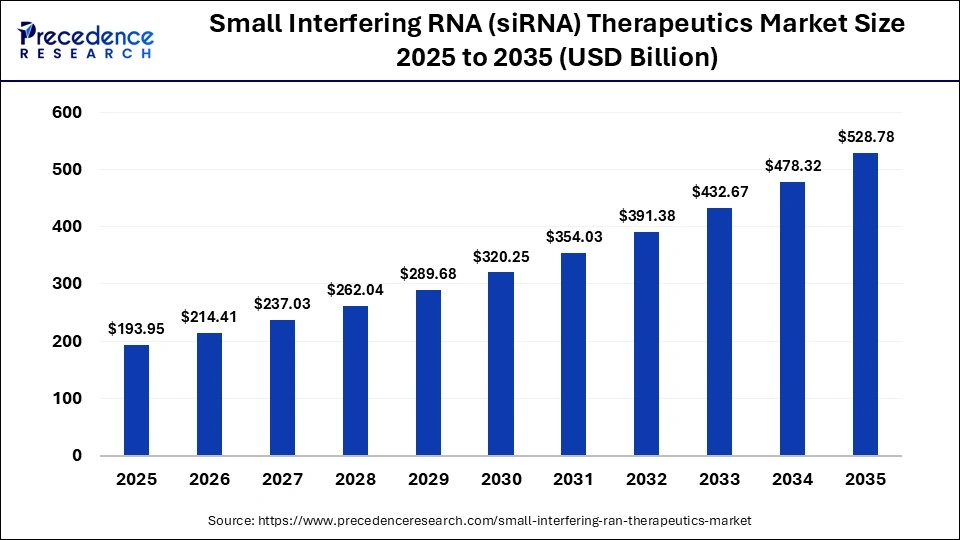
The global small interfering RNA (siRNA) therapeutics market size was calculated at USD 193.95 billion in 2025 and is predicted to increase from USD 214.41 billion in 2026 to approximately USD 528.78 billion by 2035, expanding at a CAGR of 10.55% from 2026 to 2035. This market is growing due to rising genetic and chronic diseases, advances in RNA delivery technology, and increasing demand for precision medicines.
Key Takeaway
- North America dominated the small interfering RNA (siRNA) therapeutics market in 2025.
- Asia-Pacific is expected to be the fastest-growing region between 2026 and 2035.
- By application, the cancer segment registered its dominance over the global market in 2025.
- By application, the neurological disorders segment is expected to expand rapidly in the market in the coming years.
- By delivery system, the lipid nanoparticles segment held a dominant position in the market in 2025.
- By delivery system, the viral vectors segment is expected to grow at the fastest CAGR during the forecast period.
- By synthetic route, the chemical synthesis segment dominated the small interfering RNA (siRNA) therapeutics market in 2025.
- By synthetic route, the biotechnology segment is expected to show the fastest growth over the forecast period.
- By mechanism of action, the gene silencing segment led the global market in 2025.
- By mechanism of action, the gene editing segment is expected to witness the fastest growth in the market over the forecast period.
Market Overview
The small interfering RNA (siRNA) therapeutics market is a part of the healthcare industry that focuses on a new generation of medicines that work by silencing specific genes responsible for disease. These therapies are different from traditional drugs because they work at the genetic level to stop the production of harmful proteins. Currently, siRNA therapies are mainly used for certain rare genetic disorders, liver-related diseases, and high cholesterol. Meanwhile, research is expanding into areas like metabolic disorders, cardiovascular diseases, and cancer treatment. This market includes drug discovery, clinical development, regulatory approvals, manufacturing of RNA molecules, lipid nanoparticle delivery system and distribution to hospitals and speciality pharmacies.
How AI Is Transforming the Market?
Artificial intelligence is transforming the small interfering RNA (siRNA) therapeutics market, particularly in early research and development of siRNA molecules. To design an effective siRNA molecule, identification of the gene target is necessary. AI tools help to analyze large genetic datasets and can predict suitable targets and reduce trial-and-error in molecule design. This saves both time and research costs. During clinical trials, AI supports patient selection, data analysis, and real-time data monitoring, leading to accurate results. Overall, AI is helping companies to accelerate molecule discovery to the clinical stage more efficiently.
What are the Market Trends?
- Rising cases of chronic and genetic diseases are demanding targeted therapy options. Physicians and patients are choosing advanced therapies with improved effectiveness for long-term treatment. Growing awareness of rare genetic and chronic diseases is creating more demand for new treatment technologies like siRNA.
- Pharmaceutical companies are heavily investing in research and development of siRNA molecules and improving RNA delivery systems such as lipid nanoparticles and viral vectors. Better delivery methods increase the ability to reach target cells, offering treatment stability and reduced side effects.
- A shift towards precision medicine is significantly influencing the siRNA therapeutics market. siRNA works as target specific genetic mutation that address actual biological need. This approach fits well and drives demand in the market.
- Regulatory bodies are supporting the development of RNA-based medicines, which is positively impacting the small interfering RNA (siRNA) therapeutics market. Regulatory guidelines are becoming clearer for siRNA-based products that encourages fresh investment in research.
Market Scope
| Report Coverage | Details |
| Market Size in 2025 | USD 193.95 Billion |
| Market Size in 2026 | USD 214.41 Billion |
| Market Size by 2035 | USD 528.78 Billion |
| Market Growth Rate from 2026 to 2035 | CAGR of 10.55% |
| Dominating Region | North America |
| Fastest Growing Region | Asia Pacific |
| Base Year | 2025 |
| Forecast Period | 2026 to 2035 |
| Segments Covered | Application, Delivery System, Synthetic Route, Mechanism of Action, and Region |
| Regions Covered | North America, Europe, Asia-Pacific, Latin America, and Middle East & Africa |
Segmental Insights
Delivery System Insights
Why Did the Lipid Nanoparticles Segment Dominate the Market?
The lipid nanoparticles segment registered its dominance over the global small interfering RNA (siRNA) therapeutics market in 2025 because they are a reliable delivery system. One of the main challenges with siRNA drugs is that the RNA molecule is fragile and can easily break down in the bloodstream before reaching its target site. Liquid nanoparticles act as a protective carrier and help to efficiently at target site. The LNP delivery system offers high efficiency and the ability to provide controlled release. This technology is scalable for commercial production, which supports large-volume manufacturing.
The viral vectors segment is expected to gain the highest share of the small interfering RNA (siRNA) therapeutics market over the forecast period. These systems use modified viruses to deliver genetic material directly into cells with high precision. Viral vectors have advantages like targeted delivery and overcoming biological barriers, making them important in siRNA delivery. Meanwhile, research is ongoing to improve vector safety and reduce immunogenic risks. These factors are making the segment grow faster.
Synthetic Route Insights
How the Chemical Synthesis Segment Dominated the Market?
The chemical synthesis segment accounted for the dominant share of the small interfering RNA (siRNA) therapeutics market in 2025. This method gives precise control to create an RNA sequence. Accuracy is important in siRNA therapies as any small variation affects their performance and safety. Chemical synthesis is scalable, and the process is well-established, standardised, and supported by existing pharmaceutical manufacturers.
The Biotechnology segment is expected to witness the fastest growth in the small-interfering RNA (siRNA) therapeutics market over the forecast period. These approaches use biological systems, such as enzymatic processes, to produce RNA molecules. The process relies on controlled transcription mechanisms that mimic natural RNA formation. This method is gaining interest because it offers advantages in scalability and can be used for producing more complex and longer RNA strands. The increasing investment in research and development of novel RNA therapies further strengthens the growth of this segment in the market.
Mechanism of Action Insights
What Made the Gene Silencing Segment Lead the Market in 2025?
The gene silencing segment dominated the global market in 2025 because it represents the core and most established application of siRNA technology. In this therapy, siRNA binds to messenger RNA (mRNA) and prevents the production of disease-causing proteins. This mechanism is highly targeted and does not permanently change the patient's DNA. The clinical success of products based on this approach in rare genetic and liver-related disorders further increases trust among healthcare professionals and regulators.
The gene editing segment is expected to grow at the fastest CAGR in the small interfering RNA (siRNA) therapeutics market over the forecast period. Gene editing makes permanent changes at the genetic level, unlike gene silencing, which temporarily blocks protein production. This approach is used when long-term correction of genetic mutations is required. Although gene editing is still in its early stages and attracting strong research interest.
Application Insights
Why Did the Cancer Segment Hold the Largest Share of the Market?
The cancer segment held a dominant position in the market in 2025 due to the high global burden of oncology cases and the need for more targeted treatment strategies. Cancer development involves abnormal gene expression, making it a suitable area for gene-silencing approaches. siRNA therapies offer the potential to selectively suppress oncogenes. Ongoing research is exploring the use of siRNA in combination with chemotherapy and targeted therapies to improve treatment outcomes.
The neurological disorders segment is expected to expand rapidly in the small interfering RNA (siRNA) therapeutics market in the coming years. Many neurological conditions are linked to specific genetic abnormalities that lead to the production of harmful proteins in nerve cells. siRNA works by blocking protein production; this approach is suitable for managing certain inherited and progressive neurological diseases.
Regional Insights
What Factors Made the North America Region the Dominant Region in the Market?
North America dominated the global small interfering RNA (siRNA) therapeutics market in 2025 due to its strong biotechnology infrastructure and early adoption of advanced therapies. The region has the most established biotech and pharmaceutical companies, advanced research institution. Significant funding and clear regulatory guidelines encouraged RNA-based drug development in the region. All these factors together have helped North America maintain its dominance in the market.
U.S. Market Trends
The U.S. represents the largest market in North America. The country has a strong research background, academic institutions, and large pharmaceutical firms. Huge funding for genetic medicine contributes to a strong development pipeline. The government supports and provides clear regulatory guidelines, further increasing investment in biotechnology research. Growing awareness of rare genetic disorders and chronic conditions has increased demand for targeted treatment approaches.
Which Factors Influence the Fastest Growth of the Asia Pacific Market?
Asia Pacific is expected to grow at the fastest CAGR in the small interfering RNA (siRNA) therapeutics market during the forecast period due to the high prevalence of chronic and genetic diseases, which creates long-term demand for targeted therapies. Countries such as China, India, Japan, and South Korea are expanding biotechnology capabilities and increasing funding for genomic research. The governments are encouraging innovation in genetic therapies through policy support and research grants.
China Market Trends
China is becoming an important contributor to the siRNA therapeutic market. The country has significantly expanded its biotechnology ecosystem in recent years. Chinese companies are significantly investing in RNA-based research and creating partnerships with global companies. Regulatory guidelines have streamlined drug approval timelines, encouraging faster clinical advancements. With continuous investment in research infrastructure and manufacturing capabilities, China is becoming fastest growing country in the siRNA therapeutics market.
Small Interfering RNA (siRNA) Therapeutics Market Value Chain Analysis
- R&D  
Research and development in the market focuses on identifying disease targets and designing small interfering RNA molecules.
Key Players: Alnylam Pharmaceuticals, Novartis AG, Arrowhead Pharmaceuticals, Silence Therapeutics.
- Clinical Trials and Regulatory Approvals 
Clinical trials test siRNA therapies in patients to check safety and efficacy. Sponsor submits data to regulators for approval. Regulatory approvals ensure therapies meet healthcare standards.
Key Players: Novo Nordisk, Silence Therapeutics & Dicerna Pharmaceuticals, ADARx Pharmaceuticals, Amgen Inc., and Arbutus Biopharma.
- Formulation and Final Dosage Preparation
Formulation develops the final drug form, mixing active siRNA with carriers for stability. Final dosage preparation involves developing safe, accurate units, such as injections, followed by quality checks to ensure consistency and purity before packaging.
Key Players: Alnylam Pharmaceuticals, Inc., Arrowhead Pharmaceuticals, Inc., Wave Life Sciences Ltd., Silence Therapeutics plc.
- Packaging and Sterilization
The final siRNA product is packed with protective material. Sterilization is essential for injectables to prevent contamination and protect product quality during storage and transportation.
Key Players: Arbutus Biopharma, Silence Therapeutics, Benitec Biopharma, Arrowhead Pharmaceuticals.
- Distribution to Hospitals, Pharmacies
Manufacturers supply siRNA therapies to direct hospitals, clinics, and retail healthcare outlets. Logistic teams manage the transport, warehousing, and storage of products.
Key Players: Sarepta Therapeutics, Inc., Novo Nordisk A/S, Quark Pharmaceuticals, Alnylam Pharmaceuticals, Inc.
- Patient Support and Services
Patient support programs help with therapy education programs, simple usage guides, and services may include financial aid, helplines, and follow-up care.
Small Interfering RNA (siRNA) Therapeutics Market Companied
- Alnylam
- Silence Therapeutics
- Silenseed Ltd
- Sylentis, S.A.
- Sanofi Genzyme
- Quark Pharmaceuticals
- Dicerna Pharmaceuticals
- Arrowhead Pharmaceuticals
- Novartis
- Novo Nordisk
- Johnson & Johnson company
- GSK
- Aro Biotherapeutics
- Other Market Players
Recent Developments
- In January 2026, Ribo Life Science, a leading small interfering RNA (siRNA) therapeutic developer, successfully listed on IPO in the Hong Kong Stock Market. The company plans to use the funds to develop RNA-based drugs into clinical trials for cardiovascular, kidney, liver, and metabolic diseases.(Source: https://thebambooworks.com)
- In September 2025, China-based Mabwell Bioscience and U.S.-based Aditum Bio launched a new company named Kalexo Bio to develop a new small interfering RNA (siRNA) molecule. 2MW7141 showed excellent preclinical results in suppressing the target gene for managing lipid levels and preventing atherosclerotic cardiovascular disease in patients with dyslipidemia. Aditum Bio and Kalexo Bio will collaborate to advance 2MW714 clinical trials.(Source: https://www.pharmaceutical-technology.com)
Segments Covered in the Report
By Application
- Cancer
- Neurological Disorders
- Cardiovascular Diseases
- Ophthalmic Diseases
- Infectious Diseases
- Other Therapeutic Applications
By Delivery System
- Liposomes
- Polymers
- Lipid Nanoparticles
- Viral Vectors
- Other Delivery Systems
By Synthetic Route
- Chemical Synthesis
- Biotechnology
- Other Synthetic Routes
By Mechanism of Action
- Gene Editing
- Gene Silencing
- MicroRNA Mimics
- Others (e.g.
- siRNA-mediated mRNA decay)
By Region
- North America
- Europe
- Asia-Pacific
- Latin America
- Middle East & Africa
For inquiries regarding discounts, bulk purchases, or customization requests, please contact us at sales@precedenceresearch.com
Frequently Asked Questions





Ask For Sample
No cookie-cutter, only authentic analysis – take the 1st step to become a Precedence Research client
 Get a Sample
.webp)



 sales@precedenceresearch.com
 Schedule a Meeting
