



Thin Film Encapsulation Market Trends, Companies, Revenue / Sales Performance, Manufacturing Yield, Fab Capacity, Export & Import Dynamics, Supply Chain Analysis, Competitive Landscape, and Growth Forecast
Thin Film Encapsulation Market (By Deposition Technologies: Inorganic Layers, Organic Layers; By Flexible OLED Design: Cathode, Anode; By Application: Flexible OLED Display, Flexible OLED Lighting, Thin-Film Photovoltaic) - Global Industry Analysis, Size, Trends, Leading Companies, Regional Outlook, and Forecast 2026 to 2035
Source: https://www.precedenceresearch.com/thin-film-encapsulation-market
 Get a Sample
 Table Of Content


What is the Thin Film Encapsulation Market Size in 2026?
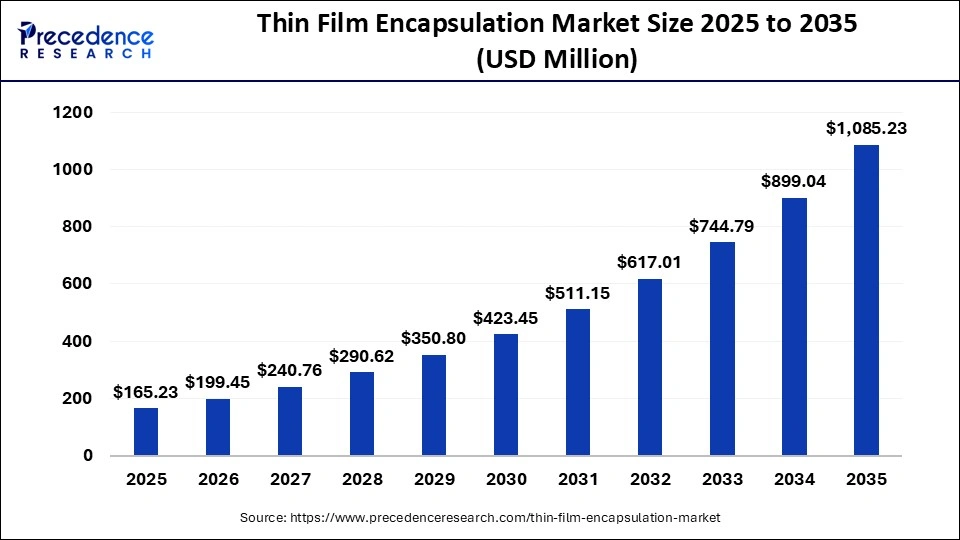
The global thin film encapsulation market size was calculated at USD 165.23 million in 2025 and is predicted to increase from USD 199.45 million in 2026 to approximately USD 1,085.23 million by 2035, expanding at a CAGR of 20.71% from 2026 to 2035. The main factors for the growth of this market are the increasing demand for flexible electronics, OLED display screens, and advanced wearable electronic devices. Moreover, there is growing investment in future display technologies and a high demand for electronic protection solutions.
Key Takeaways
- Asia-Pacific dominated the global thin film encapsulation market in 2025.
- North America is expected to grow at the fastest CAGR in the market during the forecast period.
- By deposition technologies, the inorganic layers segment held a dominant position in the market in 2025.
- By deposition technologies, the organic layers segment is expected to expand rapidly in the market in the coming years.
- By flexible OLED design, the cathode segment held the largest market share in 2025.
- By flexible OLED design, the anode segment is expected to grow at the fastest CAGR during the forecast period.
- By application, the flexible OLED lighting segment accounted for the highest market share in 2025.
- By application, the thin-film photovoltaic segment is expected to grow at the highest CAGR over the studied period.
What is the Thin Film Encapsulation Market?
Thin film encapsulation is a method of protecting sensitive electronic components from environmental damage, moisture, and oxygen. This method is based on ultra-thin protective films that provide protection to electronic components without compromising flexibility. It is used in OLED displays, flexible electronics, wearables, and organic solar cells. The benefits of thin film encapsulation include lightweight protection, increased lifespan of electronic devices, and enhanced performance of electronic devices. The increasing demand for flexible display technologies in mobile gadgets like smartphones, tablets, and smart wearables is driving demand for thin-film encapsulation, which in turn is driving the market.
Impact of AI on the Thin Film Encapsulation Market
Artificial intelligence (AI) is playing an important role in improving manufacturing processes in the market. It is used to improve material selection, increase accuracy in coating, and detect defects in the manufacturing process. It can perform predictive maintenance of manufacturing equipment, reducing costs and increasing equipment lifespan. With increasing complexities in electronic and display device technology, AI is also used to improve research and manufacturing processes in thin-film encapsulation technology. AI can design advanced barrier layers in thin-film encapsulation technology, perform simulations, and analyze data in thin-film encapsulation technology.
Primary Trends in the Thin Film Encapsulation Market
- Increasing Demand for Flexible OLED Displays: Flexible OLED displays are gaining popularity in devices such as smartphones, tablets, TVs, and foldable devices. These displays are more vulnerable to moisture and oxygen; therefore, they are being encapsulated using thin-film encapsulation. With more and more companies launching foldable and flexible display devices, this trend is likely to have a positive impact on the market.
- Increasing Demand for Wearable Electronics: Wearable electronics, including smart watches, fitness trackers, and health monitoring devices, are gaining popularity worldwide. These devices require lightweight and flexible protection layers to ensure their efficiency and longevity. Thin film encapsulation is necessary to protect sensitive electronic components from environmental damage without compromising their flexibility and miniaturization. The increased popularity of digital health and wearable devices is driving this trend.
- Increasing Investments in Semiconductor and Display Manufacturing: Companies are investing heavily in semiconductor and display manufacturing plants to keep up with the increasing global demand for electronic devices. These investments are necessary to develop high-end OLED displays and flexible electronics using thin-film encapsulation. Expanding these plants and research centres is helping companies enhance their manufacturing capabilities and develop new technologies.
- Technological Advancements in Deposition Processes: Advances in atomic layer deposition and chemical vapor deposition technologies have made it easier to improve thin-film encapsulation. New technologies enable firms to produce ultra-thin and protective thin-film encapsulation. It also enables firms to increase production efficiency and reduce production defects. They have made it easier to produce advanced electronic devices on a large scale.
- Expanding Applications of Organic Electronics and Solar Cells: Thin-film encapsulation is commonly applied to organic electronic devices such as OLEDs and organic photovoltaic solar cells. OLEDs and solar cells are sensitive to moisture and oxygen. Encapsulation is essential to protect OLEDs and solar cells from moisture and oxygen. With an increase in research and development of organic electronic devices and flexible solar energy technologies, there is an increase in demand for thin-film encapsulation technologies.
Market Scope
| Report Coverage | Details |
| Market Size in 2025 | USD 165.23 Million |
| Market Size in 2026 | USD 199.45 Million |
| Market Size by 2035 | USD 1,085.23 Million |
| Market Growth Rate from 2026 to 2035 | CAGR of 20.71% |
| Dominating Region | Asia Pacific |
| Fastest Growing Region | North America |
| Base Year | 2025 |
| Forecast Period | 2026 to 2035 |
| Segments Covered | Deposition Technologies, Flexible OLED Design, Application, and region |
| Regions Covered | North America, Europe, Asia-Pacific, Latin America, and Middle East & Africa |
Segmental Insights
Deposition Technologies Insights
Which Deposition Technologies Segment Dominated the Thin Film Encapsulation Market?
The inorganic layers segment accounted for the highest revenue share in the market in 2025, as inorganic layers have exceptional uniformity. Inorganic layers offer superior moisture and oxygen barrier properties, which are required in thin-film encapsulation. Inorganic layers provide essential, high-density, and conformal barrier protection against oxygen and moisture in flexible electronics.
The organic layers segment is expected to show the fastest growth over the forecast period, as organic thin-film ensures reliable operation and long-term stability. Organic layers for OLEDs and flexible electronics act as buffer, planarization, and flexible coupling layers to prevent moisture or oxygen ingress. They prevent cracking in inorganic layers, fill defects, and improve substrate flexibility.
Flexible OLED Design Insights
Why Did the Cathode Segment Dominate the Thin Film Encapsulation Market?
The cathode segment contributed the biggest market share in 2025, due to the ability of the cathode to inject electrons in an OLED device. The cathode has been the most widely used over several decades. Numerous researchers have modified conventional cathodes to improve the functionalities of electronic devices.
The anode segment is expected to gain the highest market share between 2026 and 2035. Anodes are widely used in thin-film encapsulation to prevent degradation of OLEDs and other sensitive electronics. OLEDs form excitons from the injected holes injected by anodes and electrons injected by cathodes, thereby emitting light. Developers prefer anodes to ensure the normal functions of the flexible displays by setting the neutral plane in the direction of the anode.
Application Insights
Which Application Segment Led the Thin Film Encapsulation Market?
The flexible OLED lighting segment led the market in 2025, due to the increasing popularity of wearable devices such as smartwatches and fitness trackers. In addition, flexible AMOLED displays are widely used for consumer electronics and automotive applications. Advances in automotive technology and the increasing use of smartphones, smartwatches, and digital devices contribute to the segment's growth.
The thin-film photovoltaic segment is expected to expand rapidly in the market in the coming years, due to the growing demand for commercial solar energy systems. Thin-film photovoltaics use up to 99% less semiconductor material to convert sunlight into electricity, making them lighter than silicon cells and resulting in lower production costs. Advances in thin film technologies are increasing efficiencies, making them more competitive with silicon products.
Regional Analysis
Why North America Dominated the Thin Film Encapsulation Market?
North America held a major revenue share of the market in 2025. This is due to the presence of robust technology infrastructure, advanced semiconductor production facilities, and high R&D spending. Moreover, the presence of major tech companies and electronics manufacturers has boosted market growth in this region. Also, rising demand for innovative electronic products and advanced display devices is further boosting market growth in North America.
Country-Level Trends
The United States is one of the key contributors to the global market due to its high investments in semiconductor devices and advanced display technologies. Many prominent technology companies are working towards the development of flexible electronic devices and OLED display technologies. In addition, the rising demand for wearable technologies is also contributing to the demand for thin-film encapsulation solutions. Canada is also heavily investing in developing a suitable infrastructure for local electronic manufacturing.
How is Asia-Pacific Growing in the Thin Film Encapsulation Market?
Asia-Pacific is expected to register the highest growth in the projected period. This is due to the presence of major electronics production centres in countries like China, South Korea, Japan, and Taiwan. Asia-Pacific is home to key OLED display manufacturers and semiconductor companies. Rapid growth in consumer electronics production and investments in display manufacturing plants are fostering market growth.
Country-Level Trends
China and South Korea are identified as prominent markets because they have well-established display manufacturing infrastructures. South Korea is also home to prominent OLED display manufacturers that are dependent on thin-film encapsulation technology. Similarly, Japan is still focused on high-end material and manufacturing technology. India is also emerging as a prominent electronics manufacturing hub with increasing investments in semiconductor and display manufacturing infrastructure.
Will Europe Grow in the Thin Film Encapsulation Market?
Europe is expected to grow at a notable CAGR during the forecast period, driven by investments in high-end electronics, automotive displays, and renewable energy technologies. The region is also focusing on innovation in organic electronics and solar cells. The government is supporting semiconductor research and development in the field of sustainable electronics, augmenting the market.
Country-Level Trends
The German government is investing in advanced semiconductor technologies and automotive display systems. These technologies demand high-performance encapsulation solutions. France is investing in research and development of organic electronics and flexible devices. Similarly, in the United Kingdom, innovation is being promoted through research centres and technology startups that offer advanced materials and electronics manufacturing technologies. These factors contribute to the growth of the market in Europe.
Thin Film Encapsulation Market Companies
- BYSTRONIC GLASS
- AMS Technologies AG
- Meyer Burger Technology AG
- ROLIC Technologies
- SAES Getters S.p.A.
- Picosun Oy(Finland)
- Angstrom Engineering Inc.
- KANEKA CORPORATION
- SNU Precision Co., Ltd.
- Kyoritsu Chemical & Co.,
- SAMSUNG SDI CO., LTD.
- LG Chem(South Korea)
- UNIVERSAL DISPLAY
- 3M(United States)
- Applied Materials, Inc.
- Kateeva
- Areesys Corporation
- Beneq
Recent Developments
- In February 2025, LG Display announced the manufacturing of iPhone OLED panels at its IT OLED line from the third quarter of 2025. The line has a capacity of 15,000 Gen 6 substrates monthly, with 5,000 aimed to convert for iPhones. Production targets rise to late-70 million units, mainly for iPhone 17.( Source: https://www.thelec.net)
- In February 2026, SALD BV, a Dutch ALD equipment maker, introduced a new sheet-to-sheet spatial ALD tool for pilot production of large-area perovskite solar devices on glass substrates. The system for deposition of functional thin film layers on glass sheets can achieve process speeds of up to 1 m per second and measure up to 1.2 m × 0.6 m to match customer pilot line specifications.(Source: https://www.pv-magazine.com)
- In February 2025, Samsung Display announced an investment of approximately $3 million in its 8th-generation IT OLED production line for laptop-sized panels. The company is also developing manufacturing capabilities for hybrid OLED panels. Samsung's OLED panels were reported to be used in Apple's first OLED MacBook Pro, which is scheduled to be released in 2026. (Source: https://www.macrumors.com)
Segments Covered in the Report
By Deposition Technologies
- Inorganic Layers
- Organic Layers
By Flexible OLED Design
- Cathode
- Anode
By Application
- Flexible OLED Display
- Flexible OLED Lighting
- Thin-Film Photovoltaic
By Region
- North America
- Latin America
- Europe
- Asia-pacific
- Middle and East Africa
For inquiries regarding discounts, bulk purchases, or customization requests, please contact us at sales@precedenceresearch.com
Frequently Asked Questions





Ask For Sample
No cookie-cutter, only authentic analysis – take the 1st step to become a Precedence Research client
 Get a Sample




 sales@precedenceresearch.com
 Schedule a Meeting
