



U.S. Targeted DNA RNA Sequencing Market Revenue, Leading Companies, Company Technology / Innovation, Diagnostic Testing Volume, Adoption Rates, Pricing Metrics, Supply Chain Performance, Competitive Positioning, and Industry Trends
U.S. Targeted DNA RNA Sequencing Market (By Product: NGS, Application, Others; By Workflow: Pre-Sequencing, Sequencing, Data Analysis; By Type: DNA Based Targeted Sequencing, RNA Based Targeted Sequencing; By Application: Human Biomedical Research, Plant and Animal Sciences, Drug Discovery, Others; By End User: Academic Research, Hospitals and Clinics, Pharma and Biotech Entities, Others) - Global Industry Analysis, Size, Trends, Leading Companies, Regional Outlook, and Forecast 2026 to 2035
Source: https://www.precedenceresearch.com/u-s-targeted-dna-rna-sequencing-market
 Get a Sample
 Table Of Content


What is the U.S. Targeted DNA RNA Sequencing Market Size?
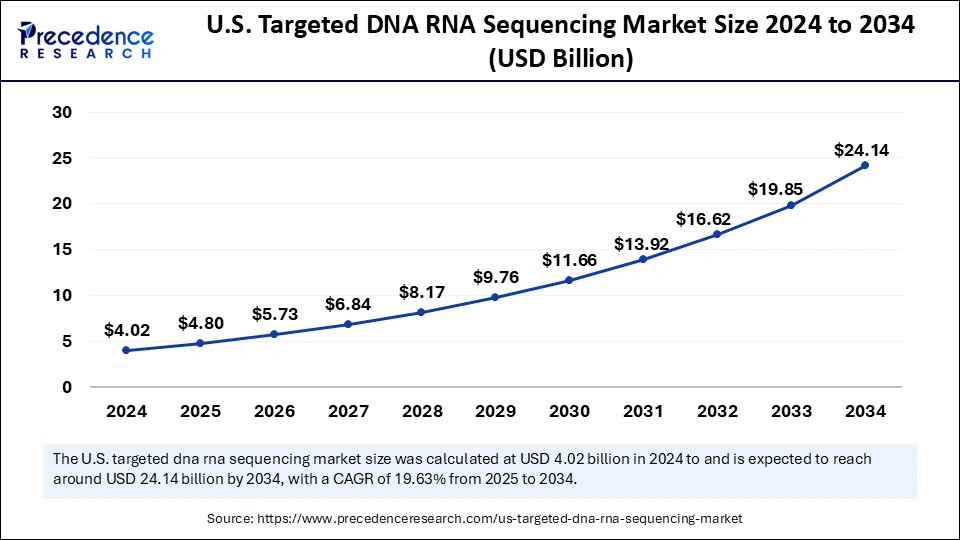
The U.S. targeted DNA RNA sequencing market size was estimated at USD 4.80 billion in 2025 and is predicted to increase from USD 5.73 billion in 2026 to approximately USD 27.72 billion by 2035, expanding at a CAGR of 19.17% from 2026 and 2035. The demand for targeted sequencing in the country is attributed to the rising prevalence of genetic disorders and cancer incidences.
U.S. Targeted DNA RNA Sequencing Market Key Takeaways
- By product, the next-generation sequencing (NGS) segment registered the highest market share in 2025.
- By workflow, the sequencing segment accounted for the largest market share in 2025.
- By workflow, the pre-sequencing segment is anticipated to emerge significantly during the forecast period.
- By type, the DNA-based targeted sequencing segment led the market in 2025.
- By type, the RNA-based targeted sequencing segment is anticipated to grow significantly from 2026 to 2035.
- By application, the drug discovery segment generated the largest market share in 2025.
- By application, plant and animal sciences segment is anticipated to grow at the fastest CAGR from 2026 to 2035.
- By end-user, the academic research segment accounted for the biggest market share in 2025.
- By end-user, the pharma and biotech entities segment is anticipated to register solid CAGR during the forecast period.
What is the U.S. Targeted DNA RNA Sequencing?
Targeted DNA RNA sequencing refers to a next-generation approach that is mainly focused on analyzing transcriptome or genome instead of the entire gene material. The U.S. targeted DNA RNA sequencing is growing rapidly due to its expanding use in medicines, which are being used in various applications. Methods like amplicon, and hybridization capture-based sequencing have become popular due to the expanding applications which play a crucial role in enhancing the accuracy and efficiency in the particular use.
How Does Artificial Intelligence (AI) Help in the U.S. Targeted DNA RNA Sequencing Market?
The technological base in the United States has been dominant in the landscape, where technologies like artificial intelligence and machine learning (ML) are widely used in various fields, including DNA and DNA sequencing. The data analyzing abilities of AI are being used in sequencing data processing which detects the genetic mutations and also increases the accuracy of the variant. The rise of bioinformatics is also supported by AI, which is improving decision-making. ML models are also anticipated to mark their expertise in managing and filtering the sequencing errors which will eventually help in the overall improvement. The data storage abilities are also being used in predicting disease risks, which will be highly adopted in these processes in the upcoming years.
- In January 2025, Genialis expanded collaboration with Debiopharm to develop RNA-based predictive biomarkers for WEE1-targeted therapy in the U.S., advancing precision oncology.
U.S. Targeted DNA RNA Sequencing Market Growth Factors
- The rising cancer prevalence in the United States is playing an influential role, which is increasing the adoption of sequencing, which would help in treatments.
- Rapid technological advancements like single-cell sequencing and long-read sequencing are playing a major role in increasing the outcomes of treatments.
- The growth of regulatory approval rates from the FDA promotes the use of these methods, which helps the growth of the U.S. targeted DNA RNA sequencing market.
- The rising focus on agriculture is also helping to attract several investments in microbiome analysis and other applications.
Market Scope
| Report Coverage | Details |
| Market Size by 2035 | USD 27.72 Billion |
| Market Size in 2025 | USD 4.80 Billion |
| Market Size in 2026 | USD 5.73 Billion |
| Market Growth Rate from 2026 and 2035 | CAGR of 19.17% |
| Base Year | 2025 |
| Forecast Period | 2026 and 2035 |
| Segments Covered | Product, Type, Application, End-User. |
Market Dynamics
Drivers
Growth of precision medicine
The rising cancer incidences have led to an increasing focus on oncology, where the demand for treatments is significantly growing. The increasing FDA approval test guides are helping in diagnosis, which is developing targeted cancer therapies for lung and breast cancer. The U.S. targeted DNA RNA sequencing market is anticipated to grow more rapidly due to the use of pharmacogenomics which is used for analyzing drug response. Additionally, the rise of rare genetic disorders is attracting more investments in the country.
- According to the American Cancer Society, in 2025, the U.S. is expected to see around 316,950 new cases of invasive breast cancer diagnosed in women and approximately 42,170 deaths from breast cancer.
Dominance in infectious disease surveillance
The healthcare industry, including the U.S., is investing heavily in adopting sequencing for variant detection and vaccine development, too. Viruses like GBS and COVID-19 have played a crucial role in attracting significant attention, which is boosting the growth of the U.S. targeted DNA RNA sequencing market. The healthcare organizations in the country are significantly investing in the adoption of targeted sequencing which would help in developing vaccines for any uncertain virus. Additionally, the rising incidence of HIV and TB in the country is anticipated to maintain the demand for sequencing in the coming years, too.
Restraint
Higher infrastructure costs
American healthcare is known for advanced technologies, which keeps it ahead of other nations, but there are still some factors that tend to affect the growth of the U.S. targeted DNA RNA sequencing market. Sequencing platforms require huge investments, which often cost around a million dollars, which affects the overall prices. Additionally, consumables like reagents, kits, and others are also very expensive, which affects the finances. This affects the overall healthcare costs in the country, making it unaffordable. Additionally, small organizations also face a barrier while adopting storage solutions that are required to store genomic data.
Opportunities
Rising government fundings
The U.S. government is investing heavily in research to develop genomics for various diseases, which could help in catering the patients. The CDC's molecular detection program is witnessing rapid growth, which is creating the demand for RNA sequencing. Additionally, other organizations, like NIH, are focused on advancing personalized medicine development, which is anticipated to boost the U.S. targeted DNA RNA sequencing market growth. The National Cancer Institute (NCI) has taken a cancer moonshot initiative, which is boosting the demand for genomics for research and development. Additionally, programs like ARPA-H are anticipated to create next-generating sequencing technologies with the use of AI and ML.
Rising trend for early disease detection
Cancer incidences in the U.S. are increasing rapidly, which is leading to significant steps toward treating these diseases at early stages. The U.S. targeted DNA RNA sequencing market is anticipated to grow rapidly due to the rising focus on liquid biopsy, which helps in early cancer detection. Many healthcare companies in the country are investing heavily which would help them mark significant revenue in the coming years. The advancements in genetic screening are anticipated to develop more methods for detecting various syndromes. These rapid advancements are anticipated to attract significant investments from public-private partnerships in the coming years.
Segment Insights
Product Insights
In the U.S. targeted DNA/RNA sequencing market, cancer gene sequencing dominates due to its critical role in precision oncology, while inherited disease screening supports early detection of genetic disorders. Drug development is the fastest-growing major application, driven by increasing use of targeted sequencing in personalized medicine and biomarker discovery. Forensic genomics remains a smaller but important segment focused on high-accuracy DNA identification in legal contexts.
Meanwhile, 16S ribosomal RNA (rRNA) sequencing is the fastest-growing niche segment because of rising microbiome research, cost-effectiveness, and expanding use in clinical diagnostics and environmental studies.
Workflow Insights
The sequencing segment generated the highest amount of share in 2025. The process includes reading and analysis of DNA and RNA using next-generation platforms. The dominance of NGS in clinical applications makes the method dominant as it is being used widely in various applications. The U.S. targeted DNA RNA sequencing market is growing rapidly due to technological advancements which would help in enhancing the outcomes and also reducing the overall costs. The companies are also investing heavily which would help them in generating more revenue in the coming years through drug discovery.
The pre-sequencing segment is expected to grow significantly during the forecast period of 2026 to 2035. The growth of the segment is attributed to the growing demand for high-quality data, which uses these steps during the research process. The companies are adopting technologies in sample preparation which significantly boost the workflow and reduce the errors. The rising demand for personalized medicine in the country is anticipated to attract more investments that would highly rely on data, leading toward the adoption of pre-sequencing technologies.
Type Insights
The DNA-based targeted sequencing stood dominant in 2025. The segment refers to the use of specific DNA genomes to focus on medicine development. The U.S. targeted DNA RNA sequencing market is growing rapidly due to the rising focus on specific diagnosis, which makes it cost-effective during research and analysis. DNA sequencing is anticipated to gain more popularity due to its effectiveness in diseases like genetic and other congenital conditions. Healthcare companies in the countries are widely focusing on developing sequencing platforms through next-generation sequencing, which would mark more growth through cost reduction.
The RNA-based targeted sequencing segment is expected to grow significantly from 2026 to 2035. The growth of the segment is attributed to the rising focus on precision medicine, which aims to cater to genetic disorders. This is leading to significant advancements, which are boosting the growth of RNA inhibitors like Aptadir Therapeutics' DiRs. The growing focus of American healthcare institutions towards genomic research is anticipated to boost the growth of sequencing technologies.
Application Insights
The drug discovery segment stood dominant as it generated the largest revenue share in 2025. The segment deals with identifying genetic mutations that can help in developing targeted therapies for the patients. The U.S. targeted DNA RNA sequencing market is witnessing rapid growth due to significant investments in the biopharma sector, which aims to focus on genomic drug development. The technological adoption in the country is anticipated to increase the research outcomes which would benefit the healthcare industry in the coming years.
The plant and animal sciences segment is expected to emerge as the fastest growing, with the highest CAGR from 2026 to 2035. The growth of the segment is attributed to the growing focus on agriculture genomics, which can improve the health of the yields and crops. Additionally, these technologies also play a vital role in sustainable farming by identifying genetic markers for the diseases of the plants. The U.S. targeted DNA RNA sequencing market is anticipated to grow more rapidly due to the increasing focus of organizations toward sustainable agriculture.
End-User Insights
The academic research segment accounted for the highest share in 2025. The U.S. government is rapidly investing in genomic research, which is creating more demand for sequencing techniques. The rising collaborations between the universities and the pharmaceutical companies are anticipated to innovate more advancements in the technologies which would boost the market growth through genomic studies. The rapidly expanding market is anticipated to excel in the coming years due to the adoption of AI-based tools.
The pharma and biotech entities segment is expected to register a solid CAGR during the forecast period of 2025 to 2034. The growth of the segment is attributed to the growing investments in cell therapy research where the companies are aiming to develop regenerative medicine. The U.S. targeted DNA RNA sequencing market is anticipated to grow more rapidly due to the rising cancer prevalence which is using these technologies for treating diseases through therapies.
Statistical Analysis for Market
- The NIH official news release confirms that scientists discovered more than 275 million new genetic variants through their research with almost 250000 study participants.
- The dataset shows almost 4 million genetic variants that exist in regions linked to diseases, thus providing better clinical targeting information.
- The supporting analysis demonstrates that the dataset contains over 1 billion genetic variants, which scientists discovered through large-scale sequencing research.
U.S. Targeted DNA RNA Sequencing Market Companies
- Bio-Rad Laboratories Inc: Offers life science solutions such as digital PCR systems, protein imaging systems, and clinical diagnostics to be used in accurate laboratory research.
- Illumina, Inc.: Offers the next-generation sequencing, high-throughput platform, library preparation kits, and microarray technologies to facilitate the advanced workflow of genetic analysis.
- Thermo Fisher Scientific Inc: Supplies analytical instruments, reagents, and software using the biggest brands in assisting research, diagnostics, and overall lab solutions worldwide.
- PierianDx : Provides clinical interpretation software that allows variant annotation, genomic analysis, and reporting to facilitate the workflow of personalized medicine and precision diagnostics.
Other Major Key Players
- DNASTAR, Inc.
- PerkinElmer, Inc.
Announcements by Industry Players in the United States
- In May 2024, Foundation Medicine launched FoundationOneRNA, an RNA sequencing test for detecting cancer-related fusions. Chief Medical Officer Mia Levy stated his thoughts, "RNA sequencing with FoundationOne RNA provides another layer of sophisticated fusion detection, empowering physicians and researchers with greater confidence in fusion detection."
Recent Developments
- In March 2026, Integrated DNA Technologies (IDT) launched Archer FUSIONPlex™-HT Dx and VARIANTPlex™-HT Dx, marking its entry into the next-generation sequencing in vitro diagnostic market. These IVD-grade solutions enhance oncology diagnostics with standardized workflows, focusing on quality, compliance, and clinical impact.
(Source: https://www.businesswire.com ) - In March 2026, Integrated DNA Technologies (IDT) launched its first in vitro diagnostic products, Archer FUSIONPlex-HT Dx and VARIANTPlex-HT Dx. The launch allowed IDT to enter the next-generation sequencing clinical market for oncology diagnostics in the US and Europe. (Source: https://clpmag.com )
- In October 2024, U.S.-based Aptadir Therapeutics secured USD 1.6 million in pre-seed funding to advance RNA inhibitors using lipid nanoparticle delivery for targeted DNA methylation therapies.
Segments Covered in the Report
By Product
- NGS
- Method
- Exome Sequencing
- Enrichment Sequencing
- Amplicon Sequencing
- Others
- Method
- Application
-
- Cancer Gene Sequencing
- Inherited Disease Screening
- Drug Development
- Forensic Genomics
- 16S ribosomal RNA (rRNA) sequencing
-
- Others
By Workflow
- Pre-Sequencing
- Sequencing
- Data Analysis
By Type
- DNA Based Targeted Sequencing
- RNA Based Targeted Sequencing
By Application
- Human Biomedical Research
- Plant and Animal Sciences
- Drug Discovery
- Others
By End User
- Academic Research
- Hospitals and Clinics
- Pharma and Biotech Entities
- Others
For inquiries regarding discounts, bulk purchases, or customization requests, please contact us at sales@precedenceresearch.com
Frequently Asked Questions





Ask For Sample
No cookie-cutter, only authentic analysis – take the 1st step to become a Precedence Research client
 Get a Sample
.webp)



 sales@precedenceresearch.com
 Schedule a Meeting
