



U.S. Automotive Human Machine Interface Market Size, Share and Trends 2026 to 2035
U.S. Automotive Human Machine Interface Market (By Technology: Visual and Acoustic; By Product Type: Voice Control, Central Display, Instrument Cluster, Steering Mounted Control, Rear-seat Entertainment (RSE) Display, and Heads-up Display (HUD); By Vehicle Type: Passenger Vehicle and Commercial Vehicle) Industry Size, Share, Growth, Trends 2025-2035
 Get a Sample
 Table Of Content


The U.S. Automotive Human Machine Interface Market size was estimated at USD 7.96 billion in 2025 and is projected to be gain around USD 25.55 billion by 2035, growing at a CAGR of 12.37% from 2026 to 2035. The U.S. market is driven by increasing connectivity, the integration of advanced driver-assistance systems (ADAS), and the growing consumer preference for high-quality in-cabin experiences.
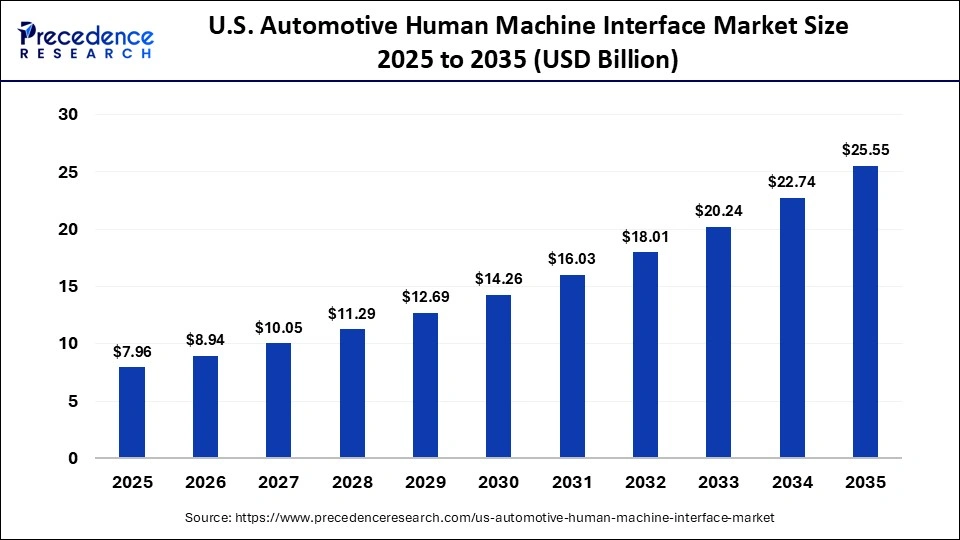
U.S. Automotive Human Machine Interface Market Statical Scope
| Reports Attributes | Statistics |
| Market Size in 2025 | USD 7.96 Billion |
| Market Size in 2026 | USD 8.94 Billion |
| Market Size by 2035 | USD 25.55 Billion |
| CAGR 2026 to 2035 | 12.37% |
| Base Year | 2025 |
| Forecast Period | 2026 to 2035 |
The U.S. automotive human machine interface (HMI) market plays a crucial role in enhancing driver safety, enriching user experience, and incorporating advanced vehicle technologies. It uses touchscreens, voice commands, and head-up displays, allowing drivers to control vehicle functions while keeping their focus on the road. This technology reduces crash risks by providing clear information from advanced driver assistance systems (ADAS). It employs voice commands and smart layouts to minimize distractions for drivers.
It transforms vehicle interiors into intelligent digital environments with touchscreens and customizable settings. It seamlessly integrates smartphones, navigation, and entertainment systems into a single dashboard. It prepares drivers for semi-autonomous and autonomous vehicles by delivering clear status notifications. Additionally, it efficiently manages electric battery metrics and power controls through digital instrument clusters.
U.S. Automotive Human Machine Interface Market, By Technology, 2025 (%)
| Segments | Shares (%) |
| Visual | 72.00% |
| Acoustic | 28.00% |
- Visual - The visual segment, with a share of 72.00% in 2025, accounts for the largest revenue share in the U.S. automotive Human-Machine Interface (HMI) market as it promotes safety, improves user experience with large digital displays, and integrates advanced technologies like Head-Up Displays (HUDs) and ADAS.
- Acoustic - The acoustic segment, with a share of 28.00% in 2025, is essential in the U.S. automotive Human Machine Interface (HMI) market for hands-free operation, minimizes driver distraction, and fulfills consumer needs for advanced voice assistants.
U.S. Automotive Human Machine Interface Market, By Product Type, 2025 (%)
| Segments | Shares (%) |
| Voice Control | 24.00% |
| Central Display | 26.00% |
| Instrument Cluster | 18.00% |
| Steering Mounted Control | 12.00% |
| Rear-seat Entertainment (RSE) Display | 8.00% |
| Heads-up Display (HUD) | 12.00% |
- Voice Control - The voice control segment, with a share of 24.00% in 2025, is important in the U.S. automotive Human Machine Interface (HMI) market as it boosts driving safety by lowering manual distractions, meets consumer expectations for smartphone-like natural language assistants, and allows hands-free management of software-defined vehicle features.
- Central Display - The central display segment, with a share of 26.00% in 2025, dominates the U.S. automotive human machine interface (HMI) market by product type, acting as the main command center for infotainment and media, feedback from advanced driver-assistance systems (ADAS), and smartphone connectivity.
- Instrument Cluster - The instrument cluster segment, with a share of 18.00% in 2025, is crucial in the U.S. Automotive HMI market as it delivers essential driver information, facilitates the transition from analog to customizable digital screens, and incorporates safety systems.
U.S. Automotive Human Machine Interface Market, By Vehicle Type, 2025 (%)
| Segments | Shares (%) |
| Passenger Vehicle | 82.00% |
| Commercial Vehicle | 18.00% |
- Passenger Vehicle - The passenger vehicle segment, with a share of 82.00% in 2025, is at the forefront of the automotive human-machine interface (HMI) market as it is the main testing ground for advanced consumer technology, software-defined features, and high-end digital cockpits.
- Commercial Vehicle - The commercial vehicle sector, with a share of 18.00% in 2025, plays a crucial role in the U.S. automotive human-machine interface (HMI) market as it improves fleet safety, boosts operational efficiency, and integrates real-time telematics.
Competitive Landscape
The U.S. automotive human-machine interface (HMI) market is highly competitive, led by major technology and tier-1 suppliers such as Continental AG, Harman International, and Visteon Corporation. These companies emphasize smart digital cockpits, voice controls, and augmented reality displays.
- Continental AG provides curved central displays, head-up displays (HUDs), and biometric driver identification systems.
- Harman International (Samsung) offers advanced digital cockpit platforms, cloud-connected safety features, and voice-activated virtual assistants.
- Visteon Corporation focuses on all-digital instrument clusters, SmartCore™ cockpit domain controllers, and infotainment displays.
- Robert Bosch GmbH supplies touch-sensitive displays with haptic feedback, predictive infotainment, and voice recognition software.
- Panasonic Automotive specializes in large-format augmented reality head-up displays (AR-HUDs) and high-performance in-vehicle infotainment systems.
Segments Covered in the Report
By Technology
- Visual
- Acoustic
By Product Type
- Voice Control
- Central Display
- Instrument Cluster
- Steering Mounted Control
- Rear-seat Entertainment (RSE) Display
- Heads-up Display (HUD)
By Vehicle Type
- Passenger Vehicle
- Commercial Vehicle
For inquiries regarding discounts, bulk purchases, or customization requests, please contact us at sales@precedenceresearch.com
Frequently Asked Questions





Ask For Sample
No cookie-cutter, only authentic analysis – take the 1st step to become a Precedence Research client




 sales@precedenceresearch.com
 Schedule a Meeting



