



US Controlled Substance Market Size, Companies, Share, Patient Volume, Treatment Adoption Rates, Pricing Analysis, Regulatory Landscape, Competitive Positioning, and Demand Forecast
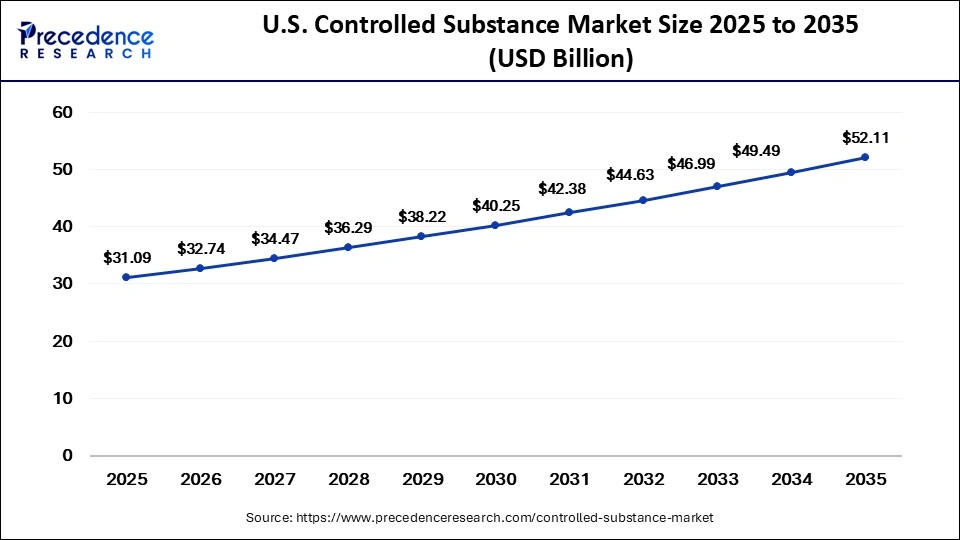
Rohan Patil, a Healthcare Industry Expert, highlights that the US controlled substance market has reached USD 32.74 billion in 2026 and is on track to reach USD 52.11 billion by 2035, advancing at a CAGR of 5.70%. Key US controlled substance market companies shaping the market include AbbVie, Inc., Pfizer, Inc., Mallinckrodt plc, while major growth segments span product type, indication, distribution channel.
Source: https://www.precedenceresearch.com/us-controlled-substance-market
 Get a Sample
 Table Of Content


US Controlled Substance Market Size and Forecast 2026 to 2035
The US controlled substance market size accounted for USD 31.09 billion in 2025 and is predicted to increase from USD 32.74 billion in 2026 to approximately USD 52.11 billion by 2035, expanding at a CAGR of 5.70% from 2026 to 2035. The market growth is attributed to increasing prescription demand for pain management, ADHD, seizure disorders, and addiction treatment, supported by expanding healthcare access and stringent controlled-substance monitoring systems.
Key Takeaways
- By product type, the opioids segment held the largest market share in 2025.
- By product type, the stimulants segment is expected to expand with the highest CAGR during the forecast period.
- By indication, the pain management segment held the largest share of the market in 2025.
- By indication, the seizure segment is expected to grow with the highest CAGR between 2026 and 2035.
- By distribution channel, the retail pharmacies segment held the highest share of the market in 2025.
- By distribution channel, the online pharmacies segment is expected to grow with the highest CAGR during the forecast period.
Market Overview
Rising demand for prescription opioids, stimulants, and other regulated medications is a major driver of the U.S. controlled substance market. Controlled substances are medicines that are regulated by the Controlled Substances Act and are subject to quota systems, electronic ordering systems, and diversion-control technologies. The technologies make it easier to ensure that patients obtain legitimate access to these medicines and prevent diversion and unauthorized distribution.
The market consists of opioids, stimulant drugs, sedatives, and addiction treatment medications provided through highly controlled pipelines. According to SAMHSA's 2024 National Survey on Drug Use and Health, approximately 48.4 million Americans aged 12 and older had a substance use disorder. Furthermore, the number of cases of persistent pain, ADHD, and substance abuse disorders is on the rise, continuing to fuel growth for the U.S. market.
Impact of Artificial Intelligence on the U.S. Controlled Substance Market
AI is reshaping the market by strengthening compliance, security, and operational efficiency across regulated pharmaceutical supply chains. AI Analytics allows drug manufacturers to predict controlled medicine demand and schedule production in accordance with the DEA quota.
AI assists pharmacies and healthcare providers in understanding prescribing patterns, aiding clinical decision-making, and minimizing drug misuse. AI has become a growing feature in several prescription drug monitoring programs, electronic health record systems, and compliance platforms, enhancing regulations.
Market Report Coverage and Key Metrics
| Report Coverage | Details |
| Market Size in 2025 | USD 31.09 Billion |
| Market Size in 2026 | USD 32.74 Billion |
| Market Size by 2035 | USD 52.11 Billion |
| Market Growth Rate from 2026 to 2035 | CAGR of 5.70% |
| Base Year | 2025 |
| Forecast Period | 2026 to 2035 |
| Segments Covered | Product Type, Indication, and Distribution Channel |
Market Dynamics
Drivers
Rising Prevalence of Chronic Pain and Neurological Disorders
The rising prevalence of chronic pain, cancer-related pain, and neurological disorders accelerates the demand for controlled medications across the U.S. Opioid analgesics and other controlled medications are becoming a common prescription for treating chronic and disabling pain.
Spinal diseases, arthritis, neuropathic pain, and musculoskeletal disorders are all chronic or long-term diseases that need long-term care. Building a successful approach to pain management is always crucial for the healthcare system for enhanced patient outcomes and quality of life. Furthermore, the Increasing diagnosis rates of attention deficit hyperactivity disorder (ADHD) are expected to strengthen demand for controlled stimulant medications.
Restraint
Stringent Regulatory Requirements
Stringent DEA regulations and compliance obligations are expected to increase operational complexity across the controlled substance supply chain, thus hindering market growth. Approval may be subject to extended regulatory scrutiny, which can have a negative effect on the product approval process and management. Moreover, the ongoing opioid-related litigation is anticipated to create financial and operational challenges for pharmaceutical manufacturers and distributors.
Opportunity
Increasing Diagnosis Rates of ADHD Supporting Stimulant Prescription Growth
Increasing diagnosis rates of attention deficit hyperactivity disorder (ADHD) are expected to create immense opportunities for the market.
According to the CDC's 2024 report, an estimated 7 million US children aged 3–17 years have been diagnosed with ADHD at some point.
Doctors are still recommended to use stimulant medications as a first-line approach in children and adults with ADHD. Awareness and improved screening, diagnosis, and initiation of treatment for neurodevelopmental disorders in health-care facilities. Furthermore, the high investment in diversion control and regulatory compliance technologies is estimated to enhance operational efficiency across controlled substance supply chains.
Market Segmentation Analysis
Product Type Insights
The Opioids Segment Dominated the Market in 2025
The opioids segment dominated the U.S. controlled substance market in 2025 due to the widespread use of regulated analgesics across hospitals, surgical centers, oncology facilities, and pain management clinics. The volume of prescriptions in all areas of healthcare was well supported by high numbers of patients requiring high-level pain relief.
Manufacturers continued to have a wide product line diversity with branded and generic opioid products to ensure long-term availability in different treatment settings. Furthermore, the SAMHSA also identified approximately 4.8 million people with an opioid use disorder in 2024, reflecting substantial demand for regulated pain therapies and addiction-treatment medications.
The stimulants segment is expected to show the fastest growth over the forecast period, driven by rising usage among children and adults with ADHD. Expanded screening and sophisticated behavioral assessment tools continue to be used by healthcare providers to identify ADHD cases and those that are misdiagnosed. Additionally, the continued innovation in extended-release formulations and patient-focused delivery technologies supports long-term expansion opportunities across the stimulant segment.
Indication Insights
The Pain Management Segment Led the Market in 2025
The pain management segment led the U.S. controlled substance market with a share in 2025, fueled by a large population of patients needing prescription medicines for acute, chronic, postoperative, and cancer-treating pain. The CDC reports that there are a large number of people in the U.S. population who suffer from chronic pain, with about 51.6 million being adults and nearly 17.1 million reporting high-impact pain.
Controlled medications were still being used within both hospitals and ambulatory surgical centers, emergency departments, and specialty pain clinics. Furthermore, the Oncology centers, palliative care facilities, and postoperative recovery programs maintained significant utilization of regulated pain therapies.
The seizure segment is expected to gain the highest market share with a CAGR between 2026 and 2035, supported by rising cases of epilepsy and other chronic neurological diseases that require seizure medication. Differential anticonvulsant medications and additional treatments are still prescribed by physicians to allow patients to live healthier lives by decreasing seizures.
The CDC estimates that there are approximately 3.4 million individuals in the U.S. with active epilepsy, including almost 470,000 children. The expansion in the market for seizure treatment was sustained with increased use of specialized neurological care and increasing knowledge about epilepsy care.
Distribution Channel Insights
The Retail Pharmacies Segment Dominated the Market in 2025
The retail pharmacies segment contributed the biggest U.S. controlled substance market share in 2025 due to the presence of multiple drug outlets, an extensive network of pharmacies, and the patients' convenience for easy drug accessibility. The demand for chronic disease management, pain treatments, neurological, and controlled drugs provided for prescriptions increased with enhanced year-over-year dispensing activity in the retail channels.
The online pharmacies segment is expected to witness the fastest growth in the market over the forecast period, supported by increasing utilization of telehealth services, electronic prescribing platforms, and digital prescription management systems. The Office of the National Coordinator for Health Information Technology reports that 92% of U.S. pharmacies have electronic-prescribing functions, providing a solid basis for enabling digital medication fulfilment. The uptake of digital healthcare services keeps increasing while further fortifying demand for the remote medication distribution model.
U.S. Controlled Substance Market: Country-Level Analysis
Why Is California a Key Growth Center for the Controlled Substance Market in the U.S.?
The market in Massachusetts is growing due to its high density of healthcare providers and CSDs in the state. California was a major retained state served by its sizable health-care workforce and its large volume of drug distribution. Oncology, psychiatric, neurological, and pain-controlled drugs/medications saw significant demand in major healthcare centers such as Los Angeles, San Diego, San Francisco, and Sacramento.
How is Texas Growing in the U.S. Controlled Substance Market?
Texas is considered to be a significantly growing area, supported by its large patient population, extensive hospital network, and rising demand for controlled therapies. The state has grown by millions of people in the last 10 years, a growth that has led to increased demand for chronic disease management and revenue from prescription therapies. Texas experienced an appreciable demand for controlled medications, which are used in postoperative recovery, trauma care, neurological disorders, and ADHD treatment.
U.S. Controlled Substance Market Value Chain Analysis
- Raw Material Sourcing
The supply chain begins with sourcing active pharmaceutical ingredients (APIs) and chemical compounds required for controlled medication production under strict regulatory oversight.
Key Players: Cambrex, Siegfried Holding, Lonza, BASF.
- Controlled Substance Manufacturing
APIs are processed into finished controlled medications, including opioids, stimulants, sedatives, and other regulated pharmaceutical products.
Key Players: Teva Pharmaceutical Industries, Hikma Pharmaceuticals, Viatris, Amneal Pharmaceuticals.
- Distribution & Regulatory-Controlled Logistics
Finished products move through authorized distributors using DEA-compliant storage, tracking, and controlled-substance handling systems.
Key Players: McKesson Corporation, Cencora, Cardinal Health, and AmerisourceBergen.
- Pharmacy & Healthcare Dispensing
Controlled medications reach hospitals, retail pharmacies, and specialty providers through secure dispensing and monitoring systems.
Key Players: CVS Health, Walgreens Boots Alliance, Walmart Pharmacy, Omnicell.
Market Competitive Landscape: Leading Companies and Strategies
The U.S. controlled substance market remains moderately consolidated, with leading pharmaceutical manufacturers, distributors, and technology providers controlling significant industry activities. Major companies, including Teva, Hikma Pharmaceuticals, Amneal Pharmaceuticals, Viatris, and Mallinckrodt, have a broad range of regulated products and supply chains. Established companies benefit from long-standing provider relationships and nationwide distribution networks.
Strategic developments are actively reshaping competition across controlled medication categories. In 2025, Collegium Pharmaceutical further developed its abuse-deterrent opioid products and its pain management efforts. Indivior deepened its commitment to OD treatment through ongoing innovation in addiction treatment solutions. Furthermore, the businesses are still proceeding with investments in abuse-deterrent forms, controlled release, and digital monitoring technologies to bolster market positions.
U.S. Controlled Substance Market Companies
- AbbVie, Inc
- Pfizer, Inc.
- Mallinckrodt plc
- F. Hoffmann-La Roche AG
- Janssen Pharmaceuticals, Inc. (Johnson & Johnson)
- Purdue Pharma L.P.
Recent Developments U.S. Controlled Substance Market (2025-2026)
- In June 2026, the U.S. FDA approved Rextovy, a 4 mg OTC naloxone hydrochloride nasal spray, for emergency opioid overdose treatment. The approval expands direct consumer access through pharmacies, convenience stores, and online channels to support overdose response efforts. (Source: https://www.fda.gov)
- In June 2026, Lupin launched Azilsartan Medoxomil tablets in the U.S. after FDA approval. The product provides a generic alternative to Edarbi and is indicated for adult hypertension treatment.(Source: https://www.lupin.com)
Segments Covered in the Report
By Product Type
- Opioids
- Stimulants
- Depressants
- Cannabinoids Drugs
By Indication
- Pain Management
- Sleep Disorder
- Anxiety
- Seizure
- Others
By Distribution Channel
- Hospital Pharmacies
- Retail Pharmacies
- Online Pharmacies
For inquiries regarding discounts, bulk purchases, or customization requests, please contact us at sales@precedenceresearch.com
Frequently Asked Questions





Ask For Sample
No cookie-cutter, only authentic analysis – take the 1st step to become a Precedence Research client
 Get a Sample




 sales@precedenceresearch.com
 Schedule a Meeting
