



U.S. Enteral Feeding Devices Market Size, Share and Trends 2026 to 2035
U.S. Enteral Feeding Devices Market (By Product Type: Enteral Feeding Tube, Enteral Feeding Pump, Administration Sets, Enteral Syringe, and Others; By Age Group: Adult and Pediatrics; By Application: Gastrointestinal Disease, Neurological Disorder, Cancer, Malnutrition, and Others; By End Use: Hospital, Home Care, Ambulatory Surgical Centers (ASCs), and Others) Industry Size, Share, Growth, Trends 2025-2035
 Get a Sample
 Table Of Content


The U.S. enteral feeding devices market size surpassed USD 1.32 billion in 2025 and is predicted to reach around USD 2.15 billion by 2035, registering a CAGR of 5% from 2026 to 2035. The market is mainly driven by an aging population, a rise in chronic diseases, and home healthcare services.
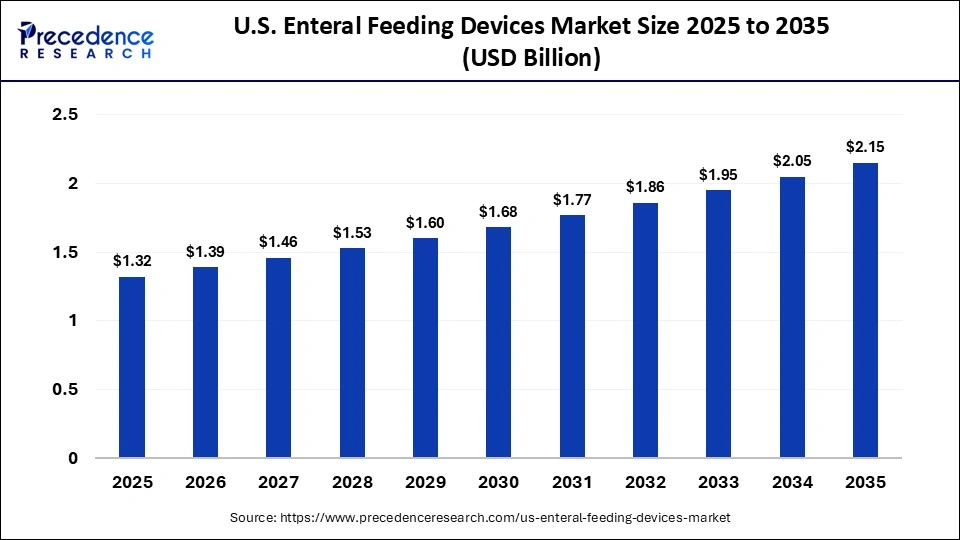
U.S. Enteral Feeding Devices Market Statical Scope
| Reports Attributes | Statistics |
| Market Size in 2025 | USD 1.32 Billion |
| Market Size in 2026 | USD 1.39 Billion |
| Market Size by 2035 | USD 2.15 Billion |
| CAGR 2026 to 2035 | 5% |
| Base Year | 2025 |
| Forecast Period | 2026 to 2035 |
The market is crucial as it meets essential patient needs due to the aging population, increasing chronic illnesses, and the integration of affordable home healthcare. It provides necessary nutritional support for many Americans who cannot eat by mouth. The growing elderly population experiences higher rates of swallowing issues (dysphagia) and neurological disorders such as stroke or Alzheimer's. These devices are vital for patients with head and neck cancers, gastrointestinal problems, and severe injuries.
They enable safe, long-term nutritional support outside of costly hospital environments using portable smart pumps and discreet tubes. This offers a more affordable and safer option compared to parenteral (intravenous) nutrition, helping to lower hospital readmission rates. The devices also include safety features like ENFit connectors and digital monitoring to reduce the risks of infection and misconnection.
U.S. Enteral Feeding Devices Market, By Product Type, 2025 (%)
| Segments | Shares (%) |
| Enteral Feeding Tube | 31.20% |
| Enteral Feeding Pump | 27.60% |
| Administration Sets | 21.80% |
| Enteral Syringe | 15.40% |
| Others | 4.00% |
- Administration Sets - The administration sets segment, with a share of 21.80% in 2025, is essential in the U.S. enteral feeding devices market due to high patient turnover, strict safety requirements for single-use items, and ongoing demand for home care. These consumables generate recurring revenue and guarantee safe nutrition delivery.
- Enteral Feeding Pump - The enteral feeding pump segment, with a share of 27.60% in 2025, plays a crucial role in the U.S. enteral feeding devices market as it provides excellent clinical accuracy, improved safety features for patients, and easy adaptability for home healthcare. The pumps promote widespread adoption through advanced automation.
- Enteral Syringe - The enteral syringe segment, with a share of 15.40% in 2025, is important in the U.S. enteral feeding devices market as it provides accurate dosage delivery, adheres to high safety standards with specialized connectors, and allows flexible management of patient nutrition in both home and hospital settings.
U.S. Enteral Feeding Devices Market, By Age Group, 2025 (%)
| Segments | Shares (%) |
| Adult | 81.30% |
| Pediatrics | 18.70% |
- Pediatrics - The pediatric segment, with a share of 18.70% in 2025, is significant in the U.S. enteral feeding devices market due to the increase in preterm births, congenital disorders, and innovations in specialized devices. It provides essential nutritional support for infants and children who cannot feed orally.
- Adult - The adult segment, with a share of 81.30% in 2025, is crucial in the U.S. enteral feeding devices market as it holds the largest revenue share, driven by an aging population, high prevalence of chronic diseases, and a strong need for long-term care.
U.S. Enteral Feeding Devices Market, By Application, 2025 (%)
| Segments | Shares (%) |
| Gastrointestinal Disease | 29.40% |
| Neurological Disorder | 24.80% |
| Cancer | 23.60% |
| Malnutrition | 17.10% |
| Others | 5.10% |
- Gastrointestinal Disease - The gastrointestinal (GI) disease segment, with a share of 29.40% in 2025, is vital in the U.S. enteral feeding devices market as chronic issues like inflammatory bowel disease and severe malabsorption lead to high malnutrition rates, resulting in frequent patient admissions and ongoing dependence on tube-feeding and nutritional support products.
- Cancer - The cancer segment, with a share of 23.60% in 2025, is key in the U.S. enteral feeding devices market due to the high incidence of treatment-related swallowing difficulties (dysphagia), significant weight loss (cachexia), and a strong reliance on nutritional support during cancer treatment.
U.S. Enteral Feeding Devices Market, By End Use, 2025 (%)
| Segments | Shares (%) |
| Hospital | 49.70% |
| Home Care | 31.60% |
| Ambulatory Surgical Centers (ASCs) | 12.80% |
| Others | 5.90% |
- Ambulatory Surgical Center (ASCs) - The Ambulatory Surgical Center (ASC) segment, with a share of 12.80% in 2025, plays a key role in the U.S. enteral feeding devices market as it promotes affordable outpatient care, facilitates the increase of minimally invasive procedures, and redirects procedural volume from conventional hospitals.
- Hospital - The hospital segment, with a share of 49.70% in 2025, leads the U.S. enteral feeding devices market as it is the main environment for initial critical care, intricate device insertions, and a large number of patient admissions.
Competitive Landscape
The U.S. market for enteral feeding devices is very competitive, dominated by key players such as Avanos Medical, Inc., Cardinal Health, and Fresenius Kabi. These top companies lead innovation with smart feeding pumps, low-profile tubes, and advanced safety systems for enteral access.
- Cardinal Health has a wide range of enteral access devices, safety enteral syringes, and administration sets for gravity and pumps.
- Fresenius Kabi AG provides specialized enteral nutrition formulas, complete tube feeding sets, and advanced application pumps.
- Avanos Medical, Inc. is recognized for its low-profile gastrostomy feeding tubes, MIC-KEY enteral feeding devices, and safety-oriented extension sets.
- Moog Inc. focuses on portable, ambulatory enteral feeding pumps and smart digital delivery systems for both clinical and home care settings.
- Nestlé Health Science / Nutricia offers integrated medical nutrition formulas along with compatible Compat and Nutren feeding sets for gravity and pumps.
- Avanos Medical, Inc. also supplies the MIC-KEY low-profile gastrostomy feeding tubes and the CORTRAK* 2 enteral access system, which allows for real-time tracking of tube placement.
Segments Covered in the Report
By Product Type
- Enteral Feeding Tube
- Enteral Feeding Pump
- Administration Sets
- Enteral Syringe
- Others
By Age Group
- Adult
- Pediatrics
By Application
- Gastrointestinal Disease
- Neurological Disorder
- Cancer
- Malnutrition
- Others
By End Use
- Hospital
- Home Care
- Ambulatory Surgical Centers (ASCs)
- Others
For inquiries regarding discounts, bulk purchases, or customization requests, please contact us at sales@precedenceresearch.com
Frequently Asked Questions





Ask For Sample
No cookie-cutter, only authentic analysis – take the 1st step to become a Precedence Research client




 sales@precedenceresearch.com
 Schedule a Meeting



