



U.S. Interventional Cardiology Devices Market Size, Share and Trends 2026 to 2035
U.S. Interventional Cardiology Devices Market (By Product: Coronary Stents, PTCA Balloon Catheters, Accessory Devices, and Intravascular Imaging Catheters and Pressure Guidewires (IVUS Catheters, OCT Catheters, FFR Guidewires)) Industry Size, Share, Growth, Trends 2025-2035
 Get a Sample
 Table Of Content


The U.S. interventional cardiology devices market size is calculated at USD 5.02 billion in 2025 and is predicted to gain around USD 10.01 billion by 2035, expanding at a CAGR of 7.15% from 2026 to 2035. The U.S. market is driven by an older population, a high rate of cardiovascular diseases, a growing preference for less invasive procedures like percutaneous coronary intervention (PCI) instead of traditional surgery, and continuous advancements in technology for drug-eluting stents and catheters.
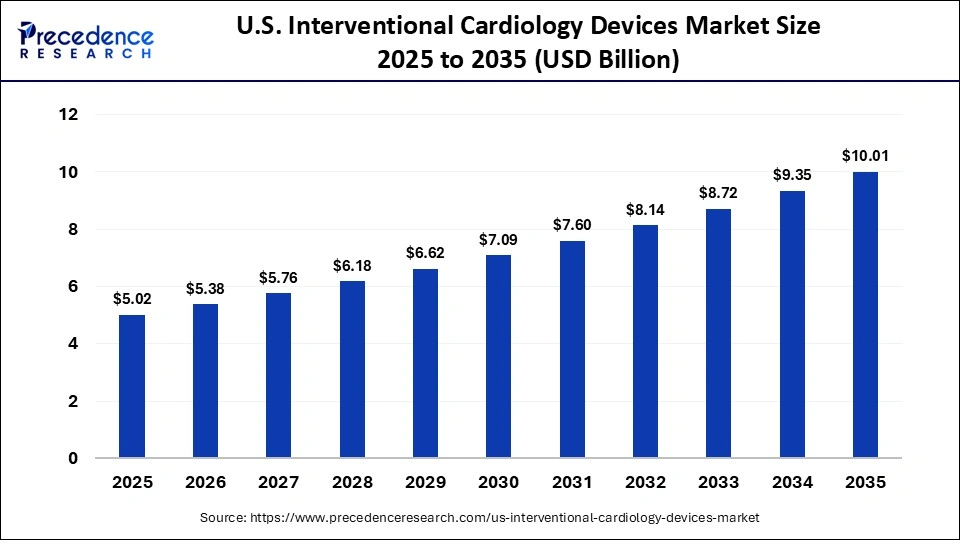
U.S. Interventional Cardiology Devices Market Statical Scope
| Reports Attributes | Statistics |
| Market Size in 2025 | USD 5.02 Billion |
| Market Size in 2026 | USD 5.38 Billion |
| Market Size by 2035 | USD 10.01 Billion |
| CAGR 2026 to 2035 | 7.15% |
| Base Year | 2025 |
| Forecast Period | 2026 to 2035 |
The market is vital as it tackles the leading cause of death in the country, which is cardiovascular disease, by offering advanced, minimally invasive solutions like drug-eluting stents, catheters, and devices for structural heart issues. It fosters global medical advancements, improves patient recovery times, and bolsters a multi-billion-dollar healthcare industry. The increasing prevalence of coronary artery disease, obesity, and diabetes results in a large patient base requiring immediate and ongoing cardiac treatment.
Procedures using catheters are replacing open-heart surgeries, which reduces the risk of complications, reduces hospital stays, and accelerates recovery for patients. The U.S. is a key center for developing next-generation devices, including specialized balloons, systems for plaque modification, and advanced imaging technologies. Strong healthcare funding, dedicated catheter labs, and clear insurance policies facilitate high adoption rates and quick access for patients.
U.S. Interventional Cardiology Devices Market, By Product, 2025 (%)
| Segments | Shares (%) |
| Coronary Stents | 49.00% |
| PTCA Balloon Catheters | 22.00% |
| Accessory Devices | 16.00% |
| Intravascular Imaging Catheters and Pressure Guidewires (IVUS Catheters, OCT Catheters, FFR Guidewires) | 13.00% |
- Coronary Stents - The coronary stents segment, with a share of 49.00% in 2025, is crucial in the U.S. interventional cardiology devices market, accounting for the largest revenue share. It is the main treatment for coronary artery disease, driven by an aging population, a strong preference for minimally invasive percutaneous coronary intervention (PCI), and continuous technological advancements like improved drug-eluting stents.
- PTCA Balloon Catheters - The Percutaneous Transluminal Coronary Angioplasty (PTCA) balloon catheter segment, with a share of 22.00% in 2025, plays a key role in the U.S. interventional cardiology market as it is essential for unblocking heart arteries, preparing complex or calcified lesions for stenting, and administering new drug-coated technologies during minimally invasive procedures.
- Accessory Devices - The accessory devices segment, with a share of 16.00% in 2025, which includes guidewires, micro-guide catheters, introducer sheaths, and hemostasis valves, is important in the U.S. interventional cardiology market due to its rapid growth and its role in facilitating complex, safe, and efficient minimally invasive procedures like percutaneous coronary interventions (PCIs).
- Intravascular Imaging Catheters and Pressure Guidewires (IVUS Catheters, OCT Catheters, FFR Guidewires) - The intravascular imaging catheters and pressure guidewires segment, with a share of 13.00% in 2025, which includes Intravascular Ultrasound (IVUS), Optical Coherence Tomography (OCT), and Fractional Flow Reserve (FFR) guidewires, is essential in the U.S. interventional cardiology market as it transitions procedures from basic anatomical estimates to accurate, physiology-guided treatments, significantly reducing stent failure and the need for repeat interventions.
Competitive Landscape
The U.S. interventional cardiology devices market is a highly competitive and consolidated sector, dominated by major medtech companies like Boston Scientific Corporation, Abbott Laboratories, Medtronic, and Edwards Lifesciences Corporation. These leaders are at the forefront of innovation in areas such as coronary stents, structural heart solutions, intravascular imaging, and minimally invasive catheter technologies.
- Boston Scientific Corporation stands out with a comprehensive portfolio that includes coronary, peripheral, and structural heart products, featuring top drug-eluting stents (DES), balloons, atherectomy systems, and intravascular lithotripsy technologies.
- Abbott Laboratories is known for its leading coronary stent lines, including the Xience family, as well as structural heart occlusion devices and advanced AI-driven intravascular imaging and physiology-guided diagnostic platforms like Ultreon Optical Coherence Tomography (OCT).
- Medtronic offers a strong cardiovascular suite with advanced coronary stents, drug-coated balloons, and specialized catheter delivery systems, supported by extensive integration into high-volume hospital networks.
- Edwards Lifesciences Corporation excels in the structural heart segment, particularly in transcatheter heart valve replacement (TAVR) and minimally invasive therapies for mitral and tricuspid valves.
- Terumo Corporation focuses on precision tools, emphasizing market-preferred guidewires, diagnostic/angiographic catheters, and specialized transradial access equipment.
Segments Covered in the Report
By Product
- Coronary Stents
- PTCA Balloon Catheters
- Accessory Devices
- Intravascular Imaging Catheters and Pressure Guidewires (IVUS Catheters, OCT Catheters, FFR Guidewires)
For inquiries regarding discounts, bulk purchases, or customization requests, please contact us at sales@precedenceresearch.com
Frequently Asked Questions





Ask For Sample
No cookie-cutter, only authentic analysis – take the 1st step to become a Precedence Research client




 sales@precedenceresearch.com
 Schedule a Meeting



