



US Rehabilitation Equipment Market Size, Share, Trends, Companies, and Forecast 2026-2035
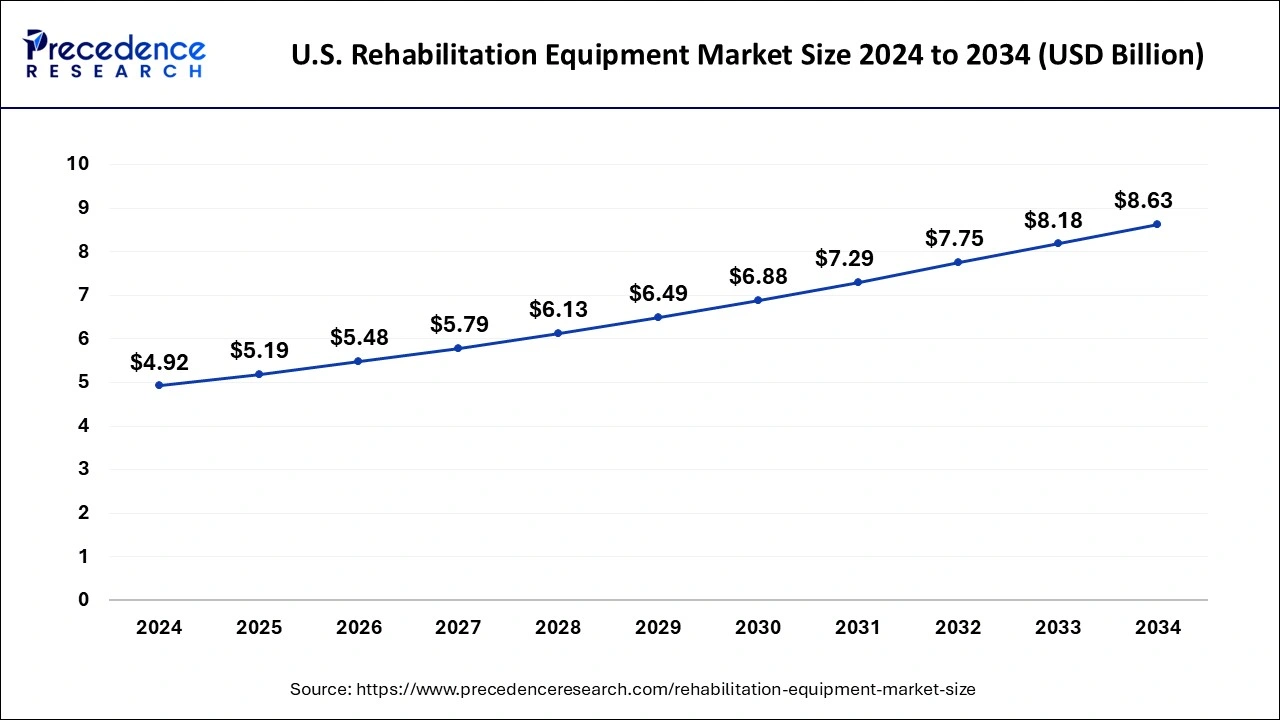
Deepa Pandey, a Healthcare Industry Expert, highlights that the US rehabilitation equipment market has reached USD 5.48 billion in 2026 and is on track to reach USD 9.07 billion by 2035, advancing at a CAGR of 5.74%. Key US rehabilitation equipment market companies shaping the market include Invacare Corporation, Medline Industries Inc., Drive DeVilbiss Healthcare, while major growth segments span product, application, end-use.
Source: https://www.precedenceresearch.com/us-rehabilitation-equipment-market
 Get a Sample
 Table Of Content


US Rehabilitation Equipment Market Size and Forecast 2026 to 2035
The US rehabilitation equipment market is predicted to increase from USD 5.48 billion in 2026 to approximately USD 9.07 billion by 2035, expanding at a CAGR of 5.74% from 2026 to 2035. The market growth is attributed to increasing disability prevalence, rising rehabilitation service utilization, expanding geriatric populations, and growing adoption of advanced mobility and assistive rehabilitation technologies.
Key Takeaways
- By product, the mobility equipment segment held the largest market share in 2026.
- By product, the daily living aids segment is expected to expand with the highest CAGR during the forecast period.
- By application, the physiotherapy segment dominated the market in 2026.
- By application, the occupational therapy segment is expected to grow at the fastest CAGR between 2026 and 2035.
- By end-user, the hospitals and clinics segment led the market in 2026.
- By end-user, the rehab centers segment is expected to grow with the highest CAGR during the forecast period.
Market Overview
High prevalence of disabilities, chronic diseases, and mobility impairments, which mandate long-term support of the rehabilitation stage, is expected to drive the U.S. rehabilitation equipment market. Examples of rehab machinery are mobility devices, robotic gait trainers, exoskeletons, prosthetics, therapeutic exercise systems, and patient lift systems. These technologies help restore physical function, improve independence, and enhance recovery outcomes across diverse patient populations.
The WHO 2024 report estimates that about 2.4 billion people in the world suffer from conditions that can be positively impacted by rehabilitation services. Nearly a third of the world's residents may need rehabilitation sometimes in their lives, according to the WHO. Additionally, growing focus on functional recovery, independent living, and technology-enabled rehabilitation solutions remains a major driver of market growth.
Impact of Artificial Intelligence on the U.S. Rehabilitation Equipment Market
Artificial intelligence (AI) is reshaping the market by improving therapy personalization and patient recovery outcomes. The rehabilitation devices that employ AI technology contain sensors that capture patients' steps and movements in real-time and adapt therapy programs to individual performance levels.
The functions enable therapists to perform more accurate interventions and effectively limit variations in the effectiveness of interventions. AI-driven monitoring systems are also utilized by health organizations to provide remote monitoring and facilitate patients' home rehabilitation exercises.
Market Dynamics
Drivers
Rising Prevalence of Mobility Disabilities and Functional Limitations
The rising prevalence of mobility disabilities and functional limitations across the U.S. drive the market growth. Personal mobility devices, such as wheelchairs, mobility scooters, walkers, transfer devices, and therapeutic systems, are becoming a growing part of healthcare solutions. Rehabilitation centers continue expanding services for patients recovering from injuries, neurological conditions, and musculoskeletal disorders, thus facilitating market growth.
- According to the CDC's 2026 report, more than 1 in 4 U.S. adults has some type of disability.
Restraint
High Acquisition and Maintenance Costs
Widespread adoption of advanced rehabilitation equipment and high acquisition and maintenance costs are certain challenges that hinder the market. Smaller rehab centers or outpatient clinics may also be limited in the sophisticated equipment that they can afford. Moreover, reimbursement limitations and coverage gaps are anticipated to affect purchasing decisions throughout the rehabilitation sector, further facilitating the market growth.
Opportunity
High Demand for Home-Based Rehabilitation and Remote Patient Monitoring
High demand for home-based rehabilitation and remote patient monitoring is estimated to create immense opportunities for the market. Hospitals and caregivers invent and utilize devices to monitor therapy compliance and functional improvement over distance.
- According to the NIH report for 2024, one in six patients benefited from home-based rehabilitation after their inpatient stay.
Compact and user-friendly equipment continues to be developed that can be used in the home or to assist caregivers. The continuing expansion of acceptance of remote rehabilitation services provides additional opportunities for advanced rehabilitation equipment brands.
Market Segmentation Analysis
Product Insights
The Mobility Equipment Segment Dominated the Market in 2026
The mobility equipment segment dominated the U.S. rehabilitation equipment market in 2026, as they are primarily required for mobility between hospitals and homes throughout the day. Products needed for patients recovering from injuries or conditions, such as wheelchairs, powered mobility devices, mobility scooters, walkers, and transfer aids, are also classified as essential products.
The U.S. Bureau of Labor Statistics found that 22.8% of people with disabilities were working in 2026, with mobility tools playing a crucial role in their ability to participate in the workplace and in their communities. Furthermore, rising patient volumes related to orthopedic procedures and sports injuries continued to strengthen demand for physiotherapy-focused equipment.
The daily living aids segment is expected to witness the fastest growth during the forecast period, as healthcare providers increasingly emphasize functional independence outside traditional clinical environments. A growing number of people live with chronic disabilities, and post-surgical recovery programs continue to uphold demand for these aids.
The U.S. Census Bureau estimated the population would reach around 58 million Americans 65 years and older, thus increasing the number of people who need help doing activities of daily living.
Application Insights
The Physiotherapy Segment Dominated the Market in 2026
The physiotherapy segment held the largest U.S. rehabilitation equipment market share in 2026 due to the increasing number of patients requiring treatment for musculoskeletal disorders, orthopedic injuries, neurological conditions, and post-surgical recovery. In 2023, the Centers for Disease Control and Prevention (CDC) estimated that 24.3% of U.S. adults had chronic pain, and 8.5% of them had high-impact chronic pain that often interfered with their daily lives. The need for planned physiotherapy sessions for restoring mobility and physical function is ongoing and considerable.
The occupational therapy segment is expected to expand rapidly over the studied period, fueled by increasing emphasis on restoring independence in daily living activities among patients recovering from illness, injury, or disability. Occupational therapists employ adaptive equipment, upper extremity rehabilitation systems, cognitive rehabilitation technologies, assistive devices, and daily living aids to enhance functional performance.
End-Use Insights
The Hospitals and Clinics Segment Dominated the Market in 2026
The hospitals and clinics segment dominated the U.S. rehabilitation equipment market with a share in 2026, due to the increasing patient population's demand for post-surgery, neurological, post-traumatic, and chronic disease rehabilitation services. The facilities are the first level of healthcare to receive patients with the need for mobility restoration, functional recovery, and post-acute rehabilitation services.
The American Hospital Association serves as a platform that reveals that about 6,100 hospitals are operating in the U.S. in 2025, which would yield a vast structure of rehabilitation equipment usage.
The rehab centers segment is expected to grow at the highest CAGR between 2026 and 2035, driven by increasing preference for specialized treatment environments focused exclusively on physical, neurological, and occupational recovery. Thousands of rehabilitation programs in the United States have accreditation standards that focus on patient outcomes, quality improvement, and specialized rehabilitation services, according to CARF International.
U.S. Rehabilitation Equipment Market: Country-Level Analysis
Why Did California Lead the Market?
The market in California is growing due to its extensive healthcare network, large aging population, and strong concentration of rehabilitation providers. There is ample demand for mobility apparatus, robotic rehabilitation devices, therapeutic exercise technology, and assistive devices in hospitals, rehab centers, and outpatient facilities throughout the state. In 2025, California's population is greater than 39 million, making it one of the largest patient rolls for rehabilitation services in the nation.
US Rehabilitation Equipment Market Value Chain Analysis
- Raw Material & Component Sourcing
Medical-grade metals, polymers, composites, sensors, batteries, and electronic components form the foundation of rehabilitation equipment manufacturing.
Key Players: DuPont, BASF, Covestro, 3M, Parker Hannifin.
- Equipment Manufacturing & System Integration
Components are assembled into mobility devices, rehabilitation robots, prosthetics, orthotics, therapeutic systems, and assistive technologies.
Key Players: Ottobock, Permobil, Sunrise Medical, Invacare Corporation, Drive DeVilbiss Healthcare.
- Distribution & Healthcare Channel Supply
Finished products are distributed through medical equipment suppliers, rehabilitation centers, hospitals, clinics, and specialized dealers.
Key Players: Medline Industries, McKesson Corporation, Cardinal Health, Performance Health, Patterson Medical.
Competitive Landscape
The U.S. rehabilitation equipment market is moderately consolidated, with its key players being global manufacturers and technology developers in the field. Major players are Ottobock, Permobil, Sunrise Medical, Invacare Corporation, and Pride Mobility Products. These companies have good market positions as a result of their wide product lines and distribution channels. Strong brand loyalty and proven collaboration in the healthcare industry for established manufacturers.
The pace of competitive activity has picked up speed, with new product launches, technology investments, and strategic partnerships. In 2025, Wandercraft further scaled up the commercialization of its robotic mobility technologies. Ekso Bionics' efforts to expand its exoskeleton solutions for rehabilitation continued this year in U.S. healthcare environments. Growing adoption of robotics, digital rehabilitation platforms, and home-based recovery solutions continues to support equipment utilization across urban and suburban healthcare settings.
U.S. Rehabilitation Equipment Market Companies
- Invacare Corporation
- Medline Industries Inc.
- Drive DeVilbiss Healthcare
- GF Health Products Inc.
- Prism Medical
- Sunrise Medical
- Dynatronics Corporation
- Ekso Bionics Holdings Inc.
- Carex Health Brands
- Ottobock
- Pride Mobility Products Corp.
- Joerns Healthcare LLC
- HoverTech International
- Kinetic Concepts Inc. (KCI)
- Hill-Rom Holdings Inc.
- Permobil AB
- ArjoHuntleigh
- Patterson Medical Holdings Inc.
- Nova Medical Products
Recent Developments
- In June 2026, RL Health, a China-based manufacturer of hyperbaric oxygen chambers, launched its latest RL Series for sports recovery centers, wellness clinics, and luxury residences. These high-performance systems operate at pressures up to 2.0 ATA, responding to the growing global demand for Hyperbaric Oxygen Therapy (HBOT) solutions. (Source: https://www.dispatch.com)
- In June 2026, Therabody introduced the CryoTherm Palm, a unique palm cooling device validated by two controlled studies. This device is designed to lower core body temperature during high-intensity activities, helping to delay fatigue and sustain performance.(Source: https://www.prnewswire.com)
Segments Covered in the Report
By Product
- Therapy Devices
- Daily Living Aids
- Medical Beds
- Bathroom & Toilet Assist Devices
- Reading Writing & Computer Aids
- Mobility Equipment
- Wheelchairs & Scooters
- Powered
- Mobility
- Manual
- Walking Assist Devices
- Canes
- Crutches
- Walker
- Wheelchairs & Scooters
- Exercise Equipment
- Lower Body Exercise Equipment
- Upper Body Exercise Equipment
- Body Support Devices
- Patient Lifts
- Medical Lifting Slings
- Others
By Application
- Physiotherapy
- Occupational Therapy
- Strength, Endurance
- Pain Reduction
By End-Use
- Hospitals & Clinics
- Rehab Centers
- Home Care Settings
- Physiotherapy Centers
For inquiries regarding discounts, bulk purchases, or customization requests, please contact us at sales@precedenceresearch.com
Frequently Asked Questions





Ask For Sample
No cookie-cutter, only authentic analysis – take the 1st step to become a Precedence Research client
 Get a Sample
.webp)



 sales@precedenceresearch.com
 Schedule a Meeting
