



U.S. Steam Turbine Market Size, Share and Trends 2026 to 2035
U.S. Steam Turbine Market (By Design: Reaction and Impulse; By Exhaust: Condensing and Non-condensing; By Fuel: Fossil Fuel, Biomass, and Geothermal; By End Use: Industrial and Utility; By Technology: Steam Cycle, Combined Cycle, and Cogeneration) Industry Size, Share, Growth, Trends 2025-2035
https://www.precedenceresearch.com/us-steam-turbine-market
 Get a Sample
 Table Of Content


The U.S. steam turbine market size is calculated at USD 3.72 million in 2025 and is predicted to attain around USD 4.62 million by 2035, expanding at a CAGR of 2.20% from 2026 to 2035. The market is mainly driven by the rise of combined-cycle gas turbine (CCGT) power plants, the upgrade of old thermal infrastructure, and strict energy efficiency requirements in industrial manufacturing and petrochemical industries.
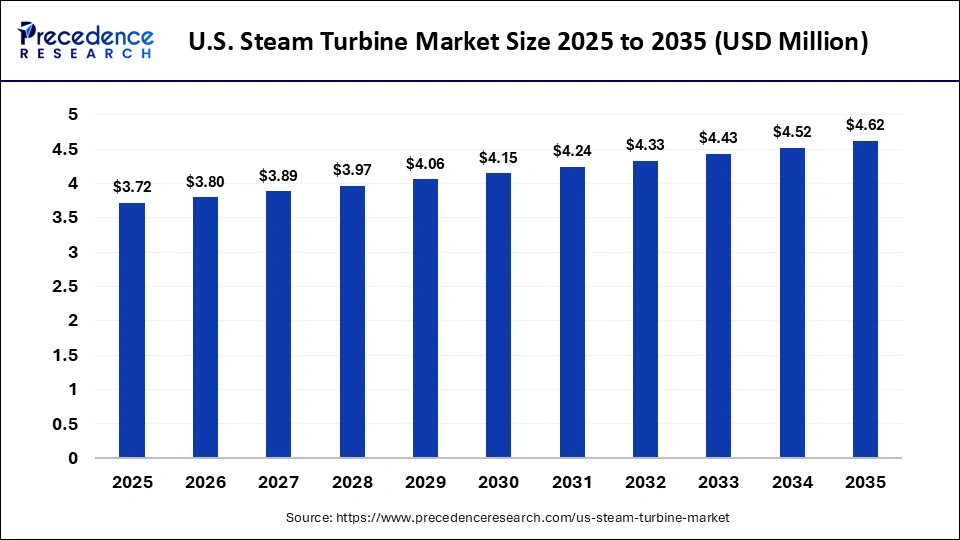
U.S. Steam Turbine Market Statical Scope
| Reports Attributes | Statistics |
| Market Size in 2025 | USD 3.72 Million |
| Market Size in 2026 | USD 3.8 Million |
| Market Size by 2035 | USD 4.62 Million |
| CAGR 2026 to 2035 | 2.20% |
| Base Year | 2025 |
| Forecast Period | 2026 to 2035 |
The market is crucial for the U.S. as it ensures grid reliability, improves industrial energy efficiency, and helps in the shift towards cleaner fuels. These systems transform pressurized steam into reliable baseload power for utilities, nuclear plants, and heavy manufacturing. Steam turbines deliver consistent electricity to counterbalance the variability of solar and wind energy. They utilize waste heat from gas turbines to improve overall power plant efficiency.
They act as the essential mechanical connection that converts nuclear thermal energy into zero-emission grid power. Refineries, chemical facilities, and paper mills rely on steam turbines for both process heating and electricity generation. The aging power infrastructure in North America creates a consistent demand for high-efficiency retrofits instead of expensive new constructions. Modern steam turbines are designed to accommodate new low-carbon technologies, such as biomass, carbon capture, and hydrogen co-firing.
U.S. Steam Turbine Market, By Design, 2025 (%)
| Segments | Shares (%) |
| Reaction | 62.00% |
| Impulse | 38.00% |
- Reaction - The reaction turbine segment, with a share of 62.00% in 2025, plays a dominant role in the U.S. steam turbine market as it offers high thermodynamic efficiency, manages continuous multi-stage steam expansion, and meets the large-scale base-load needs of utility, nuclear, and combined-cycle power plants.
- Impulse - The impulse segment, with a share of 38.00% in 2025, is crucial in the U.S. steam turbine market due to its high mechanical reliability, straightforward design, and outstanding capability to safely manage varying high-pressure steam loads across different industrial and power applications.
U.S. Steam Turbine Market, By Exhaust, 2025 (%)
| Segments | Shares (%) |
| Condensing | 71.00% |
| Non-condensing | 29.00% |
- Condensing - The condensing segment, with a share of 71.00% in 2025, accounts for the largest revenue share in the U.S. steam turbine market as it optimizes thermal efficiency, creates a vacuum at the turbine exhaust to boost power output, and facilitates valuable water recycling for closed-loop boiler systems, directly supporting the needs of large-scale utility and nuclear generation.
- Non-condensing - The non-condensing (or backpressure) segment, with a share of 29.00% in 2025, is significant in the U.S. steam turbine market as chemical, refining, pulp and paper, and food processing industries need to generate cost-effective onsite power while capturing exhaust steam for crucial industrial heating processes.
U.S. Steam Turbine Market, By Fuel, 2025 (%)
| Segments | Shares (%) |
| Fossil Fuel | 68.00% |
| Biomass | 17.00% |
| Geothermal | 15.00% |
- Fossil Fuel - The fossil fuel segment, with a share of 68.00% in 2025, leads the U.S. and global steam turbine market. It remains essential as natural gas and coal plants ensure base-load grid stability, improved combined-cycle efficiency, and support heavy industrial and chemical processing operations.
- Biomass - The biomass segment, with a share of 17.00% in 2025, is vital in the U.S. steam turbine market as it delivers reliable, dispatchable renewable power that helps stabilize intermittent green grids, contributes to industrial waste reduction, and meets strict federal and state decarbonization goals.
U.S. Steam Turbine Market, By End Use, 2025 (%)
| Segments | Shares (%) |
| Industrial | 43.00% |
| Utility | 57.00% |
- Industrial - The industrial sector, with a share of 43.00% in 2025, plays a key role in the U.S. steam turbine market by allowing energy-heavy facilities such as refineries, chemical plants, and paper mills to produce dependable on-site electricity and utilize waste heat for essential manufacturing processes through Combined Heat and Power (CHP) systems.
- Utility - The utility sector, with a share of 57.00% in 2025, is a leading force in the U.S. steam turbine market as it manages most of the generation capacity. It supports large power plants, maintains grid stability, and performs necessary infrastructure upgrades to comply with current efficiency and environmental regulations.
U.S. Steam Turbine Market, By Technology, 2025 (%)
| Segments | Shares (%) |
| Steam Cycle | 51.00% |
| Combined Cycle | 32.00% |
| Cogeneration | 17.00% |
- Steam Cycle - The steam cycle segment, with a share of 51.00% in 2025, is dominant in the U.S. steam turbine market as it is based on the Rankine cycle, which is fundamental for heavy baseload power generation. This drives large nuclear and traditional thermal generation fleets that provide consistent grid stability.
- Combined Cycle - The combined cycle segment, with a share of 32.00% in 2025, is important in the U.S. steam turbine market as it utilizes waste heat from natural gas
- turbines to power steam turbines, increasing overall plant efficiency. This method reduces fuel expenses, lowers emissions, and offers the flexible, reliable power required to support intermittent renewable energy sources.
Competitive Landscape
The U.S. steam turbine market is a competitive and consolidated field focused on utility-scale power generation, support for nuclear fleets, and upgrades for industrial efficiency. Major players include global engineering giants like GE Vernova, Siemens Energy, and Mitsubishi Power, along with various niche international and regional suppliers.
- GE Vernova is the clear market leader in North America, boasting a large installed base across fossil, nuclear, and industrial sectors. They provide high-efficiency steam power systems, nuclear steam turbines, and digital monitoring solutions aimed at reducing emissions and improving operational resilience.
- Siemens Energy is a significant tier-one competitor, offering strong equipment for U.S. utility and combined-cycle gas turbine (CCGT) plants. They supply industrial and utility steam turbines, such as the SST series, along with advanced digitalization packages and smart diagnostic tools for predictive maintenance.
- Mitsubishi Power (MHI) has a strong regional presence, delivering high-capacity thermal and advanced steam systems. They offer large-scale steam turbines designed for high efficiency, reliability, and integration into heavy thermal or nuclear cycles.
- Doosan Enerbility / Doosan Škoda Power is expanding its strategic presence in North America, recently winning orders for regional utility and data-center-supported power infrastructure. They provide tailored medium- to large-scale steam turbine and generator islands, including 370MW class units, along with long-term service agreements.
- Elliott Group is a key U.S. based industrial player that specializes in smaller-scale mechanical drive and power generation turbines. They offer single-stage and multi-stage industrial steam turbines customized for refineries, chemical plants, and decentralized energy applications.
Segments Covered in the Report
By Design
- Reaction
- Impulse
By Exhaust
- Condensing
- Non-condensing
By Fuel
- Fossil Fuel
- Biomass
- Geothermal
By End Use
- Industrial
- Utility
By Technology
- Steam Cycle
- Combined Cycle
- Cogeneration
For inquiries regarding discounts, bulk purchases, or customization requests, please contact us at sales@precedenceresearch.com
Frequently Asked Questions





Ask For Sample
No cookie-cutter, only authentic analysis – take the 1st step to become a Precedence Research client




 sales@precedenceresearch.com
 Schedule a Meeting



