



Voice and Language Intelligence Market Trends, Companies, Revenue / Sales Performance, Subscriber Growth, Pricing Strategies, Cloud Adoption, Infrastructure Expansion, Competitive Landscape, and Industry Outlook
Voice and Language Intelligence Market (By Component: Software platforms, APIs and SDKs, Professional services, Managed services; By Core Capability: Automatic speech recognition, Text to speech, Natural language understanding, Speech analytics, Voice biometrics; By Deployment Mode: Cloud, On-premise, Hybrid; By Application: Virtual assistants and conversational interfaces, Contact center intelligence, Transcription and documentation, Voice search and discovery, Security and authentication; By End-use Industry: BFSI, Retail and e-commerce, Healthcare and life sciences, Telecom and IT, Government and public sector, Manufacturing and automotive) - Global Industry Analysis, Size, Trends, Leading Companies, Regional Outlook, and Forecast 2026 to 2035
Source: https://www.precedenceresearch.com/voice-and-language-intelligence-market
 Get a Sample
 Table Of Content


What is the Voice and Language Intelligence Market Size in 2026?
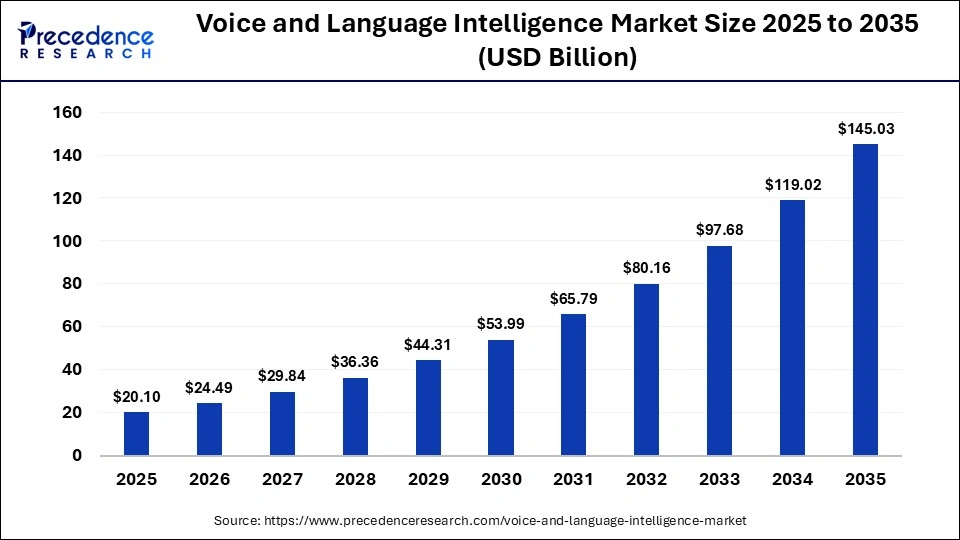
The global voice and language intelligence market size accounted for USD 20.10 billion in 2025 and is predicted to increase from USD 24.49 billion in 2026 to approximately USD 145.03 billion by 2035, expanding at a CAGR of 21.85% from 2026 to 2035. The market is primarily driven by advancements in AI technologies, increased demand for automated analytics, and the need for enhanced user interactions across diverse industries.
Key Takeaways
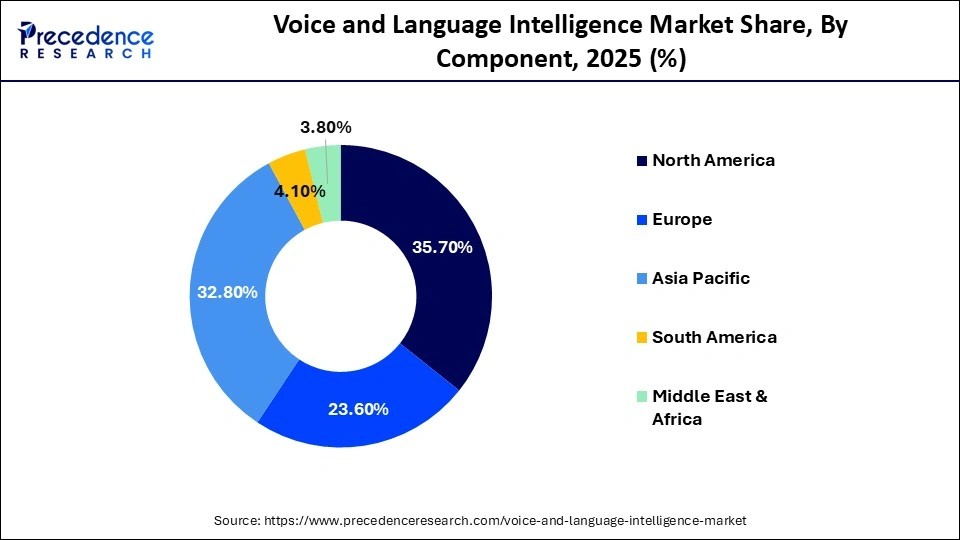
- North America dominated the market with a major share of 35.70% in 2025.
- Asia Pacific is expected to grow at the fastest CAGR between 2026 and 2035.
- By component, the software platform segment contributed the highest market share of 41.70% in 2025.
- By component, the APIs and SDKs segment is expected to grow at a strong CAGR between 2026 and 2035.
- By core capability, the automatic speech recognition segment held a major market share of 31.60% in 2025.
- By core capability, the natural language understanding segment is expected to expand at a notable CAGR from 2026 to 2035.
- By deployment mode, the cloud segment captured the highest market share of 61.40% in 2025.
- By deployment mode, the hybrid segment is poised to grow at a healthy CAGR between 2026 and 2035.
- By application, the contact center intelligence segment generated a major market share of 28.60% in 2025.
- By application, the virtual assistants and conversational interfaces segment is expected to expand at the fastest CAGR between 2026 and 2035.
- By end-use industry, the telecom and IT segment accounted for a major market share of 20.40% in 2025.
- By end-use industry, the healthcare and life sciences segment is projected to grow at a solid CAGR between 2026 and 2035.
What is Voice and Language Intelligence?
Voice and language intelligence refers to AI software and services that convert speech to text, synthesize speech, understand intent, extract insights, and automate actions from voice and language interactions. The market includes speech recognition, text-to-speech, language understanding, speech analytics, and voice biometrics delivered via platforms, APIs, and managed services. These solutions are used in contact centers, virtual assistants, healthcare documentation, voice search, and secure authentication across cloud, hybrid, and on-premises environments, and are monetized through subscriptions, usage-based pricing, and integration services.
How is AI Transforming the Voice and Language Intelligence Market?
Artificial intelligence (AI) is transforming the voice and language intelligence market by shifting from rigid command-based systems to human-like, context-aware conversations. Moving from reactive to proactive, these agents understand context, tone, and intent to engage in fluid, human-like dialogue. Advanced AI improves accuracy in noisy environments and generates natural-sounding voices with proper intonation and emotion. AI also enables seamless, instant translation across multiple languages and dialects, breaking down global communication barriers. Additionally, AI analyzes unique voiceprints for secure, passive authentication in high-security settings.
AI-powered VLI systems analyze tone, sentiment, and context to provide actionable insights, enhance customer interactions, and automate routine communication tasks. Additionally, AI facilitates multilingual support, predictive responses, and personalized user experiences, driving efficiency and adoption across sectors like customer service, healthcare, finance, and smart devices.
Major Trends in the Voice and Language Intelligence Market
- Adoption of Generative AI and Large Language Models (LLMs): Traditional, script-based voice agents are being replaced by LLM-powered systems that offer dynamic, context-aware, and unscripted conversations for natural, flowing interactions.
- Shift to Edge AI for Privacy and Performance: Voice recognition is moving from the cloud to on-device processing, which enhances data privacy, reduces latency for real-time applications, and enables functionality in offline settings.
- Advanced Voice Biometrics and Security: Voice AI is increasingly used for authentication in banking, finance, and healthcare, leveraging unique pitch, cadence, and dialect to prevent fraud and enable frictionless, secure, and touch-free verification.
- Immersive Multimodal Conversational Agents: Voice interfaces are becoming multimodal, combining voice input with visual data, gestures, and other contextual cues to deliver a richer, more human-like experience.
Market Scope
| Report Coverage | Details |
| Market Size in 2025 | USD 20.10 Billion |
| Market Size in 2026 | USD 24.49 Billion |
| Market Size by 2035 | USD 145.03 Billion |
| Market Growth Rate from 2026 to 2035 | CAGR of 21.85% |
| Dominating Region | North America |
| Fastest Growing Region | Asia Pacific |
| Base Year | 2025 |
| Forecast Period | 2026 to 2035 |
| Segments Covered | Component, Core Capability, Deployment Mode, Application, End-use Industry, and Region |
| Regions Covered | North America, Europe, Asia-Pacific, Latin America, and Middle East & Africa |
Segment Insights
Component Insights
How Did the Software Platform Segment Lead the Voice and Language Intelligence Market?
The software platform segment led the market with a 41.70% share in 2025, primarily due to the high demand for scalable, API-driven solutions that integrate NLP and machine learning to enhance accuracy and user experience. Vendors are consolidating capabilities such as neural text-to-speech, voice cloning, and multilingual support into unified platforms. Software is crucial for high-growth areas, including live transcription and automated customer support. The transition from rule-based to AI-driven voice agents, utilizing Large Language Models, has increased the dependence on software to facilitate context-aware, human-like conversations.
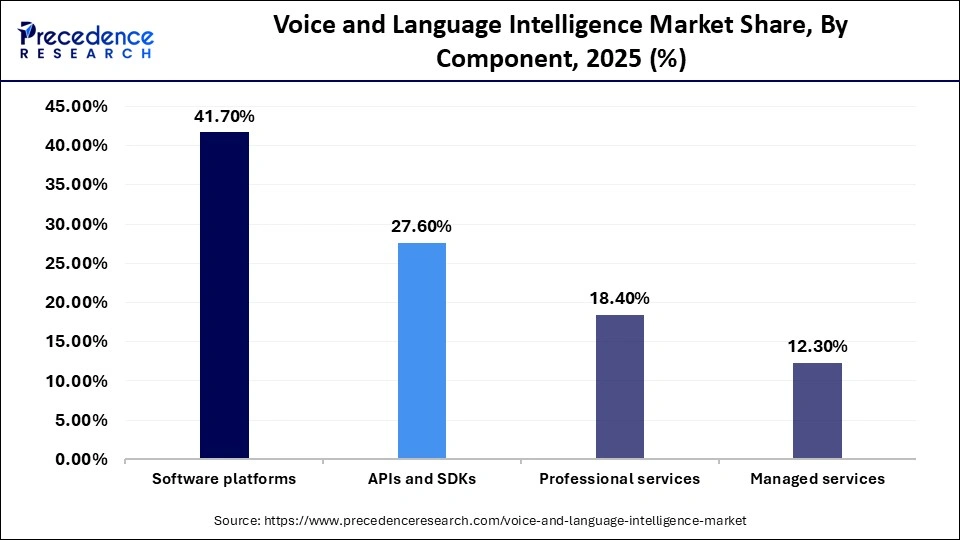
The APIs and SDKs segment is expected to grow at the fastest CAGR throughout the forecast period. This growth is driven by their provision of essential, modular building blocks that enable developers to quickly and cost-effectively integrate sophisticated voice AI capabilities into existing applications. These tools offer prebuilt libraries and developer-friendly documentation for various platforms, significantly reducing development time from months to days. APIs provide immediate access to the latest advancements in AI and deep learning, ensuring high accuracy.
Core Capability Insights
What Made Automatic Speech Recognition the Dominant Segment in the Voice and Language Intelligence Market?
The automatic speech recognition segment dominated the market with a 31.60% share in 2025. This dominance is mainly driven by its core capability to accurately convert spoken language into text in real time, enabling faster and more efficient processing of voice data. ASR is widely adopted across industries such as customer service, healthcare, and finance for transcription, call analysis, and voice-enabled applications. Its effectiveness in improving operational efficiency, enabling hands-free interactions, and integrating with AI-driven analytics and conversational platforms makes it the preferred choice.
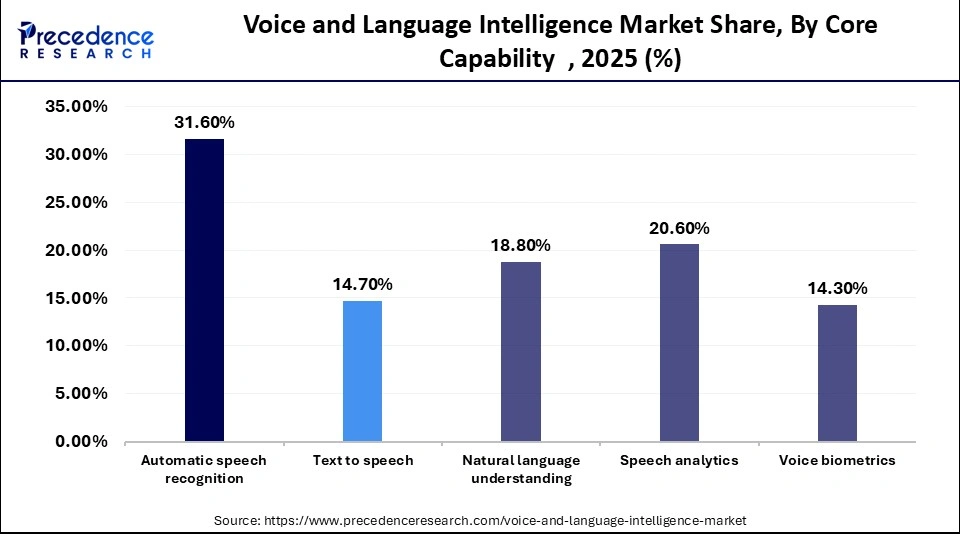
The natural language understanding segment is expected to experience the fastest growth in the coming years. This growth is primarily driven by the increasing demand for generative AI and large language models, which enable systems to comprehend user intent, sentiment, and context. This capability allows AI to manage complex interactions and provide personalized, human-like experiences in customer service, retail, and the BFSI sectors, resulting in high adoption rates. As voice-activated technologies and smart devices become more prevalent, the ability to convert spoken language into actionable commands becomes essential, driving demand for actionable insights.
Deployment Mode Insights
Why Did the Cloud Segment Lead the Voice and Language Intelligence Market?
The cloud segment led the market with the largest share of 61.40% in 2025, primarily due to its unmatched scalability, cost efficiency, and rapid integration of generative AI. Cloud-based systems allow small and medium-sized enterprises to access advanced AI technologies without incurring heavy capital expenditures on hardware, opting instead for a pay-as-you-go model. These platforms provide the computational power necessary for training large language models and processing vast datasets in real time, enabling instantaneous updates to AI models. Cloud-native solutions facilitate easier access to pre-built APIs, fostering faster deployment of conversational AI and NLP platforms.
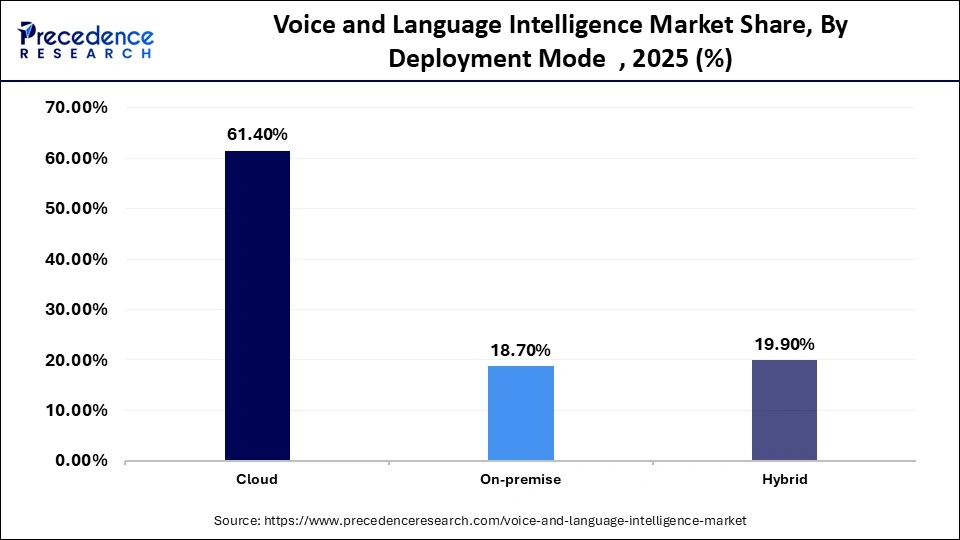
The hybrid segment is expected to expand at the fastest rate during the forecast period. This growth is primarily driven by its ability to bridge the gap between on-premise security and cloud scalability. As regulatory scrutiny increases, hybrid models enable the processing of sensitive voice data locally while leveraging cloud AI for non-sensitive tasks. In automotive and industrial applications, hybrid systems can ensure immediate response times without the need for constant, high-bandwidth connectivity. The demand for 24/7 service, multilingual support, and real-time analytics necessitates the flexible infrastructure provided by a hybrid model.
Application Insights
How Does the Contact Center Intelligence Segment Dominate the Voice and Language Intelligence Market?
The contact center intelligence segment holds a dominant position in the market, holding a major share of 28.60% in 2025. This leadership position is attributed to the rapid adoption of AI-driven tools, such as AI voice agents, which help reduce operating costs and improve first-call resolution rates. The transition from traditional interactive voice response systems to AI-powered chatbots and voice assistants facilitates 24/7 personalized support and increases task completion rates. Implementing AI reduces average handling times, boosts agent productivity, and decreases employee turnover. Additionally, it enhances security in industries like BFSI by utilizing unique voiceprints for authentication.
Voice and Language Intelligence Market Share, By Application, 2025 (%)
| Application | Market Share (%) |
| Contact Center Intelligence | 28.60% |
| Virtual Assistants and Conversational Interfaces | 24.70% |
| Transcription and Documentation | 16.40% |
| Security and Authentication | 15.70% |
| Voice Search and Discovery |
14.60% |
The virtual assistants and conversational interfaces segment is expected to expand at a robust CAGR in the coming years due to their ability to deliver 24/7 personalized customer service and automate complex enterprise workflows across various industries. The adoption of LLM enables contextual, multi-turn dialogues, resulting in higher user engagement. Virtual assistants are integrated across websites, applications, and messaging platforms, providing consistent user experiences. Significant adoption in sectors such as BFSI for fraud detection, and in healthcare for patient scheduling, is driving volume by enabling seamless, human-like interactions and reducing operational costs.
End-use Industry Insights
Why Did the Telecom and IT Segment Lead the Voice and Language Intelligence Market?
The telecom and IT segment led the market with a 20.40% share in 2025. This is mainly due to the high demand for AI-driven communication solutions, real-time customer support, and network analytics in these industries. Companies in telecom and IT leverage VLI for automated call analysis, sentiment detection, and intelligent virtual assistants to enhance customer experience and operational efficiency. Additionally, the rapid adoption of cloud-based services, contact center modernization, and the need for multilingual support have further strengthened the segment's dominance in the market.
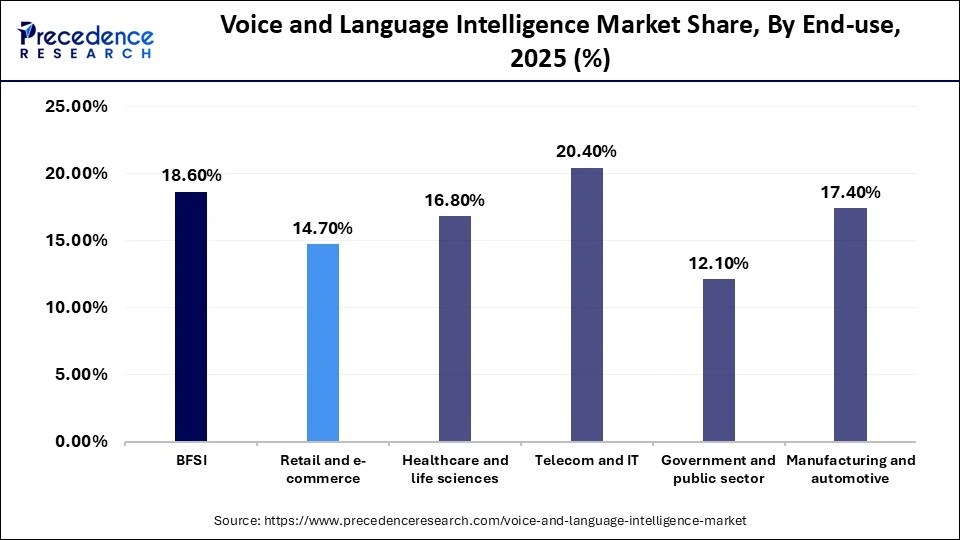
The healthcare and life sciences segment is expected to experience the fastest growth during the forecast period. This growth is driven by urgent needs for ambient clinical documentation, reduced administrative burnout, and vocal biomarker diagnostics. AI voice agents are replacing manual, outdated IVR systems for appointment scheduling, triage, and medication refills. AI is increasingly used to analyze speech, pitch, and cadence to detect early signs of disease, creating a new, high-growth, non-invasive diagnostic segment. Pharmaceutical companies utilize NLP to analyze vast amounts of unstructured clinical data, accelerating drug discovery and improving pharmacovigilance.
Regional Insights
North America Voice and Language Intelligence Market Size and Growth 2026 to 2035
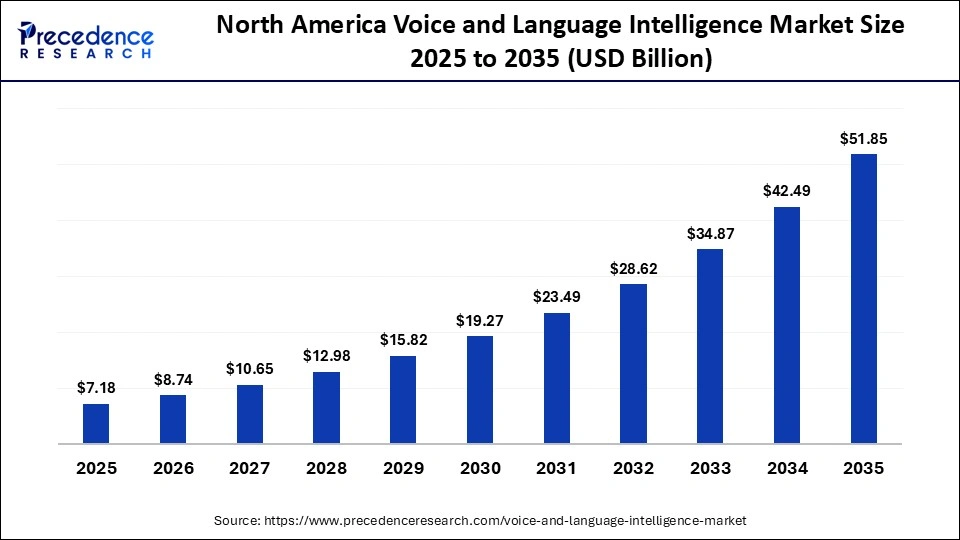
The North America voice and language intelligence market size is estimated at USD 7.18 billion in 2025 and is projected to reach approximately USD 51.85 billion by 2035, with a 21.86% CAGR from 2026 to 2035.
How Did North America Dominate the Voice and Language Intelligence Market?
North America dominated the voice and language intelligence market with a 35.70% share in 2025. The region's dominance in the market is mainly attributed to early adoption of AI, strong investment in research and development, and the presence of major tech giants. Widespread use of smart home devices, virtual assistants, and advanced cloud infrastructure also supported market growth in the region. The U.S. hosts leading companies like Google, Microsoft, Amazon, Apple, and IBM, which drive innovation in AI voice models. High demand for automation in healthcare and financial services boosts market growth. Robust venture capital funding and substantial research and development spending on AI and NLP technologies foster rapid advancements.
U.S. Voice and Language Intelligence Market Size and Growth 2026 to 2035
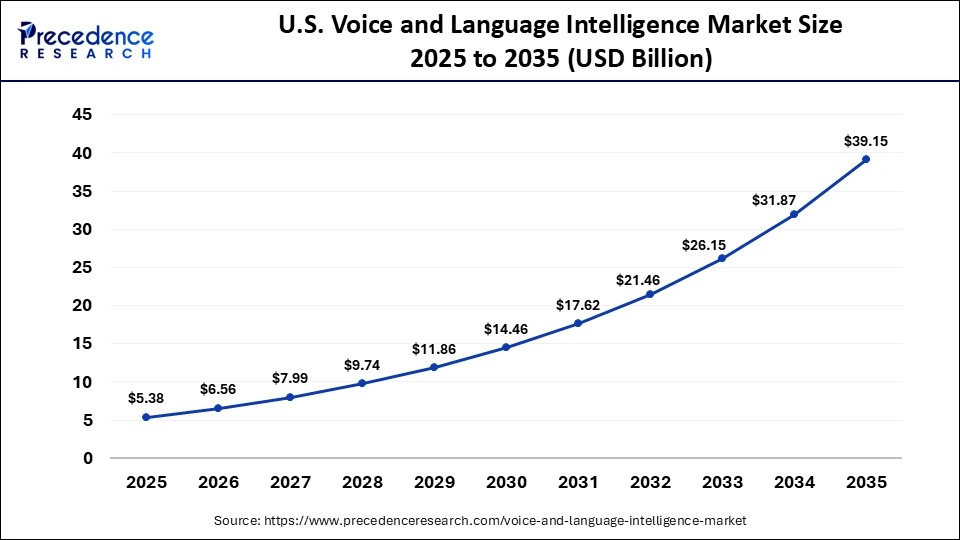
The U.S. voice and language intelligencemarket size is calculated at USD 5.38 billion in 2025 and is expected to reach nearly USD 39.15 billion in 2035, accelerating at a strong CAGR of 21.95% between 2026 and 2035.
U.S. Voice and Language Intelligence Market Trends
The U.S. plays a major role in the North American market, mainly because of its substantial investments in private AI and infrastructure development. U.S.-based companies like Microsoft, Google, Amazon, and IBM lead the development of foundational AI models, NLP, and sophisticated voice assistants. The U.S. is the center of AI research and development, with significantly higher investments compared to other nations. The adoption of conversational AI in banking, finance, and healthcare sectors further accelerates market growth.
Why is Asia Pacific Considered the Fastest-Growing Area in the Voice and Language Intelligence Market?
Asia Pacific is expected to grow at the fastest CAGR during the forecast period. This growth is primarily driven by widespread smartphone adoption, rapid digitalization, and a high demand for multilingual support among diverse populations. The surge in smartphone usage and IoT devices has created a large, receptive user base for voice-activated technology, especially in China, India, and Southeast Asia. Governments are heavily investing in AI to enhance productivity and manage large, diverse populations. Due to numerous languages and dialects, there is a high demand for advanced, localized speech recognition support regional accents and nuances, broadening accessibility.
India Voice and Language Intelligence Market Trends
The market in India is growing due to the rapid digitalization of businesses, widespread adoption of AI-powered customer support solutions, and increasing smartphone and internet penetration. It is a major contributor to global AI research and is a crucial hub for developing voice AI in regional languages, with initiatives like Digital India Bhashini supporting over 22 languages and dialects. Additionally, the government's push for digital services and initiatives like Digital India is accelerating the adoption of AI-driven voice and language technologies across the country.
Voice and Language Intelligence Market Companies
- Microsoft
- Amazon Web Services
- IBM
- NVIDIA
- Apple
- Samsung Electronics
- Baidu
- Huawei
- Nuance Communications
- Verint
- NICE
- Genesys
- SoundHound AI
- Speechmatics
Recent Developments
- In March 2026, Huawei launched next-generation voice virtual agents for its Artificial Intelligence Contact Center (AICC), enhancing customer service across various industries by improving self-service resolution rates. With a focus on domain-specific models along with intelligent agents, these agents exhibit Conversational Intelligence and Operational Agility, transitioning contact centers to end-to-end closed-loop systems for a more human-like interaction experience. Huawei aims to accelerate AI technology integration, boosting efficiency and customer experience.(Source: https://www.huawei.com)
- In February 2026, ElevenLabs and Google Cloud extended their collaboration to make AI voice tools more accessible. Their partnership enables ElevenLabs' real-time voice agents and multi-language content localization using Google Cloud's infrastructure. This technology serves various industries, allowing businesses to deploy AI agents for customer support and training, with solutions available on Google Cloud Marketplace.(Source: https://www.prnewswire.com)
- In February 2026, Sarvam AI launched Sarvam Audio, an audio-first large language model that specializes in real-world speech recognition across India's multilingual population. While competing with companies like ElevenLabs, Sarvam Audio emphasizes understanding and transcribing speech in Indian languages.(Source: https://www.businesstoday.in)
Segments Covered in the Report
By Component
- Software platforms
APIs and SDKs
Professional services
Managed services
By Core Capability
- Automatic speech recognition
- Text to speech
- Natural language understanding
- Speech analytics
- Voice biometrics
By Deployment Mode
- Cloud
- On-premise
- Hybrid
By Application
- Virtual assistants and conversational interfaces
- Contact center intelligence
- Transcription and documentation
- Voice search and discovery
- Security and authentication
By End-use Industry
- BFSI
- Retail and e-commerce
- Healthcare and life sciences
- Telecom and IT
- Government and public sector
- Manufacturing and automotive
By Region
- North America
- Asia Pacific
- Europe
- Latin America
- Middle East & Africa
For inquiries regarding discounts, bulk purchases, or customization requests, please contact us at sales@precedenceresearch.com
Frequently Asked Questions





Ask For Sample
No cookie-cutter, only authentic analysis – take the 1st step to become a Precedence Research client
 Get a Sample




 sales@precedenceresearch.com
 Schedule a Meeting
