


Semiconductor Market Trends, Leading Companies, Company Revenue / Sales Performance, Manufacturing Yield, Fab Capacity, Export & Import Dynamics, Sales Performance, Supply Chain Analysis, and Growth Forecast
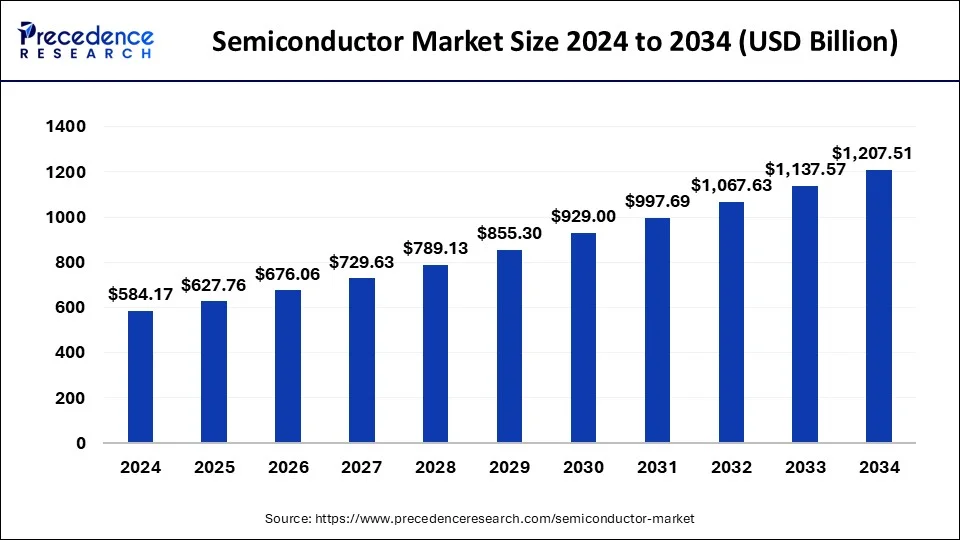
According to semiconductor and electronics specialist Laxmi Narayan, the semiconductor market is valued at USD 676.06 billion in 2026 and is forecast to reach USD 1,277.45 billion by 2035, reflecting a CAGR of 7.36%. Leading semiconductor market companies, including Taiwan Semiconductors, Samsung Electronics, Texas Instruments, are strengthening their presence across key segments such as by component , by application and region.
Source: https://www.precedenceresearch.com/semiconductor-market
 Get a Sample
 Table Of Content


What is the Semiconductor Market Size?
The global semiconductor market is projected to grow from USD 676.06 billion in 2026 to USD 1,277.45 billion by 2035, registering a CAGR of 7.36%. Growth is being driven by rising demand for AI, IoT, 5G, cloud computing, electric vehicles, and consumer electronics, alongside increasing government investment in domestic chip manufacturing and advanced semiconductor technologies. Asia Pacific dominated the market in 2025 with a 52.93% share, supported by its strong electronics manufacturing ecosystem and growing demand across China, Taiwan, and South Korea, while North America is expected to see the fastest growth on the back of expanding AI infrastructure, semiconductor fabrication investments, and government initiatives such as the CHIPS Act.
Semiconductor Market Key Takeaway
- Asia Pacific dominated the global market with the largest market share of 52.93% in 2025.
- By application, the network and communication segment contributed the highest market share of 29.75% in 2025.
- By component, the memory devices segment captured the biggest market share in 2025.
Market Overview
A semiconductor is a material valued for its distinctive electrical conductivity, sitting between insulators and full conductors in its ability to carry an electrical charge. This conductivity can be precisely engineered to power integrated circuits, transistors, and microchips, making semiconductors foundational to nearly every branch of modern electronics.
The growing sophistication of advanced electronics continues to benefit the broader semiconductor industry. High-purity materials remain essential to this process, with doping, the controlled introduction of small amounts of impurity into a material, used to precisely reconstruct electrical properties for electrified applications. Doping produces both positive and negative material types, enabling the fine-tuned electrical behavior that modern devices depend on.
Consumer electronics continue to demand ever-greater variation in electrical properties, and semiconductor materials are proving well suited to deliver it across applications including medical devices, solar panels, computers, vehicles, and smartphones. This adaptability is central to any thorough semiconductor market analysis, given how deeply connectivity now underpins both consumer devices and broader infrastructure.
How has AI Changed the Semiconductor Market?
The AI semiconductor market is expanding as chipmakers increasingly use artificial intelligence to automate chip design with greater speed and precision. In chip fabrication, AI can automatically analyze layout designs, flag deficiencies, and recommend modifications before fabrication begins, saving both time and cost. AI is also proving valuable in chip testing, where it helps predict points of potential failure ahead of deployment.
Within factories, AI systems increasingly manage machinery to improve speed and efficiency, with some systems capable of adjusting equipment automatically in real time when a fault is detected. AI is also being applied to identify optimal materials for use in chip production. Companies including Intel and NVIDIA are integrating AI in semiconductor manufacturing workflows to boost performance and compress development timelines. As chips continue to shrink and grow more intricate, AI's role in improving both performance and reliability is expected to expand further.
- For instance, TSMC uses AI across its factories to manage data from millions of sensors, helping the company identify machine errors more quickly and accurately.
Semiconductor Sales Predicted to Rebound Strongly in 2025
The global semiconductor industry delivered its strongest year on record in 2025, with sales reaching $791.7 billion, a 25.6% increase over 2024's total of $630.5 billion, driven largely by surging demand for AI hardware. Logic products led the market as the largest category at $301.9 billion (up 39.9%), followed by memory products at $223.1 billion (up 34.8%). Regionally, Asia Pacific posted the strongest annual growth at 45.0%, followed by the Americas at 30.5% and China at 17.3%, while Japan was the only major region to decline, down 4.7%. (Source: Semiconductor Industry Association, Feb 6, 2026)
Momentum has accelerated sharply through 2026. First-quarter sales reached $298.5 billion, up 25% over Q4 2025, and by April 2026 monthly sales hit $110.5 billion, a 93.9% increase year-over-year. On the back of this growth, SIA endorsed the WSTS Spring 2026 forecast projecting full-year 2026 sales will climb 90% to $1.5 trillion, with 2027 sales expected to exceed $1.9 trillion, driven by surging demand for AI infrastructure and accelerated computing platforms. (Source: Semiconductor Industry Association, Jun 5, 2026)
Technologies such as blockchain and AI are increasingly being explored to improve supply chain transparency and efficiency, offering real-time visibility into operations that help companies anticipate and respond to disruptions more effectively. Two indicators remain especially useful for tracking the industry's health: inventory levels and fab utilization rates. As of autumn 2023, inventories stayed elevated at over $60 billion, holding roughly level with the prior year. A surplus expected to weigh sales through the first half of 2024 as the industry worked to draw down excess stock. Fab utilization, which had been running strong during the recent chip shortage at around 95%, was anticipated to fall below 70% by the end of 2023; restoring industry-wide profitability will require a meaningful recovery in utilization over time.
The semiconductor sector was positioned for a transformative 2024, with advancements in AI, edge computing, 5G, sustainability, and supply chain resilience expected to drive innovation across multiple end-use industries. Companies that embraced these shifts and invested early in next-generation technology were best placed to lead the market and capture the opportunities ahead.
Semiconductor Market Growth Factors
- Broad usage of semiconductors across end-use applications, including electronics, industrial equipment, automotive, networking and communications, and data processing, remains the primary driver of semiconductor market growth globally.
Rising penetration of digital technologies and growing adoption of consumer electronics worldwide continue to support market expansion. - The growing popularity of artificial intelligence and the Internet of Things, both of which require memory chips capable of processing large volumes of data quickly, is expected to open further growth opportunities for market players.
Rapid growth in AI, machine learning, IoT, and wireless communications devices continues to encourage semiconductor demand. - The expansion of remote work globally has meaningfully increased demand for PCs and laptops, driving a corresponding rise in semiconductor consumption.
- Rapid urbanization and industrialization, paired with government investment in smart cities development, are expected to further boost semiconductor demand.
- Growing demand for semiconductors across industrial equipment and automotive applications has significantly increased overall consumption.
- The rising popularity and adoption of electric vehicle continues to fuel growth across the global semiconductor market, reflecting some of the strongest current semiconductor industry trends.
- Growing demand for integrated circuits in developing markets, driven largely by rising smartphone adoption and the corresponding need for mobile chips, is expected to further boost the semiconductor market.
Market Outlook
- Industry Growth Overview: The semiconductor market outlook remains strong, supported by significant mechanical and technological advances within the automotive sector. These innovations are creating real-time opportunities for manufacturers, prompting a shift toward more rigorous self-testing processes to meet the evolving demands of modern vehicles and smartphones, and reinforcing growth across the value chain.
- Sustainability Trends: Sustainability remains a fundamental priority across most industries, and the semiconductor sector is no exception. Meeting this priority requires validating the suitability of green chemistries across a substantial range of manufacturing resources. Growing emphasis on cleanroom standards is accelerating the deployment of environmentally conscious innovations that meet current industry benchmarks, an important thread within the broader semiconductor industry outlook.
- Global Expansion: Market expansion continues to be shaped by the adoption of advanced technologies and ongoing EV innovation. The growing use of silicon to support EV performance and modern infrastructure is contributing meaningfully to this expansion.
Semiconductor Market Trends
Escalating implementation of IoT, AI, and wireless communications is accelerating growth
Rising global demand for AI, IoT, and wirelessly connected devices is being met by companies such as Micron Technology, Inc., which supplies high-capacity memory and multi-chip packages built for AI training, deployed across embedded, cloud, and edge devices as well as mobile platforms, reflecting one of the more consequential semiconductor market trends currently shaping the industry.
Many of these newer products rely on a single system on a chip (SoC) to achieve high integration levels. SoC design allows devices to operate with improved power efficiency and stronger security by combining processors, memory, RF transceivers, sensors, power management, and connectivity into a single unit.
Memory technology trends are reshaping high-performance applications in data centers
Advances in memory technology, particularly NAND flash and Dynamic Random Access Memory (DRAM), continue to play a pivotal role across high-performance applications. Within data centers, demand for faster and more reliable storage has intensified alongside the exponential growth in data processing and storage requirements. NAND flash, valued for its non-volatile nature and high-speed data access, has become integral to data storage, retrieval, and management in these
environments, cementing its position within the broader memory semiconductor market.
Ongoing innovation in NAND flash technology, including the development of 3D NAND architectures, continues to expand storage capacity and improve data transfer speeds, helping the wider DRAM and NAND industry keep pace with evolving data center infrastructure needs.
Market Scope
| Report Highlights | Details |
| Market Size in 2025 | USD 627.76 Billion |
| Market Size in 2026 | USD 676.06 Billion |
| Market Size by 2035 | USD 1,277.45 Billion |
| Growth Rate from 2026 to 2035 | CAGR of 7.36% |
| Largest Market | Asia Pacific |
| Fastest Growing Market | North America |
| Base Year | 2025 |
| Forecast Period | 2026 to 2035 |
| Segments Covered | Component, Application, and Region |
| Regions Covered | North America, Europe, Asia-Pacific, Latin America and Middle East & Africa |
Market Dynamics
Drivers
Several forces are actively shaping semiconductor market dynamics across the forecast period, from rising end-use demand to shifting government policy and supply chain considerations, together forming the core set of semiconductor industry drivers outlined below.
Increasing demands for consumer electronics and wireless communications
- Rising global consumption of consumer electronics continues to drive positive market growth. A broad range of consumer products now depends on semiconductors, including communication devices (smartphones, tablets, smartwatches, and similar hardware), computers used in both personal and business settings, entertainment systems, and home appliances, collectively reinforcing strong semiconductor demand across categories.
- Demand for SiC semiconductors is also expected to grow further as fast charging becomes a standard feature across tablets and laptops. While relatively few laptop manufacturers currently offer fast charging, the broader industry trend is shifting toward GaN integration.
- In December 2020, Navitas Semiconductor, a pure-play next-generation power-semiconductor company, announced that Dell Technologies had adopted gallium nitride (GaN) technology for the first time through its GaNFast power ICs. GaNFast integrates a GaN power FET with drive, control, and protection circuitry, enabling up to three times more power delivery in half the size and weight compared with a silicon-based solution.
- Power semiconductors also play a central role across the communications industry, supporting technologies such as line cards, modems, routers, transmitters, base stations, and DC bricks. Continued growth in wireless communications has created significant opportunities for hardware component suppliers across the sector.
- Demand for large-capacity wireless transmission is expected to keep growing as global 5G commercialization accelerates, further boosting demand across connected applications such as connected cars (VR/AR) and high-definition video transmission.
- For instance, on March 30, 2023, SK Hynix, the world's second-largest memory chip manufacturer, announced plans to build a US$15 billion semiconductor facility in the United States, supported by the U.S. CHIPS Act, which offered US$52.7 billion in federal incentives to attract advanced chip production domestically.
Substantial government support
- In March 2023, Canada's Ministry of Innovation, Science and Industry announced a $36 million contribution to Ottawa-based Ranovus Inc., aimed at boosting domestic production of semiconductors and semiconductor-based products. Government backing of this kind, spanning semiconductor government incentives, research grants, and policies that favor domestic manufacturing, can meaningfully strengthen the industry ecosystem, accelerate technological progress, and support more resilient supply chains. Broader semiconductor manufacturing investment from public and private sources alike continues to foster innovation and boost R&D activity across the market.
Market Restraints
Shortage of silicon wafers
- Rising demand for consumer electronics, wireless communications, and high-energy, power-efficient devices across the automotive and electronics sectors continues to support market growth, but a persistent semiconductor supply shortage in silicon wafers, combined with tightening ROI considerations, remains among the clearer semiconductor market restraints facing the industry.
- For instance, according to Maruti Suzuki India CFO Mr. Ajay Seth, chip shortages caused the company (the Indian subsidiary of Japan-based Suzuki Motor Corporation) to fall roughly 46,000 units short of its production target between October and December 2022.
Human resources and training challenges in the complex world of semiconductor manufacturing
- Semiconductor design and manufacturing involve intricate processes that demand specialized expertise in materials science, physics, and chemistry, requiring a highly skilled workforce. The rapid pace of technological change across the industry means continuous training remains essential, while the precision required to operate advanced equipment adds further complexity. A persistent semiconductor workforce shortage, and the broader semiconductor manufacturing skills shortage it reflects, has contributed to rising labor costs and the risk of production delays across the sector.
Supply chain disruption
- The semiconductor supply chain relies heavily on global sourcing, with components and raw materials often drawn from multiple countries. Disruptions in transportation, logistics, or production in any single region can create delays and shortages that ripple across the wider market. Manufacturing depends on specialized inputs such as rare metals and advanced materials, and any interruption in their supply can lead to production delays and higher costs. The COVID-19 pandemic offered a clear illustration of this vulnerability, with factory closures, labor shortages, and movement restrictions all contributing to significant semiconductor supply chain disruption during that period.
Market Opportunities
Autonomous vehicles and advanced technologies
Autonomous vehicles represent a significant growth opportunity for the broader automotive semiconductor market, given their reliance on advanced sensors, processors, and other semiconductor components. Demand for autonomous vehicle semiconductors is further reinforced by the ongoing development of Advanced Driver-Assistance Systems (ADAS), Vehicle-to-Everything (V2X) communication, electric vehicles, and in-vehicle infotainment systems, all of which are expected to drive substantial growth across the category.
Nations are also increasingly forming Memoranda of Understanding (MoUs) and strategic partnerships to advance semiconductor industry development collaboratively. For instance, India and the United States signed an MoU in March 2023 to establish a semiconductor supply chain and innovation partnership under the framework of the India-U.S. Commercial Dialog.
Powering economic growth and security in the digital era
Semiconductors remain central to economic competitiveness and national security, underpinning the broader shift toward digital transformation, artificial intelligence, and 5G communications. Continued semiconductor industry investment is accelerating the financial feasibility of emerging technologies including augmented and virtual reality, the Internet of Things, Industry 4.0, and autonomous vehicles.
Growing commercialization of AI and 5G applications is also advancing packaging platforms such as Fan-Out Packaging and 3D Flip Chip technology, both aimed at addressing higher power-consumption needs while improving chip connectivity. This has prompted many companies to partner with OSAT vendors, with firms such as ASE/SPIL, Amkor, and JCET investing heavily in advanced SiP and fan-out technologies to strengthen their competitive position within broader semiconductor manufacturing.
- For instance, on March 16, 2023, Polymatech Electronics, a semiconductor chip manufacturer, announced plans to begin mass production of advanced semiconductor components in India for 5G and 6G applications, with manufacturing set to take place at its main facility in Kancheepuram, Tamil Nadu.
Penetration of advanced technologies in multiple sectors
Rising adoption of the Internet of Things (IoT) continues to advance advanced semiconductor technology across the global market. Growing demand for connected devices and smart appliances is driving the need for efficient, low-power semiconductor solutions, while expanding AI and machine learning applications require increasingly powerful processors and specialized chips, opening further opportunity for manufacturers. The healthcare sector, too, is increasingly dependent on advanced semiconductor applications for medical imaging, monitoring, and diagnostics, broadening the range of opportunities available to the market over the forecast period.
Market Challenge
Technological complexities
The global semiconductor industry operates at the leading edge of technology, and the increasingly advanced design and manufacturing processes involved bring significant semiconductor industry challenges to industry operators. Developing smaller, more powerful chips demands substantial R&D investment, and as process nodes approach their physical limits, miniaturization itself is becoming one of the more prominent semiconductor manufacturing challenges facing the market.
Segments Insights
Component Insights
The memory devices category dominated the semiconductor components market in 2025, driven by strong demand from smartphones, laptops, and cloud services. Devices such as DRAM and NAND flash depend on high-performance memory chips for storage, and major technology companies continue to build large-scale data infrastructure incorporating memory chips capable of handling vast data volumes efficiently, reinforcing steady growth across the broader memory semiconductor market.
Application Insights
The networking and communications segment accounted for approximately 29.75% of overall market share in 2025 and is projected to remain dominant throughout the forecast period, reflecting one of the largest categories of semiconductor applications. This is largely attributable to rising global adoption of smartphones and other smart devices; according to the ITU, roughly 4 billion people worldwide now have internet access, with most connecting via smartphones, a figure expected to rise further and meaningfully support this segment's continued growth.

The automotive segment is expected to be the fastest-growing category over the forecast period, driven by rising vehicle adoption across both developed and developing markets. Demand for private vehicles remains especially strong in developed regions such as North America, where limited public transport availability and consumer preference for convenience continue to support ownership. The growing global popularity of electric vehicles is further boosting demand across the automotive semiconductor market, expected to translate into sustained semiconductor demand in the years ahead.
Regional Insights
Asia Pacific Semiconductor Market Size and Growth 2026 to 2035
The Asia Pacific semiconductor market size was estimated at USD 332.95 billion in 2025 and is anticipated to reach around USD 688.30 billion by 2035, growing at a CAGR of 7.53% from 2026 to 2035.

Asia Pacific led the global semiconductor market in 2025 by revenue and is expected to sustain that leadership throughout the forecast period. The region benefits from a substantial consumer base, rising disposable income, growing demand for industrial processing and consumer electronics, rapid urbanization, and continued industrialization, all of which have collectively boosted semiconductor consumption. Countries such as China, Taiwan, and South Korea remain especially well established within the electronics manufacturing landscape, with rising consumption of a wide range of consumer electronics continuing to support growth across the Asia Pacific semiconductor industry. Growing penetration of IoT devices, artificial intelligence, and virtual reality is expected to further reinforce regional momentum in the years ahead, reflecting the broader semiconductor market by region picture across Asia Pacific.
China Semiconductor Market Trends
China remains the leading country within the Asia-Pacific semiconductor landscape, home to a diverse base of chipmakers and extensive manufacturing capacity across consumer electronics. Through its "Made in China 2025" initiative and related policy efforts, the Chinese government continues to invest billions of dollars in support of domestic chipmakers. The country is actively developing its own semiconductor supply chains and funding new technologies to reduce reliance on foreign suppliers over time.
China is increasingly focused on producing chips for electric vehicles, smartphones, and AI-enabled devices, while continued investment in smart manufacturing facilities is helping improve chip quality across the board. Backed by substantial government support and a large domestic consumer electronics market, the broader China semiconductor market continues to expand rapidly, with the China semiconductor industry remaining a central pillar of the country's broader technology and manufacturing strategy.

Growth of the Semiconductor Market in North America
The semiconductor market in North America is growing at the fastest rate. The U.S. government is investing heavily to boost domestic chipmaking and reduce reliance on others. Many large companies like Intel, NVIDIA, and Qualcomm are expanding their production and increasing spending. The boom in AI, 5G technologies, cloud computing, and electric vehicles, therefore, is creating demand for more advanced chips. Additionally, with so many new factories established in the U.S., there are many new factories coming online to produce powerful and energy-efficient chips. North America has great engineering talent, excellent universities that support research, and valuable opportunities for innovation, therefore. North America has great prospects to be among the leaders in next-generation chips with innovative partnerships, local production, and support from the government and others.
U.S. Semiconductor Market Trends
The U.S. is the leading country in the North America semiconductor market. The U.S. has many of the biggest chipmakers in the world, including Intel and Qualcomm. The U.S. government's CHIPS Act provides financial aid and incentives for businesses to build new factories and invest in new technologies. The U.S. has more of the latest design tools in order to produce more powerful chips for automations, AI, 5G, and cloud computing than any other country. The demand for smart devices, such as electric vehicles, is increasing. American chip firms are constantly working on making chips faster, smaller, and more efficient.
Growth of the Semiconductor Market in Europe
Europe shows a significant growth during the forecast period. It is driven by an intense need for automotive electronics such as electric vehicles, industrial automation, and 5G technologies. The EU is thus investing billions to secure its supply chain, with major manufacturing centres in Germany, France, and the Netherlands. Examples involve TSMC's planned facility in Dresden.
Latin America's Growing Semiconductor Industry
Latin America shows a notable growth during the forecast period. It is growing mainly to diversify global supply chains, decrease reliance on Asia, and even leverage proximity to the U.S. market. The region is developing a specialized workforce along with improving its technological infrastructure, with countries such as Brazil fostering R&D and design centers. Governments are providing incentives within free trade zones to attract foreign investment in the semiconductor sector.
Driving Innovation of the Semiconductor Industry in MEA
MEA shows a rapid growth during the forecast period. It is mainly motivated by a strategic change to diversify economies away from oil dependency, speed up digital transformation, and even strengthen supply chain resilience. To tackle the shortage of skilled labor, governments are collaborating with universities and investing in technical training programs in nanotechnology, along with chip design.
Production, Manufacturing, and Investment Data of the Global Semiconductor Market
- Taiwan Semiconductor Manufacturing Co., a globally leading manufacturer of semiconductors stood at a strong revenue of $75.881 billion for the financial year 2022. As of 2023 data, the company produces about 10 million semiconductor wafers per year.
- The Indian government has recently announced to boost its manufacturing capacity for semiconductors. The government has also launched a program ‘Semicon' to promote the production of semiconductors in the country with an outlay of Rs.76,000 crore.
- The CHIPS Act 2022 by the United States government includes $52 billion for chip manufacturing, the act also offers incentives and tax credit for semiconductor manufacturing companies. The element under this act is supposed to support the production and manufacturing of semiconductor chips by strengthening the nation's semiconductor market.
- According to the Semiconductor Industry Association, the United States exported $61.1 billion in semiconductors in 2022.
- Intel, one of the most prominent manufacturers of semiconductor chips stated in January 2023 that it has invested $20 billion in two new semiconductor chips factories in Ohio.
- In 2022, China established total 433 new companies for chip design and production. The total sales of Chinese semiconductor companies increased to $573 billion.
- In March 2023, the United States exported semiconductor devices to Mexico worth 125 million.
- The country even exported semiconductor devices to Germany in the same period worth $60.1 million.
- In April 2023, China's export for semiconductor devices reached up to $6.02 billion, the semiconductor export business in China showed a positive trade. In the month of April 2023, China mostly exported semiconductor devices to Netherlands worth $1.07 billion.
- The Canadian government has planned to spend $181.94 million on the country's domestic semiconductor production industry.
Value Chain Analysis
- Raw Material Procurement (Silicon Wafers, Gases) - The compelling raw material procurement is exceeding due to its protective element to the purity innovation. The smooth resources merge into the final product, promoting stability. The component as a business is gaining traction in the market, with smart revenue built up.
Key Players: SUMCO Corporation, GlobalWafers and Shin-Etsu Chemical. - Wafer Fabrication (Front-end) - The front-end wafer fabrication is a process that helps the fresh silicon disc to meet the microcircuit needs. This transition in the disc sets a definitive standard for the speed and potential required for the electrifying products.
Key Players: ASML, Lam Research and Tokyo Electron. - Assembly and Packaging (Back-end) - Assembly means final functional chips after the successful front-end process. The chips are a safety shield for the electrical innovations. The utilization of modernized operations tends to go to niche effective elements to unlock the chips' potential. This marks an excellent performance by the chip integration in the compatible devices.
Key Players: Amkor Technology, JCET Group and ASE Technology Holding.
Top Companies in the Semiconductor Market & Their Offerings
- Broadcom, Inc.: Broadcom, Inc. is a leading supplier of advanced semiconductor devices, aiming on high-performance networking, AI, wireless, and storage solutions for data centers as well as enterprise infrastructure.
- Taiwan Semiconductors: Taiwan Semiconductor Manufacturing Company offers essential, high-efficiency manufacturing for major tech companies such as Apple, AMD, Nvidia, and Qualcomm, powering the AI, smartphone, and automotive industries.
- Samsung Electronics: Samsung Electronics offers a comprehensive portfolio, which includes advanced memory, System LSI, and even 3nm foundry services. They serve AI, 5G, automotive, and data center markets with specialized, power-efficient, and even high-performance solutions.
- Texas Instruments: Texas Instruments provides a vast portfolio of over 80,000 analog and embedded processing chips, mainly targeting industrial, automotive, personal electronics, and communications infrastructure markets. Their core offerings aim on power management, transmission, data sensing, and signal processing, targeting to make electronics more efficient, reliable, and affordable.
Semiconductor Market Companies

- Intel Corporation
- Qualcomm Technologies, Inc.
- Broadcom, Inc.
- Taiwan Semiconductors
- Samsung Electronics
- Texas Instruments
- SK Hynix
- Micron Technology
- NXP Semiconductors
- Maxim Integrated Products, Inc.
Recent Developments
- In August 2025, Ainos entered into a three-year, $2.1 million subscription agreement with ASE Technology Holding Co. Ainos subsequently deployed 1,400 AI Nose units at three semiconductor manufacturing locations in Taiwan. This was Ainos' first industrial deployment of its scent digitization platform, used for a chip factory. (Source: https://ng.investing.com)
- In August 2025, after Ainos announced the AI Nose deal with ASE, its stock price jumped, ultimately rising just over 50 percent. This was also a first for major industrial revenue for Ainos and helped to get investors excited about commercializing its SmellTech as a Service platform in semiconductor manufacturing environments. (Source: https://www.ainvest.com)
- In August 2025, Taiwan Semiconductor Manufacturing Co. (TSMC) stated it would dedicate $100 billion in the U.S. to construct three fabrication plants, two packaging plants, and a research-and-development facility in Arizona. The expansion was outlined by TSMC's CEO at the White House and came as part of an effort to decrease its supply-chain risk while employing thousands of Union jobs in the U.S. market. (Source: https://www.marketbeat.com)
- In August 2025, Former President Trump announced a 100 percent tariff on all imported semiconductors, excepting those companies building or operating factories in the U.S. The tariff was meant to encourage domestic semiconductor production, including fabricated chips from Apple and TSMC, as the previous lion's share of tax-producing semiconductor business. (Source: https://www.qcnews.com)
- In August 2025, Merck KGaA, Darmstadt, Germany, and Electroninks announced they would work together to bring next-generation Backside Metallization (BSM) solutions to market using metal-organic decomposition inks for next-generation advanced semiconductor packaging. The collaboration will address the critical thermal management and warpage issues associated with hybrid bonding and wafer/panel-level packaging. (Source: https://www.timesnownews.com)
Segments Covered in the Report
By Component
- Logic Devices
- MPU
- Power Devices
- MCU
- Analog IC
- Memory Devices
- Sensors
- Discrete Power Devices
- Others
By Application
- Data Processing
- Industrial
- Networking & Communications
- Consumer Electronics
- Automotive
- Government
By Geography
- North America
- U.S.
- Canada
- Europe
- U.K.
- Germany
- France
- Asia Pacific
- China
- India
- Japan
- South Korea
- Rest of the World
For inquiries regarding discounts, bulk purchases, or customization requests, please contact us at sales@precedenceresearch.com
Frequently Asked Questions
Tags





Ask For Sample
No cookie-cutter, only authentic analysis – take the 1st step to become a Precedence Research client
 Get a Sample




 sales@precedenceresearch.com
 Schedule a Meeting