



AI and RAN Traffic Optimization Market Trends, Companies, Revenue / Sales Performance, Subscriber Growth, Pricing Strategies, Cloud Adoption, Infrastructure Expansion, Competitive Landscape, and Industry Outlook
AI and RAN Traffic Optimization Market (By Component: Hardware, Software, Services; By Optimization Type: Traffic Load Balancing, Resource Allocation, Spectrum Optimization, Interference Mitigation, Energy Optimization, Others (Coverage and Capacity Optimization, Latency Reduction, etc.); By End-User: Telecommunication Service Providers, Enterprises) - Global Industry Analysis, Size, Trends, Leading Companies, Regional Outlook, and Forecast 2026 to 2035
Source: https://www.precedenceresearch.com/ai-and-ran-traffic-optimization-market
 Get a Sample
 Table Of Content


What is the AI and RAN Traffic Optimization Market Size in 2026?
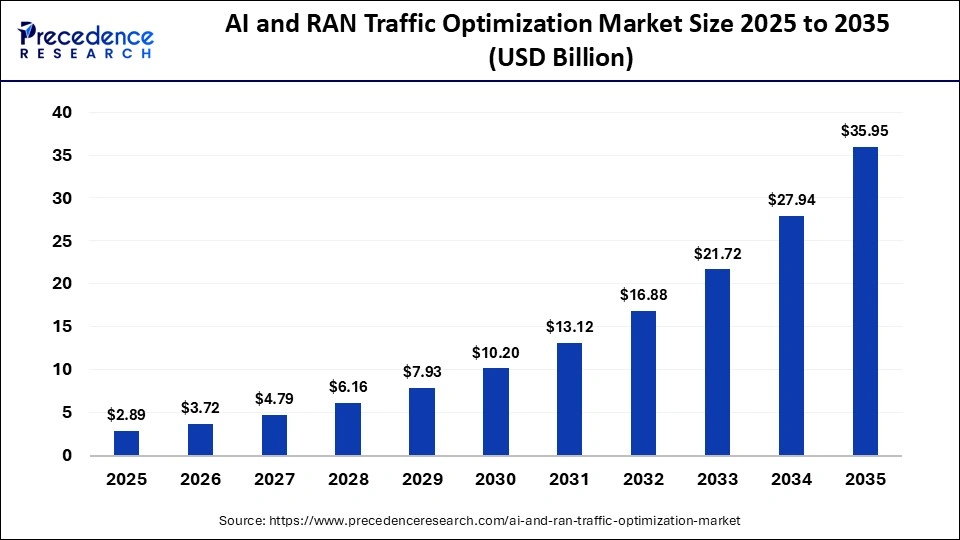
The global AI and RAN traffic optimization market size was calculated at USD 2.89 billion in 2025 and is predicted to increase from USD 3.72 billion in 2026 to approximately USD 35.95 billion by 2035, expanding at a CAGR of 28.65% from 2026 to 2035. The market is driven by growing mobile data traffic, rapid 5G network adoption, and the use of AI in real-time network optimization.
Key Takeaways
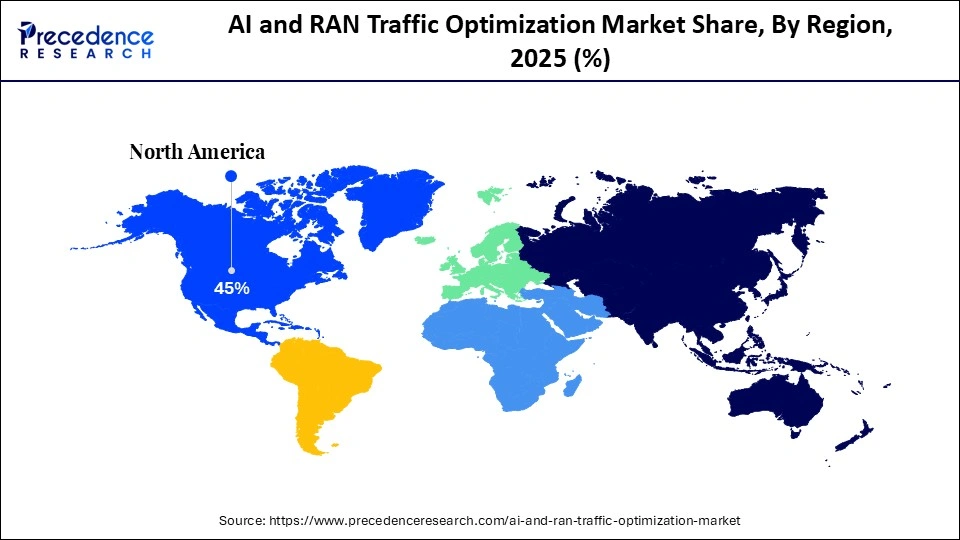
- North America led the AI and RAN traffic optimization market with the largest share of 45% in 2025.
- Asia-Pacific is expected to grow at the highest CAGR during the forecast period.
- By component type, the hardware segment led the market with the highest share of 41% in 2025.
- By component type, the services segment is expected to grow at a notable CAGR during the forecast period.
- By optimization type, the traffic load balancing segment dominated the market with a share of 29% in 2025.
- By optimization type, the resource allocation segment is expected to grow at a notable CAGR between 2026 and 2035.
- By end-user, the telecommunication services provider segment led the market with the largest share of 63% in 2025.
- By end-user, the enterprises segment is expected to expand at the highest CAGR from 2026 to 2035.
What is the AI and RAN Traffic Optimization Market?
The market for AI and RAN traffic optimization relates to the application of AI for Radio Access Network(RAN) optimization, which entails traffic prediction, load management, resource allocation, and interference mitigation. The market is applicable to 4G, 5G, and upcoming 6G networks, primarily due to the adoption of 5G technology, increased data traffic, Internet of Things(IoT), and the need for autonomous RAN management. The target customers include telecom operators and businesses with private 5G networks.
The AI models employed in the RAN traffic optimization process include supervised learning for traffic forecasting, unsupervised learning for anomaly identification, and reinforcement learning for decision making. The AI models are trained on a massive amount of data from the network, such as user activity, signal quality, and traffic dynamics. These models are implemented at centralized or edge nodes for real-time processing. The process of implementation entails the integration of AI technology with RAN controllers and network management infrastructure. Advanced AI algorithms facilitate automated load balancing, resource management, and congestion control.
Technology Shifts in the AI and RAN Traffic Optimization Market
The AI and RAN traffic optimization market is undergoing a significant technological transformation, shifting from manual network optimization to AI-native, autonomous RAN optimization with predictive analytics and no-touch orchestration. The conventional hardware-focused RAN is undergoing a transition to cloud-native, virtualized RAN solutions such as vRAN and Open RAN. These modern solutions support flexible AI integration and multi-vendor interoperability.
The market is also experiencing a rise in hybrid AI model architectures that integrate statistical approaches with deep learning for more reliable network predictions. Algorithms such as time series forecasting models are being developed to better address bursty and non-linear network traffic. On the system level, there is rising adoption of RAN Intelligent Controllers(RIC) in Open RAN, where xApps and rApps execute customized AI algorithms for specific use cases. Closed-loop control systems are being developed, which combine real-time telemetry with AI interference engines to make near-instant network adjustments without human intervention.
AI and RAN Traffic Optimization Market Trends
- Collaborations and Partnerships: Telecom organizations are collaborating with IT companies to develop AI-native RAN architectures and integrate AI workloads with telecom network infrastructure. These partnerships are centered on shared computing resources, facilitating the concurrent processing of AI and RAN traffic optimization. For instance, Nokia collaborated with NVIDIA, KDDI, and T-Mobile to jointly develop AI-RAN solutions for enhancing telecom network performance and efficiency.
- Government Initiatives: Governments are supporting AI-driven telecom innovation through global collaborations, funding initiatives, and policy support for 5G/6G and Open RAN. These initiatives are aimed at creating intelligent and adaptive telecom networks that can handle future data traffic requirements. The Indian Department of Telecommunications partnered with the U.K to develop AI, Open RAN, and next-generation telecom technologies.
- Business Expansions: Telecom operators are diversifying their businesses by entering the AI-enabled telecom network services and cloud computing space to capitalize on traffic optimization and infrastructure capabilities. Telecom firms are investing in AI-native telecom network ecosystems to enable edge computing, automation, and efficient data processing. For instance, Rakuten Mobile expanded its AI-based Open RAN telecom network capabilities to optimize traffic and provide innovative telecom network services worldwide.
Market Scope
| Report Coverage | Details |
| Market Size in 2025 | USD 2.89 Billion |
| Market Size in 2026 | USD 3.72 Billion |
| Market Size by 2035 | USD 35.95 Billion |
| Market Growth Rate from 2026 to 2035 | CAGR of 28.65% |
| Dominating Region | North America |
| Fastest Growing Region | Asia Pacific |
| Base Year | 2025 |
| Forecast Period | 2026 to 2035 |
| Segments Covered | Component, Optimization Type, End-User, and Region |
| Regions Covered | North America, Europe, Asia-Pacific, Latin America, and Middle East & Africa |
Segmental Insights
Component Type Insights
Why Did the Hardware Segment Dominate the AI and RAN Traffic Optimization Market?
The hardware segment dominated the market in 2025. The market growth of this segment can be attributed to the significant dependence of AI and RAN systems on high-performance hardware. These systems require GPUs, edge servers, and advanced baseband units for the real-time processing of network traffic. The telecom operators have significantly invested in massive MIMO radios and AI-optimized chipsets to support the increasing data traffic with low latency.
The services segment is expected to grow at a notable CAGR from 2026 to 2035. The market growth of this segment is due to increasing requirements for consulting, system integration, deployment, and managed services related to AI-driven RAN traffic optimization solutions. As telecom networks are becoming increasingly complex with the integration of 5G and the transition to 6G, telecom operators are relying on third-party assistance for the implementation of AI models. This facilitates proper integration with their existing infrastructure and the smooth functioning of the AI models in a multi-vendor environment.
Optimization Type Insights
Why Did the Traffic Load Balancing Segment Dominate the AI and RAN Traffic Optimization Market?
The traffic load balancing segment led the market in 2025. The market growth of this segment can be attributed to its importance in handling network congestion by intelligently distributing data traffic across cells, frequencies, and network nodes. With the rapid growth of mobile data usage in video streaming, gaming, and cloud services, telecom service providers are focusing on solutions that minimize network congestion. The use of AI in load balancing enhanced the market adoption of this segment as it facilitates real-time traffic analysis and dynamic resource allocation.
The resource allocation segment is expected to grow at a notable CAGR during the forecast period. The market growth of this segment is due to increasing demand for optimizing the usage of spectrum, bandwidth, and power in telecom networks. AI plays an important role in automating this process by constantly monitoring the network conditions and making dynamic changes to the resource allocation. This increases the efficiency of the network, and as a result, there is a significant adoption of resource allocation solutions.
End User Type Insights
Why Did the Telecommunication Services Provider Segment Dominate the AI and RAN Traffic Optimization Market?
The telecommunication services provider segment dominated the market in 2025. The market growth of this segment can be attributed to its direct influence on RAN infrastructure. Due to increased usage of mobile data and the implementation of 5G networks, the telecommunication service providers implemented AI-based optimization to manage congestion. This segment has robust investment capabilities and a significant need for efficient network operations.
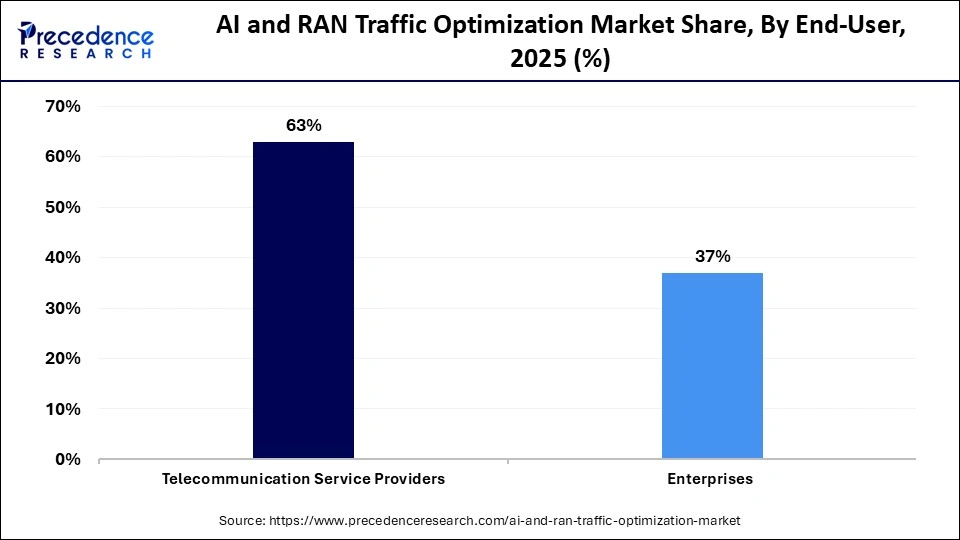
The enterprises segment is expected to grow at the highest CAGR during the forecast period. The market growth of this segment is due to the rising adoption of private networks and enhanced connectivity solutions by businesses. These solutions incorporate AI-driven RAN optimization to support applications such as IoT, automation, and real-time processing. The increasing requirement for a reliable and low-latency network in manufacturing, logistics, and smart infrastructure industries. Enterprises are also investing in AI to optimize network efficiency and ensure consistent performance for critical operations.
Regional Insights
North America AI and RAN Traffic Optimization Market Size and Growth 2026 to 2035
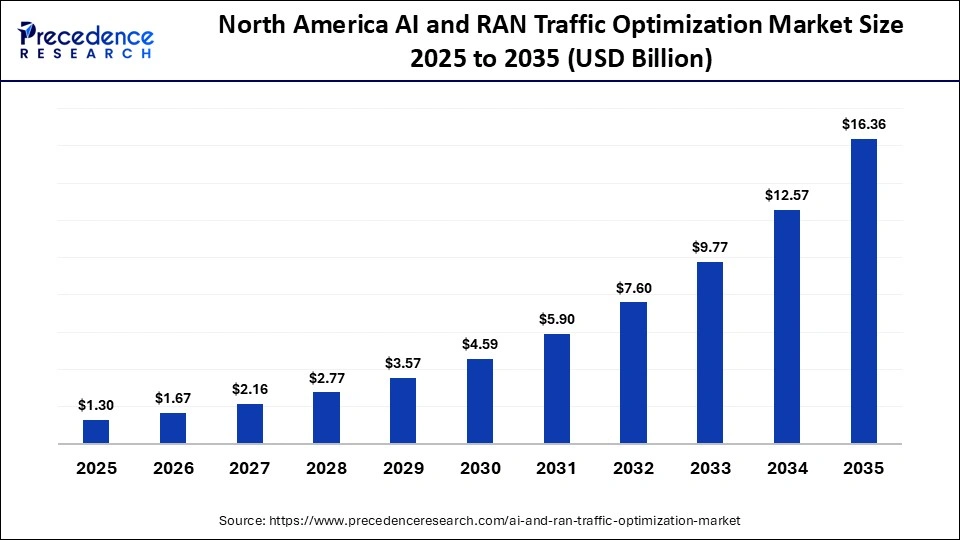
The North America AI and RAN traffic optimization market size is estimated at USD 1.30 billion in 2025 and is projected to reach approximately USD 16.36 billion by 2035, with a 28.82% CAGR from 2026 to 2035.
What Made North America the Leading Region in the AI and RAN Traffic Optimization Market?
North America dominated the market in 2025. The market growth in this region is due to early adoption of AI technologies and a developed telecom network. This region boasts a robust 5G network and ongoing efforts to enhance network capabilities. Telecom service providers are actively adopting AI-based RAN optimization to deal with heavy data traffic. The presence of leading tech companies and high smartphone and data usage further fueled market development. Additionally, favorable regulatory policies and innovation in network automation accelerated the adoption of AI technology. This synergy of innovation and investment enabled North America to retain its leading market position.
U.S. AI and RAN Traffic Optimization Market Size and Growth 2026 to 2035
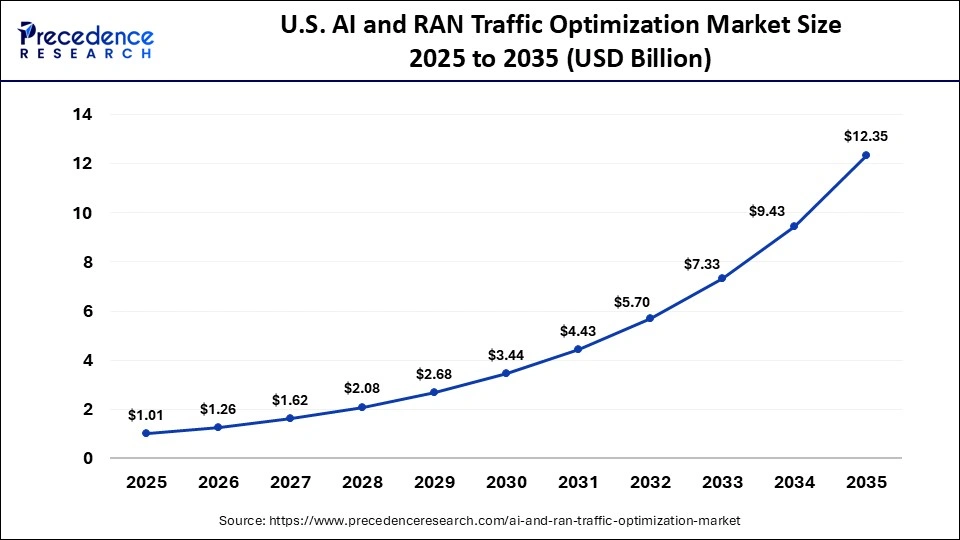
The U.S. AI and RAN traffic optimizationmarket size is calculated at USD 1.01 billion in 2025 and is expected to reach nearly USD 12.35 billion in 2035, accelerating at a strong CAGR of 28.85% between 2026 and 2035.
The U.S AI and RAN Traffic Optimization Market Analysis
The U.S. is at the forefront of the market growth in North America, thanks to its highly developed telecom ecosystem and early adoption of AI-based network solutions. This country has widespread 5G coverage and ongoing efforts to upgrade its network infrastructure and integrate AI into RAN management. The telecom providers in the U.S. are actively working on AI-based traffic management solutions to cope with the growing demand for data and ensure low latency and high network reliability. The presence of major technology companies and innovation ecosystems also helps to accelerate the development and adoption of AI solutions.
What Made Asia Pacific the Fastest Growing Region in the AI and RAN Traffic Optimization Market?
Asia Pacific is expected to grow at the highest CAGR from 2026 to 2035. The market growth in this region can be attributed to the rapid growth of telecom infrastructure and the adoption of 5G technology. This region has a huge and growing subscriber base, resulting in a rapid rise in mobile data traffic and the need for effective network management. Telecom service providers are actively investing in AI-based RAN optimization to enhance network performance and address congestion. The presence of strong government support, digital transformation, and the adoption of IoT and smart technologies is further fueling the market growth in the Asia Pacific.
China AI and RAN Traffic Optimization Market
China is at the forefront of market growth in the Asia Pacific region because of its massive 5G network rollout and government support for AI and telecom development. China has the second-largest number of mobile subscribers, which generates huge data traffic, thereby requiring efficient RAN optimization. The availability of major telecom equipment manufacturers and steady investments in digital infrastructure further fuel market growth. The adoption of IoT, smart cities, and industrial automation is gaining momentum, thereby boosting the need for advanced network optimization.
AI and RAN Traffic Optimization Market Companies
- Cisco Systems, Inc.
- Qualcomm Technologies
- Nokia Corporation
- Telefonaktiebolaget LM Ericsson
- Huawei Technologies Co., Ltd.
- Samsung Electronics
- ZTE Corporation
- Mavenir
- Intel Corporation
- NEC Corporation
- Juniper Networks
- Amdocs
Recent Developments
- In March 2025, AirHop AI launched Auptim Energy Savings with MIMO Adaptation (ESMA), an AI-driven solution that uses network traffic forecasts to automatically optimize MIMO antenna settings. This product reduces RAN energy consumption while maintaining high service quality and helps operators optimize energy bills in 4G and 5G networks. (Source: https://www.businesswire.com)
- In March 2025, SoftBank and Nokia launched AITRAS Orchestrator with AI-vRAN resource optimization, which can run AI and virtualized RAN applications on the same host. This product can dynamically allocate computing resources based on network traffic forecasts for better optimization.(Source: https://www.softbank.jp)
- In March 2025, Nokia demonstrated MantaRay AutoPilot at the Mobile World Congress. This product can dynamically adjust network parameters in real time to optimize efficiency and performance without requiring extensive manual configuration. (Source: https://www.nokia.com)
Segments Covered in This Report
By Component
- Hardware
- Servers
- Network Infrastructure
- AI Accelerators
- Others
- Software
- Traffic Optimization Algorithms
- AI/ML-Driven Platforms
- RAN Intelligent Controllers (RICs)
- Others
- Services
- Professional Services
- Implementation & Integration
- Consulting & Training
- Support & Maintenance
- Managed Services
- Professional Services
By Optimization Type
- Traffic Load Balancing
- Resource Allocation
- Spectrum Optimization
- Interference Mitigation
- Energy Optimization
- Others (Coverage and Capacity Optimization, Latency Reduction, etc.)
By End-User
- Telecommunication Service Providers
- Mobile Network Operators (MNOs)
- Internet Service Providers (ISPs)
- Enterprises
- Manufacturing
- Retail
- Healthcare
- IT & Telecom
- Media & Entertainment
- Others (Energy & Utilities, etc.)
By Region
- North America
- Europe
- Asia-Pacific
- Latin America
- Middle East & Africa
For inquiries regarding discounts, bulk purchases, or customization requests, please contact us at sales@precedenceresearch.com
Frequently Asked Questions





Ask For Sample
No cookie-cutter, only authentic analysis – take the 1st step to become a Precedence Research client
 Get a Sample




 sales@precedenceresearch.com
 Schedule a Meeting
