



AI Data Labeling Market Trends, Companies, Revenue / Sales Performance, Subscriber Growth, Pricing Strategies, Cloud Adoption, Infrastructure Expansion, Competitive Landscape, and Industry Outlook
AI Data Labeling Market (By Sourcing Type: In-house, Outsourced; By Data Type: Text, Image, Audio, Video, Point-Cloud; By Labeling Method: Manual, Automatic, Semi-supervised/Human-in-loop; By End-user Industry: Automotive and Mobility, Healthcare and Life Sciences, Retail and E-commerce, BFSI, IT and Telecom, Industrial and Robotics, Others (Agriculture, Media, etc.)) - Global Industry Analysis, Size, Trends, Leading Companies, Regional Outlook, and Forecast 2026 to 2035
Source: https://www.precedenceresearch.com/ai-data-labeling-market
 Get a Sample
 Table Of Content


What is the AI Data Labeling Market Size in 2026?
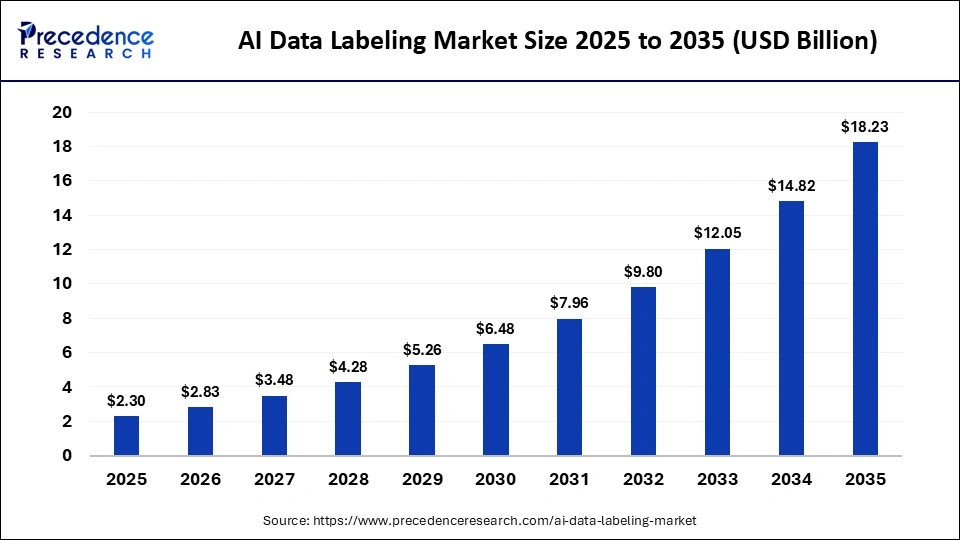
The global AI data labeling market size accounted for USD 2.30 billion in 2025 and is predicted to increase from USD 2.83 billion in 2026 to approximately USD 18.23 billion by 2035, expanding at a CAGR of 23.00% from 2026 to 2035. The market is driven by the growing adoption of AI, the rising need for high-quality labeled datasets, and the evolution of automated and AI-assisted labeling solutions.
Key Takeaways
- North America led the AI data labeling market in 2025.
- Asia-Pacific is expected to grow at the highest CAGR during the forecast period.
- By sourcing type, the outsourced segment led the market in 2025.
- By sourcing type, the in-house segment is expected to grow at the highest CAGR during the forecast period.
- By data type, the text segment dominated the market in 2025.
- By data type, the image segment is expected to grow at the highest CAGR between 2026 and 2035.
- By labeling method type, the manual segment led the market in 2025.
- By labeling method type, the automatic segment is expected to expand at the highest CAGR from 2026 to 2035.
- By end user type, the automobile and mobility segment led the market in 2025.
- By end user type, the healthcare and life sciences segment is expected to expand at the highest CAGR from 2026 to 2035.
What is the AI Data Labeling Market?
The AI data labelling market is the industry that offers tools, platforms, and services to annotate raw data such as images, videos, text, and audio so that it can be used for training machine learning models. This is a crucial step in supervised learning, where machine learning models use labeled data to make predictions. The market has been expanding rapidly due to the growing use of AI in areas such as autonomous vehicles, healthcare, finance, and retail. As AI models become more sophisticated, there has been a growing need for high-quality and large-scale labeled data.
Technology Shifts in the AI Data Labeling Market
The market for AI data labeling is undergoing a transition from manual, human-intensive labeling to more automated and intelligent approaches. There is a growing adoption of AI-assisted labeling solutions, where the AI model pre-labels the data, and human efforts are primarily used for validation and correction of the data. There is also a significant drift towards the use of synthetic data, which assists in the development of training data without solely depending on real-world data.
Another significant transition is the inclusion of human feedback mechanisms, especially in training large language models, where humans rank and then define the results rather than merely labeling the data. The labeling task is also expanding to multimodal data such as video, audio, and 3D sensor inputs, especially in the context of autonomous vehicles and immersive technologies. There is also a growing adoption of continuous data pipelines rather than static datasets, which assist in real-time model updates.
What are the AI Data Labeling Market Trends?
- Collaborations and Partnerships: Companies are establishing partnerships for handling large-scale and complex data labeling tasks. These partnerships leverage AI technologies, cloud infrastructure, and human expertise to enhance accuracy and efficiency. For instance, Appen collaborated with Google Cloud to provide high-quality labeled datasets that are seamlessly integrated with cloud-based AI solutions.
- Government Initiatives: Governments have invested in AI infrastructure and local data ecosystems to ensure data security and minimize dependence on foreign companies. These efforts also target workforce development and the development of local AI capabilities. For instance, the U.A.E government initiated the National AI Strategy program to facilitate AI development, improve data infrastructure, and encourage local data processing and labeling capabilities.
- Business Expansions: Data labeling companies are broadening their offerings from data labeling to comprehensive AI data management. This includes synthetic data, model assessment, and automation solutions. For instance, Sama has entered the high-accuracy data labeling market for autonomous vehicles and computer vision applications. They are also expanding globally while incorporating AI-powered quality assurance systems.
Market Scope
| Report Coverage | Details |
| Market Size in 2025 | USD 2.30 Billion |
| Market Size in 2026 | USD 2.83 Billion |
| Market Size by 2035 | USD 18.23 Billion |
| Market Growth Rate from 2026 to 2035 | CAGR of 23.00% |
| Dominating Region | North America |
| Fastest Growing Region | Asia Pacific |
| Base Year | 2025 |
| Forecast Period | 2026 to 2035 |
| Segments Covered | Sourcing Type, Data Type, Labeling Method, End-user Industry, and Region |
| Regions Covered | North America, Europe, Asia-Pacific, Latin America, and Middle East & Africa |
Segmental Insights
Sourcing Type Insights
Why Did the Outsourced Segment Dominate the AI Data Labeling Market?
The outsourced segment dominated the market in 2025. The market growth of this segment can be attributed to its scalability and flexibility. Businesses can easily tap into a large pool of highly skilled workers without having to spend time and resources on recruitment and training. This is particularly beneficial for large-scale and niche projects, such as medical imaging, self-driving cars, and multi-lingual datasets. Outsourced data labelling services facilitate global business operations, ensuring high-quality labels in multiple languages and domains.
The in-house segment is expected to grow at the highest CAGR from 2026 to 2035. The market growth of this segment is due to rising emphasis on data security, confidentiality, and control over sensitive data by organizations. The ability to form in-house labeling teams helps companies exercise more stringent control and adhere to privacy laws, particularly in industries such as healthcare, finance, and the military. The development of AI-assisted labeling solutions has made it simpler for companies to efficiently scale their in-house operations, reducing their reliance on third-party vendors.
Data Type Insights
Why Did the Text Segment Dominate the AI Data Labeling Market?
The text segment led the market in 2025. The market growth of this segment is because text is the largest and most widely used input for AI applications. Text data labelling is relatively simpler and less expensive compared to other types of data, such as images, videos, and 3D data. The rising use of generative AI and large language models has also driven the demand for high-quality labeled text datasets. The market growth of this segment is further driven by the availability of a large amount of text data from various sources and standardization in text data labeling.
The image segment is expected to grow at the highest CAGR during the forecast period. The market growth of this segment can be attributed to the exponential growth of computer vision applications. Autonomous vehicles, security cameras, medical imaging, retail analytics, and robotics are some of the applications that require highly accurate image labels. The proliferation of IoT devices and smart cameras is resulting in the generation of a huge amount of visual data, which needs to be labelled for AI training.
Labeling Method Type Insights
Why Did the Manual Segment Dominate the AI Data Labeling Market?
The manual segment dominated the market in 2025. The market growth of this segment is because most tasks involve human judgment and expertise. Sometimes, the data is complex, such as medical images, legal files, and text data, which cannot be labeled properly by automated systems. Manual labeling of data ensures higher accuracy and quality, which is essential for critical AI applications. Moreover, human annotators can label data for contextual nuances and ambiguous situations that might be labeled incorrectly by automated systems.
The automatic segment is expected to expand at the highest CAGR during the forecast period. The market growth of this segment is because AI-assisted and programmatic labeling tools are becoming more advanced and popular. Automated solutions are capable of processing a large amount of data in a short period of time and at a lower cost compared to manual labeling. This segment helps save human time by pre-labeling data, performing repetitive tasks, and using standardized rules for datasets.
End User Type Insights
Why Did the Automobile and Mobility Segment Dominate the AI Data Labeling Market?
The automobile and mobility segment dominated the market in 2025. The market growth of this segment is because autonomous vehicles and advanced driver-assistance systems (ADAS) need huge amounts of data to be labeled accurately. Autonomous vehicles, sensors, and in-vehicle AI systems require accurate labeling of images, LiDAR, radar, and video data to identify objects, pedestrians, lanes, and traffic signals. The adoption of electric and connected vehicles has led to the generation of more data, thereby fueling the demand for labeling services in this segment.
The healthcare and life sciences segment is expected to grow at the highest CAGR during the forecast period. The market growth of this segment is due to the growing adoption of AI in medical imaging, diagnostics, drug discovery, and genomics. The development of AI-assisted labeling solutions is also making it easier for healthcare institutions to label large amounts of complex data. Furthermore, increasing investments in personalized medicine, digital health platforms, and regulatory-compliant AI solutions are fueling the demand for high-quality labeled data in this segment.
Regional Insights
What Made North America the Leading Region in the AI Data Labeling Market?
North America dominated the AI data labeling market in 2025. The market growth in this region can be attributed to the widespread adoption of AI technologies and the presence of advanced digital infrastructure. This region is home to technology giants, startups, and research organizations that are dependent on large and high-quality labeled datasets to build AI models. Moreover, substantial investments in AI, cloud computing, and automation tools have helped scale up the data labeling services. The market growth in North America is further driven by the presence of qualified data annotation experts and an established outsourcing infrastructure.
U.S AI Data Labeling Market Analysis
The U.S. leads the market growth in North America because of its concentration of AI-centric businesses and innovation hotspots. This country is at the forefront in building complex AI applications such as autonomous vehicles, healthcare diagnostics, and large language models, which require high-quality labeled data. The adoption of AI-assisted labeling tools and synthetic data platforms is helping businesses speed up the training of AI models. Additionally, private investment, research funding, and startup ecosystems are driving the demand for scalable data annotation solutions in the U.S.
What Made Asia Pacific the Fastest Growing Region in the AI Data Labeling Market?
Asia-Pacific is expected to grow at the highest CAGR from 2026 to 2035. The market growth in this region can be attributed to rapid digital transformation and the adoption of AI. The governments in this region have significantly invested in AI for applications such as healthcare, autonomous vehicles, finance, and retail, which creates a huge demand for large-scale labeled datasets. The growing startup culture, government support for AI, and development of cloud infrastructure are also fueling the adoption of manual and automated labeling solutions.
China AI Data Labeling Market Trends
China leads the market in the Asia Pacific due to the significant presence of prominent AI companies, research, and technology startups that produce enormous amounts of data that need to be labeled. The government's support for AI adoption through programs such as the Next Generation Artificial Intelligence Development Plan has significantly contributed to the adoption of AI technology. This country has a cost-effective and skilled labor force and a robust digital infrastructure that facilitates the quick adoption of AI data labeling solutions.
Why is Europe Growing in the AI Data Labeling Market?
Europe is expected to grow at a considerable CAGR in the upcoming period, due to its strong emphasis on industrial AI implementation and strict data governance standards across the entire continent. Because of this, European companies are also utilizing more datasets that have already been annotated for manufacturing automation, automotive AI, and healthcare diagnostic applications. Therefore, the increasing amounts of investment into multi-lingual AI models and smart mobility solutions will likely continue to fuel the demand for AI annotation services in Europe.
Germany Market Trends
Germany is the dominant force in Europe because of its established automotive base and strong industrial automation industries. Thus, German industrial manufacturers are using AI-powered robotics to create autonomous vehicles, which require industrial manufacturers to use highly accurate annotated image and sensor datasets. Additionally, Germany is investing heavily in Industry 4.0 by creating innovation hubs that focus on the creation of machine learning and other AI technologies.
Will Latin America Grow in the AI Data Labeling Market?
Latin America is expected to grow at a notable CAGR in the foreseeable future. As more companies undergo digital transformation in their banking, retail, telecommunications, and e-commerce sectors, they will increasingly turn to AI for business intelligence and customer interaction through chatbots and automation. To develop training datasets for this type of application, these organizations need to have access to high-quality labeled datasets. Governments throughout the region are also supporting innovation initiatives related to AI and cloud adoption. Additionally, the increase in demand for AI models capable of processing Spanish and Portuguese will lead to even greater growth and investment in this area.
Brazil Market Trends
Brazil is also at the forefront of the Latin American market. This is due to the rapid growth in the fintech, retail analytics, and customer service automation segments of the market, resulting in a strong demand for text and audio annotation services. Furthermore, the growing number of startups in Brazil and the Brazilian government's emphasis on digital innovation and support of AI through government-sponsored programs are helping to create an environment where investment in the infrastructure necessary to train AI will continue to increase.
AI Data Labeling Market Companies
- Amazon Web Services
- Google LLC
- Microsoft Azure
- AI Appen Limited
- Scale AI Inc
- CloudFactory Ltd
- Sama Inc
- iMerit Technologies Pvt Ltd
- Cogito Tech LLC
- Labelbox Inc
- SuperAnnotate Ltd
- Explosion AI GmbH
- Deep Systems LLC
- BasicAI Inc
- Dataloop AI Ltd
- Lionbridge AI
- Alegion Corp
- Clickworker GmbH
- Deepen AI Inc
- Playment
Recent Developments
- In November 2025, Labelerr introduced SAM3 integration, enhanced polygon and boundary annotation tools, and enhanced workflow automation. These features enable users to label similar items in a single operation and process complex datasets more effectively, making the platform much faster and more intuitive to use. (Source: https://docs.labellerr.com)
- In September 2025, ThinkAnalytics unveiled ThinkMetadataAI, a solution for automatically creating detailed metadata for video assets. It labels and describes content in multiple languages and formats, reducing manual labor.(Source: https://www.tvtechnology.com)
- In August 2025, Vloggi introduced a human-in-the-loop labeling feature for videos. Users can label content while uploading, which converts unedited videos into organized data sets for AI use. It also features auto-labeling and privacy-compliant validation, which accelerates data preparation without requiring a dedicated labeling team.(Source: https://vloggi.com)
Segments Covered in the Report
By Sourcing Type
- In-house
- Outsourced
By Data Type
- Text
- Image
- Audio
- Video
- Point-Cloud
By Labeling Method
- Manual
- Automatic
- Semi-supervised/Human-in-loop
By End-user Industry
- Automotive and Mobility
- Healthcare and Life Sciences
- Retail and E-commerce
- BFSI
- IT and Telecom
- Industrial and Robotics
- Others (Agriculture, Media, etc.)
By Region
- North America
- Europe
- Asia-Pacific
- Latin America
- Middle East & Africa
For inquiries regarding discounts, bulk purchases, or customization requests, please contact us at sales@precedenceresearch.com
Frequently Asked Questions





Ask For Sample
No cookie-cutter, only authentic analysis – take the 1st step to become a Precedence Research client
 Get a Sample




 sales@precedenceresearch.com
 Schedule a Meeting
