



AI for Energy Optimization Software Market Trends, Companies, Revenue / Sales Performance, Subscriber Growth, Pricing Strategies, Cloud Adoption, Infrastructure Expansion, Competitive Landscape, and Industry Outlook
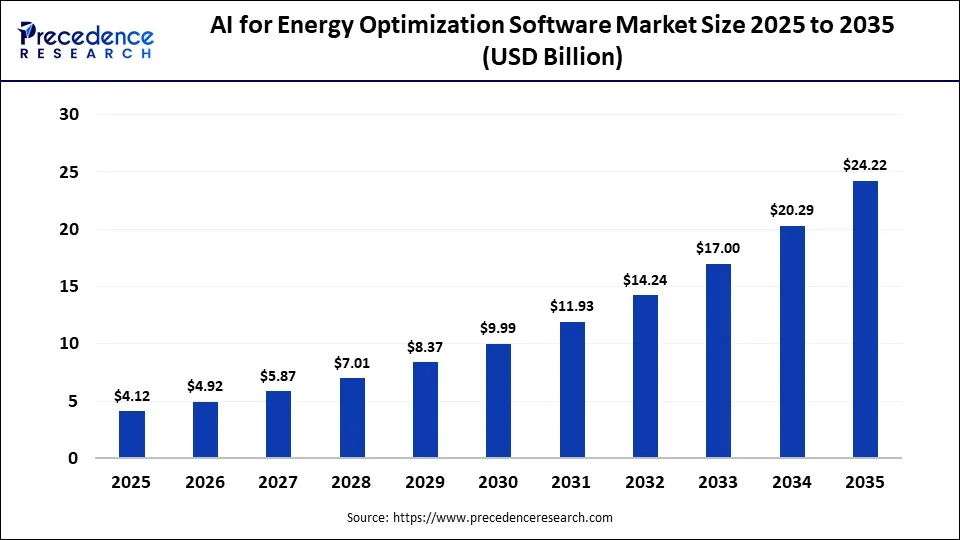
The AI for energy optimization software market is projected to grow from USD 4.12 billion in 2025 to USD 24.22 billion by 2035, expanding at a CAGR of 19.38% throughout the forecast period. This growth reflects the increasing need to manage electricity demand, integrate renewable and distributed energy resources, improve equipment performance, and respond to changing power prices. Gautam Mahajan, our primary researcher for this report, highlights the shift toward software-driven energy management solutions that can continuously evaluate consumption, generation, equipment performance, and electricity pricing. Utilities and large energy consumers are increasingly using these capabilities to improve demand forecasting, manage peak electricity consumption, and coordinate renewable and distributed power resources.
Source: https://www.precedenceresearch.com/ai-for-energy-optimization-software-market
 Get a Sample
 Table Of Content


AI for Energy Optimization Software Market Size and Forecast 2026 to 2035
The AI for energy optimization software market is projected to grow from USD 4.92 billion in 2026 to USD 24.22 billion by 2035, expanding at a CAGR of 19.38% throughout the forecast period. The market is being shaped by the growing need to manage electricity demand, integrate renewable and distributed energy resources, improve equipment performance, and respond to changing power prices.
According to our primary researcher, Gautam Mahajan, the energy management landscape is increasingly shifting toward software-driven solutions that can continuously assess consumption, generation, equipment performance, and electricity pricing. Utilities and large energy consumers are adopting these capabilities to improve demand forecasting, manage peak electricity consumption, and coordinate renewable and distributed power resources more effectively.
Within this broader shift, machine-learning-based load forecasting and distributed energy resource optimization are emerging as important areas of development. Rising electricity demand, the expansion of renewable energy, the rapid growth of data centers, and fluctuations in electricity pricing are increasing the need for software that can support more responsive energy management. These solutions can help organizations reduce energy costs while improving equipment utilization and aligning consumption with available power.
Key Takeaways
- By technology, the machine learning segment led the market with a 26% share in 2025.
- By application, the energy consumption and demand optimization segment captured a major revenue share of 28.74% in 2025.
- By end user, the utilities segment captured the largest AI for energy optimization software market share of 30% in 2025.
AI for Energy Optimization Software Market Market Sizing
The market is expected to reach USD 24.22 billion by 2035 and grow at a CAGR of 19.38% through 2035. Our researcher suggests that this rapid market compounding is attracting capital and attention at a much faster rate than the slower organic growth of established players. This helps explain the current mix of companies, ranging from businesses with a century-long presence to relatively new entrants. If the market had compounded at a slower pace, the competitive landscape would likely have been narrower, with greater consolidation around established industrial players. Instead, the pace of growth continues to create opportunities for new AI-native companies to establish a foothold before incumbent players can expand their capabilities at the same rate.
Key Insight: Market growth from USD 4.92 billion in 2026 to USD 27.37 billion by 2035 makes this a growth that almost crosses 19 times. The 34.15% CAGR indicates that the technology market is in its early stage and in a phase of a quick adoption curve.
Source: Precedence Research Database
Executive Framing & Methodology
This report evaluates 22 companies offering AI-based energy optimization software solutions across the global industrial market. The analysis covers global industrial companies, AI software providers, and energy optimization solution companies, and complements the report's market sizing and segmentation analysis. It provides a qualitative view of competitive positioning, product capabilities, market activity, and the available evidence supporting these offerings.
Many companies do not separately report revenue generated from AI-driven energy optimization, as these activities are generally included within broader business lines, such as Schneider Electric's Energy Management business, GE Vernova's Electrification segment, or IBM's Software segment. Accordingly, the company financial data presented in this report is limited to information publicly disclosed through financial reports, shareholder materials, and corporate releases. Where AI energy-specific revenue is not reported, the analysis does not attempt to estimate it. Company positioning is also assessed through defined competitive tiers rather than absolute market share.
The capability heat map and positioning assessment are based on publicly available product information, company announcements, technical documents, and analyst commentary. The assessment does not represent an independent performance test or proprietary vendor evaluation. Instead, it reflects a review of the capabilities companies publicly demonstrate and their position within the market.
Key Insight: The analysis compares 22 companies based on their publicly reported financial data, product capabilities, competitive activity, and market positioning, though it does not estimate the revenue of these companies resulting from the use of AI, or the absolute market share.
Competitive Landscape
The AI for power energy optimization software market is still highly fragmented, with competition divided among four main segments. It mirrors the evolution of the energy, building management, grid-control, and industrial software sectors to accommodate the marketplace. It mirrors where the marketplace is coming from established energy, building management, grid-control, and industrial software firms.
Market Structure
- Industrial solution providers with energy management, automation, grid, and software capabilities that serve platform products across the globe include Schneider Electric, Siemens, GE Vernova, Honeywell, and Hitachi Energy. These companies are bringing AI to existing systems adopted throughout utilities, buildings, industrial facilities, and energy infrastructure.
- AI-as-a-service firms extending analytics, optimization, forecasting, or digital energy management as parts of their offerings. Software-centric firms that recognize the value of AI and have started building on analytics, optimization, forecasting, or digital energy management, like C3.ai, Uplight, Stem, Envision Digital, or Enel X.
- Specialist regional energy firms like Verdigris Energy, Grid4C, innovatts, Amperon Energy, and Emerald AI. They are focused on particular forms of energy use. Their products focus on issues such as circuit-level building monitoring, utility forecasting, power management at the data center, as well as particular optimization, but do not seek to address the whole energy-management stack.
| Category | Companies |
| Market Leaders Scale + AI capability |
|
| Technology Leaders AI-native, building installed base |
|
| Scale Leaders Large installed base, AI capability maturing |
|
| Emerging Challengers Specialized AI capability, smaller footprint |
|
Concentration & Competitive Intensity
The market remains relatively concentrated at the broader platform level, while competition is more fragmented across individual applications. Schneider Electric, Siemens, GE Vernova, Hitachi Energy, and Honeywell benefit from established customer relationships and existing energy infrastructure investment programs. Competition is gaining momentum in data center energy optimization, which is growing at 26.0% CAGR, and energy storage optimization, which is growing at 25.0% CAGR. No established market share has been identified for AI-driven energy optimization software because these capabilities are generally embedded within broader energy-management, automation, grid, and industrial software portfolios.
The competitive structure remains fragmented. Established industrial platforms have an advantage in broad energy optimization, while AI-focused and specialist vendors are competing more directly in areas such as energy analytics, forecasting, and optimization.
Key Insight: The market is still fragmented, with existing industrial platforms dominating broad energy optimization, and AI-focused and specialty companies battling in specific market segments for energy analytics, forecasting, and optimization.
Leading Company Universe
| Company | Tier | HQ | Public/Private | Core AI-Energy Focus |
| Schneider Electric | Market Leader | Rueil-Malmaison, France | Public (EPA:SU) | Runs the EcoStruxure platform for grid, building, and industrial energy AI and acquired the process-level AI capability in 2025 through AspenTech |
| Siemens | Market Leader | Munich, Germany | Public (ETR:SIE) | It operates its Gridscale X grid software, which is complemented by Siemens Smart Infrastructure's building automation solutions. |
| GE Vernova | Market Leader | Cambridge, MA, US | Public (NYSE:GEV) | Its orchestration platform, GridOS, has been responsible for grid orchestration, and the company itself was spun off from GE in 2024 |
| Honeywell | Market Leader | Charlotte, NC, US | Public (NASDAQ:HON) | Full Building and Industrial Energy Optimization in one platform with Honeywell Forge |
| Hitachi Energy | Market Leader | Zurich, Switzerland | Private (Hitachi subsidiary) | Combines grid software and grid hardware, comprising the power grids business acquired by Hitachi from ABB in 2020 |
| ABB | Scale Leader | Zurich, Switzerland | Public (SIX:ABBN) | ABB Ability is ABB's main AI-energy business |
| IBM | Scale Leader | Armonk, NY, US | Public (NYSE:IBM) | Envizi (ESG/energy data) and Maximo (asset performance) platforms |
| Johnson Controls | Scale Leader | Cork, Ireland | Public (NYSE:JCI) | OpenBlue building AI platform; HVAC and building energy optimization |
| Trane Technologies | Scale Leader | Swords, Ireland | Public (NYSE:TT) | Building HVAC energy optimization; acquired BrainBox AI (2025) |
| C3.ai | Technology Leader | Redwood City, CA, US | Public (NYSE:AI) | Enterprise AI platform with energy/utility vertical applications (originated as C3 Energy) |
| Uplight | Technology Leader | Boulder, CO, US | Private (PE-backed) | Utility customer engagement and DERMS/VPP orchestration (via AutoGrid, 2024) |
| Stem, Inc. | Technology Leader | San Francisco, CA, US | Public (NYSE:STEM) | PowerTrack AI software for battery storage and clean energy optimization |
| Envision Digital | Technology Leader | Singapore | Private | EnOS IoT/AI platform for renewable and grid energy management |
| Enel X | Technology Leader | Rome, Italy | Private (Enel subsidiary) | Demand response, DER and energy efficiency AI solutions |
| Verdigris | Emerging Challenger | San Mateo, CA, US | Private | AI-based circuit-level energy monitoring and analytics for commercial buildings |
| Grid4C | Emerging Challenger | Tel Aviv, Israel | Private | Predictive AI analytics for utilities (demand forecasting, anomaly detection) |
| Innowatts | Emerging Challenger | Houston, TX, US | Private | AI-based energy analytics (eUtility platform) for utilities and energy retailers |
| Amperon | Emerging Challenger | Houston, TX, US | Private | AI-powered load forecasting for utilities, grid operators, and data centers |
| Emerald AI | Emerging Challenger | San Francisco, CA, US | Private | AI-based data center power orchestration and grid-flexibility software |
| Vertiv | Emerging Challenger / Adjacent | Westerville, OH, US | Public (NYSE:VRT) | Data center power and cooling infrastructure; acquired ThermoKey (2026) for AI-driven cooling |
| BrainBox AI (Trane subsidiary) | Emerging Challenger / Acquired | Montreal, Canada | Private (Trane subsidiary since Jan 2025) | Generative-AI autonomous HVAC control for commercial buildings |
Company Market Share & Ranking
- Schneider Electric, Siemens, GE Vernova, and Hitachi Energy have substantial installed bases across utility, grid, industrial, and energy infrastructure. Much of this installed base predates the current wave of AI adoption in energy software, giving these companies an established route to market as AI capabilities are added.
- Reported revenue figures provide context for the scale of pure-play AI software companies relative to diversified industrial groups. C3.ai total quarterly revenue was USD 70.3 million in Q1 FY2026, USD 53.3 million in Q3 FY2026, and USD 51.6 million in Q4 FY2026 (preliminary). These figures represent company-wide revenue and should not be interpreted as AI-energy revenue.
- International traction: Stem. Inc secured a contract to supply PowerTrack software for a 484 MW contract in Hungary, in March 2025. The company did not reveal the dollar amount of the contract.
- A comparable revenue-based ranking for AI energy optimization is not currently supported by the available data. The companies do not consistently disclose AI-energy-specific revenue, making a like-for-like ranking dependent on additional primary research or a third-party source with a transparent and comparable methodology.
Key Insights: Schneider Electric, Siemens, GE Vernova, and Hitachi Energy lead on installed-base scale, while C3.ai and Stem show momentum as AI-focused software businesses. However, the absence of disclosed AI-energy revenue limits direct revenue-based comparison.
Competitive Benchmarking
Market leaders combine broad AI-energy capabilities with greater acquisition activity, while technology leaders tend to compete through more specialized offerings. Emerging vendors face a different strategic dynamic, as their specialized capabilities can make them acquisition targets as larger platforms expand.
| Dimension | Market Leaders | Technology Leaders | Emerging Challengers |
| Typical Ownership | Public, diversified conglomerate | Private, public or “late stage” private, typically PE-backed | Private, VC-backed |
| Geographic Footprint | Global, multi-continent | Regional-to-global (US/EU concentration) | Regional (single-country or single-region) |
| Recent M&A Activity | High acquiring AI-native firms (AspenTech, BrainBox AI) | Mixed both acquirer and target (Uplight/AutoGrid; Uplight itself now a target) | Low, usually the target not the acquirer |
| Product Breadth (Section 5) | Broadest multiple 'Full' capability ratings | Moderate 2-3 'Full' categories, rest 'Partial' | Narrow typically 1 'Full' category by design |
| Primary Competitive Risk | Slower innovation velocity than AI-native rivals | The difficulty of scaling up against entrenched incumbent products and services | Larger players could acquire or displace companies from the platform. |
Key Insight: Market leaders have the most extensive AI-energy capabilities and a drive for AI acquisitions, technology leaders focus on specialization, and new entrants in the market are vulnerable to acquisition or displacement.
Product Portfolio Benchmarking
| Company | Grid / DER Mgmt | Building Energy | Industrial Energy | Renewable Forecasting | Storage Optimization | Carbon Reporting |
| Schneider Electric | Full | Full | Full | Full | Full | Full |
| Siemens | Full | Full | Full | Partial | Partial | Full |
| GE Vernova | Full | - | Partial | Full | Partial | Partial |
| Honeywell | Partial | Full | Full | - | Partial | Full |
| IBM | Partial | Full | Full | Partial | - | Full |
| C3.ai | Full | Partial | Full | Partial | Partial | - |
| Uplight | Full | - | - | Partial | Partial | - |
| Stem, Inc. | Partial | - | Partial | Partial | Full | Partial |
| Trane / BrainBox AI | - | Full | - | - | - | Partial |
Schneider Electric has the broadest disclosed product coverage in the group, with full capability across all six functions. The AspenTech acquisition also expands its industrial optimization portfolio, strengthening the breadth of its offering.
Grid/DER Management has the widest coverage among the companies analyzed, with 7/9 vendors indicating full or partial capability. The category spans distributed energy resources, demand management, load forecasting, and peak-load control. Demand optimization, load forecasting, and peak-load management together account for 38.0% of the optimization function segmentation in the provided data.
Carbon Reporting shows less consistent coverage across the reviewed portfolios. C3.ai, Uplight, GE Vernova, and Trane/BrainBox have limited or no dedicated carbon-management solutions, despite carbon emission optimization growing at 21.8% CAGR.
Storage Optimization appears across several competitive tiers. Stem, which began in battery storage and has expanded into software, provides full capability in this area. The breadth of offerings reflects the growing role of battery scheduling and optimization in energy storage economics.
Key Insights: Schneider Electric has the broadest disclosed capability, with full coverage across all six functions. Grid/DER Management has the widest vendor coverage, while Storage Optimization is becoming more strategically relevant as battery scheduling becomes a larger part of energy management.
Source: Precedence Research Database
Technology & Innovation Benchmarking
Generative AI has the highest growth rate among the technologies covered, at a 27.2% CAGR, followed by reinforcement learning at 25.0%. Machine learning is growing at a 17.6% CAGR, while optimization algorithms have the lowest growth rate at 12.5%. Beyond the ranking itself, the comparison helps show where different AI capabilities sit within the product-development and maturity cycle.
The technology pattern is also reflected in the M&A activity reviewed in the report. Industrial incumbents have generally developed machine learning and predictive analytics internally or added them through smaller acquisitions, while newer generative AI capabilities are increasingly being accessed through specialist technology acquisitions.
| Technology | 2025 Share | 2025-2035 CAGR | Companies with Disclosed Capability |
| Generative AI | 12.00% | 27.20% | C3.ai (C3 Generative AI), BrainBox AI (generative-AI HVAC control), Schneider Electric |
| Reinforcement Learning | 8.00% | 25.00% | Stem, Inc. (adaptive battery dispatch), GE Vernova (autonomous grid-edge operations) |
| Deep Learning | 14.00% | 20.10% | BrainBox AI (core HVAC prediction models), Grid4C |
| Machine Learning | 26.00% | 17.60% | Effectively implemented at the company level, widely shared and known as the basic technology of the category |
| Predictive Analytics | 18.00% | 17.70% | Innowatts, Amperon, IBM Maximo, C3.ai |
| Digital Twin & AI | 6.00% | 19.40% | GE Vernova (federated grid data fabric / digital twin), Siemens |
Much of the machine learning and predictive analytics capability has been developed internally or added through smaller, earlier-stage acquisitions, often described as tuck-ins. The pattern suggests that traditional industrial organizations may find generative AI more difficult to develop entirely in-house than established statistical and predictive techniques, increasing the strategic value of specialist acquisitions.
Key Insight: Generative AI leads technology growth at 27.2% CAGR, followed by reinforcement learning at 25.0%. The comparison points to increasing investment in more advanced AI functions as energy optimization products mature.
Application Competitive Benchmarking
Data center energy optimization has the highest growth rate in the application comparison at 26.0% CAGR. It also has the smallest competitive field among the applications reviewed. Emerald AI represents a specialist entrant, while Vertiv has expanded its position through acquisition. The combination of high growth and relatively limited specialist competition makes this application a notable white-space opportunity.
| Application | 2025 Share | 2025-2035 CAGR | Application Leaders / Specialists |
| Energy Consumption & Demand Optimization | 28.74% | 18.60% | Schneider Electric, Siemens, Honeywell broadest, most mature application |
| Asset Performance & Predictive Maintenance | 18.00% | 18.20% | IBM (Maximo), GE Vernova, Siemens |
| Smart Grid & DER Management | 16.00% | 20.10% | GE Vernova (GridOS), Schneider Electric (EcoStruxure ADMS), Hitachi Energy (Network Manager), Uplight/AutoGrid |
| Renewable Energy Forecasting & Integration | 14.00% | 23.00% | Envision Digital (EnOS), Amperon, Grid4C |
| Data Center Energy Optimization | 2.00% | 26.00% | Emerald AI, Vertiv (via ThermoKey acquisition) smallest current share, fastest growth, thinnest specialist field |
| Building Energy Optimization | 6.00% | 21.00% | Trane Technologies / BrainBox AI, Johnson Controls (OpenBlue), Verdigris |
| Industrial Energy Optimization | 4.00% | 21.80% | Schneider Electric (post-AspenTech), Siemens, ABB |
Key Insight: The market's fastest-growing white-space opportunity is data center energy optimization, which features a thin competitive field and few mature specialized players and is projected to grow at 26.0% CAGR.
Geographic Competitive Landscape
Europe holds the largest regional market share at 34.56% in 2025, while Asia Pacific has the fastest growth rate at 22.1% CAGR. The regional competitive picture also differs, reflecting variations in installed bases, regulatory environments, technology adoption, and the presence of specialist vendors.
Asia Pacific combines the highest growth rate in the table with a relatively limited presence of dedicated Western AI-native challengers. Envision Digital is the only company in the reviewed universe with a clearly international platform position originating from the region. At 22.1% growth, the combination of market expansion and limited specialist competition could create room for regional entrants or international vendors seeking to expand their presence.
| Region | 2025 Share | CAGR | Competitive Character |
| Europe | 34.56% | 18.20% | Schneider Electric, Siemens, ABB, and Hitachi Energy's European businesses rely on the home market, where the established regulatory conditions, such as EU energy efficiency and carbon regulations, position established incumbents with the experience to meet their requirements. |
| North America | 28.00% | 19.00% | Demand for data-center-based solutions is concentrated in the United States, with most AI-native challengers, such as C3.ai, Uplight, Stem, Verdigris, the US operations of Grid4C, Amperon, and Emerald AI, being based in the United States. |
| Asia-Pacific | 23.00% | 22.10% | Envision Digital, Singapore, is clearly the best-known regional specialist with global aspirations, and most Western Market Leaders have a presence here but have yet to establish the greatest installed base here. |
| Latin America | 7.00% | 19.40% | The set of sources in which dedicated competitive presence is disclosed is limited, and demand is likely met by the Market Leaders' already established regional presence instead of dedicated local specialists. |
| Middle East & Africa | 7.44% | 18.80% | Smart city and desalination-related infrastructure investments create demand, while AI-related energy specialists are disclosed. |
Key Insights: Europe remains the largest regional market, accounting for 34.56% of the market, while Asia Pacific is the fastest-growing region at 22.1% CAGR. The distinction highlights different competitive conditions rather than simply different market sizes.
Manufacturing & Delivery Capability Benchmarking
- Cloud-based deployment accounted for 66.41% of the market in 2025 and is expected to grow at a 19.9% CAGR. It is the dominant delivery model across the companies reviewed, reflecting the role of SaaS platforms in energy data analysis, forecasting, and optimization.
- On-Premises deployment accounted for 17.59% of the market in 2025 and is projected to decline to 12.00% by 2035. Its CAGR of 14.8% is the lowest among the three deployment modes. Utilities and critical infrastructure operators may continue to retain on-premises environments where control over operational data and systems is a priority.
- Hybrid deployment records the fastest growth among the deployment patterns, with a 21.0% CAGR and a 16.00% share in 2025. Examples include Schneider Electric's One Digital Grid Platform, which combines local and cloud intelligence, and Stem's PowerTrack, which combines cloud analytics with local battery controls.
Key Insights: Cloud deployment leads the market with a 66.41% share and a 19.9% CAGR. Hybrid deployment is growing faster at 21.0%, reflecting demand for architectures that combine cloud analytics with local operational control.
Customer & Channel Benchmarking
The go-to-market model differs by vendor type. Market Leaders generally sell directly to enterprises and can bundle AI software with established hardware or control-system relationships. AI-native challengers rely more heavily on direct enterprise or utility sales and systems integrators. Emerging Challengers may use established market leaders' channels, as illustrated by vendors such as Verdigris integrating with building-management-system providers.
| End User (per provided dataset) | 2025 Share | CAGR | Primary Vendor Exposure (disclosed case studies/products) |
| Utilities | 30.12% | 18.50% | GE Vernova, Hitachi Energy, Schneider Electric, Uplight/AutoGrid, Innowatts, Grid4C, Amperon |
| Commercial Buildings | 24.00% | 20.20% | Johnson Controls (OpenBlue), Trane/BrainBox AI, Verdigris, Honeywell Forge |
| Industrial Facilities | 23.00% | 20.00% | Schneider Electric (post-AspenTech), Siemens, ABB |
| Data Centers | 8.00% | 26.00% | Vertiv (ThermoKey), Emerald AI: smallest current vendor field relative to growth rate |
The available sample does not provide customer-retention or switching-cost data. Based on product architecture rather than reported statistics, grid and DER software may involve higher switching costs because of deeper integration with SCADA and control systems. Analytics and monitoring products that operate alongside existing infrastructure may face lower switching barriers. This should be treated as a qualitative assessment rather than a measured market statistic.
Key insights: The data center end-user segment accounts for 8.0% of the market but has the fastest growth rate at 26.0%. Its relatively small current share and high growth rate make it the most dynamic major end-user segment in the dataset.
Strategic Developments
2025 Schneider Electric: Acquired AspenTech
- What Happened: The Thunderbolt acquisition enabled Schneider Electric to acquire the complement of Schneider's Industrial Software, Process Simulation and Optimization offerings to its existing portfolio of EcoStruxure products.
- Why It Matters: The acquisition expands Schneider Electric's position in industrial optimization and process control, areas associated with a 21.8% CAGR in the dataset. It connects the company's established energy-management capabilities with more advanced industrial software applications.
- Business Impact: The transaction broadens Schneider Electric's position across industrial, building, grid, renewable, storage, and carbon applications, reinforcing the role of software and optimization within its wider energy portfolio.
Source: Energy Digital, "Top 10: AI Companies in Energy," 2026; company disclosures
February 2, 2026 Schneider Electric: Launched One Digital Grid Platform enhancements at DISTRIBUTECH
- What Happened: The changes Schneider Electric made to its One Digital Grid Platform encompass support for AI-driven risk assessments, automated workflows, and real-time grid visibility. The company pointed out the integration from Proof of Work to Microsoft, AiDASH, Technosylva, and Neara as well.
- Why It Matters: The platform enhancements illustrate a broader shift toward integrating specialist third-party AI capabilities into established energy software. This approach can allow vendors to add specialized functionality without developing every AI capability internally.
- Business Impact: The updated platform extends Schneider Electric's resilience offering beyond conventional energy-consumption management, adding applications related to storm risk, network conditions, and wildfire-related assessment.
Source: BriefGlance company disclosure summary, May 2026
June 9, 2026 GE Vernova: Introduced GridOS for Transmission
- What Happened: Launched a unified grid intelligence solution combining near-real-time operations, capacity awareness, forecasting, and system stability for transmission networks, alongside two new AI whitepapers on grid planning and autonomous grid-edge operations.
- Why It Matters: The launch extends GridOS and DER management capabilities toward transmission networks at a time when data centers, electrification, and renewable generation are increasing demands on transmission infrastructure.
- Business Impact: The development establishes GridOS for transmission as a distinct software offering and strengthens GE Vernova's competitive position relative to Schneider Electric's grid software and Siemens' Gridscale X.
Source: GE Vernova press release, June 9, 2026
January 2025 (completed) Trane Technologies: Completed acquisition of BrainBox AI
- What Happened: BrainBox AI added its generative AI-powered HVAC optimization solution to Trane's commercial building technology portfolio. As per the company's claims, it can save up to 25% of building energy and up to 40% of GHG emissions.
- Why It Matters: The trade was needed to provide Trane with an AI-based building optimization platform and BrainBox with the installed base and distribution muscle of a large HVAC organization.
- Business Impact: It obviously highlights the concept of an existing equipment manufacturer buying in specialist AI technology rather than trying to build it in-house. BrainBox itself had purchased Turntide's automation business in May 2024, adding to the fast pace at which businesses around building optimization technologies are consolidating.
Source: Trane Technologies press release, January 3, 2025; Facilities Dive
August 12, 2025: Trane Technologies/BrainBox AI: Launched BrainBox AI Lab
- What Happened: Trane Technologies formed the BrainBox AI Lab to further research and development of building energy management and sustainability.
- Why It Matters: The dedicated lab indicates that Trane Technologies intends to continue investing in BrainBox AI's research and development capabilities rather than simply absorbing the technology into its broader portfolio.
- Business Impact: The model could be relevant to other strategic acquirers seeking to retain specialist teams and maintain the pace of innovation after an acquisition.
Source: Business Wire, August 12, 2025
July 2025 Uplight: Reported to be seeking a buyer
- What Happened: Uplight was announced as being interested in a sale. The company is positioning itself as an AI-driven platform for managing the variability of grid demand and earlier announced and completed the acquisition of Schneider Electric's AutoGrid.
- Why It Matters: The reported sale process highlights continued ownership activity and consolidation around DER orchestration and energy-management platforms.
- Business Impact: A change in ownership would add another stage to the development of AutoGrid's technology within the broader market. The sequence also illustrates the strategic value placed on DER management and virtual power plant capabilities, with the technology having changed hands among larger companies since 2022.
Source: Latitude Media, "Scoop: Uplight is looking for a buyer," July 29, 2025
March 24, 2026 Vertiv: Acquired ThermoKey
- What Happened: Vertiv acquires Italian heat-exchanger manufacturer ThermoKey to bolster its data centre thermal-management business and help address accelerating demand driven by AI infrastructure.
- Why It Matters: Data Center Energy Optimization is the fastest-growing application in the dataset, with a CAGR of 26.0%. Vertiv's expansion through ThermoKey shows how infrastructure providers are responding to the efficiency requirements associated with AI data centers.
- Business Impact: The acquisition strengthens Vertiv's position in data center cooling and adds to the broader convergence of power, thermal management, and software-enabled optimization.
Source: buildmvpfast.com, "AI Infrastructure Funding 2026," April 2026
March 4, 2025 Stem, Inc.: Reported FY2024 results and announced strategic pivot toward software
- What Happened: Stem emphasized that their PowerTrack platform would become the foundation for its recurring software and services business. The company also announced it had secured an international contract of 484 MW in Hungary.
- Why It Matters: Stem's shift is consistent with the broader move toward recurring software revenue and asset optimization across energy technology markets.
- Business Impact: The change reflects a wider move toward software-led energy management. In the provided dataset, software grew at a 20.5% CAGR, while Services held a 69.85% share of the market.
Source: Stem, Inc. SEC Form 8-K, March 4, 2025
M&A Landscape
| Date | Deal/Acquisition | Key Detail |
| 2020 | Hitachi acquires ABB Power Grids | Formed Hitachi Energy; combined grid hardware with digital/AI-ready control platforms. |
| 2022 | Schneider Electric acquires AutoGrid | Added DERMS/VPP orchestration and distributed energy resource management capabilities to EcoStruxure. |
| Dec-23 | Uplight agrees to acquire AutoGrid from Schneider | Combined Uplight's customer-engagement platform with AutoGrid's DER flexibility stack; deal closed in 2024. |
| May-24 | BrainBox AI acquires Turntide Technologies' Automation Division | Expanded BrainBox AI's autonomous HVAC control and hardware/software integration capabilities. |
| Jan-25 | Trane Technologies completes acquisition of BrainBox AI | Combined BrainBox AI's HVAC optimization with Trane's building management installed base. |
| 2025 | Schneider Electric acquires AspenTech | Added industrial process AI and simulation capabilities alongside the EcoStruxure energy platform. |
| Mar-26 | Vertiv acquires ThermoKey | Added heat-exchanger technology to strengthen AI-driven data-center cooling optimization. |
Emerging M&A Themes
- Advanced AI: Established companies are using acquisitions and strategic deals to add specialized AI capabilities to their existing offerings. BrainBox AI, for example, has announced deals with AspenTech and ThermoKey to strengthen capabilities in areas including AI, optimization, simulation, and thermal management. These partnerships and acquisitions are aimed at accelerating the time to market for new technologies while building on existing customer relationships and distribution platforms.
- The repeated consolidation around AutoGrid, Schneider Electric, and Uplight since 2022 illustrates continued interest in DER orchestration and virtual power plant software. The reported Uplight sale process adds another potential step in this consolidation cycle.
- The competitive field is expanding beyond traditional energy software vendors, particularly in data center optimization. Vertiv's acquisition of ThermoKey reflects the increasing overlap between AI infrastructure, power management, cooling, and data center optimization.
Key Insight: M&A is becoming an important route to specialized AI, optimization, and thermal-management capabilities. The strongest consolidation themes in the reviewed data are DER orchestration and data center technologies.
Source: Precedence Research Database
Company Profiles
Schneider Electric
- HQ: Rueil-Malmaison, France Founded: 1836 Ownership: Public (Euronext Paris: SU)
- Schneider Electric has one of the broadest portfolios in the reviewed market, with EcoStruxure spanning energy management, industrial operations, buildings, distributed energy resources, and grid applications. The addition of AspenTech technology strengthens its industrial process simulation and optimization capabilities. In 2026, the company also expanded One Digital Grid Platform functionality with AI-backed grid-risk assessment and integrations with Microsoft, AiDASH, Technosylva, and Neara.
- Key Strengths: The review indicates broad product coverage combined with established relationships across utilities, buildings, industrial facilities, and energy infrastructure.
- Key Vulnerabilities: The breadth of the platform can create a depth challenge in individual niches, where AI-native specialists such as Amperon in load forecasting may be able to innovate more quickly in a specific application.
GE Vernova
- HQ: Cambridge, Massachusetts, US Founded: 2024 (spin-off from General Electric) Ownership: Public (NYSE: GEV)
- GE Vernova is developing GridOS as its core grid software and orchestration platform. The platform now supports distribution and transmission applications, with GridOS for Transmission added in June 2026. Its architecture brings together grid operations, forecasting, capacity management, and an AI-ready data environment.
- Key Strengths: GE Vernova combines focused investment in power generation, electrification, grid infrastructure, and software within a dedicated corporate structure.
- Key Vulnerabilities: As a relatively new company, GE Vernova has a more focused grid and electrification software portfolio than broader competitors such as Schneider Electric and Siemens.
Siemens
- HQ: Munich, Germany Founded: 1847 Ownership: Public (Frankfurt: SIE)
- Siemens combines Gridscale X with Smart Infrastructure solutions for building automation, energy management, and digital infrastructure. The platform can support grid operations as part of its DERMS and flexibility-management strategy.
- Key Strengths: Siemens has a large geographic footprint and established relationships across European utilities, buildings, industrial facilities, and infrastructure. Its modular approach to DER management also supports different utility programs.
- Key Vulnerabilities: The company has reported fewer material generative-AI-related developments than GE Vernova and Schneider Electric, which may reduce its visibility in the rapidly developing AI optimization segment.
C3.ai
- HQ: Redwood City, California, US Founded: 2009 (as C3 Energy/C3 IoT) Ownership: Public (NYSE: AI)
- C3.ai originated in energy through C3 Energy and expanded its analytics capabilities across energy generation, transmission, distribution, and consumption. It has since developed into a broader Enterprise AI platform serving 19 sectors. In the first quarter of FY2026, the company reported total revenue of USD 70.3 million, with 90% from subscriptions, compared with USD 53.3 million in Q3 FY2026.
- Key Strengths: C3.ai retains a strong foundation in energy-focused AI and predictive analytics while extending its capabilities into other enterprise applications. The company has also increased its focus on generative AI.
- Key Vulnerabilities: Energy is one of 19 industries served by C3.ai rather than its sole focus. This broader positioning may reduce specialization relative to dedicated energy vendors, while the company's financial history includes ongoing losses and customer concentration.
Uplight
- HQ: Boulder, Colorado, US Founded: 2019 (merger of six energy-efficiency/customer-engagement startups) Ownership: Private, PE-backed (reportedly exploring a sale as of July 2025)
- Uplight was formed through the merger of Tendril, Simple Energy, EEme, EnergySavvy, and FirstFuel. It later acquired AutoGrid's DERMS/VPP platform from Schneider Electric, with the deal announced in Dec 2023 and closed in Feb 2024. The combined platform integrates over 6 GW of DERs under management.
- Key Strengths: Uplight combines utility customer management with DER management and flexibility capabilities, giving it a broader offering than vendors focused only on customer programs or grid orchestration.
- Key Vulnerabilities: The reported sale process introduces uncertainty for utilities evaluating long-term platform commitments. The company was acquired in 2021 for around USD 1.5 billion, while the AutoGrid transaction expanded its technology portfolio.
Trane Technologies/BrainBox AI
- HQ: Swords, Ireland (Trane)/Montreal, Canada (BrainBox AI) Founded: 2020 (Trane Technologies, post-Ingersoll Rand split)/2017 (BrainBox AI) Ownership: Public (NYSE: TT); BrainBox AI has been a Trane subsidiary since January 2025
- BrainBox AI provides a Generative-AI-driven HVAC optimization platform that adjusts systems to changing operating conditions. Trane Technologies completed the acquisition in January 2025. BrainBox AI states that its technology can save up to 25% of building energy use and 40% of GHG emissions. Trane formed the BrainBox AI Lab in August 2025 to continue development.
- Key Strengths: The combination of specialized AI-based building optimization with Trane's installed HVAC base, customer relationships, and distribution network creates a strong route to market.
- Key Vulnerabilities: Integration remains an important consideration. BrainBox had acquired Turntide Technologies' automation division in May 2024 before joining Trane, creating several technology and organizational integration steps within a relatively short period.
Stem, Inc.
- HQ: San Francisco, California, US Founded: 2009 Ownership: Public (NYSE: STEM)
- Stem began as a battery-storage integrator and developed PowerTrack into the center of its software offering for clean-energy platforms. In March 2025, it outlined a shift toward recurring software and services revenue and referenced a 484 MW contract in Hungary.
- Key Strengths: Stem brings experience in battery storage and energy asset optimization, areas identified as high-growth segments in the market dataset. Its public-company reporting also provides more financial visibility than is available for many private competitors.
- Key Vulnerabilities: Stem is transitioning from hardware and integration toward a software-first model. Its financial profile therefore remains less directly comparable with pure software companies such as C3.ai.
Vertiv
- HQ: Westerville, Ohio, US Founded: 2016 (spin-off from Emerson Network Power) Ownership: Public (NYSE: VRT)
- Vertiv is not a conventional energy optimization software provider; its core position is in power and cooling infrastructure for data centers. Its inclusion reflects the acquisition of ThermoKey in March 2026 and the growing overlap between infrastructure and software-enabled energy optimization. Data Center Energy Optimization is the fastest-growing application in the dataset at a 26.0% CAGR.
- Key Strengths: Established relationships with data center operators and a large installed base of power and cooling infrastructure provide a strong channel for software-enabled optimization.
- Key Vulnerabilities: Vertiv's AI optimization capabilities remain less mature than those of specialist software vendors. Integrating acquired technology and developing a differentiated software proposition are key execution considerations.
Company Strategic Positioning
| Archetype | Defining Evidence | Representative Companies |
| Market Leaders | The widest solution-category disclosure coverage, the highest number of installations, and a multi-region, global presence | Schneider Electric, Siemens, GE Vernova, Honeywell, Hitachi Energy |
| Technology Leaders | A more product-centric origin, recent funding or growth activity, and a more specific but deeper category focus | C3.ai, Uplight, Stem Inc., Envision Digital, Enel X |
| Scale Leaders | A large number of existing customers from a nearby product line (e.g., building controls or industrial automation) that can be integrated with AI using acquisition or partnership | IBM, Johnson Controls, Trane Technologies, ABB |
| Emerging Challengers | A large number of existing customers from a nearby product line (e.g., building controls or industrial automation) that can be integrated with AI using acquisition or partnership | Verdigris, Grid4C, Innowatts, Amperon, Emerald AI |
Key Insight: Market leaders are known for their global scope and comprehensive solution coverage, whereas technology leaders focus on technology that goes beyond the scope of the market, and challengers are the newcomers that focus on specific applications with limited customer bases.
Company Opportunity & White-Space Analysis
Data Center Energy Optimization
Data center energy optimization is projected to grow at a CAGR of nearly 26% and is the fastest-growing application in the dataset, starting from a 2.0% market share. The competitive field remains smaller than in buildings, utilities, and industrial applications. Emerald AI represents a dedicated specialist, while Vertiv has expanded its position through the ThermoKey transaction. The combination of high growth, low current penetration, and increasing interest from infrastructure providers makes this the strongest white-space opportunity identified in the review.
Energy Storage Optimization
Energy storage optimization is among the fastest-growing optimization segments, with a 25.0% CAGR. Reinforcement learning is also growing at 25.0% CAGR. The repeated charge-and-discharge decisions involved in storage are well suited to reinforcement-learning approaches, suggesting a potential technical connection. Several platform providers have partial capabilities, while Stem, Inc. is the clearest specialist within the reviewed platform group.
Generative AI-Native Product Design
Recent acquisitions point to continued demand for specialized AI functionality. BrainBox AI, AspenTech, and ThermoKey have brought specialized technologies into larger businesses, allowing established energy and infrastructure companies to add capabilities without building every optimization function internally.
Asia-Pacific Platform Presence
Asia-Pacific has the fastest growth rate in the dataset at 22.1% CAGR, alongside a comparatively small number of dedicated Western-born competitors. Envision Digital, based in Singapore, is the clearest regional example with international platform ambitions. This combination creates scope for both local businesses and established international vendors to expand energy optimization offerings in growing electricity markets.
Additional opportunities include the capability gap in carbon reporting and AI-based energy trading. Carbon emission optimization is projected to grow at 21.8% CAGR, while AI-Based Energy Trading has the smallest addressable opportunity at 10.0% CAGR. The difference may reflect the relative size of the opportunity or the limited number of vendors currently addressing it.
Expert Insights
The energy management industry is moving beyond standard monitoring and pre-set controls toward software solutions that can respond to changing loads, energy costs, generation, and equipment requirements. Our primary researcher, Gautam Mahajan, sees strong opportunities for platform-based solutions that combine real-time energy data with load forecasting. As data center construction accelerates, accurate and real-time energy coordination is becoming increasingly important. Over the next decade, rising electricity costs are expected to remain an important factor shaping competition across the market.
Our Experts
- Gautam Mahajan, Primary Researcher: Led the primary market research, methodology, market segmentation, assessment of technology adoption patterns and regional trends, competitive landscape analysis, and market projections.
- Aman Singh, Head of Research: Strengthened the market estimates through the collection and validation of utility data, energy consumption statistics, technology deployment information, company disclosures, pricing data, and other independently sourced quantitative data.
- Aditi Shivarkar, VP Research: Reviewed the report in its entirety, conducted quality checks on statistics and figures, identified inconsistencies, and refined the analysis and content to support accurate, clear, and consistent reporting.
AI for Energy Optimization Software Market Segmentation
By Component
- Software
- Services
By Deployment Mode
- Cloud-Based
- On-Premises
- Hybrid
By AI Technology
- Machine Learning
- Deep Learning
- Generative AI
- Reinforcement Learning
- Predictive Analytics
- Natural Language Processing
- Computer Vision
- Digital Twin & AI
- Optimization Algorithms
By Optimization Function
- Energy Consumption Optimization
- Demand Optimization
- Load Forecasting
- Peak Load Management
- Energy Cost Optimization
- Renewable Energy Optimization
- Energy Storage Optimization
- Carbon Emission Optimization
- Asset Performance Optimization
- Energy Trading Optimization
By Application
- Energy Consumption & Demand Optimization
- Asset Performance & Predictive Maintenance
- Smart Grid & DER Management
- Renewable Energy Forecasting & Integration
- Energy Trading, Pricing & Market Intelligence
- Building Energy Optimization
- Industrial Energy Optimization
- Data Center Energy Optimization
- Energy Storage Management
- Carbon & Sustainability Management
By Energy Source
- Electricity
- Solar Energy
- Wind Energy
- Hydropower
- Natural Gas
- Battery Energy Storage
- Distributed Energy Resources
- Hybrid Energy Systems
By End User
- Utilities
- Commercial Buildings
- Industrial Facilities
- Data Centers
- Manufacturing
- Healthcare Facilities
- Retail & Hospitality
- Residential Buildings
- Transportation & Mobility
- Other End Users
By Facility Type
- Office Buildings
- Retail & Shopping Centers
- Hotels
- Hospitals
- Educational Institutions
- Manufacturing Plants
- Warehouses & Logistics Centers
- Data Centers
- Airports & Transportation Facilities
- Other Facilities
By Solution Type
- Energy Analytics & Monitoring
- AI Energy Forecasting
- Automated Energy Control
- Demand Response Optimization
- Predictive Maintenance
- Renewable Energy Management
- Energy Storage Optimization
- Carbon Management
- Energy Management & Reporting
- AI-Based Energy Trading
By Organization Size
- Small & Medium Enterprises
- Large Enterprises
- Government & Public Sector
By Region
- North America (U.S., Canada, Mexico)
- Europe (Germany, U.K., France, Italy, Spain, Netherlands, Switzerland, Rest of Europe)
- Asia-Pacific (China, Japan, India, South Korea, Australia, Singapore, Rest of Asia-Pacific)
- Latin America (Brazil, Argentina, Mexico, Rest of Latin America)
- Middle East & Africa (UAE, Saudi Arabia, Israel, South Africa, Rest of Middle East & Africa)
Questions This Report Deliberately Leaves Open
- Which acquisition targets make sense for a large industrial company that would like to go deep on generative AI or reinforcement learning capabilities in the wake of brainwave-heavy deals like BrainBox AI and AspenTech?
- If Uplight moves forward with the sale, who would be the best strategic fit for the business: an AI company's software business, a utility-services firm, or an industrial-technology firm, and how will the transaction affect DERMS and VPP consolidation?
- Is Schneider Electric's wide capability lead sustainable vs. specialized vendors who might be able to serve one particular application and can go toe-to-toe on price and/or customization?
- Which of the fastest-growing optimization functions (Energy Storage Optimization, 25.0% CAGR, and Renewable Energy Optimization, 23.0%) has the highest difference between the market growth and the current competitive coverage in the market?
- If utility and building operators move towards centralizing software purchases around platform-based applications, what new revenue stream could AI challenger firms like C3.ai, Uplight, and Stem grab?
- Which market, Data Center Energy Optimization or Building Energy Optimization, which is growing at 26.0% CAGR from 2.0% share or 6.0% base respectively, should a new entrant prefer?
- How can GE Vernova afford to incubate software development and R&D activities vis-à-vis private equity-backed and privately held competitors like Uplight and Hitachi Energy?
- How could specialized AI vendors like Amperon, Grid4C, and Innowatts be able to connect to the customer base of utility vendors currently dominated by Schneider Electric, Siemens, GE Vernova, and Hitachi Energy?
- What makes vendors powered by legacy optimization algorithms, which come in at 5.0% and are falling to 2.0%, so vulnerable to more and more bigger platforms powered by generative AI and reinforcement learning?
- Between Europe (where there is a more established market and Asia Pacific, where the market grows at a high rate of 22.1% CAGR, which of them would be preferable for any company that needs to expand internationally?
- How will AI-native software vendors like Hitachi Energy and GE Vernova deliver reliability, cybersecurity, and certification to the satisfaction of utility and critical-infrastructure customers in the short time span in which they have not yet fully capitalized?
- When comparing Stem with software-based peers like C3.ai, what would investors have to consider about Stem's move towards software and services?
- Which company relies most heavily on one solution category in the capability heatmap, and what would be the risk from it if the demand for that category had been reduced?
- Which additions, joint ventures, and/or acquisitions would best fill the Carbon Reporting void of companies like C3.ai, Uplight, GE Vernova, and Stem?
- How should Emerging Challengers such as Verdigris, Grid4C, Innowatts, Amperon, and Emerald AI evaluate acquisition offers from larger industrial companies against remaining independent and pursuing longer-term growth?
- What potential does AI-Based Energy Trading hold as the market's smallest, but perhaps slowest-growing solution category (2.0% share declining toward 0%, 10.0% CAGR) remain?
- Following Vertiv's ThermoKey acquisition, which companies in data center cooling, power distribution, and infrastructure are most likely to acquire AI optimization capabilities next?
- What would you expect the go-to-market strategies to be like for the Utilities segment (mainstay of the market in 2025 at 30.12%) vs the more rapidly growing market segments of Commercial Buildings and Industrial Facilities?
- What competitive response could be expected from Siemens and Honeywell if Schneider Electric's AspenTech-enabled industrial optimization capabilities begin taking share in industrial energy projects?
- Which companies are best placed to serve Small & Medium Enterprise customers, which represent 17.0% of the market and are growing at 22.0% CAGR, given that many current deployments are concentrated among large enterprises and utilities?
References
- Precedence Research Dataset
"AI for Energy Optimization Software Market Size, Segmentation, and Regional Data, 2025-2035"
https://www.precedenceresearch.com
Data used: Market size, CAGR, and all segment/regional share tables referenced throughout - Energy Digital
"Top 10: AI Companies in Energy" 2026
https://energydigital.com/top10/top-10-ai-companies-in-energy
Data used: GE Vernova, Schneider Electric competitive positioning; AspenTech acquisition context - GE Vernova
"GE Vernova Introduces GridOS for Transmission and New AI Whitepapers at Orchestrate 2026" June 9, 2026
https://www.gevernova.com/news/press-releases/ge-vernova-introduces-gridosr-transmission-new-ai
Data used: GE Vernova strategic development - BriefGlance
"Schneider Electric Bolsters Grid Resilience with AI-Driven Software" May 2026 (event: Feb 2, 2026)
https://briefglance.com/companies/schneider-electric-se/pulses/9948
Data used: Schneider Electric One Digital Grid Platform launch - ScadaProtocols
"ADMS Vendors: Schneider vs Siemens vs GE vs Hitachi" 2026
https://scadaprotocols.com/adms-vendors/
Data used: Competitive architecture comparison; Hitachi/ABB Power Grids history - Renewable Energy World / Uplight
"Uplight to Acquire DERMS Provider AutoGrid" December 14, 2023
https://www.renewableenergyworld.com/power-grid/smart-grids/uplight-to-acquire-derms-provider-autogrid/
Data used: Uplight/AutoGrid/Schneider M&A chain - Latitude Media
"Scoop: Uplight Is Looking for a Buyer" July 29, 2025
https://www.latitudemedia.com/news/scoop-uplight-is-looking-for-a-buyer/
Data used: Uplight strategic development; valuation history - Latitude Media
"What's Next for Uplight and AutoGrid?" March 26, 2025
https://www.latitudemedia.com/news/whats-next-for-uplight-and-autogrid/
Data used: Uplight/AutoGrid integration status - Trane Technologies
"Trane Technologies Completes Acquisition of BrainBox AI" January 3, 2025
https://investors.tranetechnologies.com/news-and-events/news-releases/news-release-details/2025/Trane-Technologies-Completes-Acquisition-of-BrainBox-AI/default.aspx
Data used: BrainBox AI acquisition; product capability claims - Facilities Dive
"Trane Technologies Agrees to Acquire BrainBox AI" December 20, 2024
https://www.facilitiesdive.com/news/trane-technologies-agrees-to-acquire-brainbox-ai/736155/
Data used: BrainBox AI deal announcement context - Tracxn
"BrainBox AI 2026 Company Profile, Team, Funding & Competitors" February 20, 2026
https://tracxn.com/d/companies/brainboxai/
Data used: BrainBox AI funding history; Turntide acquisition - C3.ai, Inc.
"SEC Form 8-K and Quarterly Earnings Releases, FY2026" 2025-2026
https://ir.c3.ai/
Data used: C3.ai quarterly revenue and business commentary - Stem, Inc.
"SEC Form 8-K, Fourth Quarter and Full Year 2024 Results" March 4, 2025
https://www.sec.gov/Archives/edgar/data/1758766/000175876625000002/exhibit99-8xkx20250304xq42.htm
Data used: Stem, Inc. strategic pivot and Hungary contract - buildmvpfast.com
"AI Infrastructure Funding 2026: Cooling & Networking Startups" April 23, 2026
https://www.buildmvpfast.com/blog/ai-infrastructure-funding-cooling-networking-startups-2026
Data used: Vertiv/ThermoKey acquisition; data center cooling market context - EnkiAI
"Mainspring On-Site Power 2026, 10 Startups, NVIDIA Backing" 2026
https://enkiai.com/ai-infrastructure/mainspring-on-site-power-2026-10-startups-nvidia-backing/
Data used: Emerald AI, Amperon, data center energy
For inquiries regarding discounts, bulk purchases, or customization requests, please contact us at sales@precedenceresearch.com
Frequently Asked Questions





Ask For Sample
No cookie-cutter, only authentic analysis – take the 1st step to become a Precedence Research client
 Get a Sample




 sales@precedenceresearch.com
 Schedule a Meeting
