



AI for Scientific Discovery Market Size, Companies, Share, Patient Volume, Treatment Adoption Rates, Pricing Analysis, Regulatory Landscape, Competitive Positioning, and Demand Forecast
AI for Scientific Discovery Market (Machine Learning Algorithms: Deep Learning Models, Generative AI Models, Graph Neural Networks and Molecular AI, Other AI Techniques; By Application: Drug Discovery and Biomedical Research, Materials Science and Chemistry Discovery, Genomics and Multi-omics Analysis, Climate and Environmental Modelling, Physics and Astronomy Research; By End User: Pharmaceutical and Biotechnology Companies, Academic and Research Institutes, Chemical and Materials Companies, Government and National Labs Other Scientific Organizations) - Global Industry Analysis, Size, Trends, Leading Companies, Regional Outlook, and Forecast 2026 to 2035
Source: https://www.precedenceresearch.com/ai-for-scientific-discovery-market
 Get a Sample
 Table Of Content


What is the AI for Scientific Discovery Market Size in 2026?
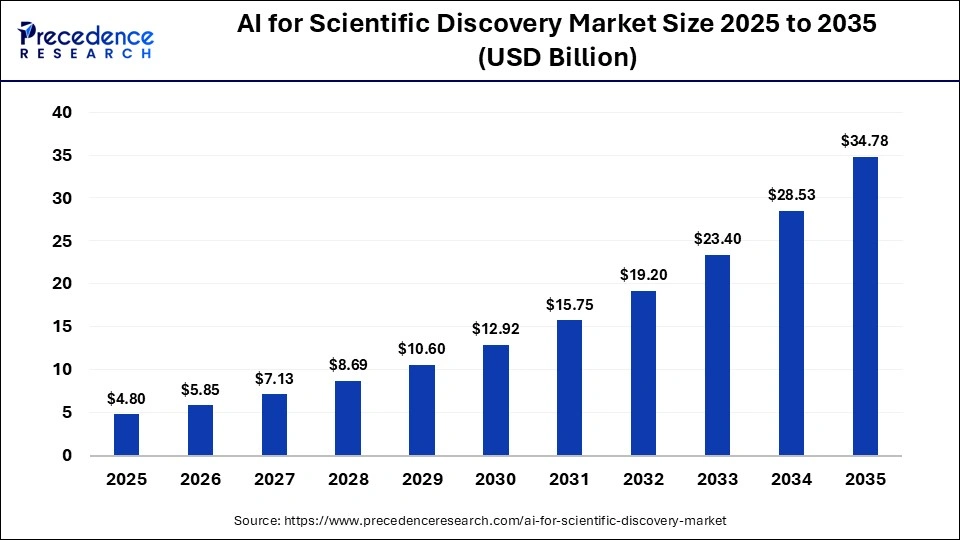
The global AI for scientific discovery market size was calculated at USD 4.80 billion in 2025 and is predicted to increase from USD 5.85 billion in 2026 to approximately USD 34.78 billion by 2035, expanding at a CAGR of 21.90% from 2026 to 2035.The market is significantly growing due to massive data generation, advances in high-performance computing, and increasing use of generative AI for drug discovery.
Key Takeaways
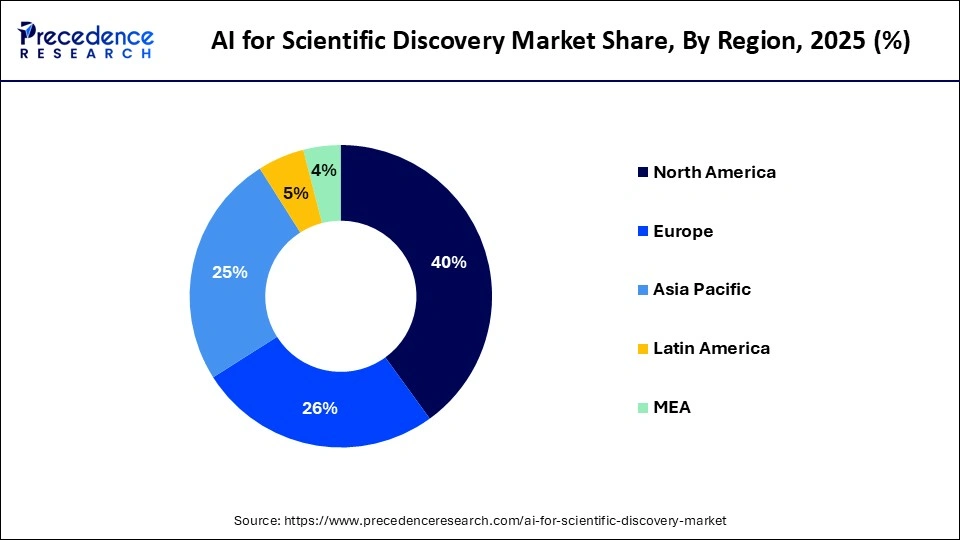
- By region, North America held the largest market share of nearly 40% in 2025.
- By region, Asia Pacific is projected to grow at the fastest CAGR during the foreseeable period.
- By offering, the AI software platforms segment held the largest market share of nearly 44% in 2025.
- By offering, the data infrastructure and HPC platforms segment is projected to grow at the fastest CAGR during the foreseeable period.
- By technology, the machine learning algorithms segment held the largest market share of nearly 36% in 2025.
- By technology, the generative AI models segment is projected to grow at the fastest CAGR during the foreseeable period.
- By application, the drug discovery and biomedical research segment held the largest market share of nearly 34% in 2025.
- By application, the materials science and chemistry discovery segment is projected to grow at the fastest CAGR during the foreseeable period.
- By end user, the pharmaceutical and biotechnology companies segment held the largest market share of nearly 36% in 2025.
- By end user, the chemicals and materials companies segment is projected to grow at the fastest CAGR during the foreseeable period.
Market Overview
The global AI for scientific discovery market includes artificial intelligence platforms, algorithms, and services used to accelerate scientific research across fields such as life sciences, chemistry, physics, materials science, and climate modelling. These solutions leverage machine learning, deep learning, generative AI, and high-performance computing to analyse complex scientific datasets, predict molecular structures, simulate experiments, and generate new hypotheses. AI-driven discovery platforms are increasingly used in pharmaceutical R&D, academic research labs, and industrial innovation programs to shorten research timelines and reduce experimental costs.
AI for Scientific Discovery Market Trends
- Generative AI for Drug Discovery: Platforms like Merck's ADDISON are enabling the virtual design of molecular structures, accelerating the identification of new drug candidates.
- Multimodal AI Adoption: AI models are increasingly analyzing diverse data types, text, images, and numerical data, improving the accuracy of scientific predictions.
- Cloud Computing Integration: Advanced cloud systems are being leveraged to manage high-volume AI-generated data and extract actionable insights efficiently.
- Data Privacy Innovations: Techniques like synthetic data generation and homomorphic encryption allow secure sharing and use of confidential datasets for research without compromising privacy.
Market Scope
| Report Coverage | Details |
| Market Size in 2025 | USD 4.80 Billion |
| Market Size in 2026 | USD 5.85 Billion |
| Market Size by 2035 | USD 34.78 Billion |
| Market Growth Rate from 2026 to 2035 | CAGR of 21.90% |
| Dominating Region | North America |
| Fastest Growing Region | Asia Pacific |
| Base Year | 2025 |
| Forecast Period | 2026 to 2035 |
| Segments Covered | Offering, Technology, Application, End User, and region |
| Regions Covered | North America, Europe, Asia-Pacific, Latin America, and Middle East & Africa |
Segment Insights
Offering Insights
Why Does the AI Software Platforms Segment Dominate the AI for Scientific Discovery Market?
The AI software platforms segment dominated the market while holding the largest share of nearly 44% in 2025 due to the accelerated research to find drug candidates with cost efficiency and manage massive datasets in sectors like material sciences and drug discovery. These platforms effectively manage complex datasets to gain insights from information about genomic sequences or chemical compound libraries to reduce project timelines that are beyond human capabilities. Also, AI software predicts the efficacy of compounds before lab testing, which further enhances the success rates of early-stage trials.
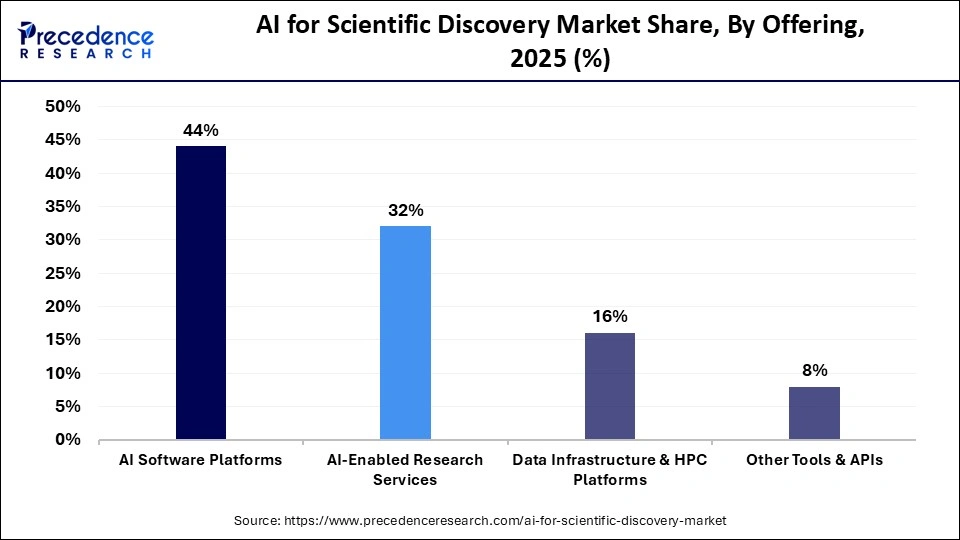
The data infrastructure and HPC platforms segment is expected to grow at the fastest CAGR during the foreseeable period, as these platforms offer unmatched processing power, low-latency networking, and data storage, making them crucial to train massive AI models on huge datasets. High-performance storage prevents GPUs from staying idle as HPC platforms are designed to handle intensive and synchronized AI/ML models. Therefore, modern cloud-based HPCs enable organizations to leverage scalable infrastructure for faster research and outcomes.
Technology Insights
Why Did the Machine Learning Algorithms Segment Lead the AI for Scientific Discovery Market?
The machine learning algorithms segment led the market with the largest share of nearly 36% in 2025, driven by their ability to accelerate research through large-scale data analysis and pattern recognition. ML automates repetitive and time-consuming tasks, enabling researchers to focus on complex problems requiring human expertise. It can simulate and predict outcomes, reducing reliance on costly physical testing and clinical trials. Additionally, ML algorithms analyze millions of molecular structures in a single day to identify promising drug candidates, significantly accelerating the research and drug discovery process beyond traditional capabilities.
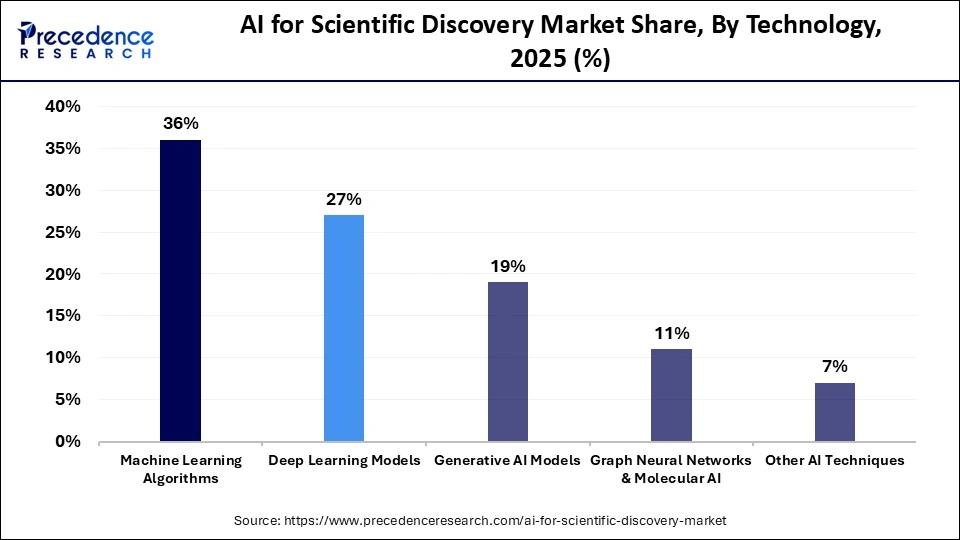
The generative AI models segment is projected to grow at the fastest CAGR during the foreseeable period due to their capability to simulate experiments and predict outcomes for complex molecular structures without extensive human intervention or physical lab testing. These models can design entirely new molecular structures and analyze drug-to-drug interactions, enabling innovative drug repurposing strategies. By accelerating discovery timelines and minimizing costly trial-and-error processes, generative AI significantly reduces R&D expenditure and speeds up commercialization.
Application Insights
Why Did the Drug Discovery and Biomedical Research Segment Lead the Market?
The drug discovery and biomedical research segment led the AI for scientific discovery market, holding nearly 34% share in 2025. The dominance of the segment is driven by AI's ability to process complex datasets and solve intricate scientific problems, enabling faster and more cost-effective drug development. The huge costs of failure per approved compound have driven the massive AI investments to predict drug interactions and speed up clinical trials with simulation at the molecular level. Additionally, deep learning algorithms enhance drug-target interaction prediction, further strengthening investments by these companies.
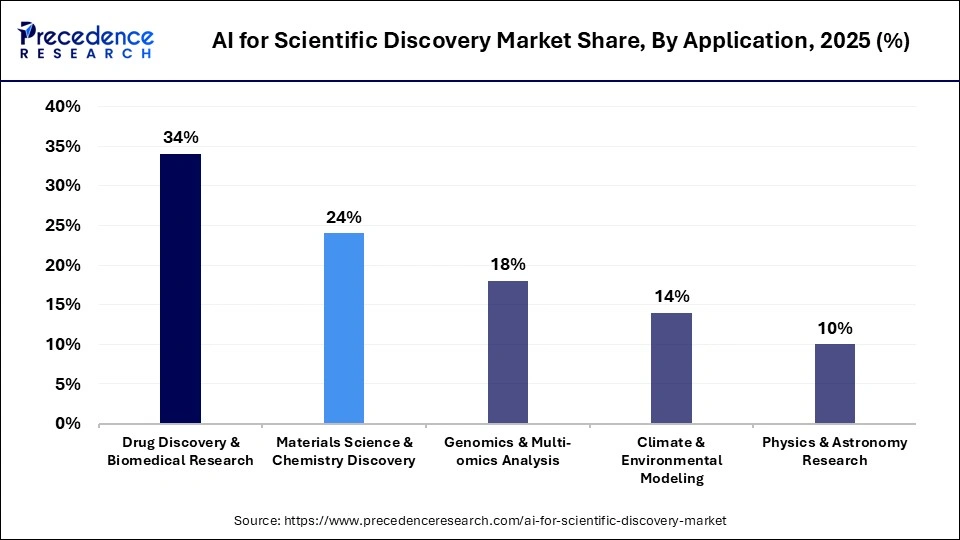
The materials science and chemistry discovery segment is projected to grow at the fastest CAGR during the foreseeable period due to the higher complexity involved in the material science and chemistry research, with massive data generation that needs to be handled skillfully to find patterns. Advanced AI technologies, including graph neural networks and physics-informed neural networks, enable accurate prediction of material properties even before physical synthesis. By simulating atomic-level interactions with high precision, these tools significantly accelerate innovation and reduce experimental costs.
End User Insights
What Made Pharmaceutical and Biotech Companies the Dominant Segment in the Market?
The pharmaceutical and biotech companies held the largest market share of nearly 36% in 2025 due to the increased R&D activities by these companies. This significantly encouraged them to adopt AI technologies to reduce frequent failure rates, optimize clinical trials, and analyze massive biological datasets. Large pharmaceutical firms heavily invest in AI-powered platforms to enhance decision-making and better outcomes. According to PwC, approximately 53% of pharmaceutical industry leaders prioritize AI and advanced analytics to streamline operations and automate critical processes.
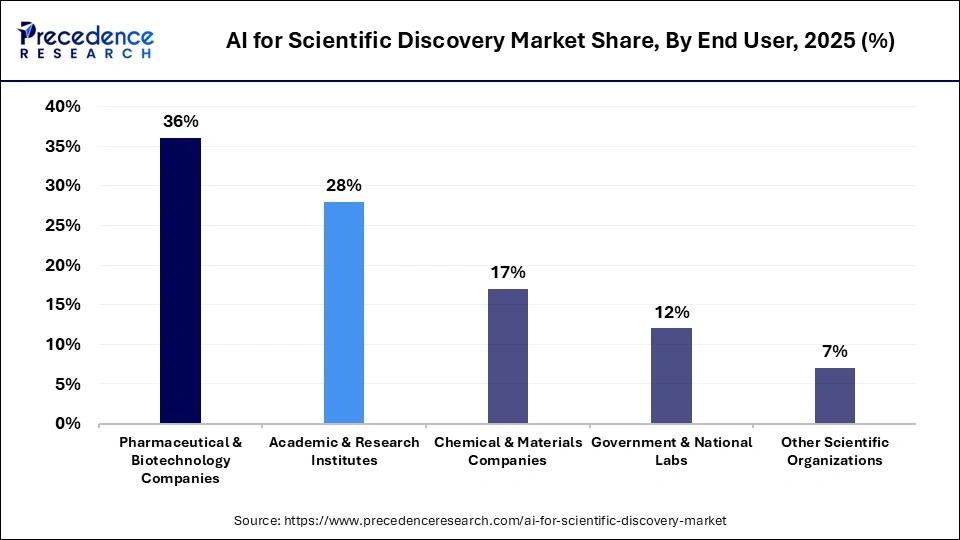
The chemicals and materials companies segment is projected to grow at the highest CAGR during the foreseeable period, driven by the increasing use of AI tools such as deep learning and machine learning to identify molecules and accurately predict their chemical properties and environmental interactions. These companies generate vast datasets that support AI training and enable the detection of complex chemical behaviors for advanced material development. Additionally, AI helps optimize production processes, reduce waste, and develop sustainable alternatives, supporting compliance with stringent environmental regulations.
Regional Analysis
North America AI for Scientific Discovery Market Size and Growth 2026 to 2035
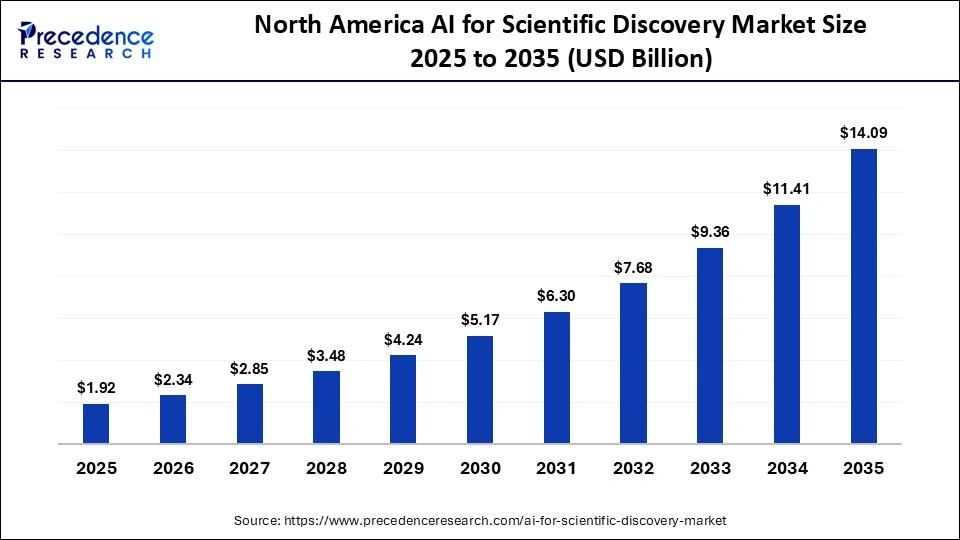
The North America AI for scientific discovery market size is estimated at USD 1.92 billion in 2025 and is projected to reach approximately USD 14.09 billion by 2035, with a 22.06% CAGR from 2026 to 2035.
What Made North America a Leader in the AI for Scientific Discovery Market?
North America dominated the AI for scientific discovery market by capturing the largest share of nearly 40% in 2025. The region's dominance in the market is attributed to strong technological advancements and extensive R&D integration across scientific sectors. The region benefits from the expansion of cutting-edge technologies such as AI-integrated quantum computing and blockchain. Moreover, strategic collaborations between leading pharmaceutical companies and AI solution providers, along with the active presence of major technology players like NVIDIA, IBM, and Google, are further strengthening market growth and innovation.
U.S. AI for Scientific Discovery Market Size and Growth 2026 to 2035
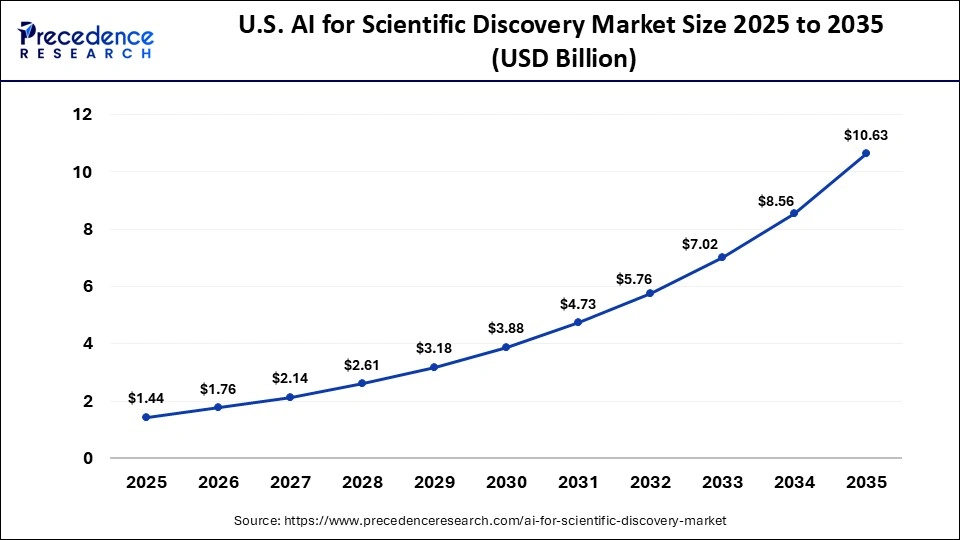
The U.S. AI for scientific discovery market size is calculated at USD 1.44 billion in 2025 and is expected to reach nearly USD 10.63 billion in 2035, accelerating at a strong CAGR of 22.13% between 2026 and 2035.
U.S. AI for Scientific Discovery Market Analysis
The U.S. is considered a major contributor to the North American market, owing to the convergence of factors like strategic initiatives such as the AI Action Plan and the Genesis Mission, along with well-established research institutions and substantial private-sector investments in AI-driven scientific research. The country further benefits from strong federal backing, with agencies actively advancing AI platforms and research programs. Organizations such as the National Science Foundation (NSF), Department of Energy (DOE), National Institutes of Health (NIH), and National Oceanic and Atmospheric Administration (NOAA) play a critical role in promoting AI adoption across scientific and R&D domains.
Why is Asia Pacific Rapidly Expanding in the AI for Scientific Discovery Market?
Asia Pacific is projected to grow at the fastest CAGR during the foreseeable period, driven by a strong R&D ecosystem across key sectors such as defense, pharmaceuticals, biotechnology, aviation, and chemicals, supported by substantial government investments in AI-enabled research platforms. The region has shown significant progress in AI-powered drug discovery, particularly with neural network programs like AlphaFold, which revolutionized protein structure prediction and earned global recognition, including a Nobel Prize. According to Morgan Stanley, AI applications in drug development could result in approximately 50 additional successful treatments over the next decade, further reinforcing the region's growth potential.
China AI for Scientific Discovery Market Analysis
China is rapidly expanding its AI research capabilities, supported by a strong pool of young talent and a growing innovation-driven ecosystem. With an estimated 30,000 active AI researchers and a large number of postdoctoral scholars pursuing advanced AI studies, the country has secured a significant share of global AI-related patents, underscoring its strength in leveraging AI across research sectors. Leading domestic AI firms such as DeepSeek are accelerating model development and advancing large-scale AI systems, reinforcing China's ambition to become a global AI superpower.
How is the Opportunistic Rise of Europe in the AI for Scientific Discovery Market?
Europe is experiencing an opportunistic rise in the market due to strong government-backed research initiatives, advanced academic institutions, and well-established pharmaceutical and chemical industries. Collaborative programs such as Horizon Europe and investments in AI-driven laboratories are accelerating AI adoption in drug discovery, materials science, and chemical research. Additionally, growing partnerships between European tech firms and research organizations are driving innovation in AI models, computational chemistry, and predictive analytics, positioning Europe as a competitive hub for AI-enabled scientific breakthroughs.
AI for Scientific Discovery Market Companies
- AbCellera Biologics Inc.
- Amazon Web Services Inc.
- Atomwise Inc.
- Benchling Inc.
- BenchSci Analytics Inc.
- BenevolentAI
- Evaxion AS
- Generate Biomedicines
- Google LLC
- Healx Ltd.
- IBM Corp.
- Insilico Medicine
- Microsoft Corp.
- Nimbus Therapeutics
- Novartis AG
- NVIDIA Corp.
- Recursion Pharmaceuticals Inc.
- Schrodinger Inc.
- Others
Recent Developments
- In February 2026, Tamarind Bio secured a USD 13.6M series A, aiming to make AI accessible for life science researchers with Tamarind Libraries of over 200 models with a wide range of modalities from life science.(Source: https://www.genengnews.com)
- In February 2026, Google DeepMind introduced a national partnership for AI and collaboration in India to broaden AI access to researchers with AI tools like AI Co-Scientist, Earth AI, and AlphaGenome.(Source: https://deepmind.google)
Segments Covered in the Report
By Offering
- AI Software Platforms
- Molecular modelling platforms
- AI research analytics tools
- AI-Enabled Research Services
- Scientific consulting
- AI model development services
- Data Infrastructure and HPC Platforms
- Other Tools and APIs
By Technology
- Machine Learning Algorithms
- Deep Learning Models
- Generative AI Models
- Graph Neural Networks and Molecular AI
- Other AI Techniques
By Application
- Drug Discovery and Biomedical Research
- Materials Science and Chemistry Discovery
- Genomics and Multi-omics Analysis
- Climate and Environmental Modelling
- Physics and Astronomy Research
By End User
- Pharmaceutical and Biotechnology Companies
- Academic and Research Institutes
- Chemical and Materials Companies
- Government and National Labs
Other Scientific Organizations
By Region
- North America
- Europe
- Asia-Pacific
- Latin America
- Middle East & Africa
For inquiries regarding discounts, bulk purchases, or customization requests, please contact us at sales@precedenceresearch.com
Frequently Asked Questions





Ask For Sample
No cookie-cutter, only authentic analysis – take the 1st step to become a Precedence Research client
 Get a Sample




 sales@precedenceresearch.com
 Schedule a Meeting
