



AI In Endoscopy Market Size, Companies, Share, Patient Volume, Treatment Adoption Rates, Pricing Analysis, Regulatory Landscape, Competitive Positioning, and Demand Forecast
AI In Endoscopy Market (By Application: Colonoscopy, Gastrointestinal Endoscopy, Respiratory Endoscopy, Urological Endoscopy; By Type of Endoscopes: Rigid Endoscopes, Flexible Endoscopes; By Endoscopy Techniques: Endoscopic Ultrasound, Confocal Endoscopy, Capsule Endoscopy, Autofluorescence Endoscopy; By Endoscopy Imaging Modalities: White-Light Endoscopy, Narrow-Band Imaging, High-Definition Endoscopy, Fluorescence Endoscopy) - Global Industry Analysis, Size, Trends, Leading Companies, Regional Outlook, and Forecast 2026 to 2035
Source: https://www.precedenceresearch.com/ai-in-endoscopy-market
 Get a Sample
 Table Of Content


What is the AI In Endoscopy Market Size in 2026?
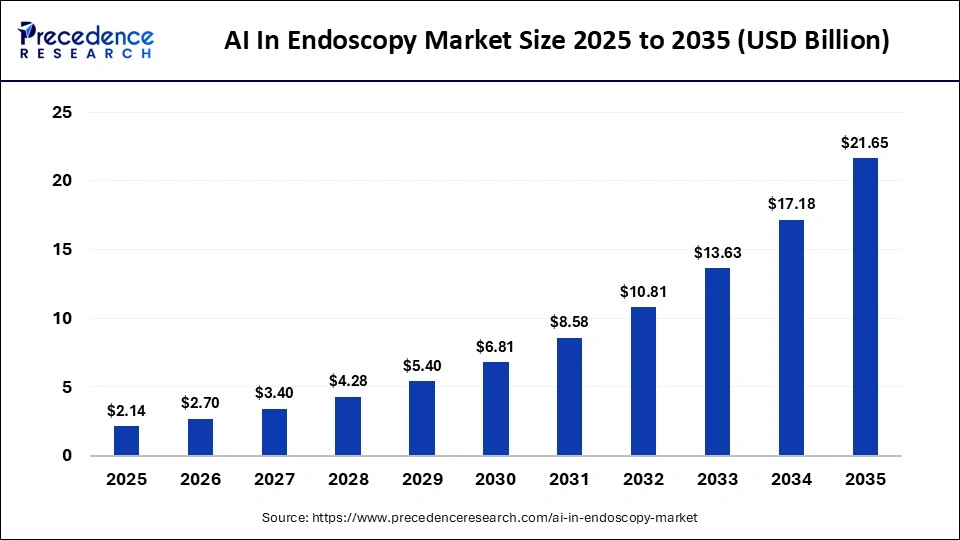
The global AI in endoscopy market size was calculated at USD 2.14 billion in 2025 and is predicted to increase from USD 2.70 billion in 2026 to approximately USD 21.65 billion by 2035, expanding at a CAGR of 26.04% from 2026 to 2035. Market growth is attributed to the increasing adoption of AI-assisted endoscopy systems that enhance diagnostic accuracy and workflow efficiency in hospitals worldwide.
Key Takeaways
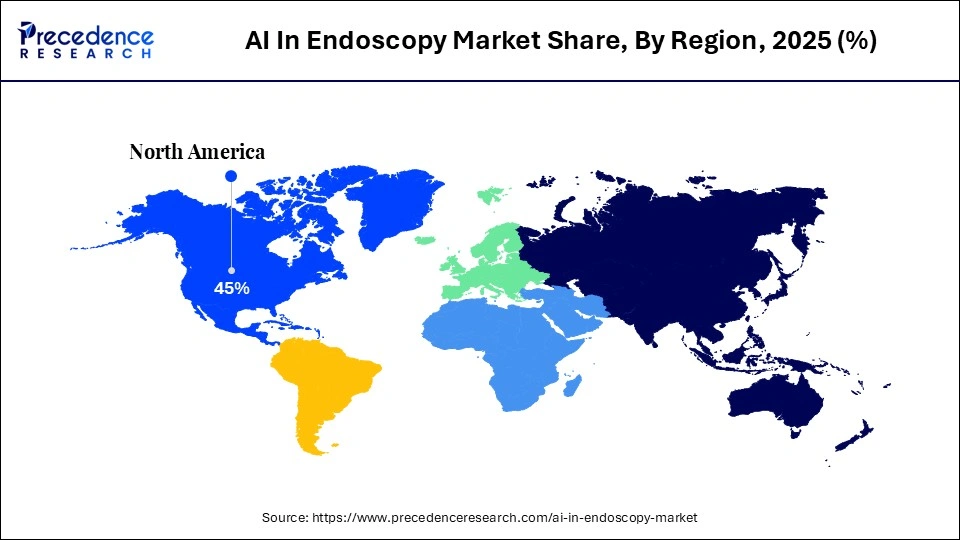
- North America dominated the market with the largest market share of 45% in 2025.
- Asia-Pacific is expected to grow at the fastest CAGR between 2026 and 2035.
- By application, the gastrointestinal endoscopy segment contributed the highest AI in endoscopy market share in 2025.
- By application, the urological endoscopy segment is expected to grow at a rapid CAGR between 2026 and 2035.
- By type of endoscopes, the flexible endoscopes segment held a major market share in 2025.
- By type of endoscopes, the rigid endoscopes segment is expected to expand at the fastest CAGR from 2026 to 2035.
- By endoscopy techniques, the endoscopic ultrasound segment captured the highest market share in 2025.
- By endoscopy techniques, the autofluorescence endoscopy segment is poised to grow at a fast CAGR between 2026 and 2035.
- By endoscopy imaging modalities, the white-light endoscopy segment generated the biggest market share in 2025.
- By endoscopy imaging modalities, the fluorescence endoscopy segment is expected to expand at a steady CAGR between 2026 and 2035.
AI In Endoscopy Market Growth Factors
- Increasing Integration with Robotic Endoscopy Platforms: Advancements in robotic-assisted procedures are boosting demand for AI algorithms that enhance precision and real-time guidance.
- Expansion of Cloud-Based Endoscopy Solutions: Adoption of cloud-enabled AI platforms is fueling remote diagnostics and centralized data analysis across hospital networks.
- Advancements in Deep Learning Algorithms: Continuous improvements in image recognition and anomaly detection are driving higher adoption of AI systems in routine endoscopy.
Global Advances and Adoption Trends in AI-Powered Endoscopy Technologies
- China leads globally in research and clinical development of AI-powered colonoscopy technologies, contributing over 745 scientific publications related to AI in digestive endoscopy, reflecting strong academic and hospital-based adoption of AI diagnostic systems across major medical institutions.
- The United States is among the most active countries deploying AI-enabled colonoscopy technologies in clinical practice, with over 286 research publications and extensive hospital collaborations with AI developers, supporting real-time polyp detection and computer-aided diagnostic systems in gastrointestinal procedures.
- As of 2024, regulatory data shows that 13 AI-enabled devices dedicated specifically to gastrointestinal endoscopy have received clearance from the U.S. Food and Drug Administration (FDA), reflecting the early but steadily expanding regulatory landscape for AI-assisted endoscopic technologies.
- In 2024, Olympus subsidiary Odin Vision received FDA 510(k) clearance for the CADDIE cloud-based AI system, designed to assist gastroenterologists in detecting suspected colorectal polyps during colonoscopy procedures, representing one of the first cloud-based AI endoscopy platforms approved for clinical use.
- The United States continues expanding colorectal cancer screening programs supported by advanced diagnostics and AI tools, with more than 15 million colonoscopy procedures performed annually, creating a large clinical foundation for integrating computer-aided detection (CADe) technologies into routine screening programs.
- Global academic interest in AI-assisted gastrointestinal endoscopy has increased rapidly, with 345 scientific publications recorded in 2023, representing the highest annual research output in the field and reflecting growing global research activity in AI-based endoscopic diagnostics.
Which Factors Drive the AI in Endoscopy Market?
The rapid rise in gastrointestinal (GI) disorders and colorectal cancer prevalence is a key driver accelerating the adoption of AI-assisted endoscopy technologies worldwide. Health systems are emphasizing early detection to minimize morbidity and mortality. AI in endoscopy combines machine learning (ML) and deep learning technologies, in particular, computer-aided detection (CADe) and computer-aided diagnosis (CADx) systems, and endoscopic imaging.
Such systems read video feeds in real time, and indicate polyps, lesions, and foci of mucosal abnormalities that can be overlooked during regular work. It is clinically proven that AI-assisted colonoscopy results in a better adenoma detection rate (ADR). A meta-analysis involving 23,861 participants across 28 randomized controlled trials reported that AI use increased ADR by about 20% and reduced miss rates by 55% compared with unassisted procedures.
Furthermore, the need to have standardized, accurate, and efficient diagnostic processes is fuelling the AI implementation in endoscopy systems.
AI in Endoscopy Market Trends
- Growth of AI-Enabled Capsule Endoscopy Solutions: AI-assisted capsule endoscopy is a wireless imaging device with automated lesion detection capabilities and is minimally invasive compared to traditional methods. The market is growing with increased adoption, as clinics need patient-friendly diagnostics with quicker results.
- Integration of Cloud-Based AI Platforms and Telemedicine: AI systems based on clouds allow remote monitoring of endoscopic data and provide telemedicine consultation and centralized diagnostics. This tendency enables the growth of the market because hospitals do not need a lot of on-site infrastructure to implement AI tools. Small clinics and smaller markets are also gaining faster with cloud integration, which links more patients to sophisticated diagnostics.
Market Scope
| Report Coverage | Details |
| Market Size in 2025 | USD 2.14 Billion |
| Market Size in 2026 | USD 2.70 Billion |
| Market Size by 2035 | USD 21.65 Billion |
| Market Growth Rate from 2026 to 2035 | CAGR of 26.04% |
| Dominating Region | North America |
| Fastest Growing Region | Asia Pacific |
| Base Year | 2025 |
| Forecast Period | 2026 to 2035 |
| Segments Covered | Application, Type of Endoscopes , Endoscopy Techniques , Endoscopy Imaging Modalities , and region |
| Regions Covered | North America, Europe, Asia-Pacific, Latin America, and Middle East & Africa |
Segmental Insights
Application Insights
Which Application Segment Dominated the AI in Endoscopy Market?
The gastrointestinal endoscopy segment dominated the market in 2025, due to its support of the highest proportion of clinical endoscopies to detect early cancer and screen the bowel. Colorectal cancer remains a major global health concern, with approximately 154,000 new cases and 54,000 deaths projected for 2025, reflecting a heavy disease burden that drives demand for enhanced diagnostics. Furthermore, the continued accumulation of evidence is expected to support the sustained dominance of GI endoscopy in the coming years.
The urological endoscopy segment is expected to grow at the fastest CAGR in the coming years, owing to the emerging trend in the development of AI technology that assists in imaging and diagnostic guidance of urological cancer and diseases. Urological cancers, including prostate, bladder, and kidney cancers, accounted for about 2.25 million new global cases and over 815,000 deaths in recent burden estimates. This highlights the clinical need to develop better detection tools, such as AI-based endoscopy technology, further boosting the segment growth.
Type of Endoscopes Insights
How the Flexible Endoscopes Segment Dominated the AI in Endoscopy Market?
The flexible endoscopes segment held the largest revenue share in the market in 2025, due to their high quality of visualization and accessibility with the intricate anatomical structures. Their structure makes them navigate through curved and narrow ducts, and both diagnose and perform therapeutic intervention within the same session. Furthermore, the high level of procedural volume and broad clinical use across all endoscopy suites around the globe is expected to boost the demand for this type of endoscopes.
The rigid endoscopes segment is expected to show the fastest growth over the forecast period, as they remain essential tools in surgical specialties requiring precise, stable visualization. They have found wide application in such procedures as arthroscopy and cystoscopy.
This type of endoscopes is more compatible with high-definition imaging systems, and durability enhances surgical control and outcomes. Moreover, the combination of surgical precision, evolving tech integration, and clinical trust is expected to sustain the segment's growth.
Endoscopy Technique Insights
Why Did the Endoscopic Ultrasound Segment Dominate the AI in Endoscopy Market?
The endoscopy ultrasound segment contributed the biggest market share in 2025 due to its unique combination of high-resolution imaging and deep tissue access that supports complex diagnostic tasks across GI and pancreatic diseases. AI results in better interpretation of subtle features of pancreatic and biliary pathologies. This enables more accurate characterization of the lesion compared to the conventional use of ultrasound.
The autofluorescence endoscopy segment is expected to witness the fastest growth in the market over the forecast period, as clinicians are demanding advanced optical imaging to detect early-stage cancer that cannot be easily observed using white light imaging. Autofluorescence imaging enhances the ability to identify dysplasia and early malignancy using autofluorescence imaging to increase contrast between normal and abnormal tissue.This results in earlier diagnosis and potentially improved patient outcomes. Furthermore, the current technological advances and growing evidence of its diagnostic merit are likely to drive its growth as an adjunctive methodology in various specialties.
Endoscopy Imaging Modalities Insights
How the White-Light Endoscopy Segment Dominated the AI in Endoscopy Market?
The white-light endoscopy segment accounted for the highest revenue share in the market in 2025, as it is the leading diagnostic instrument in GI, urological, and upper GI biopsy in most parts of the world. The extensive use of the technology is supported by the presence of professional societies, including ESGE, ASGE, and UEG. That advise the use of white-light imaging to support the routine surveillance and cancer screening programs. Furthermore, the procedural efficiency, widespread adoption, and guideline support are expected to sustain its dominance in the market.
The fluorescence endoscopy segment is expected to expand rapidly in the market in the coming years, owing to its ability to highlight molecular and vascular tissue characteristics not visible under white-light imaging. The method involves the use of specific fluorophores to increase the contrast of the mucosa, which is used to accurately delineate the tumor margins and reduce unnecessary biopsies. Increasing attention to early cancer diagnosis and individual diagnostics at the global scale is becoming an adoption driver encouraged by the constant advances in multispectral imaging and AI-assisted analysis.
Regional Insights
North America AI In Endoscopy Market Size and Growth 2026 to 2035
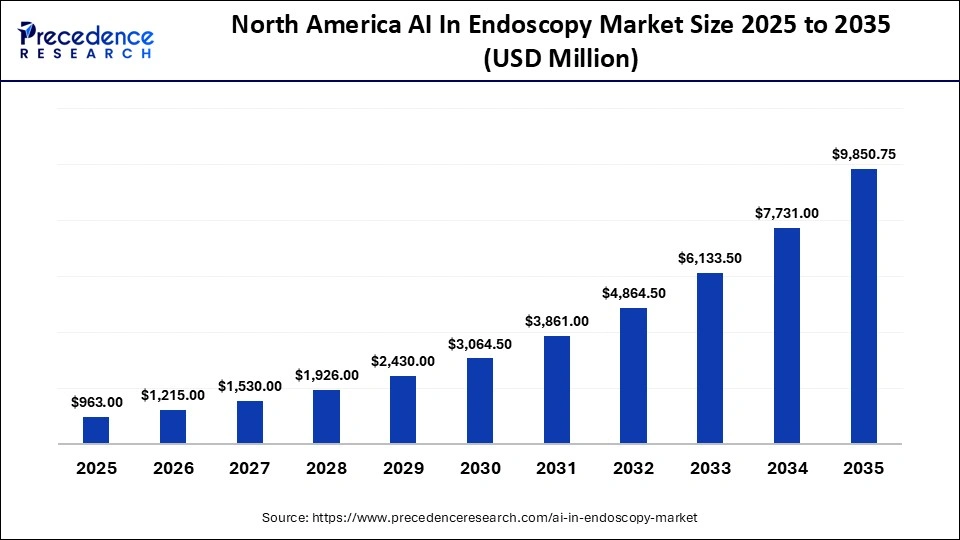
The North America AI In Endoscopy Market market size is estimated at USD 963.00 million in 2025 and is projected to reach approximately USD 9,850.75 million by 2035, with a 26.18% CAGR from 2026 to 2035.
Why Did North America Retain its Leadership in the AI in Endoscopy Market?
North America led the market in 2025, due to early technology adoption, large healthcare investments, and advanced screening programs across the United States and Canada. This is guided by the guidelines and expert consensus of societies such as the American Society for Gastrointestinal Endoscopy and the American College of Gastroenterology, among others.
- In over 72 randomized controlled trials, real-time AI systems have demonstrated high rates of adenoma detection by statistically significant ADR improvements in clinical settings in the U.S., supporting clinical confidence and standard adoption in 2025. Moreover, the evidence from ClinicalTrials.gov lists numerous active colonoscopy AI trials across the U.S., strengthening market growth in the coming years.
U.S. AI In Endoscopy Market Size and Growth 2026 to 2035
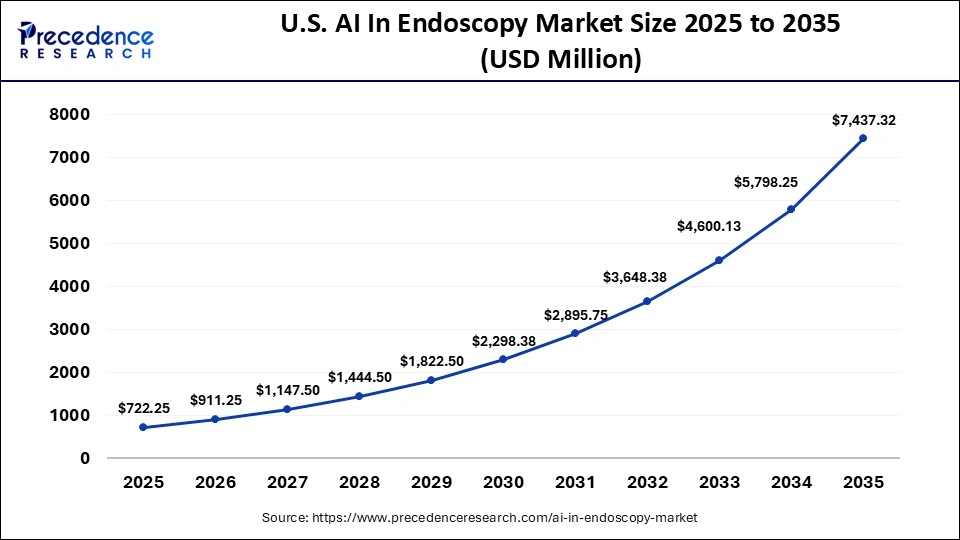
The U.S. AI In Endoscopy Market market size is calculated at USD 722.25 million in 2025 and is expected to reach nearly USD 7,437.32 million in 2035, accelerating at a strong CAGR of 26.26% between 2026 and 2035.
U.S. Leading AI-Assisted Endoscopy Adoption in North America
The U.S. is leading the endoscopy adoption in North America, supported by the country's robust clinical research system and initial regulatory approvals of CADe system usage through the FDA. Professional societies such as the American Society of Gastrointestinal Endoscopy and the American College of Gastroenterology have approved AI-assisted tools to be used in regular practice. This impacted procedural guidelines and clinician training programs nationwide, thus facilitating the market growth in the coming years.
How is Asia-Pacific Growing in the AI in Endoscopy Market?
Asia-Pacific is expected to experience the fastest growth during the predicted timeframe, owing to the increasing prevalence of GI diseases, particularly colorectal and gastric cancer. Increasing healthcare capacity in China, Japan, and South Korea, with national health program focuses on early diagnosis and preventative diagnostics.
The Asia-Pacific region is focusing on the use of AI-assisted colonoscopy in routine screening and surveillance of the colon, with support in terms of clinical integration pending the accumulation of evidence. Furthermore, the Expansion of healthcare expenditure and clinical training programs in the Asia-Pacific is spurring an increased openness to AI workflows.
China Emerging as Asia-Pacific's Growth Hub for AI-Enhanced Endoscopy
China is leading the charge in the Asia-Pacific market, due to the fast adoption of digital health technologies in screening programs. Chinese multicenter studies spanning seven hospitals have developed foundation AI models capable of staging complex esophagogastric junction adenocarcinoma with high levels of accuracy scores. Furthermore, the partnership of Chinese hospitals and international medtech innovators is increasing the speed of the implementation of on-site and cloud AI systems, thus propelling the regional growth in the coming years.
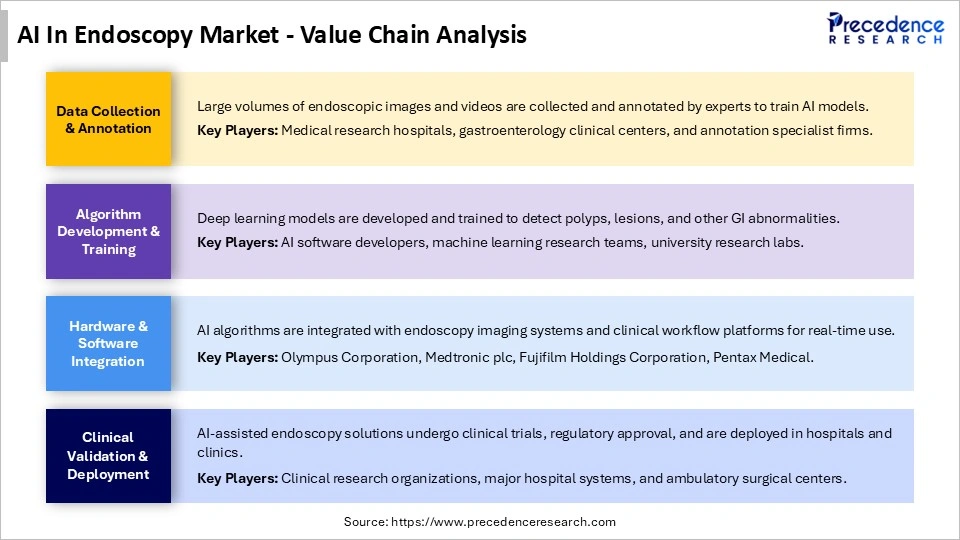
AI In Endoscopy Market Value Chain Analysis
AI In Endoscopy Market Companies
- Ambu
- Fujifilm
- Hoya
- Intuitive Surgical
- Iterative Scopes
- Magentiq Eye
- Medtronic
- NEC Corporation
- Odin Vision
- Olympus
- PENTAX Medical
- Wision Al
- Wuhan EndoAngel Medical Technology
Recent Developments
- In March 2026, Cosmo Pharmaceuticals N.V. signed a strategic R&D agreement with Amsterdam UMC and Eindhoven University of Technology to develop and clinically validate an AI-based CADe system for early neoplasia in Barrett's esophagus. This collaboration aims to extend the GI Genius platform's application beyond colorectal cancer screening into broader upper GI indications. (Source: https://finance.yahoo.com)
- In March 2026, Fujifilm India inaugurated local endoscopy manufacturing operations in Jodhpur, Rajasthan, establishing production of advanced diagnostic equipment. The move strengthens India's medical-device ecosystem and supports the Make in India initiative by localizing the supply of cutting-edge endoscopy systems. (Source: https://www.digitalhealthnews.com)
- In October 2024, Olympus Europa SE & Co. KG announced that its subsidiary, Odin Medical Ltd., received CE marking for its innovative cloud-AI endoscopy devices, CADDIE, CADU, and SMARTIBD, under the European Medical Device Regulation (MDR). This milestone reinforces Olympus' commitment to enhancing clinical precision and operational efficiency in endoscopy across Europe. (Source: https://www.olympus-global.com)
Segments Covered in the Report
By Application
- Colonoscopy
- Gastrointestinal Endoscopy
- Respiratory Endoscopy
- Urological Endoscopy
By Type of Endoscopes
- Rigid Endoscopes
- Flexible Endoscopes
By Endoscopy Techniques
- Endoscopic Ultrasound
- Confocal Endoscopy
- Capsule Endoscopy
- Autofluorescence Endoscopy
By Endoscopy Imaging Modalities
- White-Light Endoscopy
- Narrow-Band Imaging
- High-Definition Endoscopy
- Fluorescence Endoscopy
By Region
- North America
- Latin America
- Europe
- Asia-pacific
- Middle and East Africa
For inquiries regarding discounts, bulk purchases, or customization requests, please contact us at sales@precedenceresearch.com
Frequently Asked Questions
Tags





Ask For Sample
No cookie-cutter, only authentic analysis – take the 1st step to become a Precedence Research client
 Get a Sample




 sales@precedenceresearch.com
 Schedule a Meeting
