



Automotive Balance Shaft Market Size, Share and Trends 2026 to 2035
Automotive Balance Shaft Market (By Engine Type: Inline-3 Cylinder, Inline-4 Cylinder, Inline-5 Cylinder, V-6 Cylinder; By Manufacturing Process: Forged Balance Shaft, Cast Balance Shaft; By Vehicle Type: Passenger Cars, Light Commercial Vehicles, High Commercial Vehicles) - Global Industry Analysis, Size, Trends, Leading Companies, Regional Outlook, and Forecast 2026 to 2035
Source: https://www.precedenceresearch.com/automotive-balance-shaft-market
 Get a Sample
 Table Of Content


What is the Automotive Balance Shaft Market Size?
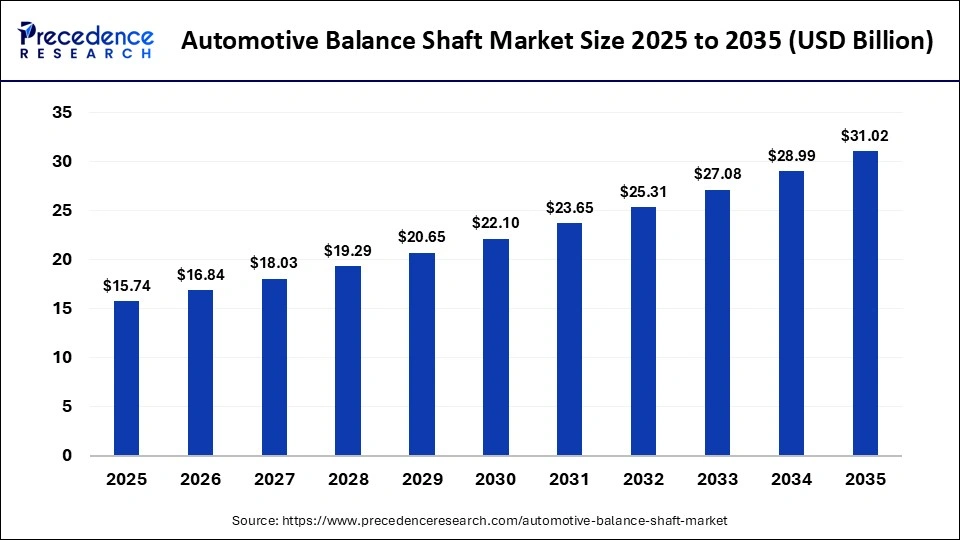
The global automotive balance shaft market size was calculated at USD 15.74 billion in 2025 and is predicted to increase from USD 16.84 billion in 2026 to approximately USD 31.02 billion by 2035, expanding at a CAGR of 7.02% from 2026 to 2035.The automotive balance shaft market is witnessing unprecedented growth, driven by the increasing need for improved engine performance and the rising production of inline 4-cylinder engines.
Market Highlights
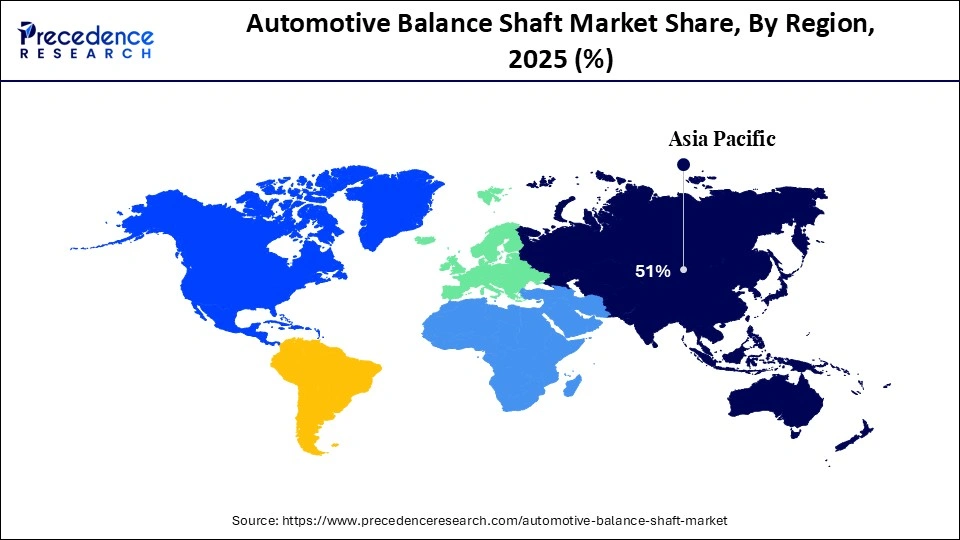
- Asia-Pacific dominated the market, holding the largest market share of 51% in 2025.
- North America is expected to expand at the fastest CAGR in the automotive balance shaft market between 2025 and 2034.
- By engine type, the inline 4-cylinder segment accounted for the highest market share of 39% in 2025.
- By engine type, the V6-cylinder segment is expected to grow at a remarkable CAGR between 2025 and 2034.
- By manufacturing process, the forged balance shaft segment contributed the biggest market share of 77% in 2025.
- By manufacturing process, the cast balance shaft segment is expected to grow at a significant CAGR from 2025 to 2034.
- By vehicle type, the LCV segment held the largest share in the automotive balance shaft market.
- By vehicle type, the passenger cars segment is set to grow at a notable CAGR.
Market Overview
Balance shafts play a vital role in the automotive sector, contributing significantly to the improved performance and efficiency of engines. An automotive balance shaft is a crucial engine component that is designed to reduce vibrations caused by the vertical movement of pistons and crankshaft rotation. Automotive balance shaft improves passenger comfort, reduces noise, vibration, and harshness (NVH), and lowers mechanical stress on engine components. Automotive engineers design and integrate balance shafts into engines to improve overall driving comfort and reduce wear and tear.
How is AI Impacting the Growth of the Automotive Balance Shaft Market?
In the digital evolution, the integration of Artificial Intelligence (AI) is driving innovation and accelerating the growth of the automotive balance shaft market. Artificial Intelligence (AI) integration emerges as a critical enabler of innovation and is playing an increasingly crucial role in reshaping the automotive industry. The rapid advancements in machine learning and computer vision have led to enhancing manufacturing processes, improving passenger experiences, and optimizing vehicle performance.
The integration of AI and advanced manufacturing techniques allows for optimized design, enhances the accuracy of manufacturing, and reduces errors in the production of these high-precision engine components. AI accurately identifies any defects in real-time, improving inspection accuracy and reducing overall manufacturing costs.
What are the Emerging Trends in the Automotive Balance Shaft Market?
- The rising need for enhanced noise, vibration, and harshness (NVH) performance in 4-cylinder and hybrid engines is anticipated to accelerate the growth of the automotive balance shaft market during the forecast period. The growing focus on comfortable and reduced noise driving experiences pushes vehicle manufacturers to improve their designs to comply with NVH standards.
- The stricter government emission standards and the demand for more refined performance in passenger vehicles are expected to contribute to the overall growth of the automotive balance shaft market. The implementation of stringent emission regulations is compelling the automotive manufacturers to incorporate technologies that lessen emissions from internal combustion engines.
- The rising production of passenger and commercial vehicles, along with the growing demand for fuel-efficient & lower-vibration vehicles, is anticipated to fuel the expansion of the automotive balance shaft market in the coming years.
- The rapid technological innovation has led to the increasing launch of new, lighter, and more efficient balance shaft technology to enhance engine smoothness is anticipated to boost the market's expansion in the coming years.
- The increasing focus of automotive manufacturers on optimizing balance shafts for hybrid engines to improve casting and forging quality is expected to bolster the growth of the automotive balance shaft market during the forecast period.
Market Scope
| Report Coverage | Details |
| Market Size in 2025 | USD 15.74 Billion |
| Market Size in 2026 | USD 16.84 Billion |
| Market Size by 2035 | USD 31.02 Billion |
| Market Growth Rate from 2026 to 2035 | CAGR of 7.02% |
| Dominating Region | North America |
| Fastest Growing Region | Asia Pacific |
| Base Year | 2025 |
| Forecast Period | 2026 to 2035 |
| Segments Covered | Engine Type, Manufacturing Process, Vehicle Type, and region |
| Regions Covered | North America, Europe, Asia-Pacific, Latin America, and Middle East & Africa |
Segmental Insights
Engine Type Insights
The inline 4-cylinder segment accounted for the majority of the market share in 2025. Balancing shafts are widely used in 4-cylinder engines to provide a smooth-running engine with minimal vibration. Automotive balance shafts in 4-cylinder engines are counter-weighted components designed to target and cancel out inherent secondary vibrations produced by the pistons and connecting rods. Moreover, as automakers are shifting toward smaller, more efficient inline 4-cylinder engines, balance shafts play an essential role in mitigating severe vibrations, enhancing engine longevity, and improving overall driving comfort.
On the other hand, the V6-cylinder segment is expected to grow at a remarkable CAGR between 2025 and 2034. The segment with the fastest growth is driven by the inherent imbalance design, the rise of V6 hybrid integration, and stringent emission regulations. With the rising consumer demand for quieter and more comfortable rides, luxury cars and SUVs frequently use V6 engines, which require balance shafts to reduce Noise, Vibration, and Harshness (NVH) to meet stringent emission standards.
Manufacturing Process Insights
The forged balance shaft segment dominated the automotive balance shaft market by holding a majority share in 2025, owing to the growing demand for commercial and high-performance passenger vehicles. Forging produces strong, durable, and reliable components with superior resistance, which ensures longevity under high rotational speeds. As automakers prioritize lightweight materials to improve fuel efficiency and reduce emissions, forged components provide the necessary strength.
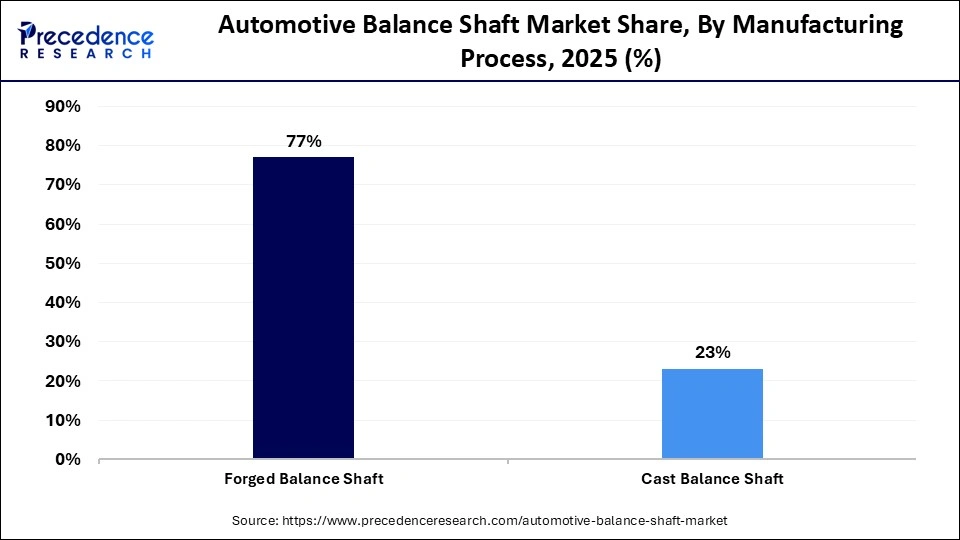
On the other hand, the cast balance shaft segment is the fastest-growing in the automotive balance shaft market. The growth of the segment is primarily driven by its cost efficiency, high production efficiency for large-scale manufacturing, and the ability to align with the stringent NVH standards for 4-cylinder engines. Automakers are increasingly focusing on compact and high-output inline 4-cylinder engines to reduce engine vibration and improve passenger comfort increased the need for cast balance shafts, driving the segment's growth in the coming years.
Inspection Type Insights
The surface & defect inspection segment dominated the automotive balance shaft market. The growth of the segment is owing to the increasing focus on high-precision detection of surface anomalies such as dents, scratches, and paint flaws using AI-driven computer vision. This technology enables faster and more accurate quality control, reducing manual inspection errors and enhancing overall production efficiency. As automotive manufacturers prioritize product reliability and customer satisfaction, investment in advanced inspection systems continues to rise.
On the other hand, the functional inspection segment is expected to expand at a remarkable growth rate of 17.0% between 2025 and 2034, owing to the rising demand for zero-defect manufacturing, the rise of electric vehicles (EVs) and autonomous systems, and stringent global safety and emissions regulations. Several automakers are increasingly adopting AI-driven functional inspections to detect internal or mechanical defects at early manufacturing stages to meet high safety and reliability standards before final assembly.
Vehicle Type Insights
The light commercial vehicles (LCV) segment dominated the automotive balance shaft market. The rising expansion of e-commerce, increasing need for urban logistics, and growing consumer demand for last-mile delivery have substantially increased the demand for light commercial vehicles, encouraging automotive manufacturers for high volume production. LCVs often use 4-cylinder engines that require balance shafts to ensure a smooth-running engine and minimize severe vibration.
On the other hand, the passenger cars segment is a significant and rapidly growing application segment for the automotive balance shaft market, owing to the increasing production of high-volume passenger cars and growing demand for fuel-efficient vehicles. The increasing adoption of inline 4-cylinder engines in passenger cars requires balance shafts to provide a quiet & comfortable experience and enhance smooth driving. Additionally, the stringent emission regulations necessitate advanced engine technologies in passenger cars, which increases the adoption of balance shafts for better fuel efficiency and improved performance.
Regional Insights
What is the Asia Pacific Automotive Balance Shaft Market Size?
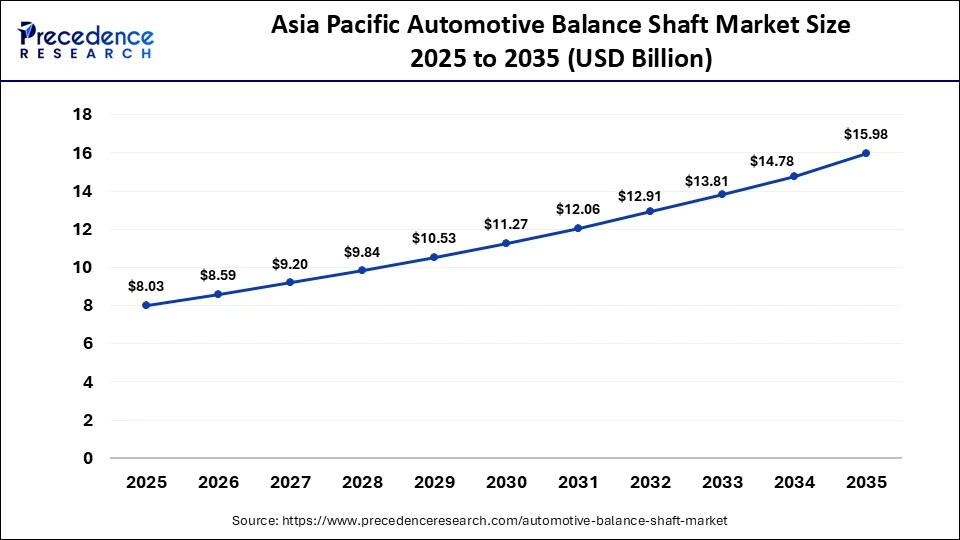
The Asia Pacific automotive balance shaft market size is expected to be worth USD 15.98 billion by 2035, increasing from USD 8.03 billion by 2025, growing at a CAGR of 7.12% from 2026 to 2035.
Asia-Pacific's Automotive Balance Shaft Market Analysis
Asia-Pacific dominates the automotive balance shaft market, holding the majority of the revenue share in 2025. The region is home to the major automotive production hubs, notably in China, Japan, South Korea, and India, creating a strong demand for automotive balance shafts to optimize vehicles' engine performance and ensure smooth operations. The region's leadership position is driven by the increase in vehicle production and sales, the rising importance of noise, vibration, and harshness (NVH), stricter government emission standards, increasing focus on fuel efficiency, and rapid technological innovation. These factors collectively contribute to the strength of the region's leadership position in the automotive balance shaft market.
- In October 2025, the Ford Motor Company announced an investment of up to Rs 3,250 crore into its plant in Chennai, Tamil Nadu, intending to export next-gen engines to foreign markets. The American carmaker has signed a Memorandum of Understanding (MOU) with the Tamil Nadu government for the same. Ford stated that the fresh investment will go into its existing engine manufacturing facility in Chennai to produce next-generation engines starting from 2029 for global markets. The company also announced that the upgraded facility will have a planned production capacity of 2.35 lakh units per annum and help to create over 600 new jobs.
China's Automotive Balance Shaft Market Analysis
China holds a substantial market share in the automotive balance shaft market. China is a major contributor to the automotive balance shaft market in the Asia Pacific region. Several automotive manufacturers are heavily investing in design optimization that focuses on compact, lightweight, and friction-optimized balance shafts to fit into fuel-efficient engines. The growth of the country is driven by a combination of factors such as an established automotive manufacturing base, tightening emission regulations, rising consumer demand for better fuel efficiency, high consumer spending on vehicles, rising demand for inline 4-cylinder engines in passenger cars, and rapid technological advancement in manufacturing techniques.
According to data from the China Association of Automobile Manufacturers (CAAM), China's automotive industry achieved a significant milestone in 2025, with vehicle production reaching 34.531 million units and sales totaling 34.4 million units, up 10.4% and 9.4% year on year, respectively.
North America's Automotive Balance Shaft Market Analysis
The North America region is the fastest-growing region in the automotive balance shaft market. The region's fastest growth is largely attributed to the significant rise in the production and sales of passenger cars, increasing demand for high-performance, compact, and fuel-efficient vehicles, stringent emission norms, growing consumer demand for quieter & smoother rides, increasing integration of balance shafts into hybrid powertrains, and rising collaboration among suppliers and OEMs to integrate these systems into modern vehicles.
The region is experiencing the push for better fuel efficiency, which increases the need for balance shafts to optimize engine performance by reducing Noise, Vibration, and Harshness (NVH). Such a combination of factors is expected to propel the growth of the automotive balance shaft market in the region during the forecast period
The United States' Automotive Balance Shaft Market Analysis
The country is experiencing significant growth. The growth of the automotive balance shaft market is mainly supported by the increasing demand for NVH reduction, growing demand for inline-4-cylinder engines, rising consumer expectations for smoother & comfortable driving experiences in passenger cars, rapid growth in hybrid powertrains, and rising technological advancement in lightweight materials.
Moreover, the increasing adoption of the automotive balance shaft has significantly increased in the country, owing to the stricter government emission standards, and the demand for more refined performance vehicles is expected to accelerate the growth of the automotive balance shaft market in the country.
Who are the Major Players in the Global Automotive Balance Shaft Market?
The major players in the automotive balance shaft market include Schaeffler AG, American Axle & Manufacturing, Hirschvogel Automotive Group, Zhejiang Jinfei Kaida Group, Musashi Seimitsu Industry Co., Ltd. Sintercom India Ltd., SMB Bearing, Hitachi Astemo Americas, Inc. , Marposs S.p.A,. MAT Foundry Group Ltd., SAC Engine Components Pvt. Ltd,. SHW AG , OTICS Corp., Engine Power Components, Inc., Sansera Engineering Limited, Ningbo Jingda Hardware Manufacturing Co., Ltd,. TFO Corporation
Recent Developments
- In April 2025, American Axle and Manufacturing (AAM) agreed to acquire GKN Automotive owner Dowlais in a USD 1.14bn cash and stock deal. This deal strengthens cash flow, improves the balance sheet, and expands the company's global presence as the auto industry continues transitioning toward electric and hybrid powertrains.
- In November 2025, Toyota Motor announced plans to invest USD 912 million in U.S. manufacturing plants in five Southern states as part of a previously announced plan for the company to invest up to USD 10 billion domestically by 2030. The investments aim to support the increasing production of hybrid vehicles. An investment of USD 453 million in Toyota's Buffalo, West Virginia, plant to increase assembly of four-cylinder hybrid-compatible engines.
Segment covered in the report:
By Engine Type
- Inline-3 Cylinder
- Inline-4 Cylinder
- Inline-5 Cylinder
- V-6 Cylinder
By Manufacturing Process
- Forged Balance Shaft
- Cast Balance Shaft
By Vehicle Type
- Passenger Cars
- Light Commercial Vehicles
- High Commercial Vehicles
By Region
- North America
- Europe
- Asia-Pacific
- Latin America
- Middle East & Africa
For inquiries regarding discounts, bulk purchases, or customization requests, please contact us at sales@precedenceresearch.com
Frequently Asked Questions





Ask For Sample
No cookie-cutter, only authentic analysis – take the 1st step to become a Precedence Research client
 Get a Sample




 sales@precedenceresearch.com
 Schedule a Meeting
