



Bioinformatics Services Market Size, Key Companies, Company Product Portfolio, Hospital Procurement Trends, Manufacturing Capacity, Sales Performance, Regulatory Approvals, Company Market Share, and Forecast
Rohan Patil, a Healthcare Industry Expert, highlights that the bioinformatics services market has reached USD 4.52 billion in 2026 and is on track to reach USD 15.27 billion by 2035, advancing at a CAGR of 14.51%. Key bioinformatics services market companies shaping the market include QIAGEN N.V, PerkinElmer while major growth segments span type, application, deployment mode, end user, region.
Source: https://www.precedenceresearch.com/bioinformatics-services-market
 Get a Sample
 Table Of Content


What is the Bioinformatics Services Market Size?
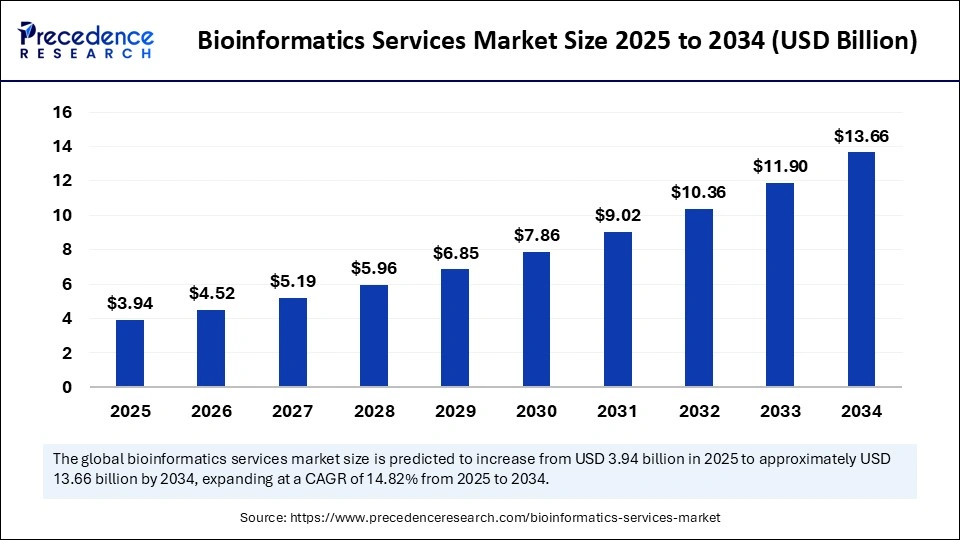
The global bioinformatics services market size is calculated at USD 3.94 billion in 2025 and is predicted to increase from USD 4.52 billion in 2026 to approximately USD 15.27 billion by 2035, expanding at a CAGR of 14.51% from 2026 to 2035. The bioinformatics services market is driven by increased funding and investment, growing adoption of cloud-based solutions, and the integration of artificial intelligence and machine learning for biological data processing and analysis.
Market Highlights
- North America led the bioinformatics services market with around 48.4% of the market share in 2025.
- Asia Pacific is estimated to expand the fastest CAGR between 2026 and 2035
- By type, the sequencing services segment captured the 47.3% of market share in 2025.
- By type, the data analysis services segment is expected to grow at a 11.6% CAGR from 2026 to 2035
- By application, the genomics segment held a major market share of 56.4% in 2025.
- By application, the proteomics segment is growing at a CAGR of 12.1% from 2026 to 2035
- By deployment mode, the cloud-based segment held major market share of 61.4% in 2025.
- By deployment mode, the hybrid model segment is growing at a strong CAGR of 11.5% between 2026 to 2035
- By end-user, the pharmaceutical & biotechnology companies segment captured more than 48.8% of market share in 2025.
- By end-user, the hospitals & clinical laboratories segment is growing at a strong CAGR of 11.7% from 2026 to 2035
Factors Contributing to Market Growth of Bioinformatics Services
The bioinformatics services market is experiencing robust growth, driven by increased demand for data-driven research in genomics, proteomics, and precision medicine. Bioinformatics services use computational tools and software to process, analyze, and interpret biological data, thereby facilitating advancements in drug discovery, molecular diagnostics, and personalized medicine.
They are widely utilized by pharmaceutical companies, biotechnology firms, academic institutions, and healthcare organizations. Market growth is driven by advancements in next-generation sequencing (NGS), AI-driven analytics, personalized medicine, and rising demand for outsourced bioinformatics expertise and cloud-based computational infrastructure.
AI is Changing the Future of the Bioinformatics Services Industry
AI is transforming bioinformatics services through faster, smarter analysis of complex biological data. Innovations in deep learning and neural networks are improving accuracy in genome sequencing, protein structure predictions, and the integration of multi-omics data. An increasing number of AI models are predicting disease susceptibility and facilitating drug discovery and personalized medicine through data-driven insights.
In April 2025, Signios Biosciences, a science-first biotechnology company at the leader of multiomics and AI-powered bioinformatics, announced the Launch of an AI-driven bioinformatics and advanced multiomics platform to power the future of precision medicine and drug discovery.
Bioinformatics services use machine learning to automate previously tedious or repetitive tasks, extracting useful or meaningful biological patterns that were difficult or impossible to identify. Educational initiatives and industry collaborations are helping to broaden the scope for the use of AI for molecular diagnostics and genetic studies, thus narrowing the gap between data science and life sciences. As AI systems grow, bioinformatics services will play an increasingly important role in developing personalized and predictive healthcare innovations.
Bioinformatics Services Market Outlook
[[market_outlook]]
Market Scope
| Report Coverage | Details |
| Market Size in 2025 | USD 3.94 Billion |
| Market Size in 2026 | USD 4.52 Billion |
| Market Size by 2035 | USD 15.27 Billion |
| Market Growth Rate from 2026 to 2035 | CAGR of 14.51% |
| Dominating Region | North America |
| Fastest Growing Region | Asia Pacific |
| Base Year | 2025 |
| Forecast Period | 2026 to 2035 |
| Segments Covered | Type, Application, Deployment Mode, End User, and Region |
| Regions Covered | North America, Europe, Asia-Pacific, Latin America, and Middle East & Africa |
Bioinformatics Services Market Segment Insights
[[segment_insights]]
Bioinformatics Services Market Regional Insights
[[regional_insights]]
Overview of Global Government-Funded Bioinformatics Institutes
| Institute Name | Location | Affiliation/Funding Body | Primary Services & Key Databases/Tools |
| National Center for Biotechnology Information (NCBI) | Bethesda, Maryland, USA | U.S. National Institutes of Health (NIH) | GenBank, PubMed, RefSeq, dbSNP, BLAST |
| European Bioinformatics Institute (EMBL-EBI) | Hinxton, Cambridge, UK | European Molecular Biology Laboratory (EMBL) | Ensembl, UniProt, ArrayExpress, InterPro |
| DNA Data Bank of Japan (DDBJ) | Mishima, Shizuoka, Japan | National Institute of Genetics (NIG), MEXT (Japan) | DDBJ Sequence Database, BioProject, BioSample; supports genome analysis and INSDC data sharing. |
| Swiss Institute of Bioinformatics (SIB) | Lausanne, Switzerland | Swiss Government, Universities & Research Grants | ExPASy, SWISS-MODEL, STRING, UniProt; focuses on proteomics and computational biology. |
| China National Center for Bioinformation (CNCB) / National Genomics Data Center (NGDC) | Beijing, China | Chinese Academy of Sciences (CAS) | GSA, Genome Warehouse, BioProject China; national genomics data and bioinformatics standards. |
| DOE Joint Genome Institute (JGI) | Walnut Creek, California, USA | U.S. Department of Energy (DOE) | Environmental and energy genomics, metagenomics, and microbial diversity databases. |
| National Centre for Cell Science (NCCS) | Pune, Maharashtra, India | Department of Biotechnology (DBT), Govt. of India | Cell line repository, molecular biology research, and access to global databases like UniProt, Pfam, and PDB. |
| Institute of Genomics and Integrative Biology (IGIB) | Delhi, India | Council of Scientific & Industrial Research (CSIR), Govt. of India | Genomic medicine, structural biology, computational genomics, and disease gene discovery. |
| National Institute of Biomedical Genomics (NIBMG) | Kalyani, West Bengal, India | Department of Biotechnology (DBT), Govt. of India | Biomedical genomics, population genetics, and data analysis for health and disease. |
| ELIXIR (European Research Infrastructure for Bioinformatics) | Distributed across Europe | European Commission and Member States | The integration of national bioinformatics centers supports data sharing and standards across Europe. |
| Genome Canada | Ottawa, Ontario, Canada | Government of Canada | National genomics coordination, data commons, and project funding for bioinformatics. |
Bioinformatics Services Market Value Chain
Bioinformatics Services Market Companies
[[market_company]]
Other Players in the Market for Bioinformatics Services
- QIAGEN N.V.: QIAGEN provides comprehensive bioinformatics software and services through its CLC Genomics platform, designed to streamline genomic data analysis and reduce computational bottlenecks. The company's solutions support next-generation sequencing (NGS), RNA-seq, and variant analysis workflows for researchers in genomics, diagnostics, and drug discovery.
- PerkinElmer, Inc. – PerkinElmer offers advanced bioinformatics and informatics solutions for managing and interpreting large-scale biological data. Its software platforms integrate multi-omics data processing, visualization, and predictive modeling, supporting applications in precision medicine, diagnostics, and life sciences research.
- DNAnexus, Inc: DNAnexus provides a secure, cloud-based bioinformatics platform for genomic data analysis, storage, and sharing. The company's platform supports diverse data types, including DNA, RNA, and proteomics, enabling scalable, collaborative research in clinical genomics and population health initiatives.
- BGI Genomics Co., Ltd: BGI Genomics delivers next-generation sequencing and bioinformatics services leveraging its proprietary DNBse technology. The company provides genomic, transcriptomic, and epigenetic analysis solutions for applications in human health, agriculture, and biodiversity research.
- Eurofins Scientific: Eurofins Genomics offers a wide range of sequencing and bioinformatics services, including NGS, Sanger sequencing, and oligonucleotide synthesis. As one of Europe's first providers of NGS using the Roche/454 GS20 system, Eurofins continues to deliver high-quality data interpretation and analysis support for research institutions and biopharma clients.
- Fios Genomics Ltd.: Fios Genomics provides bioinformatics data analysis services for pharmaceutical, biotechnology, and academic clients. The company specializes in integrating genomics, transcriptomics, proteomics, and metabolomics data, supporting drug discovery, preclinical, and clinical development projects.
- Seven Bridges Genomics (Velsera): Seven Bridges, now part of Velsera, offers a robust cloud-based bioinformatics platform integrating tools such as the GRA Suite for next-generation sequencing (NGS) analysis. The company supports end-to-end data management, analysis, and collaboration for genomics research and clinical data science.
- Biomax Informatics AG: Biomax Informatics develops knowledge management and bioinformatics software for data integration and systems biology. Its BioXM platform helps life science companies and research institutions manage complex biological data and derive actionable insights for R&D.
- GENEWIZ (Azenta Life Sciences): GENEWIZ, now operating under Azenta Life Sciences, provides sequencing, gene synthesis, and bioinformatics services for genomics research. The company's bioinformatics solutions include data analysis pipelines for NGS, single-cell sequencing, and metagenomics applications.
- Macrogen, Inc: Macrogen offers a full range of genomic sequencing and bioinformatics services, including human whole-genome sequencing, transcriptomics, and clinical genomics. The company's bioinformatics division provides data interpretation and reporting for precision medicine and genetic research.
- Pine Biotech, Inc.: Pine Biotech provides bioinformatics education and analysis platforms such as the T-BioInfo portal, which supports transcriptomics, metagenomics, and machine learning-based data analysis. The company focuses on democratizing bioinformatics tools for researchers and educators worldwide.
- Dassault Systemes (BIOVIA): BIOVIA, a division of Dassault Systemes, offers informatics and bioinformatics solutions that integrate life sciences data modeling, molecular simulation, and research workflow management. Its platforms enable data-driven decision-making in biopharmaceutical R&D and precision medicine.
- Genedata AG: Genedata develops enterprise bioinformatics software for automating and scaling omics data analysis. Its solutions, such as Genedata Profiler and Genedata Screener, support biopharmaceutical research, biomarker discovery, and translational medicine programs.
Recent Developments
- In February 2025, HaploX Group established its Japanese subsidiary HaploX JAPAN K.K. in Osaka to offer cancer-genetic testing, sequencing and multi-omics services, supported by Japan External Trade Organization's IBSC.(Source: https://www.jetro.go.jp)
- In November 2024, Solis Agrosciences the trusted partner for high-quality AgTech research services acquired Ferris Genomics' sequencing and bioinformatics platform to deliver end-to-end genotyping and bioinformatics services for agriculture.(Source: https://www.globenewswire.com)
- In November 2024, Sequentia Biotech secured €10million Series A, led by Seventure Partners, a French Venture Capital & Growth investment company with an extensive experience in Life Sciences.(Source: https://www.businesswire.com)
- In September 2024, Almaden Genomics announced launch of new Data Management and Informatics Services business to support its bioinformatics and computational biology solutions with vision of transforming the bioinformatics landscape by making complex data management more accessible and actionable.(Source: https://catalyze.partners)
Exclusive Insights
From a market research perspective, the bioinformatics services market is on a multi-year growth trajectory driven by declining sequencing costs, increased adoption of bioinformatics-as-a-service in the cloud, and increased outsourcing by pharma and clinical organizations. Advancements in AI, particularly protein language models and ML-driven variant interpretation, should increase throughput, clinical-grade reporting, and modular subscription offerings.
Commercial opportunities will likely include managed clinical pipelines, analytics for compliant companion diagnostics, and collaborations with sequencing clinics or CROs. Principal risk factors include data privacy and consent frameworks, a lack of standardization and interoperability, an insufficient number of skilled talent, and reproducibility. Firms that invest in validated pipelines, compliance and regulatory assessments, domain experts, and geographic expansion options will likely accrue asymmetrical market value.
Bioinformatics Services Market Segments Covered in the Report
[[segment_covered]]
For inquiries regarding discounts, bulk purchases, or customization requests, please contact us at sales@precedenceresearch.com
Frequently Asked Questions





Ask For Sample
No cookie-cutter, only authentic analysis – take the 1st step to become a Precedence Research client
 Get a Sample




 sales@precedenceresearch.com
 Schedule a Meeting
