


Ceramic Substrate Market Size, Key Companies, Company Market Share, Chip Production Volume, Wafer Capacity, Technology Adoption, Pricing Trends, Competitive Positioning, and Demand Analysis
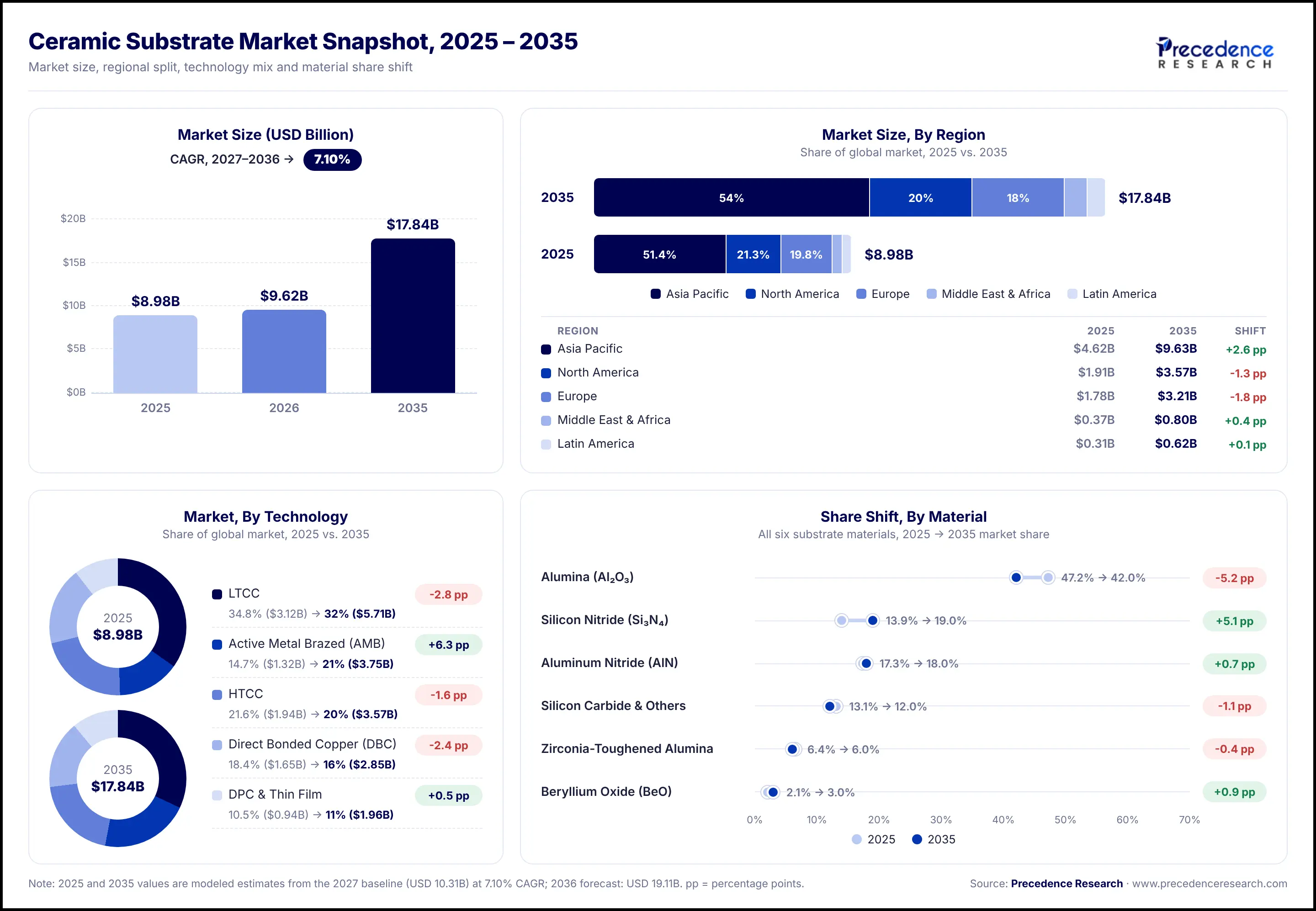
According to semiconductor and electronics specialist Laxmi Narayan, the ceramic substrate market is valued at USD 10.31 billion in 2026 and is forecast to reach USD 19.11 billion by 2035, reflecting a CAGR of 7.10%. Leading ceramic substrate market companies, including KYOCERA Corporation, Murata Manufacturing Co., Ltd., MARUWA Co., Ltd, NGK Insulators, Ltd. are strengthening their presence across key segments such as material, technology, application, end use and region .
Source: https://www.precedenceresearch.com/ceramic-substrate-market
 Get a Sample
 Table Of Content


Ceramic Substrate Market Size, Trends, Share, and Innovations 2036
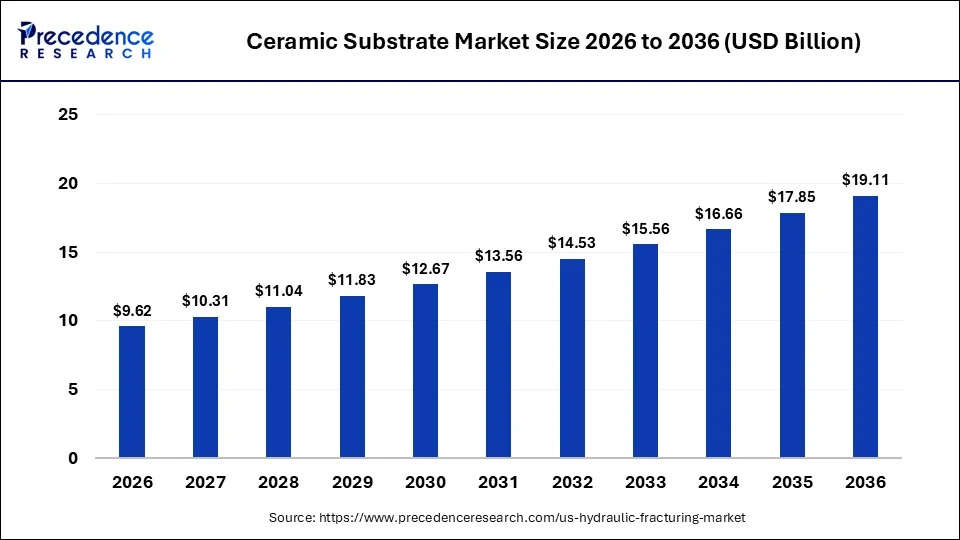
The ceramic substrate market is estimated at USD 9.62 billion in 2026 and is projected to reach USD 10.31 billion in 2027, expanding at a CAGR of 7.10% from 2027 to 2036.
Key Takeaways
Market Size & Growth Outlook
- Market size in 2026: USD 9.62 billion
- Estimated market size in 2027: USD 10.31 billion
- Projected market size by 2036: USD 19.11 billion
- CAGR (2027-2036): 7.10%
Regional Market Spotlight
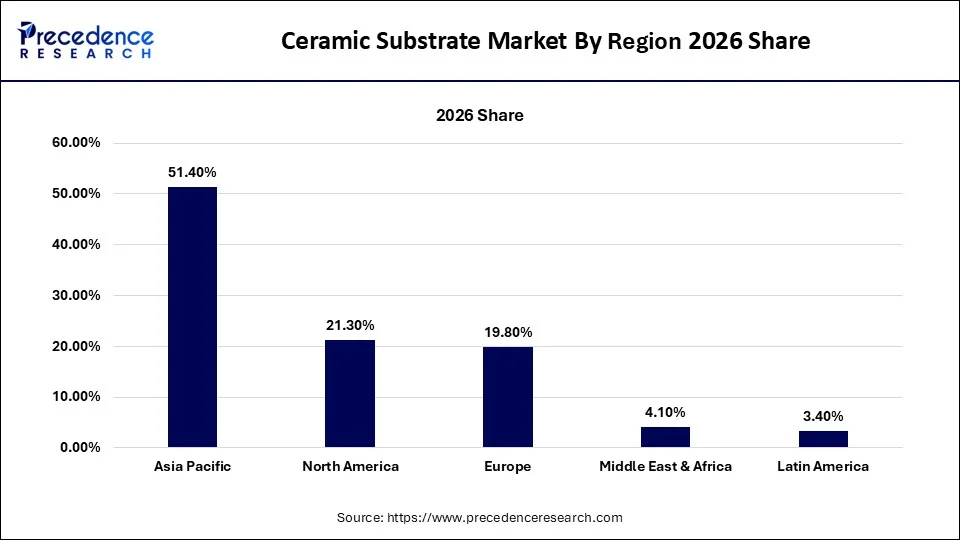
- Asia Pacific led the market with an estimated 51.40% (USD 4.94 billion) share in 2026 and is projected to be the fastest-growing region, at a CAGR of 7.95% from 2026 to 2036.
- North America accounted for an estimated 21.30% (USD 2.05 billion) of the market in 2026.
- Europe accounted for an estimated 19.80% (USD 1.90 billion) of the market in 2026.
Segmental Spotlight
- By material, Alumina (Al2O3) accounted for an estimated 47.20% (USD 4.54 billion) in 2026.
- By technology, Low-Temperature Co-Fired Ceramic (LTCC) captured an estimated 34.80% of the market in 2026, with revenue reaching USD 3.35 billion.
- By application, Power Electronics Modules dominated the market in 2026, accounting for an estimated 31.40% share, equivalent to USD 3.02 billion.
- By end use, Automotive held an estimated 34.60% share of the market in 2026, valued at USD 3.33 billion.
Ceramic Substrate Market Size 2026 to 2036
The market is forecast to reach USD 19.11 billion by 2036. Ceramic substrates are insulating ceramic boards that carry, connect, and cool electronic circuits in power modules, chip packages, RF components, and LEDs. Alumina accounted for the largest material share in 2026, estimated at 47.20%, due to its balance of cost, electrical insulation, and manufacturability. Asia Pacific is estimated to account for 51.40% of market revenue in 2026, supported by electronics and power-module production in China, Japan, South Korea, and Taiwan. Demand is driven by silicon carbide inverters in electric vehicles, 5G and satellite RF front ends, and AI server power delivery.
Market Trends
- Silicon carbide power modules are shifting demand from alumina DBC to silicon nitride AMB substrates.
- NGK Insulators plans to raise silicon nitride AMB substrate output about 2.5 times by fiscal 2026 to meet EV inverter demand.
- Chinese producers are scaling alumina, DBC, and AMB output, increasing price competition.
- AI server power delivery is opening a new market for high-thermal-conductivity substrates.
- LTCC demand is rising with automotive radar, 5G, and satellite RF modules.
- Thin-film and DPC substrates are gaining use in high-power LEDs and laser diodes.
Key Growth Drivers, Market Restraints and Emerging Opportunities
Driver
Vehicle electrification is increasing demand for ceramic substrates that handle high currents and dissipate heat efficiently. Silicon carbide (SiC) inverters, onboard chargers, and industrial drives are key applications driving this demand.
Restraint
Silicon nitride and AMB substrates have higher costs than alumina and face limited production capacity, restricting their adoption in price-sensitive consumer and industrial applications.
Opportunity
Growing investment in AI data centers and renewable energy is creating new demand for ceramic substrates in power supplies and energy converters. Suppliers offering high-thermal-conductivity materials can target these high-value applications and command premium prices.
Ceramic Substrate Market Segmentation: 2026 Share and Value
By Material
Note: 2026 values are estimates. Sources: Expert interviews, secondary sources, Precedence Research database, and Precedence Research analysts.
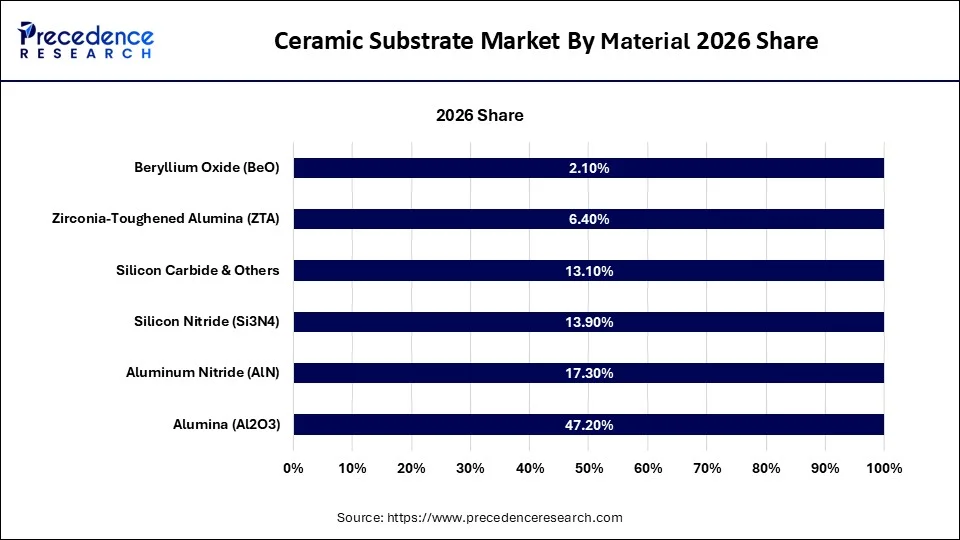
Alumina accounted for an estimated 47.20% of the ceramic substrate market in 2026, valued at USD 4.54 billion, supported by its low cost and widespread use in consumer electronics, telecommunications, and LEDs. Aluminum nitride held 17.30% (USD 1.66 billion), driven by demand in high-power RF and laser applications. Silicon nitride represented 13.90% (USD 1.34 billion) and is gaining traction in silicon carbide (SiC) power modules for electric vehicles due to its strength and thermal performance.
Silicon carbide and other ceramics accounted for 13.10% (USD 1.26 billion), serving high-temperature and specialty applications. Zirconia-toughened alumina held a 6.40% share (USD 0.62 billion), offering improved strength for power modules. Beryllium oxide represented the remaining 2.10% (USD 0.20 billion), with its use limited by strict handling and safety requirements.
By Technology
| Segments | 2026 Share | 2026 Market Value |
| Low-Temperature Co-Fired Ceramic (LTCC) | 34.80% | USD 3.35 billion |
| High-Temperature Co-Fired Ceramic (HTCC) | 21.60% | USD 2.08 billion |
| Direct Bonded Copper (DBC) | 18.40% | USD 1.77 billion |
| Active Metal Brazed (AMB) | 14.70% | USD 1.41 billion |
| Direct Plated Copper (DPC) & Thin Film | 10.50% | USD 1.01 billion |
Note: 2026 values are estimates. Sources: Expert interviews, secondary sources, Precedence Research database, and Precedence Research analysts.
Low-temperature co-fired ceramic (LTCC) held the largest share of the ceramic substrate market in 2026, at an estimated 34.80% (USD 3.35 billion), driven by demand for RF front ends, sensors, and automotive radar modules. High-temperature co-fired ceramic (HTCC) accounted for 21.60% (USD 2.08 billion), supported by its use in hermetic packaging. Direct-bonded copper (DBC) substrates represented 18.40% (USD 1.77 billion), primarily serving IGBT power modules.
Active metal brazed (AMB) substrates captured 14.70% (USD 1.41 billion), as EV and industrial power applications increasingly adopted silicon carbide (SiC) chips. Direct-plated copper (DPC) and thin-film substrates accounted for the remaining 10.50% (USD 1.01 billion), supported by demand for fine-line circuitry in LEDs, laser diodes, and precision RF applications.
By Application
Note: 2026 values are estimates. Sources: Expert interviews, secondary sources, Precedence Research database, and Precedence Research analysts.
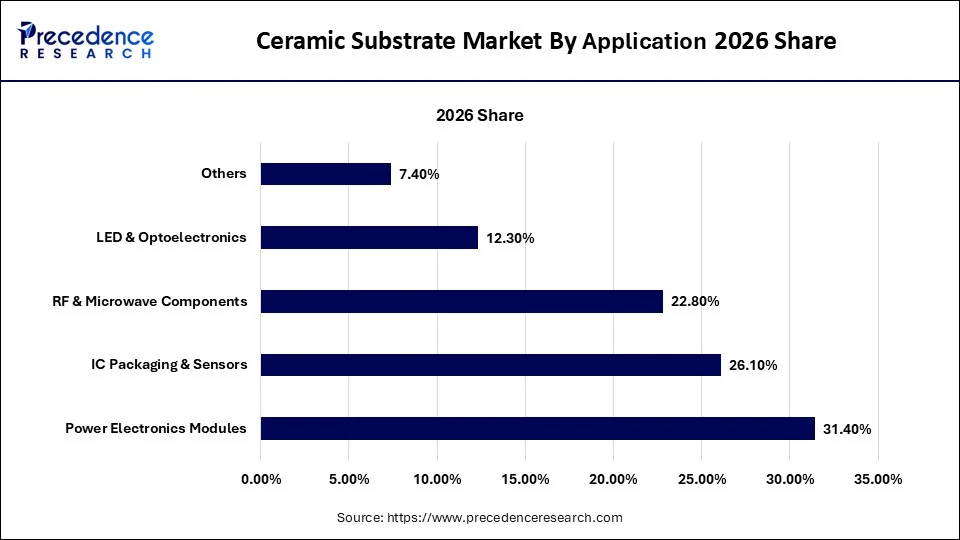
Power electronics modules accounted for the largest share of the ceramic substrate market in 2026, at an estimated 31.40% (USD 3.02 billion), driven by demand for EV inverters and renewable energy converters. IC packaging and sensors held 26.10% (USD 2.51 billion), supported by growing use in AI and automotive electronics. RF and microwave components represented 22.80% (USD 2.19 billion), driven by the expansion of 5G and satellite communication networks.
LED and optoelectronics represented 12.30% of the ceramic substrate market in 2026, valued at USD 1.18 billion. Aluminum nitride (AlN) and direct-plated copper (DPC) substrates support efficient heat dissipation in these applications. Other uses, including medical devices and industrial systems, contributed 7.40% of the market, equivalent to USD 0.71 billion.
By End Use
| Segments | 2026 Share | 2026 Market Value |
| Automotive | 34.60% | USD 3.33 billion |
| Consumer Electronics | 27.30% | USD 2.63 billion |
| Industrial & Energy | 14.20% | USD 1.37 billion |
| Telecommunications | 10.90% | USD 1.05 billion |
| Aerospace & Defense | 6.70% | USD 0.64 billion |
| Medical & Others | 6.30% | USD 0.61 billion |
Note: 2026 values are estimates. Sources: Expert interviews, secondary sources, Precedence Research database, and Precedence Research analysts.
In 2026, the automotive segment is estimated to hold the largest market share at 34.60%, valued at USD 3.33 billion, driven by increasing demand for high-performance power-electronics substrates in electric vehicles. Consumer electronics accounts for 27.30% (USD 2.63 billion), supported by continued demand for electronic devices and components. Industrial and energy applications represent 14.20% (USD 1.37 billion), driven by investments in solar inverters, motor drives, and grid energy storage. Telecommunications contributes 10.90% (USD 1.05 billion), fueled by the expansion of 5G infrastructure and satellite communication systems.
Aerospace and defense account for 6.70% (USD 0.64 billion), reflecting the need for reliable substrates in demanding operating environments, while medical and other applications collectively represent the remaining 6.30% (USD 0.61 billion).
- Analyst View: Automotive demand is driving the ceramic substrate market, supported by EV adoption and power electronics. Growth in consumer electronics, renewable energy, 5G infrastructure, and aerospace applications further supports market expansion.
Regional Analysis
Ceramic Substrate Market by Region 2026 Share & Size
Note: 2026 values are estimates. Sources: Expert interviews, secondary sources, Precedence Research database, and Precedence Research analysts.
Asia Pacific led the ceramic substrate market in 2026, with an estimated 51.40% share (USD 4.94 billion), supported by electronics and power-module manufacturing in China, Japan, South Korea, and Taiwan. North America held 21.30% (USD 2.05 billion), driven by demand from defense, aerospace, and data center electronics. Europe represented 19.80% (USD 1.90 billion), supported by Germany's automotive power-module industry.
The Middle East and Africa accounted for 4.10% (USD 0.39 billion), while Latin America held 3.40% (USD 0.33 billion). Both regions remain smaller markets, with demand largely met through imported substrates and electronic components.
Asia Pacific is estimated to account for 51.40% of the market in 2026, valued at USD 4.94 billion. China drives regional demand through large-scale consumer electronics manufacturing, electric vehicle production, and alumina substrate manufacturing.
North America accounted for an estimated 21.30% (USD 2.05 billion) in 2026. The United States drives demand through aerospace, defense, RF and data center electronics, and reshoring of power-module production supports growth in high-performance substrates.
Europe is projected to hold a 19.80% share of the market in 2026, valued at USD 1.90 billion. Germany drives regional demand through its established automotive industry, growing electric vehicle production, and industrial power-electronics applications. Manufacturers such as Heraeus and CeramTec contribute to the regional supply chain by providing advanced ceramic materials, metallized substrates, and specialized solutions for power modules.
Increasing demand for energy-efficient systems, automotive electrification, and reliable industrial drives is expected to support the adoption of high-performance ceramic substrates across Europe.
The Middle East & Africa accounted for an estimated 4.10% (USD 0.39 billion) in 2026. Israel's defense and semiconductor sector leads demand, while Gulf states add electronics and renewable energy projects.
Latin America is estimated to account for 3.40% of the market in 2026, valued at USD 0.33 billion. Brazil leads regional demand, supported by its automotive manufacturing base, electric mobility initiatives, and consumer electronics assembly activities. The market relies substantially on imported ceramic substrates and electronic components to meet industrial requirements.
- Analyst View: Asia Pacific is expected to maintain its market leadership, supported by strong electronics manufacturing, electric vehicle production, and advanced ceramic substrate capabilities across China, Japan, South Korea, and Taiwan. North America benefits from aerospace, defense, radio-frequency (RF), and data center applications, alongside efforts to strengthen domestic power-module manufacturing.
Top 10 Companies in the Ceramic Substrate Market
| Rank | Company Name | Market-Specific Revenue (USD Billion) | 2026 Share (Est.) | Key Products / Business | Headquarters |
| 1 | KYOCERA Corporation | 1.42 | 14.76% | HTCC packages, alumina and AlN substrates, LTCC modules | Japan |
| 2 | Murata Manufacturing Co., Ltd. | 0.78 | 8.11% | LTCC multilayer substrates and modules | Japan |
| 3 | MARUWA Co., Ltd. | 0.47 | 4.89% | Alumina, AlN and silicon nitride substrates | Japan |
| 4 | NGK Insulators, Ltd. | 0.41 | 4.26% | Silicon nitride AMB power substrates | Japan |
| 5 | CoorsTek, Inc. | 0.39 | 4.05% | Alumina, AlN and thin-film ceramic substrates | United States |
| 6 | Chaozhou Three-Circle (Group) Co., Ltd. | 0.36 | 3.74% | Alumina substrates and ceramic packages | China |
| 7 | Ferrotec Holdings Corporation | 0.33 | 3.43% | DBC and AMB power electronic substrates | Japan |
| 8 | CeramTec GmbH | 0.29 | 3.01% | Alumina and AlN substrates, metallized ceramics | Germany |
| 9 | Heraeus Electronics | 0.24 | 2.49% | Condura metal-ceramic substrates (DBC/AMB) | Germany |
| 10 | Toshiba Materials Co., Ltd. | 0.22 | 2.29% | Silicon nitride substrates for power modules | Japan |
Note: 2026 company revenues and shares are estimates. Sources: Company press releases, expert interviews, secondary sources, Precedence Research database and Precedence Research analysts.
KYOCERA led the ceramic substrate market in 2026, with an estimated 14.76% share (USD 1.42 billion), followed by Murata at 8.11% (USD 0.78 billion) and MARUWA at 4.89% (USD 0.47 billion). KYOCERA's position is supported by its broad co-fired package and substrate portfolio, while Murata focuses on LTCC modules for RF and automotive electronics. MARUWA supplies alumina, aluminum nitride (AlN), and silicon nitride substrates.
The top 10 companies held an estimated 51.04% of market revenue in 2026, valued at USD 4.91 billion. The remaining 48.96% (USD 4.71 billion) was distributed among Chinese, South Korean, and Taiwanese producers and smaller specialty manufacturers. Competition is increasingly focused on silicon nitride and active metal brazed (AMB) substrate capacity for EV power modules. NGK's planned capacity expansions and other suppliers' efforts to secure automotive programmes are shaping the competitive landscape.
Ceramic Substrate Market Segments
By Material
- Alumina (Al2O3)
- Aluminum Nitride (AlN)
- Silicon Nitride (Si3N4)
- Silicon Carbide & Others
- Zirconia-Toughened Alumina (ZTA)
- Beryllium Oxide (BeO)
By Technology
- Low-Temperature Co-Fired Ceramic (LTCC)
- High-Temperature Co-Fired Ceramic (HTCC)
- Direct Bonded Copper (DBC)
- Active Metal Brazed (AMB)
- Direct Plated Copper (DPC) & Thin Film
By Application
- Power Electronics Modules
- IC Packaging & Sensors
- RF & Microwave Components
- LED & Optoelectronics
- Others
By End Use
- Automotive
- Consumer Electronics
- Industrial & Energy
- Telecommunications
- Aerospace & Defense
- Medical & Others
By Region
- North America (U.S., Canada, Mexico)
- Europe (Germany, France, U.K., Italy, Rest of Europe)
- Asia Pacific (China, Japan, South Korea, Taiwan, India, Rest of Asia Pacific)
- Latin America (Brazil, Rest of Latin America)
- Middle East & Africa (Israel, Saudi Arabia, UAE, Rest of MEA)
Overview of Research Methods and Procedures
The 2026 ceramic substrate market estimate was developed using a bottom-up assessment of demand across power modules, electronic packages, RF devices, and LEDs. The estimates were cross-checked against producer revenues and electronics production data. Market segmentation by application, region, and company was based on end-market output, supplier portfolios, and manufacturing capacity.
The analysis was validated against company disclosures, regulatory and industry statistics, and third-party research, with inconsistent inputs excluded. All segment, regional, and company estimates were aligned with the same 2026 base-year market value. Forecasts through 2036 were calculated using a consistent CAGR methodology and validated in the Excel workbook.
Analyst View Overall Market
Ceramic substrates are becoming increasingly important in high-performance electronics, where silicon carbide power modules and AI server systems require better thermal conductivity and electrical insulation than conventional organic substrates can provide. Alumina and LTCC continue to support volume demand in consumer and telecom electronics, while silicon nitride and AMB substrates are gaining traction in EV and industrial power modules. The market is projected to grow at a CAGR of 7.10% from 2027 to 2036, driven by EV inverters, renewable energy converters, and AI data center power supplies. Key risks include slower EV adoption in Europe and the US, price competition from Chinese manufacturers, and fluctuations in raw-material costs.
Sources and References
- International Energy Agency (IEA). "Global EV Outlook 2025". 2025. Electric vehicle sales trends driving power electronics demand. (Source: https://www.iea.org)
- News Europe. "NGK looks to Europe as it doubles power substrate production". 2024-03-22. NGK silicon nitride AMB capacity expansion to fiscal 2026 and 2030 sales target. (Source: https://www.eenewseurope.com
- Ferrotec. "DBC & AMB Power Electronic Substrates". Undated. Ferrotec DBC and AMB substrate portfolio. (Source: https://www.ferrotec.com)
- Tiger Brokers News. "Rogers Corporation Q1 2025 results coverage". 2025. Rogers revenue and soft curamik power substrate sales. (Source: https://www.itiger.com)
- KYOCERA Corporation. "Corporate website - fine ceramics and packages". Undated. Ceramic package and substrate portfolio. (Source: https://global.kyocera.com)
- Murata Manufacturing. "Corporate website - LTCC products". Undated. LTCC multilayer substrate portfolio. (Source: https://www.murata.com
- MARUWA Co., Ltd. "Corporate website - ceramic substrates". Undated. Alumina, AlN and silicon nitride substrate portfolio. (Source:https://www.maruwa-g.com)
- Heraeus Electronics. "Corporate website - metal-ceramic substrates". Undated. Condura DBC/AMB substrate portfolio. (Source: https://www.heraeus-electronics.com)
- CeramTec. "Corporate website - electronic substrates". Undated. Alumina and AlN substrate portfolio. (Source: https://www.ceramtec-group.com)
- Denka Company Limited. "Corporate website - circuit substrates". Undated. AlN and silicon nitride circuit substrates. (Source: https://www.denka.co.jp/eng/)
For inquiries regarding discounts, bulk purchases, or customization requests, please contact us at sales@precedenceresearch.com
Frequently Asked Questions





Ask For Sample
No cookie-cutter, only authentic analysis – take the 1st step to become a Precedence Research client
 Get a Sample
.webp)



 sales@precedenceresearch.com
 Schedule a Meeting