



Clinical Alarm Management Market Size, Companies, Share, Patient Volume, Treatment Adoption Rates, Pricing Analysis, Regulatory Landscape, Competitive Positioning, and Demand Forecast
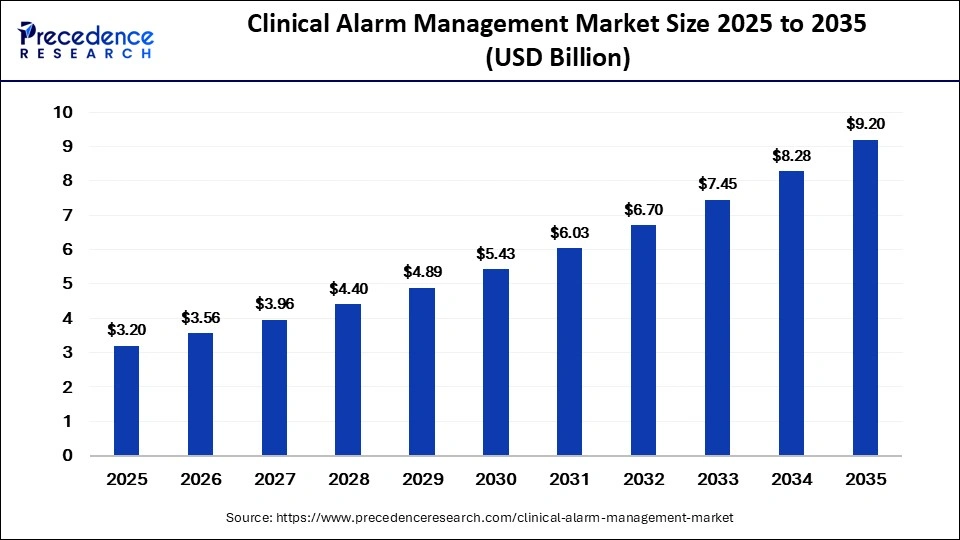
Rohan Patil, a Healthcare Industry Expert, highlights that the clinical alarm management market has reached USD 3.56 billion in 2026 and is on track to reach USD 9.20 billion by 2035, advancing at a CAGR of 11.20%. Key clinical alarm management market companies shaping the market include Philips, GE Healthcare, Medtronic, Siemens Healthineers, while major growth segments span By Component, By Product, By Deployment Mode, By End-User, By Type.
Source: https://www.precedenceresearch.com/clinical-alarm-management-market
 Get a Sample
 Table Of Content


What is the Clinical Alarm Management Market Size in 2026?
The global clinical alarm management market size accounted for USD 3.20 billion in 2025 and is predicted to increase from USD 3.56 billion in 2026 to approximately USD 9.20 billion by 2035, expanding at a CAGR of 11.20% from 2026 to 2035. Factors such as rising alarm fatigue amid government initiatives to promote healthcare IT solutions are expected to boost market growth.
Key Takeaways
- North America dominated the clinical alarm management market with a 41.0% market share in 2025.
- Asia Pacific is expected to grow at the fastest CAGR in the market during the forecast period.
- By component, the solutions segment contributed the highest market share of 56.0% in 2025.
- By product, the nurse call systems segment held a major market share of 28.0% in 2025.
- By deployment mode, the on-premise segment captured the highest market share of 62.0% in 2025.
- By end-user, the hospitals and clinics segment generated the biggest market share of 70.0% in 2025.
- By type, the centralized alarm management systems segment accounted for the largest market share of 64.0% in 2025.
Market Overview
The clinical alarm management market is witnessing steady growth as healthcare providers strive to improve patient safety and reduce alarm fatigue in critical care environments. Medical devices in hospitals generate many non-actionable alerts, leading to desensitization among healthcare professionals and increasing the risk of missed critical alerts. Healthcare institutions are adopting advanced alarm management systems that can filter and prioritize urgent alerts and reduce alarm frequency effectively. Artificial intelligence, machine learning, and remote patient monitoring are further enhancing the efficiency of these systems. The growing incidence of chronic diseases, longer hospital stays, and increasing investments in healthcare IT infrastructure by the government are contributing to the rising demand for clinical alarm management solutions globally.
Role of AI in the Clinical Alarm Management Market
AI is playing a vital role in the market. It improves the accuracy and efficiency of patient monitoring systems. In hospitals, a large proportion of clinical alarms generated by medical devices are non-actionable, which causes alarm fatigue among healthcare professionals. To distinguish between true clinical alarms and false alarms, AI and machine learning algorithms analyze large volumes of patient data in real time, which helps reduce unnecessary alerts. AI-powered systems can prioritize alarms based on severity, patient condition, and clinical context, enabling faster and more effective and quick responses from medical staff. AI enables personalized alarm settings by studying individual patient patterns, improving detection accuracy, and ensuring patient safety. The integration of AI enhances clinical workflow efficiency and supports better decision-making in modern healthcare settings.
Clinical Alarm Management Market Trends
- Healthcare settings are increasingly adopting AI and machine learning in alarm management systems to analyze alarm data and reduce false or non-actionable alerts. AI and machine learning integration help prioritize critical alarms, enabling faster clinical responses and improving patient safety.
- Growing adoption of integrated monitoring systems and centralized alarm notification platforms that connect multiple devices to streamline communication between devices and healthcare staff, improving clinical workflow efficiency.
- Advanced alarm management solutions help filter and prioritize alarms, which enables clinicians to focus on patient safety and reducing alarm fatigue caused by non-actionable alarms.
- Rising integration with Electronic Health Records (EHR) systems to ensure easy access to data and patient monitoring.
- Regulatory and compliance requirements strengthen the alarm management protocols by adopting advanced alarm management technologies to comply with safety standards and improve clinical workflow in healthcare settings.
Market Scope
| Report Coverage | Details |
| Market Size in 2025 | USD 3.20 Billion |
| Market Size in 2026 | USD 3.56 Billion |
| Market Size by 2035 | USD 9.20 Billion |
| Market Growth Rate from 2026 to 2035 | CAGR of 5.80% |
| Dominating Region | North America |
| Fastest Growing Region | Asia Pacific |
| Base Year | 2025 |
| Forecast Period | 2026 to 2035 |
| Segments Covered | Component, Product, Deployment Mode, End-User, Type, and Region |
| Regions Covered | North America, Europe, Asia-Pacific, Latin America, and Middle East & Africa |
Market Dynamics
Drivers
Rising Focus on Patient Safety and Alarm Fatigue Reduction
The market is driven by the increasing emphasis on patient safety and the need to minimize alarm fatigue caused by excessive non-actionable alerts. Additionally, the growing use of connected medical devices and strict regulatory requirements are pushing healthcare providers to adopt advanced alarm systems to improve response time and workflow efficiency.
Restraint
High Implementation Cost and Integration Challenges
A major restraint is the high cost and complexity involved in implementing alarm management systems, including integration with existing infrastructure, staff training, and maintenance. Interoperability issues and limited technical expertise further restrict adoption, especially in smaller healthcare settings.
Opportunity
Growth of Remote Monitoring and AI Integration
The increasing adoption of remote patient monitoring, home healthcare, and telehealth creates significant opportunities. Advancements in AI and cloud-based technologies support smarter alarm prioritization and real-time decision-making, expanding the application of alarm management solutions beyond hospitals.
Segment Insights
Component Insights
Clinical Alarm Management Market Share, By Component, 2025-2035 (%)
| Component | 2025 | 2035 |
| Solutions | 56.00% | 52.00% |
| Services | 44.00% | 48.00% |
The solutions segment dominated with a market share of 56.0% in 2025. This is mainly due to the widespread adoption of advanced healthcare IT systems that integrate and centralize alarm data. These solutions help reduce alarm fatigue by filtering and prioritizing clinically relevant alerts, thereby improving patient safety and clinical outcomes. Additionally, their ability to enhance workflow efficiency, support decision-making, and meet regulatory requirements further drives their dominance.
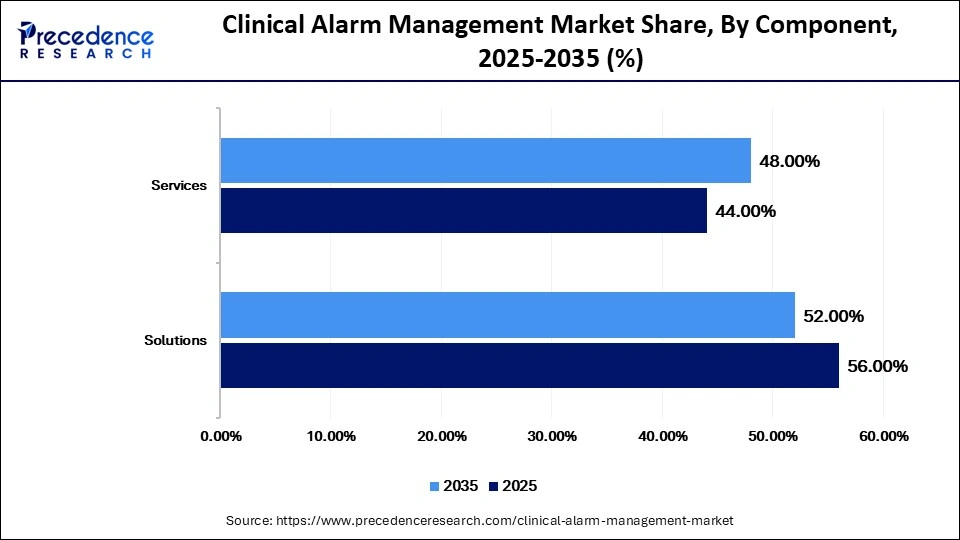
The services segment held 44.0% of market shares in 2025. This is due to the increasing need for expert support in implementing, integrating, and maintaining complex alarm management systems. Healthcare institutions are increasingly relying on consulting, training, and support services to customize solutions and minimize patient safety risks. Additionally, growing initiatives by public and private healthcare organizations, technological advancements, and the expansion of service providers are further accelerating growth.
Product Insights
Clinical Alarm Management Market Share, By Product, 2025-2035 (%)
| Product | 2025 | 2035 |
| Nurse Call Systems | 28.00% | 24.00% |
| Physiological Monitors | 20.00% | 19.00% |
| Bed Alarms | 14.00% | 12.00% |
| EMR Integration Systems | 12.00% | 15.00% |
| Ventilators | 11.00% | 10.00% |
| Infusion Pumps & Others | 15.00% | 20.00% |
The nurse call systems segment dominated with a market share of 28.0% in 2025. This is due to its essential role in enabling immediate communication between patients and healthcare providers, ensuring a timely response to critical situations. These systems are widely adopted across hospitals and healthcare facilities because they enhance patient safety, improve workflow efficiency, and reduce response time. Additionally, continuous technological advancements, such as wireless systems and integration with other monitoring devices, further strengthen their dominance in the market.
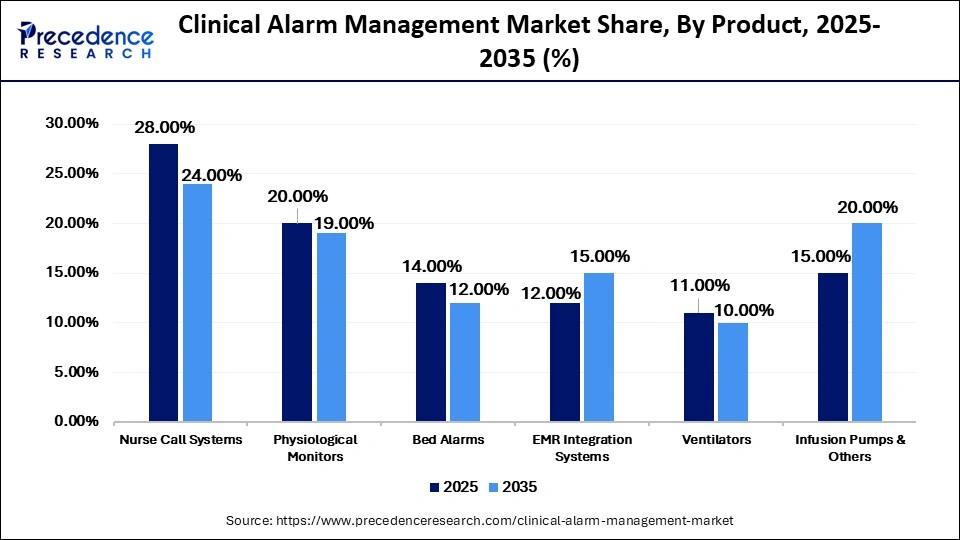
The physiological monitors segment held the second-largest share of 20.0% in 2025. This is due to its widespread use in continuous patient monitoring across hospitals and critical care settings. These devices generate a high volume of clinical alarms by tracking vital parameters such as heart rate, blood pressure, and oxygen levels, making them essential for real-time clinical decision-making. Additionally, their integration with advanced alarm management systems and the growing emphasis on patient safety and regulatory compliance further support their significant market share.
The bed alarms segment held 14.0% of market shares in 2025, due to the rising need for fall prevention and patient mobility monitoring, especially among the growing geriatric population and long-term care patients. These alarms are increasingly adopted in hospitals, rehabilitation centers, and home care settings to enhance patient safety and reduce adverse events. Additionally, increasing healthcare awareness, expanding long-term care facilities, and the need for continuous patient monitoring are further driving the rapid growth of this segment.
Deployment Mode Insights
The on-premise segment held a market dominance with a market share of 62.0% in 2025. This is due to its ability to offer greater data security, privacy, and control over sensitive patient information. Healthcare organizations prefer on-premise systems as they ensure compliance with strict regulatory requirements and provide reliable performance without dependence on external networks. Additionally, their seamless integration with existing hospital infrastructure and IT systems further supports their widespread adoption and market dominance.
Clinical Alarm Management Market Share, By Deployment Mode, 2025-2035 (%)
| Deployment Mode | 2025 | 2035 |
| On-Premise | 62.00% | 45.00% |
| Cloud-Based | 38.00% | 55.00% |
The cloud-based segment held 38.0% of market shares in 2025, due to its flexibility, scalability, and cost-effectiveness compared to on-premise systems. These solutions enable real-time and remote access to patient data, supporting telemedicine and continuous monitoring across multiple locations. Additionally, easy deployment, seamless updates, and growing adoption of digital healthcare technologies are further accelerating the rapid growth of cloud-based deployment.
End-User Insights
The hospitals and clinics segment led with a market share of 70.0% in 2025. This is primarily due to the high patient volume and extensive use of monitoring devices that generate frequent clinical alarms. These healthcare settings require efficient alarm management systems to ensure timely response, improve patient safety, and reduce alarm fatigue among staff. Additionally, the presence of advanced healthcare infrastructure, higher adoption of digital technologies, and strict regulatory requirements further contribute to the segment's dominance.
Clinical Alarm Management Market Share, By End-User, 2025-2035 (%)
| End-User | 2025 | 2035 |
| Hospitals & Clinics | 70.00% | 64.00% |
| Long-Term Care Centers | 12.00% | 14.00% |
| Ambulatory Care Centers | 10.00% | 11.00% |
| Home Care Settings | 8.00% | 11.00% |
The long-term care centers segment held the second-largest share of 12.0% in 2025. This is due to the increasing number of elderly patients and the rising demand for continuous patient monitoring in such facilities. These centers require extensive use of alarm management systems as patients often suffer from chronic diseases and disabilities, leading to higher adoption of these solutions. Also, growing awareness about patient safety, alarm fatigue management, and the expansion of senior living and care facilities are driving market expansion.
The ambulatory care centers segment held 10.0% of market shares in 2025, due to the increasing shift toward outpatient care and cost-effective treatment settings. These centers are rapidly adopting alarm management systems to improve workflow efficiency, streamline administrative tasks, and ensure patient safety with real-time monitoring. Additionally, the growing adoption of remote patient monitoring, the rising elderly population, and the focus on reducing healthcare costs are further accelerating the segment's growth.
Type Insights
The centralized alarm management systems segment dominated with a market share of 64.0% in 2025. This dominance is due to its ability to integrate and manage alarms from multiple medical devices on a single platform. These systems enable better alarm prioritization, reduce alarm fatigue, and ensure timely response by providing real-time alerts to healthcare professionals. Additionally, their role in improving patient safety, enhancing workflow efficiency, and supporting clinical decision-making contributes to their market dominance.
Clinical Alarm Management Market Share, By Type, 2025-2035 (%)
| Type | 2025 | 2035 |
| Centralized Alarm Management Systems | 64.00% | 57.00% |
| Decentralized/Distributed Systems | 36.00% | 43.00% |
The decentralized/distributed systems segment held 36.0% of market shares in 2025. This is due to its flexibility and scalability, allowing healthcare facilities to manage alarms at departmental or unit levels. These systems enable localized and real-time responses, improving efficiency and supporting personalized patient care across different clinical settings. Additionally, the growing shift toward decentralized healthcare models, remote monitoring, and expanding care settings beyond hospitals is further accelerating the segment's growth.
Regional Insights
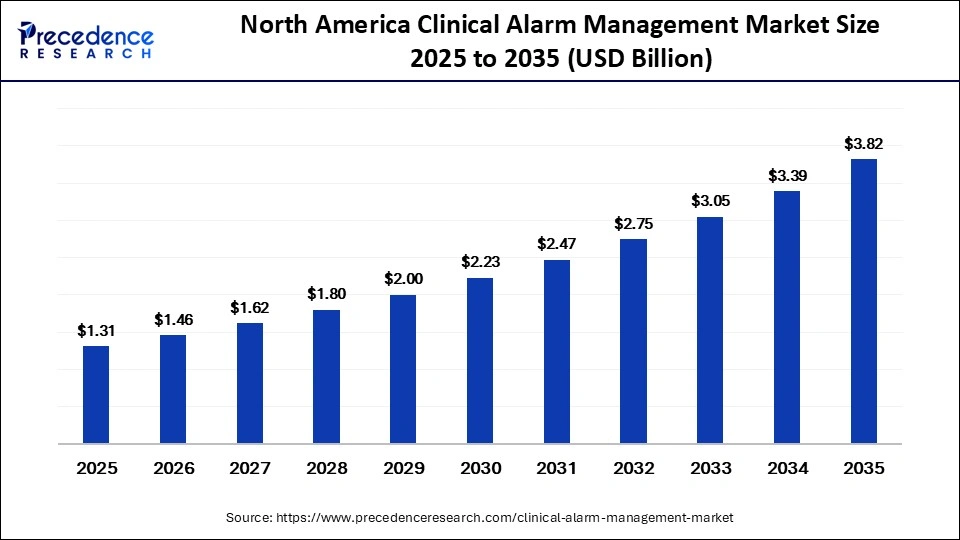
North America Clinical Alarm Management Market Size and Growth 2026 to 2035
The North America clinical alarm management market size is estimated at USD 1.31 billion in 2025 and is projected to reach approximately USD 3.82 billion by 2035, with a 11.30% CAGR from 2026 to 2035.
What Factors Have Driven the Dominance of North America in the Clinical Alarm Management Market?
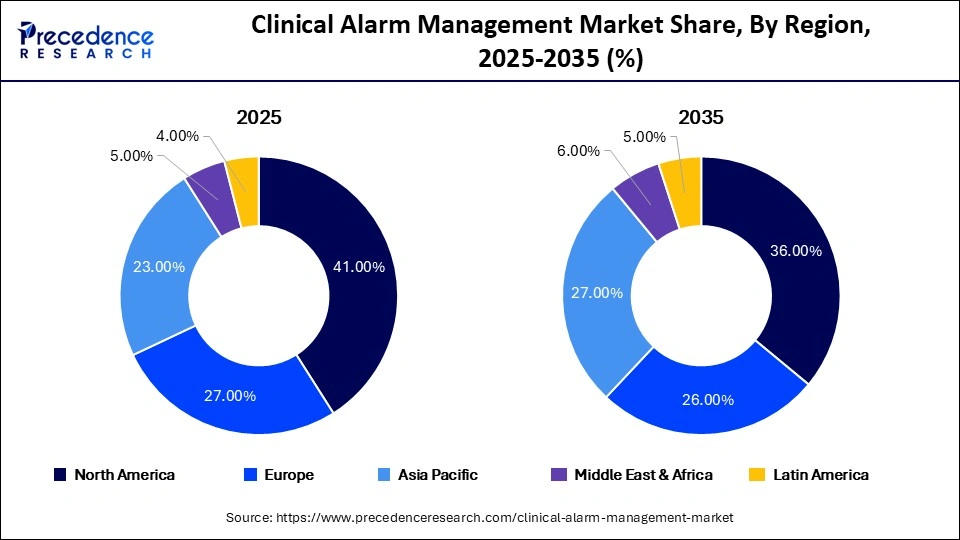
North America dominated the clinical alarm management market with holding 41.0% shares in 2025. The region has a well-established healthcare infrastructure. The region is rapidly adopting advanced patient monitoring devices and healthcare IT solutions, increasing the demand for clinical alarm management systems. The region hosts major market players such as GE Healthcare, Medtronic, and Philips Healthcare. The Joint Commission has introduced strict patient safety guidelines related to alarm management, supporting the adoption of advanced technologies for alarm management. High adoption of healthcare IT and digital health technologies is supported by significant investments in centralized monitoring systems and integrated alarm notification platforms. Further, the rising prevalence of chronic diseases and an aging population in the region has increased the need for continuous remote patient monitoring.
U.S. Clinical Alarm Management Market Size and Growth 2026 to 2035
The U.S. clinical alarm management market size is calculated at USD 1.00 billion in 2025 and is expected to reach nearly USD 2.92 billion in 2035, accelerating at a strong CAGR of 11.31% between 2026 and 2035.
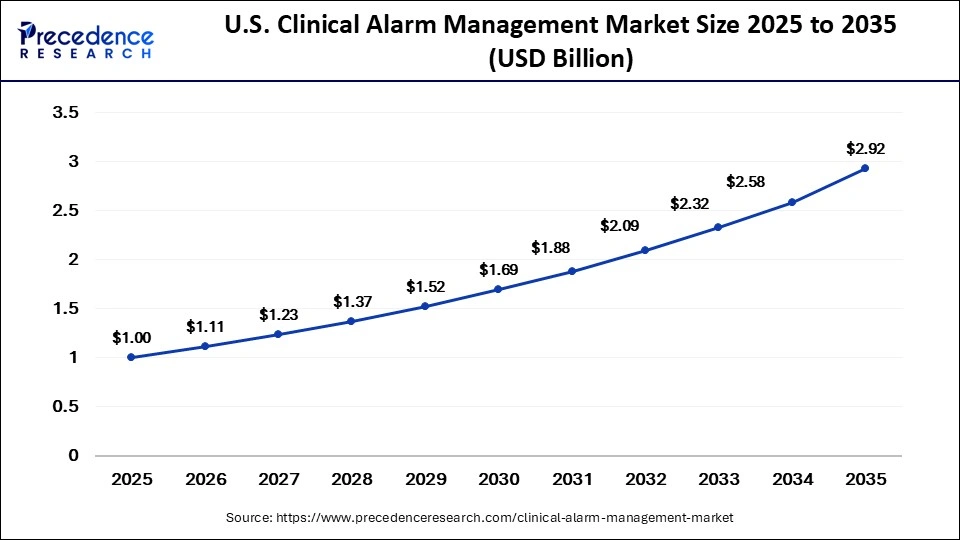
U.S. Clinical Alarm Management Market Analysis
The country represents the largest share of the global market. The market is driven by high patient volumes and extensive use of patient monitoring devices, generating a large volume of alarms, creating the need for clinical alarm management solutions. The hospitals in the country are rapidly adopting artificial intelligence integrated systems, centralized monitoring platforms, and mobile alarm notification systems to streamline clinical workflows. The strict regulatory requirements and patient safety guidelines by organizations such as the Joint Commission and the Centers for Medicare and Medicaid Services (CMS) encourage adoption of effective alarm management protocols to reduce alarm fatigue and improve care quality.
What Supports the Market's Fastest Growth in Asia Pacific?
The Asia Pacific clinical alarm management held 23.0% of market shares in 2025, due to rising alarm fatigue among staff and increasing adoption of smart, integrated, patient-monitoring devices. Governments are investing heavily in modernizing healthcare infrastructure, while a growing geriatric population increases demand for advanced, accurate, and real-time patient surveillance technologies.
China Clinical Alarm Management Market Analysis
In China, the market is expanding through massive investments in digital health technology, particularly in large, urban hospitals seeking to reduce alarm fatigue. The National Health Commission is prioritizing upgraded clinical infrastructure, driving high adoption rates of AI-based alarms, smart communication, and advanced monitoring systems to improve critical care efficiency.
What makes Europe a Significantly Growing Region in the Clinical Alarm Management Market?
Europe is expected to grow at a notable CAGR in the market during the forecast period. The region has a strict healthcare regulatory framework, such as the EU Medical Device Regulation (MDR), for patient safety, encouraging clinicians to adopt advanced alarm management solutions. European countries are heavily investing in healthcare IT infrastructure and digital health to modernize the healthcare system, accelerating the adoption of alarm management technologies. The rising aging population and chronic disease burden create demand for continuous monitoring, increasing the need for advanced alarm management systems. AI-powered alarm filtering and centralized monitoring systems are rapidly adopted by the region. The region is adopting integrated medical devices, electronic health records, and alarm notification systems to improve workflow efficiency.
Germany Clinical Alarm Management Market Analysis
Germany's market is expected to grow rapidly due to its advanced healthcare infrastructure and increasing adoption of advanced alarm management solutions. The country is facing an increasing aging population and burden of chronic diseases, which creates the need for continuous patient monitoring, thereby increasing demand for clinical alarm management technologies. One of the key factors driving the market is healthcare digitization. Government initiatives such as the Digital Healthcare Act and the Hospital Future Act support the digitization of healthcare infrastructure by providing heavy funding. Further, the market growth is driven by the presence of leading medical technology companies. The country is also highly adopting innovation in AI-powered alarm management, predictive analysis, and integrated monitoring platforms.
Clinical Alarm Management Companies
- Philips
- GE Healthcare
- Medtronic
- Siemens Healthineers
- Cerner Corporation
- Nihon Kohden
- Ascom
- Spacelabs Healthcare
- Zoll Medical Corporation
- Stryker
- Baxter International, Inc
- Capsule Technologies, Inc.
- Hill-Rom Services, Inc.
Recent Developments
- In January 2025, AirStrip, a leader in advanced clinical monitoring and alarm management solutions, announced the acquisition of DECISIO Health, a provider of innovative clinical decision support and visualization tools. This acquisition enhances AirStrip's product portfolio and further improves patient outcomes and streamlines clinical workflows.(Source: https://www.airstrip.com)
- In November 2024, GE HealthCare announced the publication of data from a two-phase pilot study conducted with the Cleveland Clinic in the peer-reviewed Journal of Clinical Anesthesia. The study highlights the performance of the wireless and wearable Portrait Mobile monitoring solution in the post-surgical ward environment.(Source: https://www.snsinsider.com)
Segments Covered in the Report
By Component
- Solutions
- Services
By Product
- Nurse Call Systems
- Physiological Monitors
- Bed Alarms
- EMR Integration Systems
- Ventilators
- Infusion Pumps & Others
By Deployment Mode
- On-Premise
- Cloud-Based
By End-User
- Hospitals & Clinics
- Long-Term Care Centers
- Ambulatory Care Centers
- Home Care Setting
By Type
- Centralized Alarm Management Systems
- Decentralized/Distributed Systems
By Region
- North America
- Europe
- Asia-Pacific
- Latin America
- Middle East & Africa
For inquiries regarding discounts, bulk purchases, or customization requests, please contact us at sales@precedenceresearch.com
Frequently Asked Questions





Ask For Sample
No cookie-cutter, only authentic analysis – take the 1st step to become a Precedence Research client
 Get a Sample




 sales@precedenceresearch.com
 Schedule a Meeting
