



Cloud Carbon Management System Market Trends, Companies, Revenue / Sales Performance, Subscriber Growth, Pricing Strategies, Cloud Adoption, Infrastructure Expansion, Competitive Landscape, and Industry Outlook
Cloud Carbon Management System Market (By Deployment Model: Public Cloud, Private Cloud, Hybrid Cloud; By Component: Software, Services, Platforms; By Application: Carbon Footprint Management, Carbon Accounting, Emissions Reporting; By End Use: Energy and Utilities, Manufacturing, Transportation; By Organization Size: Small Enterprises, Medium Enterprises, Large Enterprises) - Global Industry Analysis, Size, Trends, Leading Companies, Regional Outlook, and Forecast 2026 to 2035
Source: https://www.precedenceresearch.com/cloud-carbon-management-system-market
 Get a Sample
 Table Of Content


What is the Cloud Carbon Management System Market Size in 2026?
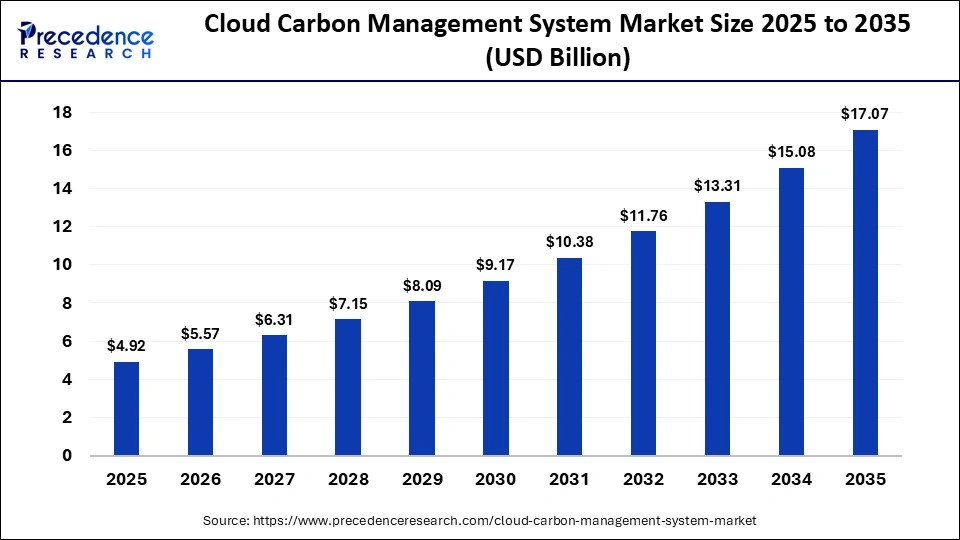
The global cloud carbon management system market size was calculated at USD 4.92 billion in 2025 and is predicted to increase from USD 5.57 billion in 2026 to approximately USD 17.07 billion by 2035, expanding at a CAGR of 13.25% from 2026 to 2035. An increase in regulatory pressure, the forced disclosure of ESGs, and the commitment to net-zero are driving the implementation of cloud-based carbon management systems.
Key Takeaways
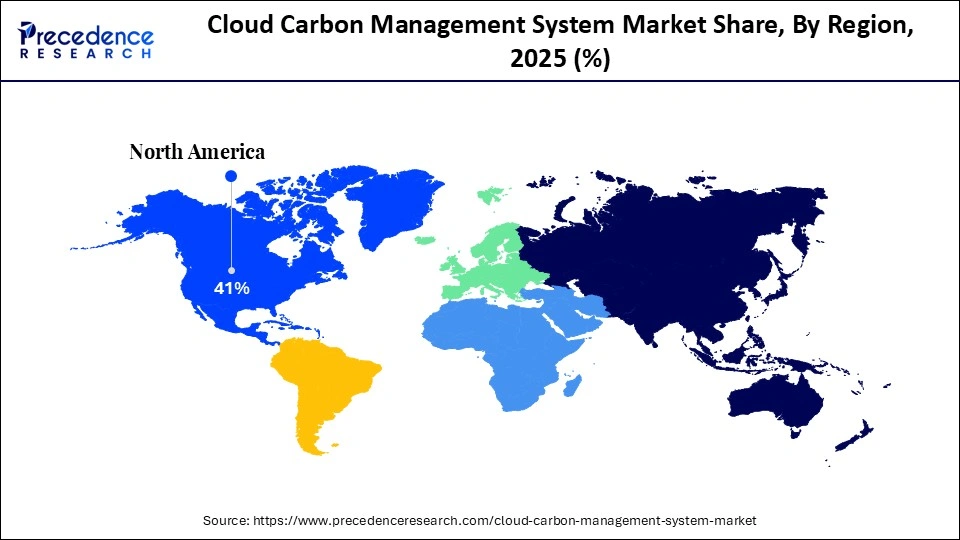
- North America dominated the global cloud carbon management system market with the largest market share of 41% in 2025.
- Asia-Pacific is expected to grow at the fastest CAGR in the market during the forecast period.
- By deployment model, the public cloud segment held a dominant position in the market in 2025.
- By deployment model, the hybrid cloud segment is expected to grow at the fastest CAGR in the market between 2026 and 2035.
- By component, the software segment led the global market in 2025.
- By component, the services segment is expected to grow with the highest CAGR in the market during the studied years.
- By application, the carbon footprint management segment dominated the global market in 2025.
- By application, the emissions reporting segment is expected to expand rapidly in the market in the coming years.
- By end use, the energy and utilities segment held the largest revenue share of the market in 2025.
- By end use, the transportation segment is expected to witness the fastest growth in the market over the forecast period.
- By organization size, the large enterprises segment contributed the biggest revenue share of the market in 2025.
- By organization size, the small enterprises segment is expected to gain the highest market share between 2026 and 2035.
Powering the Net-Zero Transition Through Cloud Systems
The cloud carbon management system market is growing at a fast pace, as business organizations focus on decarbonization plans and data transparency. These platforms centralize emissions monitoring, carbon management, reporting, and reduction planning on scalable cloud infrastructures. The growing environmental policies and carbon pricing systems are compelling firms to adopt automated and auditable reporting solutions. Multinational corporations requiring standardized, real-time environmental performance information in their global operations are in high demand.
What is the Role of AI in the Cloud Carbon Management System Market?
Artificial intelligence (AI) is revolutionizing a carbon management system, which was a fixed reporting instrument to a predictive decision-making instrument. AI enables the automatic detection of decarbonization pathways, anomalies, forecasts, and model scenarios. Machine learning (ML) algorithms augment the accuracy of Scope 1, 2, and 3 emissions, with the assistance of intricate supplier and functional data sets. With the maturation of AI capabilities, platforms are becoming prescriptive and offer carbon reduction investment advice and optimization of sustainability strategies.
Cloud Carbon Management System Market Trends
- AI and Real-Time Analytics: Companies are incorporating AI-based analytics to watch over emissions on a real-time basis, so that they can make proactive decisions to reduce carbon. Developed dashboards and a predictive model to assist the business in detecting inefficiencies and optimizing power usage.
- Scope 3 Emissions Focus: Firms are stepping up the campaign to quantify and control the Scope 3 emissions throughout the supply chain. Cloud systems currently have supplier interaction tools, lifecycle evaluation modules, and automated information sharing functionality.
- Automated Data Reporting and Collection: Spreadsheets and disjointed reporting systems are being superseded by automation. Cloud platforms are directly integrated with ERP, IoT, and energy management systems to draw emissions data in a seamless manner.
- Cloud-First Deployment: The reason that cloud-native architecture is becoming the norm is that it is more flexible and scalable, and it also costs less to maintain. Carbon management solutions based on SaaS are easier to upgrade and deploy centrally at the global level by organizations.
- Sector-Specific Solutions: Vendors are coming up with industry-specific modules in manufacturing, energy, finance, retail, and transport sectors. These tailored systems target industry-specific factors of emission, compliance, and operational nuances.
Market Scope
| Report Coverage | Details |
| Market Size in 2025 | USD 4.92 Billion |
| Market Size in 2026 | USD 5.57 Billion |
| Market Size by 2035 | USD 17.07 Billion |
| Market Growth Rate from 2026 to 2035 | CAGR of 13.25% |
| Dominating Region | Asia Pacific |
| Fastest Growing Region | North America |
| Base Year | 2025 |
| Forecast Period | 2026 to 2035 |
| Segments Covered | Deployment Model , Component, Application, End Use,Organization Size, and Region |
| Regions Covered | North America, Europe, Asia-Pacific, Latin America, and Middle East & Africa |
Segmental Insights
Deployment Model Insights
Which Deployment Mode Segment Dominated the Cloud Carbon Management System Market?
The public cloud segment accounted for the highest revenue share in the market in 2025 because of its scalability and cost-effectiveness. The reason why organizations are adopting the use of public cloud is that it is used to track emissions centrally across various locations. The SaaS model allows quicker implementation without having to invest heavily in infrastructure. High compliance and reliability are created by automatic updates and robust cybersecurity systems. It works well with enterprise systems, such as ERP and energy management systems, due to its flexibility.
The hybrid cloud segment is expected to show the fastest growth with a CAGR over the forecast period, as more enterprises want to have more data control and customization. The reason is that companies that deal with sensitive sustainability or financial information would like a mix between the privatization of infrastructure and public cloud scalability. Hybrid models will enable critical data regarding emissions to be safely stored, but use deep analytics tools in the cloud. This will serve to regulate data-sensitive industries. The increasing digital transformation efforts are accelerating the adoption of hybrid.
Component Insights
What Made the Software Segment Dominate the Cloud Carbon Management System Market?
The software segment contributed the biggest revenue share in the market in 2025, since it is the center of carbon tracking and analytics platforms. These systems have dashboards, emission calculation engines, forecasting tools, and reporting modules. Regulatory compliance features and data accuracy are enhanced through constant updates. Implementation of real-time monitoring and automated data aggregation is made possible by cloud-based software. Advanced software features are of interest to enterprises to handle complex Scope 1, 2, and 3 emissions.
The services segment is expected to gain the highest market share between 2026 and 2035, owing to the rise in demand for consulting, implementation, and integration support. Companies usually need professional assistance to coordinate the carbon management systems with the ESG frameworks. Managed services assist firms in ensuring conformity and maximum utilization of the platform. Sustainability reporting is getting complicated; hence, training and advisory services are on the increase. Custodial deployments would also increase the growth of services.
Application Insights
How the Carbon Footprint Management Segment Dominated the Market?
The carbon footprint management segment contributed the biggest revenue share in the cloud carbon management system market in 2025, due to the need for companies to monitor and cut down the overall emissions. These channels offer precise operations and supply chain emissions measurements. They are employed by businesses to define areas of inefficiency and focus on decarbonization efforts. Carbon footprint data is very crucial for strategic sustainability planning. Demand is supported by regulatory requirements and corporate net-zero objectives.
The emissions reporting segment is expected to witness the fastest growth in the market over the forecast period, due to the growing awareness of environmental sustainability and stringent regulations. Cloud carbon management systems provide visibility and tooling to measure, monitor, and reduce cloud carbon emissions. Companies make annual strategic goals to accomplish their ESG targets. The integration of advanced technologies, such as AI and ML, enables real-time emissions reporting and monitoring.
End Use Insights
Why the Energy and Utilities Segment Dominated the Cloud Carbon Management System Market?
The energy and utilities segment held the largest revenue share in the market in 2025 because of the high carbon intensity and total regulatory control. These firms need sophisticated monitoring devices that can monitor emissions from the generation and distribution activities. Carbon management platforms are useful in realizing the optimal strategies for integrating renewable strategies by utilities. They also promote adherence to the emissions trading programs and decarbonization requirements. Sustainability needs to be met through continuous monitoring.
The transportation segment is expected to expand rapidly in the market in the coming years, as the sector is being decarbonized and electrified. Carbon management tools are being embraced by the logistics companies and airlines as a means of quantifying fuel use and emissions in their supply chains. Emission regulation of the fleet leads to the use of a cloud platform. Analytics are used to help companies optimize routes and decrease carbon output. The transition of the world towards sustainable mobility promotes high growth.
Organization Size Insights
Which Organization Size Segment Led the Cloud Carbon Management System Market?
The large enterprises segment led the market in 2025, driven by intricate operations and strict reporting requirements of these businesses worldwide. They have high expenditures on sophisticated carbon accounting programs and in-built analytics systems. Sustainability performance is a bigger issue in large organizations as regulators and investors subject them to scrutiny. Specialized ESG departments are catalysts behind the need to have enterprise-based platforms. They can be implemented on a large scale due to their large budgets.
The small enterprises segment is expected to grow with the highest CAGR in the market during the studied years, because cloud-based SaaS solutions are becoming less expensive. Streamlined subscriptions reduce adoption costs. The growing demand to boost transparency in supply chains compels smaller suppliers to monitor emissions. Demand is being propelled by governments that are imposing sustainability regulations on SMEs. Small business-friendly sites are growing at a fast rate.
Regional Insights
North America Cloud Carbon Management System Market Size and Growth 2026 to 2035
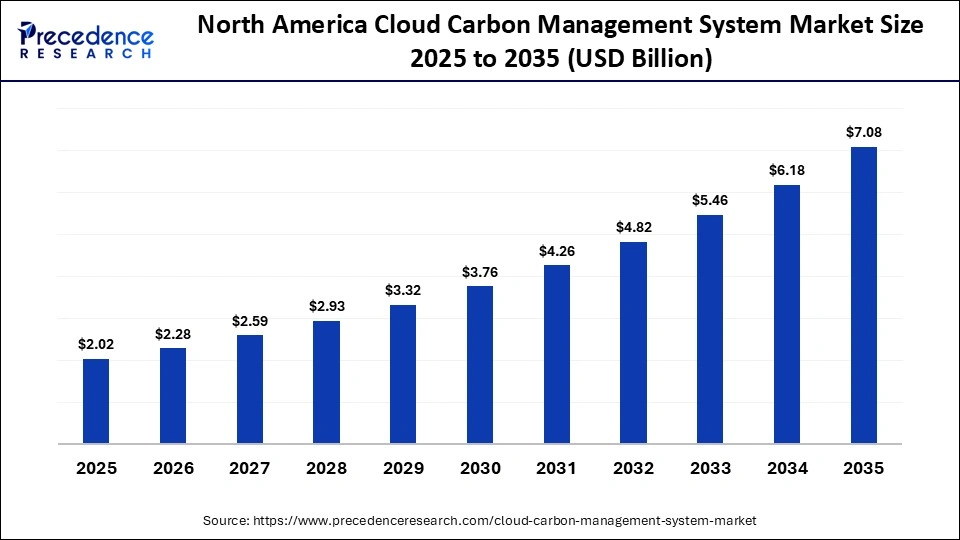
The North America cloud carbon management system market size is estimated at USD 2.02 billion in 2025 and is projected to reach approximately USD 7.08 billion by 2035, with a 13.36% CAGR from 2026 to 2035.
Why North America Dominated the Cloud Carbon Management System Market?
North America held a major revenue share of the market in 2025, due to favorable regulatory policies and company sustainability requirements. The area is also advantageous in terms of high levels of digital infrastructure and an early implementation of ESG reporting principles. Emissions analytics face an acceleration of change by big technology vendors and climate-tech startups. The increasing investor pressure also contributes to the market demand. The number of carbon disclosure requirements is on the rise. Net-zero commitments of the corporations play a major role in regional supremacy.
U.S. Cloud Carbon Management System Market Size and Growth 2026 to 2035
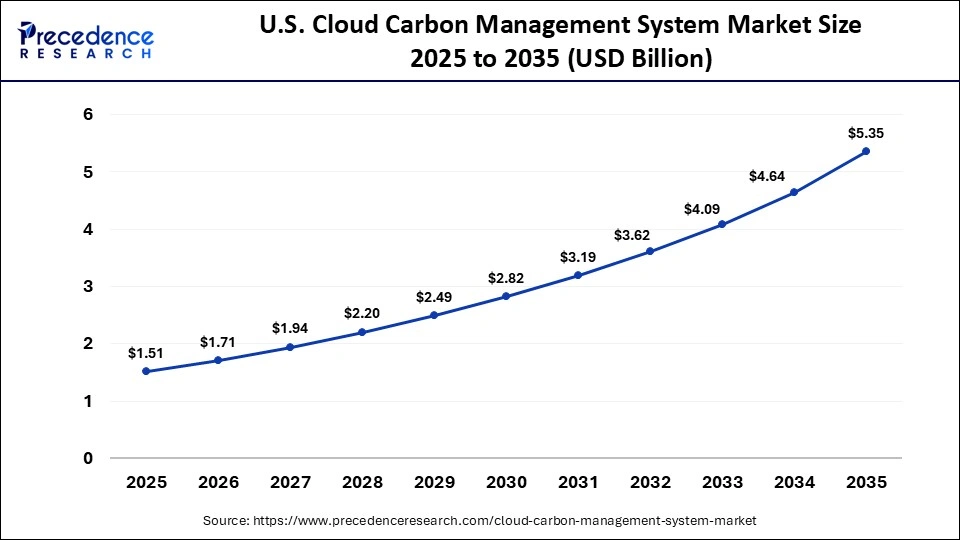
The U.S. cloud carbon management system market size is calculated at USD 1.51 billion in 2025 and is expected to reach nearly USD 5.35 billion in 2035, accelerating at a strong CAGR of 13.48% between 2026 and 2035.
Country-Level Analysis
The adoption of carbon management systems is widespread in the U.S. due to federal and state-level policies on climate issues. Large companies are also going into AI-enabled sustainability platforms to enhance transparency. Canada is enhancing carbon pricing and company reporting. Both nations focus on monitoring supply chain emissions. Clean technology investments increase demand, both publicly and privately. The full-fledged cloud ecosystem in the U.S. and Canada facilitates scalable deployment.
Why is Asia-Pacific the Fastest-Growing Region in the Market?
Asia-Pacific is expected to witness the fastest growth in the cloud carbon management system market during the predicted timeframe, due to the rapid industrialization and the growing awareness towards the environment. Governments in the region are launching carbon neutrality undertakings and emission reduction policies. Growing cloud infrastructure is in favor of digital sustainability solutions. Multinational companies that are present in the region are adopting the standardized systems of carbon reporting. Increasing trends of ESG investments enhance adoption. The manufacturing base is tremendous in the region and, as a result, creates a high demand for emissions monitoring tools.
Country-Level Analysis
Digital reporting solutions are enticed by the carbon trading market and the decarbonization goals of China. Japan and South Korea are encouraging green innovation and complying with corporate sustainability. India is reinforcing ESG systems and investments in renewable energy. Corporate responsibility is on the rise because of the climate disclosure efforts in Australia. All these factors make Asia-Pacific one of the high-growth markets.
Will Europe Grow in the Cloud Carbon Management System Market?
Europe is expected to grow at a notable CAGR in the foreseeable future because of the stricter environmental laws and competitive climate goals. Digital emissions reporting is promoted by the sustainability directives of the European Union. Companies are also quickly adopting carbon management systems as a way of meeting disclosure requirements. High pressure on Scope 3 emissions raises the complexity and demand of the system. Sustainable digital solutions are also encouraged by climate finance initiatives. The adoption is boosted by the technological innovation in the region.
Country-Level Analysis
The industrial sector of Germany is investing in digital decarbonization approaches. France is increasing corporate sustainability requirements and carbon responsibility systems. The UK is enhancing the climate disclosure requirements of financial disclosure. Green digital transformation is also ahead in Nordic countries. These national programs are all contributing to fast market growth.
Cloud Carbon Management System Market Companies
- Accuvio
- Carbon Footprint Ltd.
- Dakota Software
- Enablon
- EnergyCap
- Engie
- Envizi
- Enviance
- Envirosoft
- ESP
- IBM
- Intelex
- Isometrix
- Locus Technologies
- NativeEnergy
- Salesforce
- SAP
- Schneider Electric
Recent Developments
- In January 2026, Snowflake Inc. introduced the Energy Solutions to its AI Data Cloud that combines its governance capabilities, partner-built applications, and industry-critical datasets into an integrated platform for the energy sector. The offering assists utilities, oil, and gas companies in integrating IT, OT, and IoT data to enhance reliability, modernize infrastructure, and accelerate progress towards a more reliable and low-carbon future.(source: https://www.snowflake.com)
- In September 2025, AENTS launched AENTSCOPE, an all-in-one cloud-based carbon management software that would make greenhouse gas accounting and ESG reporting easier. The platform automates Scope 1-3 emissions tracking, contributes to analyzing product carbon footprint, and complies with the standards of international disclosure.(source: https://www.prnewswire.com)
- In July 2025, Green Project Technologies purchased Emitwise's platform solution to enhance its carbon management, especially on the Scope 3 supply chain emissions and product carbon footprint (PCF) technology. The acquisition combines automated supply vendor data gathering and audit quality carbon accounting into a more robust and comprehensive climate management solution to enterprise customers.(source: https://www.prnewswire.com)
Segments Covered in the Report
By Deployment Model
- Public Cloud
- Private Cloud
- Hybrid Cloud
By Component
- Software
- Services
- Platforms
By Application
- Carbon Footprint Management
- Carbon Accounting
- Emissions Reporting
By End Use
- Energy and Utilities
- Manufacturing
- Transportation
By Organization Size
- Small Enterprises
- Medium Enterprises
- Large Enterprises
By Region
- North America
- Europe
- Asia-Pacific
- Latin America
- Middle East & Africa
For inquiries regarding discounts, bulk purchases, or customization requests, please contact us at sales@precedenceresearch.com
Frequently Asked Questions





Ask For Sample
No cookie-cutter, only authentic analysis – take the 1st step to become a Precedence Research client
 Get a Sample




 sales@precedenceresearch.com
 Schedule a Meeting
