



Coal Bed Methane Market Size, Companies, Share, Production Capacity, Raw Material Pricing, Export & Import Analysis, Manufacturing Cost, Competitive Positioning, and Demand Forecast
Coal Bed Methane Market (By Technology: Hydraulic Fracturing, Horizontal Drilling, CO2 Sequestration; By Application: Power Generation, Industrial Fuel, Residential and Commercial Heating, Transportation (CNG/LNG); By End-User: Oil and Gas Companies, Electric Utilities, Mining Operators, Others (Chemicals, Fertilizers)) - Global Industry Analysis, Size, Trends, Leading Companies, Regional Outlook, and Forecast 2026 to 2035
Source: https://www.precedenceresearch.com/coal-bed-methane-market
 Get a Sample
 Table Of Content


What is the Coal Bed Methane Market Size?
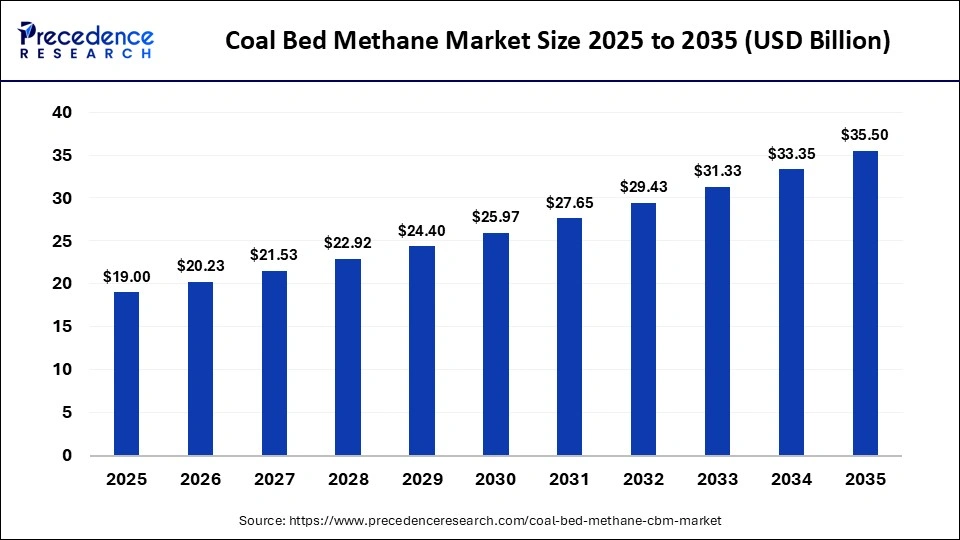
The global coal bed methane market size was calculated at USD 19.00 billion in 2025 and is predicted to increase from USD 20.23 billion in 2026 to approximately USD 35.50 billion by 2035, expanding at a CAGR of 6.45% from 2026 to 2035. The market is growing rapidly, driven by an increasing demand for clean energy solutions. The growing prices of natural gas and innovations in extraction methods have boosted this growth. Furthermore, the role of coalbed methane (CBM) in reducing greenhouse gas emissions bolsters its acceptance across various energy sectors.
Key Takeaways
- North America held a dominant revenue share of the coal bed methane market in 2025.
- Asia-Pacific is expected to grow at the fastest CAGR in the market during the forecast period.
- By technology, the hydraulic fracturing segment accounts for the biggest revenue share in the market in 2025.
- By technology, the CO2 sequestration segment is expected to grow rapidly in the market in the coming years.
- By application, the power generation segment contributed the highest revenue share in the market in 2025.
- By application, the transportation (CNG/LNG) segment is expected to grow at the fastest CAGR in the market between 2026 and 2035.
- By end-user, the electric utilities segment registered its dominance over the market in 2025.
- By end-user, the oil and gas companies segment is expected to grow at the fastest CAGR in the market between 2026 and 2035.
What is the Coal Bed Methane Market?
Coal bed methane (CBM) refers to unconventional natural gas that is adsorbed onto the rock structures of coal, providing energy security and complementing natural gas. Because it has adsorption characteristics, it is not like ordinary sandstone or other gas reservoirs. The gas stored, as methane, in coal can also be dissolved in a near-liquid state, while open fractures could also produce free methane gas. Extracting methane from methane gas is very important to avoid explosion hazards.
Core methods of extraction include hydraulic fracturing to increase permeability in low-porosity coal seams, horizontal drilling to provide full reservoir access, and innovative COâ‚‚ sequestration systems that allow methane recovery while holding up GHG. Countries with large coal reserves, high energy demand, and dense populations are promising markets. The sector is gaining momentum as nations are driving the sector towards energy security, aiming at reducing carbon intensity, seeking to cut carbon intensity, and accessing unexplored stranded gas from previously untapped resource pools.
Impact of AI in the Coal Bed Methane Market
Artificial intelligence is transforming the market by analyzing seismic signatures, historical well logs, desorption curves, and real-time pressure data. It can predict methane production at a high level of accuracy. Rather than heavy drilling or premature abandonment of wells, now operators can adjust de-watering cycles, adjust simulation timing, and even accelerate treatment timing before each change in permeability causes issues that could be costly setbacks. Surface infrastructure-based machine learning systems also track compression units and water management systems and attempt to minimize downtimes through predictive maintenance.
Beyond increasing production efficiency, AI is increasingly critical in monitoring methane emissions and is already beginning to detect fugitive leaks (through satellite images and networks of sensors) for compliance. These digital improvements are not only a cosmetic retrofit in high-capital basins with high profit margins, which are typically sensitive to the volatility of the price of gas, but they also lower operating costs, increase recovery factors, and enhance the ESG business. In summary, AI is transforming CBM from an extraction activity into a data-based optimization.
Trends Influencing the Coal Bed Methane Market
- LNG Linkages & Market Diversification: Growingly, CBM is integrated into LNG value chains, empowering producers to tap exports rather than domestic consumption. By sending much of the methane output into LNG terminals, companies are gaining pricing flexibility and long-term offtake contracts. This also brings in CBM as an adjunct to renewable energy deployment in hybrid power ecosystems, complementing renewable energy sources and establishing CBM as a transitional fuel to enhance the energy supply to the grid and provide a stabilizing force.
- Greater Recovery and Deep Seam Extension: Drilling precision in CBM drilling and stimulation methods has further extended the commercial opportunities in CBM reserves. Operators are turning to deeper coal seams and lower-permeability formations, using more advanced hydraulic methods and improved water management methods to improve recovery from coal seams.
- Focus on the Regional Capital and Energy Security: Investment in CBM today increasingly reflects the geopolitical energy agenda. LNG-importing Asia-Pacific nations are pursuing an incremental development in order to reduce their reliance, and North American operators are more focused on tech optimization to save profit. This capital realignment is symbolic of a larger transition; unconventional gas has gone beyond economic opportunism to emerging as a strategic weapon of national energy resilience and supply diversification.
Marlet Scope
| Report Coverage | Details |
| Market Size in 2025 | USD 19.00 Billion |
| Market Size in 2026 | USD 20.23 Billion |
| Market Size by 2035 | USD 35.50 Billion |
| Market Growth Rate from 2026 to 2035 | CAGR of 6.45% |
| Dominating Region | North America |
| Fastest Growing Region | Asia Pacific |
| Base Year | 2025 |
| Forecast Period | 2026 to 2035 |
| Segments Covered | Technology, Application, End-User, and region |
| Regions Covered | North America, Europe, Asia-Pacific, Latin America, and Middle East & Africa |
Segmental Insights
Technology Insights
Which Technology Segment Dominated the Coal Bed Methane Market?
The hydraulic fracturing segment held the biggest revenue share in the market in 2025, due to its ability to deliver gas from low-permeability coal seams at large production gains. Operators improved seam connectivity and methane flow rates through the infusion of pressurized fluids that form fracture networks. This method made commercial sense in hitherto marginal basins, particularly in North America and Australia. It was confirmed as the most used stimulation method by existing infrastructure, technical familiarity, and scalable deployment, which made it the stimulation method for mature CBM programs.
The CO2 sequestration segment is expected to show the fastest growth over the forecast period, driven by carbon legislation and global commitment to decarbonization. The move boosts methane recovery by pumping in CO2 into coal seams, where it has a much stronger adsorption capability than methane, which can be used to extract the gas while leaving it underground. The method enables more production and reduces emissions, aligning with the ESG agenda and carbon credit structure. As climate accountability increases, CO2-enhanced CBM projects can expect to find both financial and strategic momentum.
Application Insights
Why Did the Power Generation Segment Dominate the Coal Bed Methane Market?
The power generation segment contributed the highest revenue share in the market in 2025, due to the growing demand for electricity and infrastructure readiness. This transitional fuel, known as CBM, provided lower emissions than coal while also maintaining grid reliability. Gas-fired power plants began to blend methane from coal seams with gas from coal fuel, particularly those at the transition from conventional coal combustion. Long-term supply agreements in place with utilities in this industry, too, were instrumental in cementing its dominance.
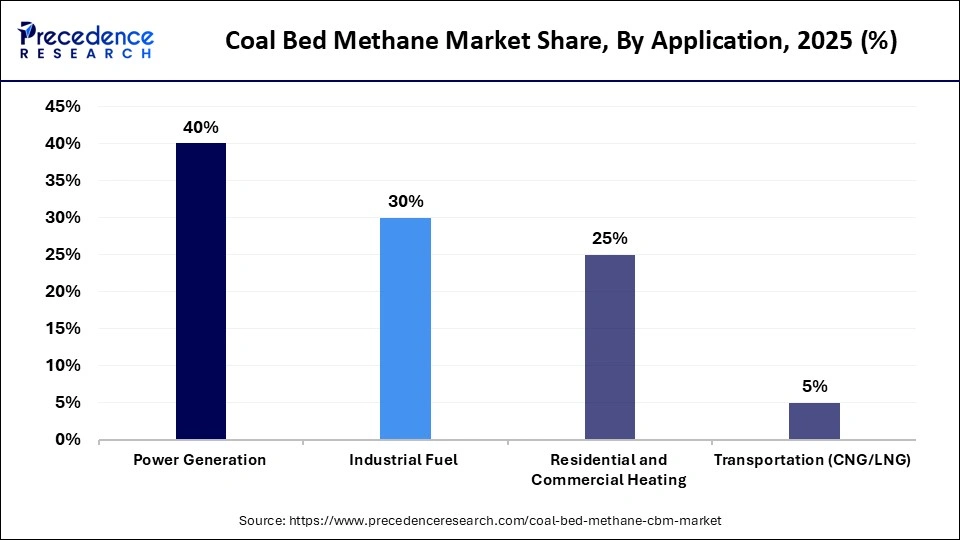
The transportation segment is expected to gain the highest market share with a CAGR of XX% between 2026 and 2035. This growth is driven by an increase in the deployment of CNG and LNG vehicles in both public and freight fleets. Conversion of CBM to CNG or LNG is a lower-emission alternative to diesel. Along the Asia-Pacific metropolitan corridors, policy mandates, cost-effectiveness of fuels, and urban air-quality efforts are expected to help speed up fleet conversions.
End-User Insights
How the Electric Utilities Segment Led the Coal Bed Methane Market?
The electric utilities segment led the market in 2025, due to long-term procurement arrangements and high-volume consumption. Utilities added CBM elements to diversified fuel portfolios to lower the coal dependence for a more predictable electricity generation. With pipeline integration and integrated power grid reliability, utility companies are now the dominant source of revenue in advanced CBM-producing areas.
The oil and gas companies segment is expected to witness the fastest growth in the market over the forecast period. Growth is driven by strategic diversification into unconventional gas resources. With conventional reserves maturing, leading operators are pouring capital into coal seam gas growth. Advanced drilling capabilities, reservoir analytics, and enhanced marketing capabilities allow these organizations to scale CBM production efficiently.
Regional Insights
What is the North America Coal Bed Methane Market Size?
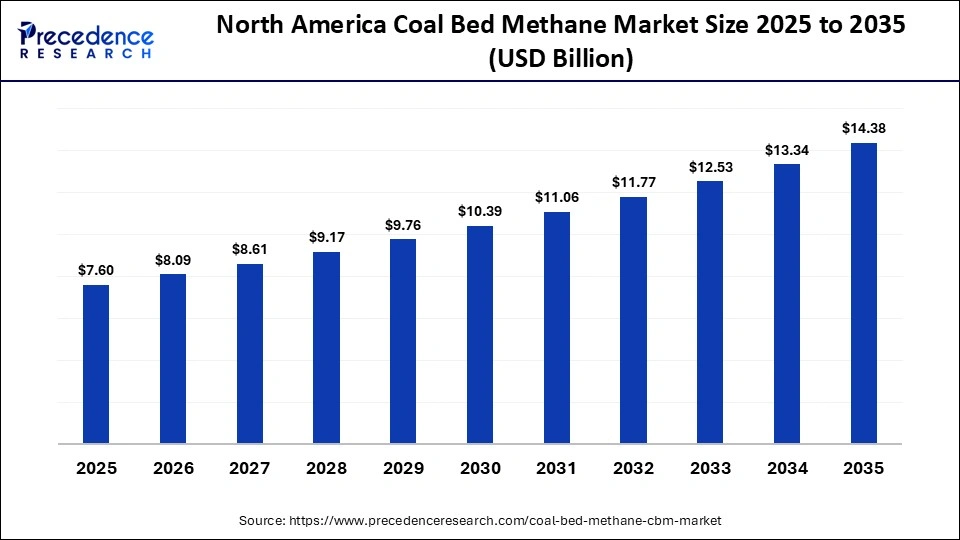
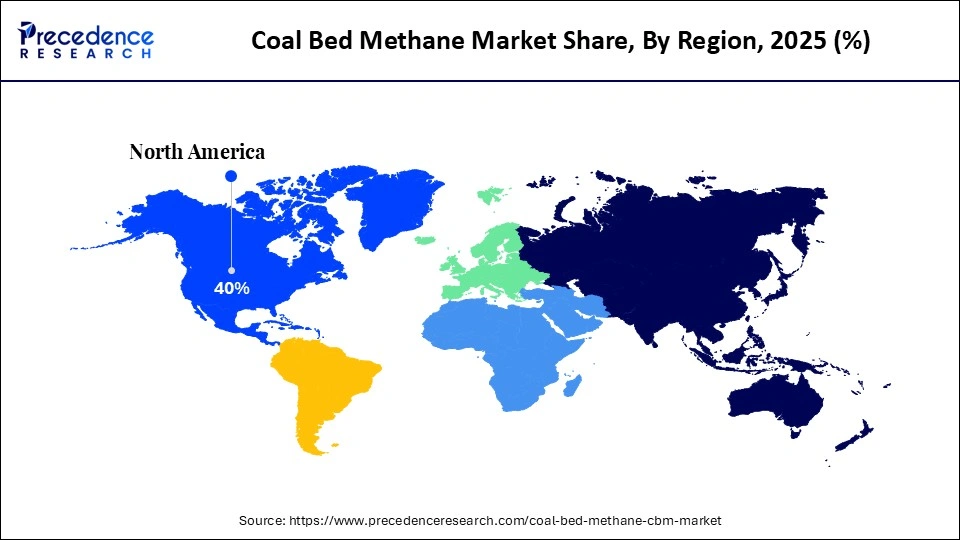
The North America coal bed methane market size is estimated at USD 7.60 billion in 2025 and is projected to reach approximately USD 14.38 billion by 2035, with a 6.58% CAGR from 2026 to 2035.
Why Did North America Dominate the Coal Bed Methane Market?
North America held a major revenue share of the market in 2025, driven by early commercialization, mature basin development, and developed gas infrastructure. The region had the benefits of advanced drilling technologies, high private sector participation, and well-defined mineral rights frameworks that incentivized investment in unconventional gas.
Connections to large pipelines and integration with LNG export terminals helped to strengthen liquidity in the market. Clear regulatory regimes and operational expertise allowed for the same production processes to be maintained across major basins while enhancing the North American region's decades-old leadership position as the industry standard for CBM evolution.
U.S. Coal Bed Methane Market Size and Growth 2026 to 2035
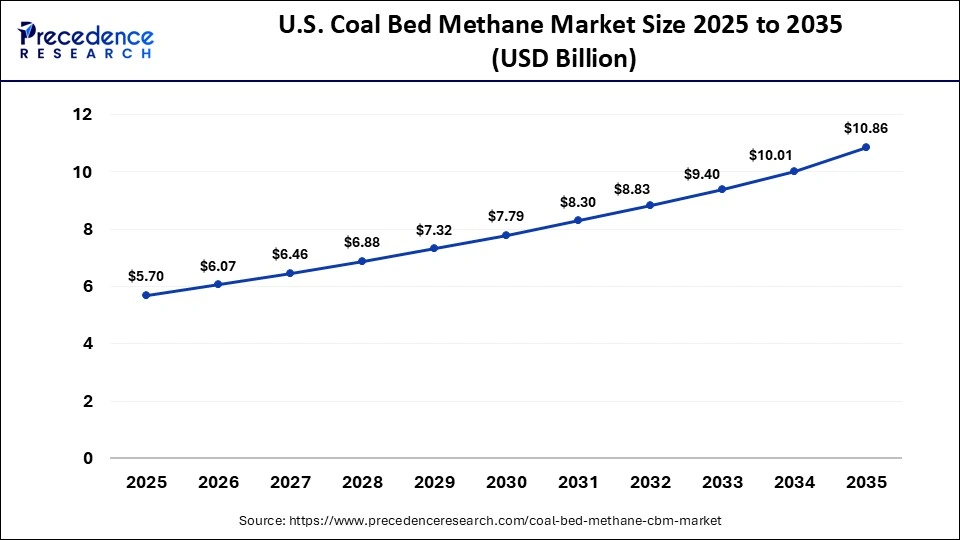
The U.S. coal bed methane market size is calculated at USD 5.70 billion in 2025 and is expected to reach nearly USD 10.86 billion in 2035, accelerating at a strong CAGR of 6.66% between 2026 to 2035.
U.S. Market Trends
The U.S. accounted for the largest market share of the North American market due to technology leadership and traditional unconventional gas operations. Deep hydraulic fracturing and horizontal drilling experience facilitated efficient methane extraction from the highly developed coal deposit basins of the Powder River and San Juan. Strong midstream and gas trading centers improved the efficiency of commercialization. Robust private investment and integrated energy markets maintained output by steady supply, and the U.S. would become the central regional CBM output hub.
How is Asia-Pacific Growing in the Coal Bed Methane Market?
Asia-Pacific is expected to witness the fastest growth during the predicted timeframe. High energy demand and the move to reduce import dependency from LNG are driving growth. The region's accelerated industrialization, urban development, and policy frameworks should accelerate unconventional gas exploration. In addition to the growing CBM commercialization across emerging Asian countries, expanding city gas grids and upgrading infrastructures would also drive CBM commercialization.
China Market Trends
China holds a major market share in the Asia-Pacific. Growth is being fueled by security considerations and ambitious domestic objectives in developing gas. With massive coal reserves and an increasing natural gas supply, China is set on ramping CBM exploration to cut reliance on imported fuels. Projects are being fast-tracked through state-backed investment, expanding infrastructure, and policy incentives. As environmental pressures are projected to rise, coal seam gas will have a strategic role to strike the proper balance between industry demand and emission reduction obligations.
China's Shanxi CBM production reached a record 7.3 billion cubic meters, which is more than 80% of national production. The country aims to drive CBM production and accelerate technological revolution in the unconventional gas sector.
Which Factors Drive the Coal Bed Methane Market?
Europe is expected to grow at a notable CAGR in the foreseeable future, driven by increased interest in domestic sources of gas. As European countries seek to limit their reliance on foreign energy supplies, they are increasingly investigating unconventional sources of natural gas; one of these sources includes CBM. The increased focus on and application of CBM and other forms of fathomless gas capture technologies, like CO2 emission reduction, will help Europe achieve decarbonization goals. Global energy supply volatility has created upward pressure on existing European energy infrastructure and has resulted in increasing investment in alternative gas production.
Germany Market Trends
Since Germany has an established industrial base and continued growth in energy diversity, it is at the forefront of advancing the use of coal-bed methane within European countries. As Germany continues to increase its investments in more environmentally friendly gas technologies and CBM recovery systems and associates those investments with decarbonization targets for its industrial economy, the desire for energy security will drive additional investment into unconventional sources of natural gas.
Why Is Latin America Emerging in the Coal Bed Methane Market?
Latin America is considered to be a significantly growing area, due to an increase in demand for natural gas within the region and because many countries are trying to diversify their energy supply away from relying only upon traditional fossil fuels. In order to strengthen their domestic fuel supplies and reduce their reliance upon imports, multiple countries within Latin America are exploring unconventional natural gas reserves.
Growth in industrial uses of fossil fuels, urbanization, and increased use of electricity have also driven investment into methane recovery programs and new gas infrastructure projects throughout Latin America. Energy companies and governments in the region are gradually increasing their respective amount of exploration activity and their cleaner-burning fuel initiatives, as a means to promote long-term energy security and industrial development.
Brazil Market Trends
Brazil is the market leader in Latin America due to the increased demand for industrial energy and the interest in the development of unconventional gas. The declining reliability of hydropower supplies during climate change-related weather events has led to a diversification toward utilizing gas to generate electricity. The growth in industrialization and the implementation of policies that promote the adoption of cleaner-burning fuel will provide opportunities for more coal-bed methane exploration and production in Brazil throughout the energy sector in the future.
How is the Middle East and Africa Developing in the Coal Bed Methane Market?
The Middle East and Africa are expected to grow at a notable CAGR in the foreseeable future because of the growing energy usage and investment in the search for unconventional gas sources. Energy diversification and methane reduction have become key focuses of many governments. In addition, the growth of industries and infrastructure development provides opportunities for CBM development.
South Africa Market Trends
The South African market is growing due to its abundant coal deposits, rising demand for electricity, and production of renewable energy. South Africa engages in coal-bed methane projects in order to ensure energy security and minimize dependence on coal-fueled electricity. Industrialization is another reason behind the market growth.
Competitive Landscape
The consolidation level in the market of coal-bed methane is moderate due to the presence of significant energy enterprises, independent gas companies, and regional explorers. Key players concentrate efforts on developing innovative drilling methods and technologies as well as improving practices for the extraction of methane, which contributes to making the gas extraction more efficient and cheaper. Enterprises increase their production capacity and develop unconventional gas reserves to satisfy customers' requirements.
Strategic alliances, acquisitions, and other forms of collaboration contribute to forming competition within the industry, particularly in countries that are rich in unexplored coal deposits. Digital monitoring tools, fracking technologies, and carbon management solutions are becoming widely used among companies to increase efficiency and competitiveness. Growing government support for natural gas exploitation and investments in low-emission fuels contribute to creating an environment favorable for the innovation of coal-bed methane.
Value Chain Analysis-Coal Bed Methane Market
- Resource Extraction
The methane trapped in coal seams can be efficiently released through geological surveys, drilling, and dewatering.
Key Players: Thungela, Bharat Coking Coal Ltd., and Arrow Energy Ltd. - Power Generation
Power is generated through extracted methane fuels, turbines, and gas engines.
Key Players: Essar Oil and Gas Exploration and Production, Santos, and ConocoPhillips. - Distribution Network Management
Distribution is managed through pipeline infrastructure, compression stations, and flow control systems.
Key Players: Hindustan Oil Exploration Co. Ltd., Reliance Industries Ltd., and PetroChina Company Ltd. - Energy Storage Systems
Gas storage and LNG terminal facilities balance the required demand for methane.
Key Players: Clarke Energy, Essar, and Baker Hughes Ltd. - Grid Maintenance and Monitoring
Energy transmission is monitored through smart metering, pressure surveillance, and predictive diagnostics.
Key Players: Kores Engineering, Clarke Energy, and Ember Energy. - Regulatory Compliance and Energy Trading
Profitability is shaped by emissions reporting, safety audits, and gas trading platforms.
Key Players: Prabha Energy Limited, Reliance Industries Limited, and Essar.
Coal Bed Methane Market Companies
- Global Energy Resources – Offers solutions related to exploration, drilling, reservoir management, and production of natural gas from coal beds.
- Reliance Unconventional Gas – Engages in the development of unconventional natural gas, including CBM, shale gas, and other forms of gas extraction technology in India.
- Nexus Hydrocarbons – Offers services for the exploration of hydrocarbons and production of CBM, along with gas transportation.
- Apex Gas Solutions – Offers solutions related to methane recovery, gas processing, and energy optimization systems.
- Liberty Energy Partners – Offers services related to unconventional energy developments, including hydraulic fracturing and CBM production.
Other Major Key Players
- Frontier Methane
- Integrated Coalbed Ventures
- PetroCarbon Innovations
- Summit Energy Systems
- Titan Gas Exploration
- Arrow Energy
- Pioneer CBM Solutions
- Unity Unconventional
- Valor Resources Group
- Evergreen Fuels
- Horizon Gas Development
- Quantum Hydrocarbon
- Pioneer CBM Solutions
Recent Developments
- In January 2026, Essar Oil and Gas Exploration & Production Limited (EOGEPL) announced an investment of $100 million to increase the production capacity of its Raniganj East CBM block. The expansion aims to achieve a large-scale output growth, bolstering India's dominant role in coal seam gas production and private investment in the construction project.
(Source: https://economictimes.indiatimes.com) - In August 2024, Shell's joint venture with PetroChina and Arrow Energy announced the Phase 2 expansion of Surat Gas Project (SGP) in Queensland, Australia, with first gas expected in 2026. Phase 2 aims to produce 22,400 BOE/D of gas to feed the Shell-operated Queensland Curtis LNG (QCLNG) facility on Curtis Island to support long-term contracts and domestic demand.
(Source: https://jpt.spe.org) - In July 2024, the Rajasthan Government (India) began drilling coal-bed methane reserves in well-known coal-bearing regions. It set off a wave of momentum at the state level for unconventional gas exploration while helping move the country toward a bigger goal of increasing domestic natural gas production as well as reducing reliance on imports.
(Source: https://energy.economictimes.indiatimes.com)
Segments Covered in the Report
By Technology
- Hydraulic Fracturing
- Horizontal Drilling
- CO2 Sequestration
By Application
- Power Generation
- Industrial Fuel
- Residential and Commercial Heating
- Transportation (CNG/LNG)
By End-User
- Oil and Gas Companies
- Electric Utilities
- Mining Operators
- Others (Chemicals, Fertilizers)
By Region
- North America
- Europe
- Asia-Pacific
- Latin America
- Middle East & Africa
For inquiries regarding discounts, bulk purchases, or customization requests, please contact us at sales@precedenceresearch.com
Frequently Asked Questions
Tags





Ask For Sample
No cookie-cutter, only authentic analysis – take the 1st step to become a Precedence Research client
 Get a Sample




 sales@precedenceresearch.com
 Schedule a Meeting
