



Dashboard Camera Market Trends, Companies, Revenue / Sales Performance, Subscriber Growth, Pricing Strategies, Cloud Adoption, Infrastructure Expansion, Competitive Landscape, and Industry Outlook
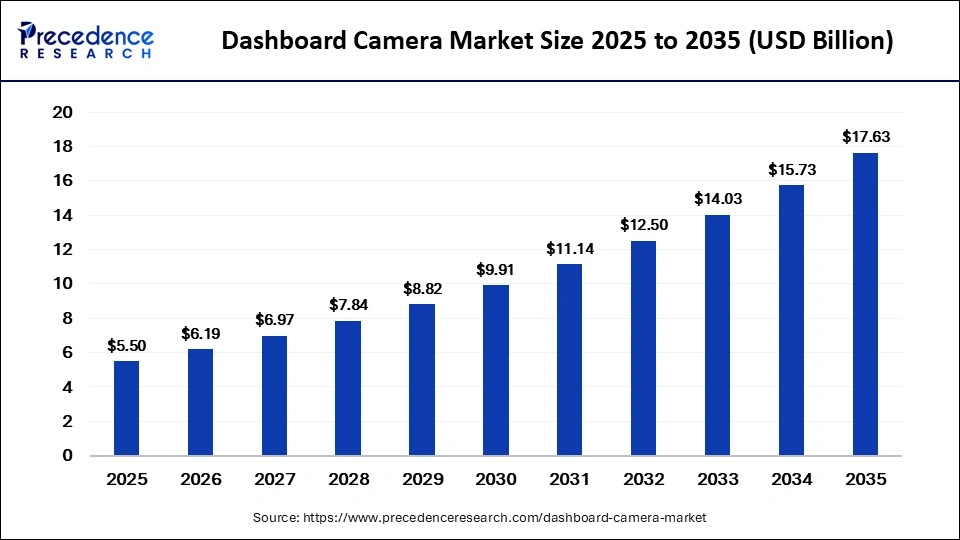
ICT industry specialist Gautam Mahajan estimates the dashboard camera market at USD 6.19 billion in 2026, with continued technology adoption expected to take the market to USD 17.63 billion by 2035 at a CAGR of 12.60%. Leading dashboard camera market providers such as Garmin Ltd., Nextbase, Thinkware, BlackVue are expanding their capabilities across segments including By Product Type, By Technology, By Vehicle Type, By Distribution Channel, By Application, By End-use.
Source: https://www.precedenceresearch.com/dashboard-camera-market
 Get a Sample
 Table Of Content


What is the Dashboard Camera Market Size in 2026?
The global dashboard camera market size was calculated at USD 5.50 billion in 2025 and is predicted to increase from USD 6.19 billion in 2026 to approximately USD 17.63 billion by 2035, expanding at a CAGR of 12.60% from 2026 to 2035. The market growth is attributed to increasing adoption of AI-enabled vehicle surveillance systems, rising road safety awareness, and expanding connected mobility infrastructure across passenger and commercial transportation sectors.
Key Takeaways
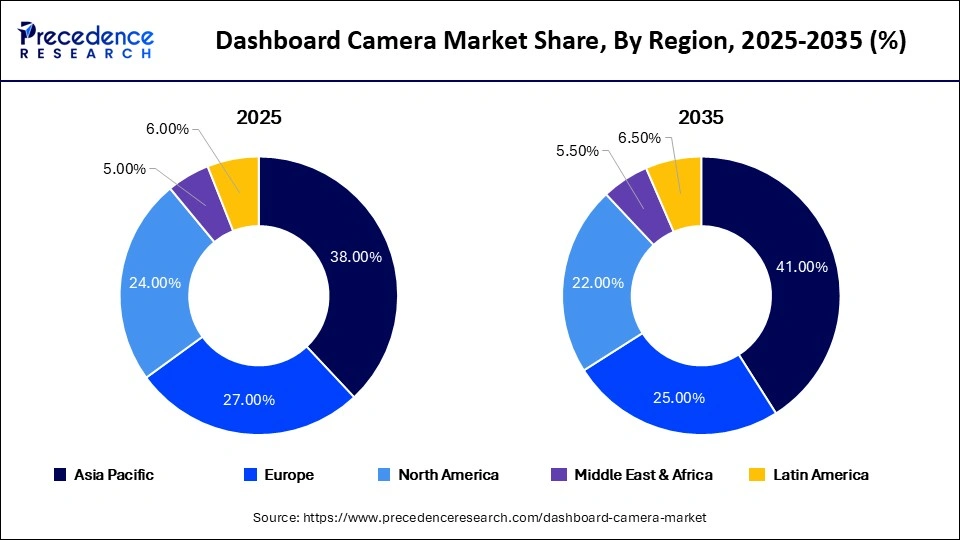
- Asia-Pacific dominated the market with 38% of the market share in 2025 and is expected to witness the fastest growth with a CAGR of 14.5% in the coming years.
- Europe held the second-largest dashboard camera market share of 27% in 2025 and is expected to register a significant growth of 11.2% CAGR during 2026 and 2035.
- By product type, the advanced dashboard cameras segment contributed the highest market share of 34% in 2025.
- By product type, the dual-channel dashboard cameras segment held a 28% share of the market in 2025 and is expected to grow at a significant CAGR of 14.2% in between 2026 and 2035.
- By technology, the full HD dashcams segment held a major market share of 36% in 2025.
- By technology, the 4K dashcams segment held a 20% market share in 2025 and is expected to register the fastest growth of 19.5% CAGR during 2026 and 2035.
- By vehicle type, the passenger vehicles segment contributed the highest dashboard camera market share of 58% in 2025.
- By vehicle type, the commercial vehicles segment contributed 24% to the market in 2025 and is expected to grow at a notable CAGR rate of 13.5% over the projected period.
- By distribution channel, the aftermarket segment contributed the highest market share of 68% in 2025.
- By distribution channel, the OEM segment held a 32% share of the market in 2025 and is expected to grow at the highest CAGR of 15% in between 2026 and 2035.
- By application, the accident recording segment contributed the highest market share of 34% in 2025.
- By application, the fleet management segment held a 20% share of the market in 2025 and is expected to grow at the fastest CAGR of 16.5% in between 2026 and 2035.
Market Overview
Rising road accidents, increasing insurance fraud cases, and growing connected vehicle adoption are strongly driving the market globally. A dashboard camera is like a video recorder in the vehicle that automatically records what goes on the road, how the driver drives, what happens during parking time, and what happens in an accident. Furthermore, the global market is set for ongoing expansion with enhanced investments in smart transportation infrastructure and cloud-based telematics systems.
Impact of Artificial Intelligence on the Dashboard Camera Market
AI is reshaping the dashboard camera industry by elevating the traditional role of a camera into one that is intelligent and proactive in safeguarding road safety and managing driving. Investing in AI-powered dashboard cameras is becoming a common practice for companies that run fleets to better ensure driver accountability and verify insurance claims. The expansion of predictive risk alerts, automated incident checking, and cloud-powered, real-time monitoring is driving the growth of AI video telematics apps from fleet technology vendors such as Geotab, Lytx, and Motive.
Growth Factors
- Rising Demand for Real-Time Fleet Visibility: Commercial transportation operators are boosting investments in live vehicle monitoring and remote surveillance technologies across logistics networks.
- Surging Deployment Across Ride-Sharing Mobility Platforms: Expanding ride-hailing and urban mobility operations are fuelling demand for cabin-facing and multi-channel dashboard cameras.
Smart Transportation Investments Accelerating Global Dashboard Camera Adoption
- China retained its position as the world's biggest manufacturer of dashboard cameras from 2024 to 2026, which accounts for an estimated 60-70% of the global production capacity. Chinese manufacturers also control the exports to the entire Southeast Asia, Europe, and Latin America.
- Under the General Safety Regulation (GSR) framework, the European Union updated laws on vehicle safety and intelligent transportation from 2024 to 2026, to increase the use of dashboard cameras and AI-powered driver monitoring systems in both the commercial fleet and logistics sectors and connected vehicle platforms.
- China led the world in terms of smart transportation infrastructure deployments between 2024 and 2026, with over 500 smart city pilot initiatives combining AI-powered camera systems on passenger transport and logistics vehicles with connected vehicle monitoring solutions and intelligent traffic surveillance utilizing the results of these systems.
Dashboard Camera Market Trends
Edge AI Dash Cameras Replacing Cloud-Only Recording Systems
Dashboard camera makers incorporate more edge AI processors that can analyze driving risks directly inside the dashboard camera. This technology saves fleet operators money on cloud processing, enhances real-time driver alerts, and bolsters data privacy compliance. Advanced AI-powered dash cams were launched by companies such as Geotab and Motive with built-in risk detection, collision prediction, and automated driver coaching functionality built-in.
Market Scope
| Report Coverage | Details |
| Market Size in 2025 | USD 5.50 Billion |
| Market Size in 2026 | USD 6.19 Billion |
| Market Size by 2035 | USD 17.63 Billion |
| Market Growth Rate from 2026 to 2035 | CAGR of 12.60% |
| Dominating Region | Asia Pacific |
| Fastest Growing Region | Europe |
| Base Year | 2025 |
| Forecast Period | 2026 to 2035 |
| Segments Covered | Product Type, Technology, Vehicle Type, Distribution Channel, Application, End-use, and Region |
| Regions Covered | North America, Europe, Asia-Pacific, Latin America, and Middle East & Africa |
Market Dynamics
Drivers
Rising Road Accident Rates and Insurance Disputes
Rising global road accident cases and insurance fraud incidents are expected to accelerate the drive of the dashboard camera market. Dashboard cameras are increasingly becoming the inevitable choice for drivers for video evidence on claims to strengthen claims management and minimize bogus insurance claims. Moreover, the growing connected vehicle adoption and smart mobility investments are projected to expand demand for cloud-connected dashboard camera technologies worldwide.
Restraint
Hamper Growth Through Data Privacy and Surveillance Concerns
Rising concerns regarding driver privacy and continuous video surveillance are expected to hamper the market in the coming years. In vitro, the requirements for vehicle data protection and video recording are still being enforced across Europe and North America. Furthermore, the restrained market penetration through increasing costs associated with AI-enabled dashboard cameras is projected to affect adoption among price-sensitive consumers.
Opportunity
Surging E-Commerce and Logistics Fleet Expansion
Surging e-commerce delivery volumes and logistics fleet expansion are estimated to create immense opportunities for the market across commercial transportation networks. Last-mile delivery companies are increasingly using record systems to track driver behaviour, cargo handling tasks, and incidents involving accidents. Multi-camera dashboard cameras are desired by fleet operators due to their ability to enhance the transparency of operations and decrease cargo theft risk in real time.
Segment Insights
Product Type Insights
Dashboard Camera Market Share, By Product Type, 2025-2035 (%)
| Product Type | 2025 | 2035 | CAGR (%) |
| Basic Dashboard Cameras | 24.00% | 18.00% | 7.50% |
| Advanced Dashboard Cameras | 34.00% | 38.00% | 15.00% |
| Dual-channel Dashboard Cameras | 28.00% | 31.00% | 14.20% |
| Rear-view Dashboard Cameras | 14.00% | 13.00% | 9.50% |
The Advanced Dashboard Cameras Segment Dominated the Market with 34% of Market Share in 2025
The advanced dashboard cameras segment generated approximately USD 1.87 billion in 2025 and is projected to reach nearly USD 6.70 billion by 2035, growing at a CAGR of 15% during the forecast period. The advanced dashboard cameras segment dominated the dashboard camera market with a share of 34% in 2025, due to their capability of deploying AI-driven analytics, ADAS, cloud integration, and GPS-based tracking systems. This continues to drive more penetration into both passenger cars and trucks. Automotive AI vision processors grew in both size and number over 2025 for connected car edge computing and high-resolution video analytics from Ambarella and NVIDIA.
The dual-channel dashboard cameras segment accounted for approximately USD 1.54 billion in 2025 and is projected to reach nearly USD 5.47 billion by 2035, growing at a CAGR of 14.2% during the forecast period. The dual-channel dashboard cameras segment held a 28% share in 2025, due to increased awareness of the importance of road accident evidence collection among drivers. Drivers are looking for cheap cameras with nighttime recording, wide-angle views, and an emergency lock recording mode to use for daily driving.
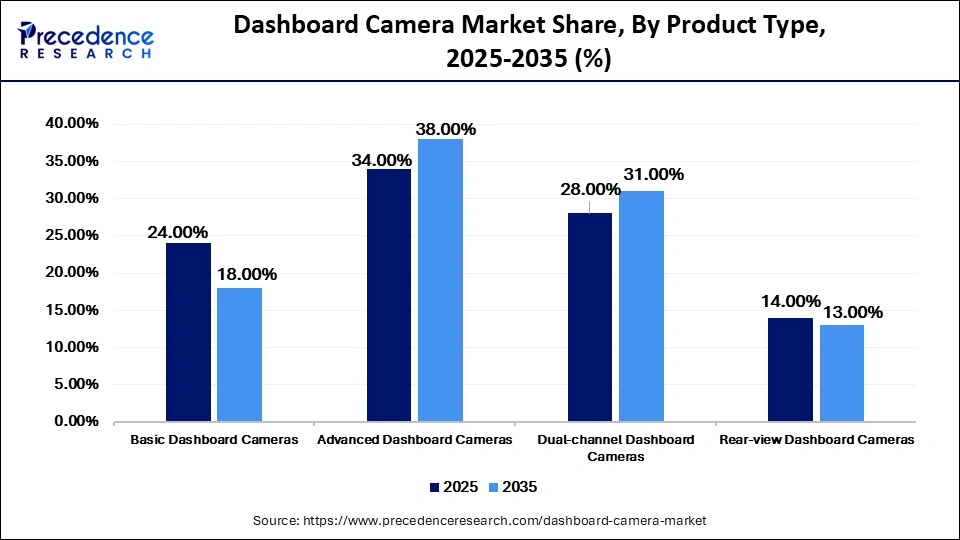
The basic dashboard cameras segment generated approximately USD 1.32 billion in 2025 and is projected to reach nearly USD 3.17 billion by 2035, growing at a CAGR of 7.5% during the forecast period. The basic dashboard cameras segment held a 24% share of the market in 2025, due to insurance verification requirements and commercial fleet safety regulations. They are continuing to increase and drive the adoption of the insurance verification solution across various transportation industries.
The rear-view dashboard cameras segment accounted for approximately USD 770 million in 2025 and is projected to reach nearly USD 2.29 billion by 2035, growing at a CAGR of 9.5% during the forecast period. The rear-view dashboard cameras segment contributed 14% to the market in 2025, driven by its larger rate of adoption across urban passenger vehicle types. This trend of growing parking pressures and subsequent rear-collision rates keeps building demand for rear recording/reversing assistance upgrades.
Technology Insights
The Full HD Dashcams Segment Dominated the Market with 36% of Market Share in 2025
The full HD dashcams segment generated approximately USD 1.98 billion in 2025 and is projected to reach nearly USD 5.29 billion by 2035, growing at a CAGR of 9.5% during the forecast period. The full HD dashcams segment dominated the dashboard camera market with a share of 36% in 2025, as full HD recording systems combine balance, clear video, and moderately-priced hardware systems for consumers to optimize the price for common driving positions. Moreover, the Adoption is further bolstered by the increasing need for reliable video evidence and cost-effective surveillance technologies, and this is evident in all global vehicle segments.
The 4K dashcams segment accounted for approximately USD 1.10 billion in 2025 and is projected to reach nearly USD 5.29 billion by 2035 at the highest CAGR of 19.5% during the forecast period. The 4K dashcams segment held a 20% share of the market in 2025, due to growing trends of ultra HD image and AI-based vehicle surveillance technologies adoption. Commercial logistics companies also choose ultra-HD systems for better monitoring of the cargo more efficient.
Dashboard Camera Market Share, By Technology, 2025-2035 (%)
| Technology | 2025 | 2035 | CAGR (%) |
| HD Dashcams | 18.00% | 12.00% | 6.00% |
| Full HD Dashcams | 36.00% | 30.00% | 9.50% |
| 4K Dashcams | 20.00% | 30.00% | 19.50% |
| Night Vision Dashcams | 14.00% | 15.00% | 13.00% |
| Wi-Fi & Cloud-connected Dashcams | 12.00% | 13.00% | 16.50% |
The HD dashcams segment generated approximately USD 990 million in 2025 and is projected to reach nearly USD 2.12 billion by 2035, growing at a CAGR of 6% during the forecast period. The HD dashcams segment held 18% of the market share in 2025, supported by its high demand amongst first-time car buyers. These dashcams offer much-needed road recording capabilities for reasonable prices. Furthermore, the easy installation process and reduced need for maintenance also contribute to sustainable demand in affordable car surveillance offerings.
The night vision dashcams segment accounted for approximately USD 770 million in 2025 and is projected to reach nearly USD 2.64 billion by 2035, growing at a CAGR of 13% during the forecast period. The night vision dashcams segment contributed 14% to the market in 2025, due to its deployment with high activity in the long-distance driving and commercial transportation sector. Growing nighttime road accidents and in-the-dark driving conditions continue to build momentum for night vision technology in logistics fleets and heavy-duty vehicles.
Vehicle Type Insights
Dashboard Camera Market Share, By Vehicle Type, 2025-2035 (%)
| Vehicle Type | 2025 | 2035 | CAGR (%) |
| Relapsing-Remitting Multiple Sclerosis (RRMS) | 62.00% | 58.00% | 8.00% |
| Secondary Progressive Multiple Sclerosis (SPMS) | 18.00% | 20.00% | 10.0% |
| Primary Progressive Multiple Sclerosis (PPMS) | 16.00% | 18.00% | 11.20% |
| Progressive-Relapsing Multiple Sclerosis (PRMS) | 4.00% | 4.00% | 6.20% |
The Passenger Vehicles Segment Dominated the Market with 58% of Market Share in 2025
The passenger vehicles segment generated approximately USD 3.19 billion in 2025 and is projected to reach nearly USD 10.23 billion by 2035, growing at a CAGR of 8% during the forecast period. The passenger vehicles segment dominated the dashboard camera market with a share of 58% in 2025, due to the massive integration of intelligent dashboard recording technology into the urban mobility environment. The reliability of visual dashcam driving data is becoming an important aspect for connected driving system installations by car owners.
In 2025, the International Organization of Motor Vehicle Manufacturers reported more than 67.67 million passenger vehicles produced globally. This further bolsters deployment opportunities for integrated automotive surveillance electronics.
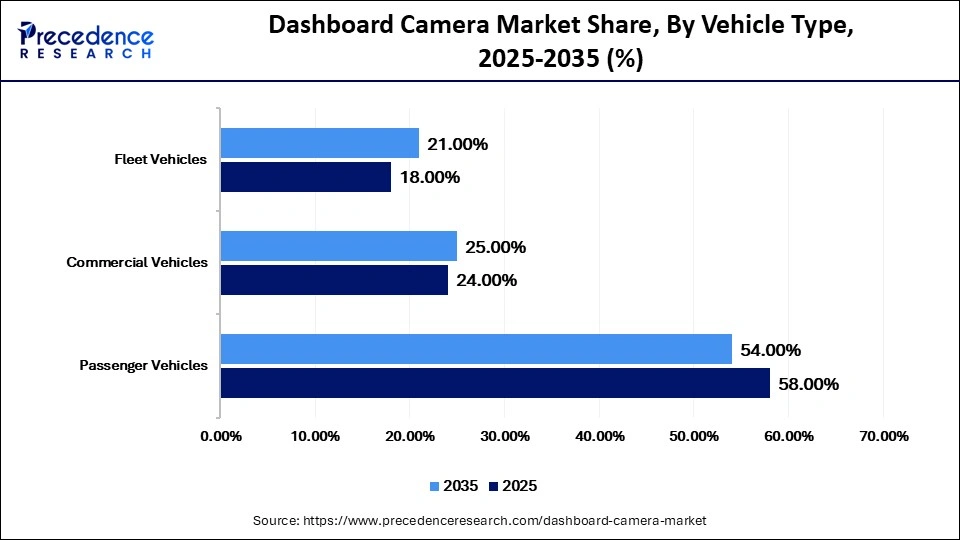
The commercial vehicles segment accounted for approximately USD 1.32 billion in 2025 and is projected to reach nearly USD 4.23 billion by 2035, growing at a CAGR of 13.5% during the forecast period. The commercial vehicles segment held a 24% share of the market in 2025, driven by growing mobility segments of freight transport, industrial logistics, and construction. Commercial vehicles are expected to have high long-term adoption of surveillance technology with rising investments in connected freight networks and AI-powered transportation intelligence platforms.
The fleet vehicles segment generated approximately USD 990 million in 2025 and is projected to reach nearly USD 3.17 billion by 2035 at the fastest CAGR of 16% during the forecast period. The fleet vehicles segment held a 18% share in 2025, due to growing use of dashcams in fleet in ride-hailing, urban delivery, and enterprise mobility. Large transportation fleets are turning to dashboard camera systems that are enhanced by AI technologies. This enables real-time video intelligence that helps optimize routes, create driver accountability, and enhance passenger safety.
Distribution Channel Insights
Dashboard Camera Market Share, By Distribution Channel, 2025-2035 (%)
| Distribution Channel | 2025 | 2035 | CAGR (%) |
| OEM | 32.00% | 38.00% | 15.00% |
| Aftermarket | 68.00% | 62.00% | 11.00% |
The Aftermarket Segment Dominated the Market with 68% of Market Share in 2025
The aftermarket segment generated approximately USD 3.74 billion in 2025 and is projected to reach nearly USD 10.93 billion by 2035, growing at a CAGR of 11% during the forecast period. The aftermarket segment dominated the dashboard camera market with a share of 68% in 2025, as consumers prefer aftermarket options, as this provides the necessary technology for an affordable upgrade. The adoption of dashboard cameras in the automotive after-market environment is rising and continues to increase at an accelerated pace as the need for customized electronics and connected mobility accessories grows.
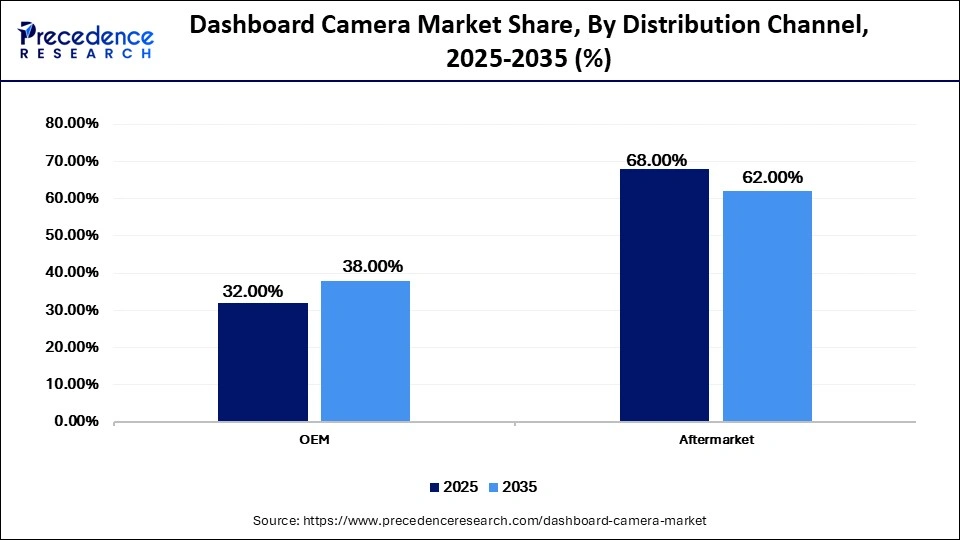
The OEM segment accounted for approximately USD 1.76 billion in 2025 and is projected to reach nearly USD 6.70 billion by 2035 at the highest CAGR of 15% during the forecast period. The OEM segment held a 32% share of the market in 2025, owing to the demand for connected safety architectures produced by the factory and for smart vehicle platforms, which are increasing. In 2025, mobility technology providers such as Magna International and Valeo continued to implement the vision technologies needed for both the workstation and mobility aspects of intelligent vehicles.
Application Insights
The Accident Recording Segment Dominated the Market with 34% of Market Share in 2025
The accident recording segment generated approximately USD 1.87 billion in 2025 and is projected to reach nearly USD 5.99 billion by 2035, growing at a CAGR of 12.5% during the forecast period. The accident recording segment dominated the dashboard camera market with a share of 34% in 2025, due to expanding legal reliance on digital driving evidence and increasing consumer awareness regarding vehicle accountability systems. Insurance services and legal providers are increasingly promoting intelligent recording systems that enable the accurate documentation of collisions.
The fleet management segment accounted for approximately USD 1.10 billion in 2025 and is projected to reach nearly USD 3.53 billion by 2035, growing at a CAGR of 16.5% during the forecast period. The fleet management segment contributed 20% to the market in 2025, supported by rising digitization across logistics and enterprise mobility infrastructure. This continues accelerating dashboard camera deployment within fleet management ecosystems.
The driver monitoring segment generated approximately USD 990 million in 2025 and is projected to reach nearly USD 2.82 billion by 2035, growing at a CAGR of 15.5% during the forecast period. The driver monitoring segment held a 18% share of the market in 2025, driven by increasing focus on transportation safety intelligence and systems for reducing behavior risk through AI. This helps to drive projected accelerated long-term deployments of driver monitoring applications. The functions of driver monitoring systems are expanding to include facial recognition analytics, adaptive alert systems, emotion detection technology, and real-time.
In May 2026, NTT DATA, a global AI and tech leader, announced a new brain health monitoring service that analyzes driving data with AI to generate a brain health score. Aiming to extend healthy lifespan and ensure driving safety, the service is available from April 2026. Kokusai Motorcars Co., Ltd. (km Taxi), a Japanese taxi operator, is the first to trial it.
The insurance telematics segment accounted for approximately USD 660 million in 2025 and is projected to reach nearly USD 2.47 billion by 2035, growing at a CAGR of 14% during the forecast period. The insurance telematics segment held a 12% share in 2025, due to the need for usage-based insurance for better ecosystems, which has continued to ramp up the adoption of dashboard cameras. Insurers are increasingly mobilizing new technology, such as data recorders in the vehicle's dashboard, that help prevent fraud and manage digital evidence in auto insurance.
Regional Insights
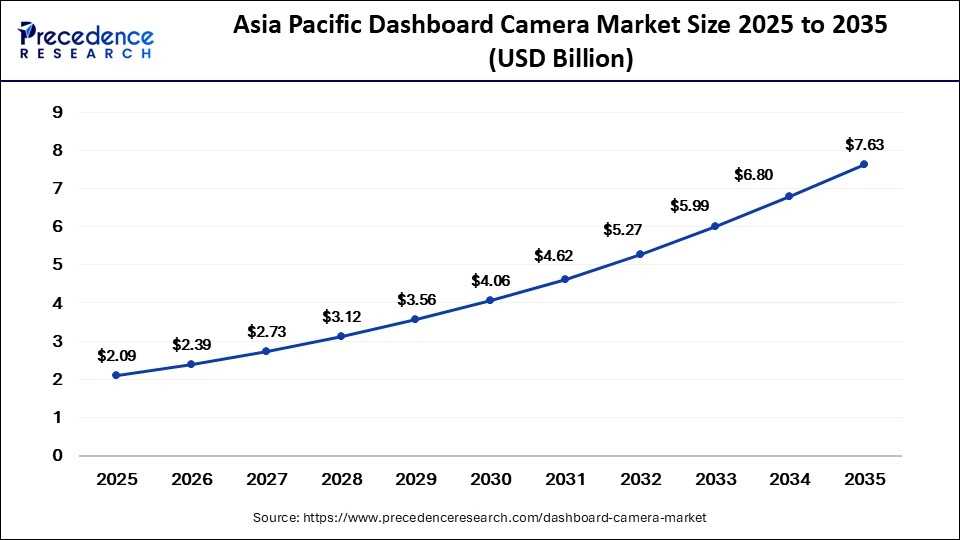
Asia Pacific Dashboard Camera Market Size and Growth 2026 to 2035
The Asia Pacific dashboard camera market size was exhibited at USD 2.09 billion in 2025 and is projected to be worth around USD 7.63 billion by 2035, growing at a CAGR of 14.50% from 2026 to 2035.
Which Factors Drive the Dashboard Camera Market in Asia-Pacific?
Asia-Pacific held a major market share of 38% in 2025 and is expected to experience the fastest growth with a CAGR of 14.5% during the predicted timeframe, due to the affordable prices of dashboard cameras in China, Japan, and South Korea. This strengthens the region's leadership position in both passenger and commercial vehicle markets.
Around 31 million vehicles were manufactured in China in 2025, as the China Association of Automobile Manufacturers (CAAM) reported, highlighting the integration of intelligent recording technology within connected mobility ecosystems.
India Becoming a High-Growth Dashboard Camera Hub Across the Asia-Pacific
India leads the market due to its enhanced road safety concerns and the growing all-in-one trend of connected mobility. This is driving the continued growth of India as one of the fastest-growing centers for dashboard camera adoption in the Asia-Pacific. The Society of Indian Automobile Manufacturers also said that passenger vehicle sales spiked past 4.3 million units in FY2025, with the rise of intelligent in-vehicle electronics and connected monitoring systems.
How is Europe Growing in the Dashboard Camera Market?
Europe held the second-largest market share of 27% in 2025 and is expected to show lucrative growth with a CAGR of 11.2% over the projected period. Supported by increased regulation on legal proof collection and driver accountability is being seen in commercial transportation fleets and continues to pick up speed in private cars. The use of intelligent mobility rules and connected transportation ecosystems is further driving confidence in long-term deployment of dash cameras in Europe.
United Kingdom Accelerating Dashboard Camera Adoption Across Europe
The UK is a major contributor to the market due to rising insurance telematics usage and increasing vehicle security awareness across the passenger and commercial transportation sectors. British consumers also put a high value on high-quality recording systems with the ability to monitor parking spaces, protect against theft, and capture emergency incidents.
Will North America Grow in the Dashboard Camera Market?
North America held a 20% share of the market in 2025 and is expected to grow at a 10.8% CAGR between 2026 and 2035, driven by growing market demand for dashboards with connected vehicle technology. The Federal Motor Carrier Safety Administration also increased its fleet safety programs to encourage the implementation of connected vehicle monitoring technology. Enterprise telematics infrastructure and intelligent mobility systems are undergoing fast growth, keeping the deployment of dashboard cameras in North America robust.
Canada Strengthening Connected Dashboard Camera Deployment Across North America
In Canada, the market is expected to grow in connected fleet operations and the investment in intelligent transportation technologies. Rising adoption of smart transportation infrastructure and connected mobility ecosystems continues to accelerate dashboard camera integration throughout Canada.
Dashboard Camera Market Value Chain Analysis
- Semiconductor & Imaging Sensor Supply
The foundation of dashboard camera production lies in the supply of image sensors, AI processors, memory chips, and connectivity semiconductors used in intelligent recording systems.
Key Players: Sony Semiconductor Solutions, OmniVision Technologies, Ambarella, Qualcomm, NXP Semiconductors.
- Dashboard Camera System Design & Manufacturing
Dashboard cameras are assembled with AI-enabled software, video processing technologies, night vision systems, and cloud connectivity capabilities under strict automotive quality standards.
Key Players: Garmin, Nextbase, BlackVue, Thinkware, DDPAI, 70mai.
- OEM Integration & Vehicle Installation
Dashboard camera systems are integrated into passenger vehicles, commercial fleets, and connected mobility platforms through OEM partnerships and factory-installed safety ecosystems.
Key Players: Toyota, Hyundai Motor Group, Tesla, Ford, General Motors, Stellantis.
- Distribution & Aftermarket Retail
Completed dashboard camera systems are distributed through automotive retailers, e-commerce platforms, fleet solution providers, and automotive accessory distribution networks.
Key Players: Amazon, Best Buy, Halfords, Alibaba, Pioneer Corporation.
Dashboard Camera Market Companies
- Garmin Ltd.
- Nextbase
- Thinkware
- BlackVue
- 70mai
- Panasonic Corporation
- DOD Tech
- Cobra Electronics
- Pittasoft Co., Ltd.
- Vantrue
- VIOFO
- Kenwood Corporation
- Mio Technology
- Azdome
- Rexing Inc.
Recent Developments
- In May 2026, Geotab introduced the GO Focus Plus AI dash cam and video intelligence platform in Indonesia to enhance fleet safety and risk management. The launch expands access to advanced AI telematics to help fleets proactively reduce risk, improve driver safety, and enhance operational resilience.(Source: https://www.prnewswire.com)
- In April 2026, Redtiger launched the F7NA 4K dual dash cam with upgraded features and expanded storage support for modern drivers. The F7N series is equipped with a 4K front camera, 1080p rear camera, and Sony STARVIS 2 low light-vision sensor.(Source: https://www.prnewswire.com)
- In April 2026, DDPAI hosted its Vision Experience in Istanbul, showcasing its latest intelligent imaging and dash cam innovations. The newly launched Z-series of DDPAI delivers dual 4K front and rear recording, combined with a 3K interior camera.(Source: https://www.globenewswire.com)
Segments Covered in the Report
By Product Type
- Basic Dashboard Cameras
- Advanced Dashboard Cameras
- GPS-enabled
- ADAS-enabled
- AI-powered Dashcams
- Dual-channel Dashboard Cameras
- Rear-view Dashboard Cameras
By Technology
- HD Dashcams
- Full HD Dashcams
- 4K Dashcams
- Night Vision Dashcams
- Wi-Fi & Cloud-connected Dashcams
By Vehicle Type
- Passenger Vehicles
- Commercial Vehicles
- Fleet Vehicles
By Distribution Channel
- OEM
- Aftermarket
- Online Retail
- Offline Retail
By Application
- Accident Recording
- Driver Monitoring
- Insurance Telematics
- Fleet Management
- Parking Surveillanc
- Security & Theft Protection
By End-use
- Individual Consumers
- Commercial Fleet Operators
- Ride-sharing & Taxi Services
- Government & Law Enforcement
By Region
- North America
- Latin America
- Europe
- Asia-pacific
- Middle and East Africa
For inquiries regarding discounts, bulk purchases, or customization requests, please contact us at sales@precedenceresearch.com
Frequently Asked Questions
Tags





Ask For Sample
No cookie-cutter, only authentic analysis – take the 1st step to become a Precedence Research client
 Get a Sample




 sales@precedenceresearch.com
 Schedule a Meeting
