



Data Center Cable Market Trends, Companies, Revenue / Sales Performance, Subscriber Growth, Pricing Strategies, Cloud Adoption, Infrastructure Expansion, Competitive Landscape, and Industry Outlook
ICT industry specialist Shivani Zoting estimates the data center cable market at USD 15.15 billion in 2026, with continued technology adoption expected to take the market to USD 37.52 billion by 2035 at a CAGR of 10.60%. Leading data center cable market providers such as Amphenol Corporation, Belden Inc., CommScope Holding Company, Inc., Corning Incorporated are expanding their capabilities across segments including By Cable Type, By Application, By Data Center Type, By End-Use Industry.
Source: https://www.precedenceresearch.com/data-center-cable-market
 Get a Sample
 Table Of Content


What is the Data Center Cable Market Size in 2026?
The global data center cable market size accounted for USD 13.70 billion in 2025 and is predicted to increase from USD 15.15 billion in 2026 to approximately USD 37.52 billion by 2035, expanding at a CAGR of 10.60% from 2026 to 2035. The market growth is attributed to the rapid expansion of hyperscale data centers and rising demand for high-speed, low-latency connectivity infrastructure.

Key Takeaways
- North America dominated the market with a 38% share in 2025.
- Asia Pacific is expected to grow at the fastest CAGR of 13% between 2026 and 2035.
- By cable type, the fiber optic cables segment held the highest market share of 45% in 2025.
- By cable type, the copper cables segment held the second-largest market share of 30% in 2025 and is expected to grow at a CAGR of 7% between 2026 and 2035.
- By application, the server-to-switch connectivity segment held a major market share of 35% in 2025.
- By application, the data center interconnect (DCI) segment is expected to grow at the fastest CAGR of 14.5% during the projection period.
- By data center type, the hyperscale data centers segment contributed the highest market share of 40% in 2025.
- By data center type, the edge data centers segment is estimated to grow at the fastest CAGR of 15% over the projection period.
- By end-use industry, the IT & cloud services providers segment contributed the highest market share of 45% in 2025.
- By end-use industry, the telecommunications segment held a 15% share of the market in 2025 and is expected to grow at a CAGR of 10% between 2026 and 2035.
Market Overview
Rising adoption of hyperscale data centers across industries and increasing AI investments are strongly driving the growth of the data center cable market. Cables in data centers link servers, storage systems, switches, and power units to ensure high-speed operations without interruption. This technology has fiber optic cables, copper cables, and organized dense connectivity systems. Long-distance network transmission is facilitated by fiber cables, whereas short-range networking within facilities is done efficiently by copper cables. The International Energy Agency reports that the worldwide demand for data centers can increase more than twofold by 2030. Furthermore, the demand for AI computing and the expansion of cloud networks drive the market.
Impact of Artificial Intelligence on the Data Center Cable Market
Artificial intelligence is creating strong growth opportunities for the data center cable market by increasing demand for faster, denser, and more reliable connectivity infrastructure. AI workloads require high-volume data transfer between GPUs, storage systems, and network switches, boosting demand for high-speed fiber optic and advanced copper cabling solutions. This shift is accelerating the adoption of next-generation network architectures such as 400G, 800G, and beyond to support AI-driven data center performance.
Major Market Trends
- Expansion of Hyperscale Data Centers: The rapid global buildout of hyperscale campuses is significantly increasing demand for high-density fiber and copper cabling systems to support large-scale computing environments. These facilities require robust and scalable connectivity infrastructure to handle massive data traffic and ensure uninterrupted operations.
- Growing AI and Machine Learning Workloads: The rise of AI and machine learning workloads is driving the need for ultra-low latency and high-bandwidth cable infrastructure across cloud and enterprise data centers. As AI training clusters expand, operators are investing in advanced cabling solutions to support faster data transfer and improved network performance.
Market Scope
| Report Coverage | Details |
| Market Size in 2025 | USD 13.70 Billion |
| Market Size in 2026 | USD 15.15 Billion |
| Market Size by 2035 | USD 37.52 Billion |
| Market Growth Rate from 2026 to 2035 | CAGR of 10.60% |
| Dominating Region | North America |
| Fastest Growing Region | Asia Pacific |
| Base Year | 2025 |
| Forecast Period | 2026 to 2035 |
| Segments Covered | Cable Type, Application, Data Center Type, End-Use Industry, and Region |
| Regions Covered | North America, Europe, Asia-Pacific, Latin America, and Middle East & Africa |
Market Dynamics
Drivers
Growing Hyperscale Cloud Infrastructure
The growing hyperscale cloud infrastructure is driving the growth of the data center cable market. Cloud vendors around the world are building multi-megawatt campuses that require extensive fiber backbones and structured connectivity systems. Thousands of cable links are utilized in each new facility across servers, switches, storage arrays, and power systems. Increasing cloud traffic is also driving continuous upgrades and replacement demand in existing data centers.
Restraint
Raw Material Price Volatility
Volatility in the prices of raw materials hampers the market growth. Materials like copper, aluminum, specialty polymers, and optical glasses are subject to price fluctuations that are dependent on mining supply. This creates cost uncertainty for manufacturers. Long procurement cycles in hyperscale projects and ongoing supply chain disruptions further complicate pricing stability and project planning.
Opportunity
Transition to 400G and 800G Networks
The accelerating shift toward 400G, 800G, and next-generation network architectures presents a strong growth opportunity for the market. Legacy cabling systems often fail to meet modern bandwidth and latency requirements. This encourages enterprises to upgrade to high-performance fiber and advanced copper solutions, while colocation data center expansion further boosts structured cabling demand.
Segment Insights
Cable Type Insights
Data Center Cable Market Share, By Cable Type, 2025-2035 (%)
| Cable Type | 2025 | 2035 | CAGR (%) |
| Fiber Optic Cables | 45.00% | 50.00% | 13.50% |
| Copper Cables | 30.00% | 25.00% | 7.00% |
| Active Optical Cables (AOC) | 15.00% | 15.00% | 10.50% |
| Direct Attach Cables (DAC) | 10.00% | 10.00% | 9.50% |
The Fiber Optic Cables Segment Held a 45% Market Share in 2025
The fiber optic cables segment dominated the data center cable market with a share of 45% in 2025, due to their widespread adoption in spine-leaf architecture, hyperscale campuses, and AI clusters handling massive traffic. These cables are used in long transmission networks due to their minimal signal loss, constant latency, and high bandwidth. The demand for these cables is growing at an incredible pace due to the transition toward 400G, 800G, and future 1.6T switching networks.
The copper cables segment held a 30% share of the market in 2025 and is expected to grow at a CAGR of 7% between 2026 and 2035, owing to their widespread use in enterprise data centers and legacy systems. Copper cables are the preferred choice due to their established reliability and ease of installation. Additionally, copper cables are essential for power distribution between racks and other infrastructure, further driving their demand in the market.
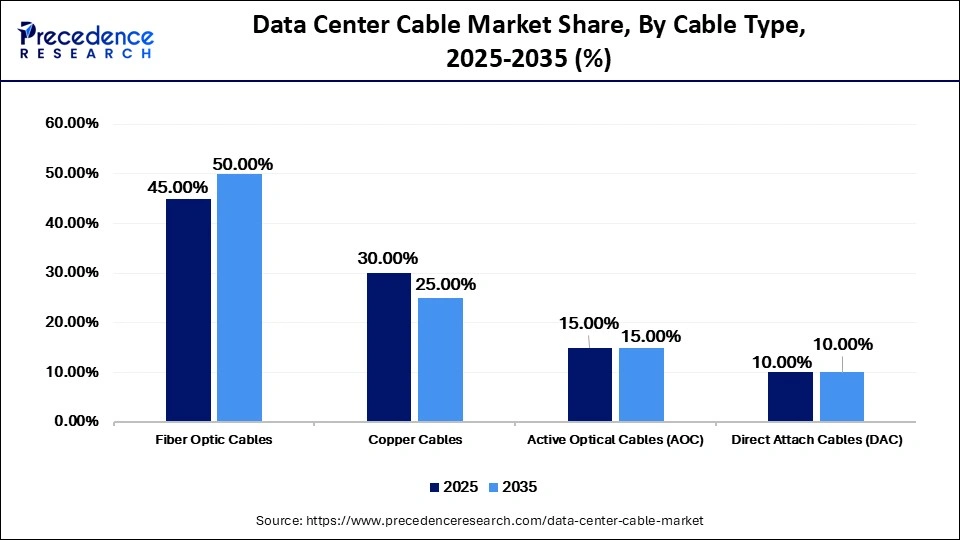
The active optical cables (AOC) segment held a 15% share of the market in 2025 and is expected to grow at a 10.5% CAGR during the projection period. This growth is largely driven by the increasing demand for modular infrastructure that reduces setup complexity. AOCs combine optical fiber and integrated transceivers into compact, deployable assemblies, making them ideal for high-speed switch-to-server and switch-to-switch (S2S) connections, offering a lighter and more efficient cabling solution.
The direct attach cables (DAC) segment held a 10% market share in 2025 and is estimated to grow at a strong CAGR of 9.5% over the projected period. This is because they offer a cost-effective alternative to transceivers, making them a preferred choice for many enterprise and colocation data centers, especially during scaling programs. Their low cost and simplicity in procurement make them an attractive option for organizations looking to optimize their cable infrastructure.
Application Insights
The Server-to-Switch Connectivity Segment Dominated the Market in 2025
The server-to-switch connectivity segment dominated the data center cable market with a share of 35% in 2025. This is because all servers require a direct network uplink, with compute nodes placed in each rack and connected to top-of-rack switches via short, high-speed cable runs. The increasing demand for AI servers and GPU clusters, which add more ports, is driving the need for DACs, AOCs, Cat6A cables, and short fiber connections.
The switch-to-switch connectivity segment held a 25% share of the market in 2025 and is expected to grow at a CAGR of 10% between 2026 and 2035. This is mainly due to the increasing demand for high-speed, low-latency connections that support the high-volume traffic between switches within modern data centers. As data centers scale to accommodate 400G and 800G networks, these connections require advanced cabling solutions like low-loss fiber trunks and precision connectors to ensure efficient data flow and network performance.
Data Center Cable Market Share, By Application, 2025-2035 (%)
| Application | 2025 | 2035 | CAGR (%) |
| Server-to-Switch Connectivity | 35.00% | 33.00% | 10.50% |
| Switch-to-Switch Connectivity | 25.00% | 24.00% | 10.00% |
| Data Center Interconnect (DCI) | 20.00% | 25.00% | 14.50% |
| Storage Area Networks (SAN) | 20.00% | 18.00% | 9.50% |
The data center interconnect (DCI) segment held a 20% market share in 2025 and is expected to grow at the fastest CAGR of 14.5% between 2026 and 2035. The segment growth is driven by the increasing need for high-capacity, long-distance fiber connections to support data replication, workload balancing, and disaster recovery across multiple data center campuses. As businesses expand their digital infrastructure, the demand for robust, high-speed interconnects to link geographically dispersed data centers is driving the adoption of advanced cabling solutions.
The storage area networks (SAN) segment held a 20% market share in 2025 and is estimated to grow at a CAGR of 9.5% over the projected period. This is mainly due to the increasing reliance on centralized data storage and high-performance connectivity in enterprises. As businesses handle larger volumes of data, the demand for low-latency, high-throughput cabling solutions to connect servers with storage arrays is driving the adoption of specialized cabling in SAN infrastructures.
Data Center Type Insights
Why Did the Hyperscale Data Centers Segment Lead the Market in 2025?
The hyperscale data centers segment dominated the data center cable market with a share of 40% in 2025, owing to their massive scale and increasing demand for high-density fiber and copper cabling systems to support large-scale cloud services, AI workloads, and data processing. Their extensive infrastructure requirements, coupled with the rapid growth in data consumption and the need for efficient, scalable solutions, drove the adoption of advanced cabling systems to ensure high-speed, low-latency connectivity across multiple servers and storage systems. According to a report, in 2025, the global hyperscale operators exceeded 1,100+ large data center sites worldwide, significantly boosting the demand for data center cables.
The colocation data centers segment held a 30% share of the market in 2025 and is expected to grow at a significant CAGR of 10% between 2026 and 2035, driven by the preference of enterprises for the outsourced infrastructure model. The presence of colocation facilities consequently maintains a steady level of demand for fiber and copper cabling solutions due to their reliability.
Data Center Cable Market Share, By Data Center Type, 2025-2035 (%)
| Data Center Type | 2025 | 2035 | CAGR (%) |
| Hyperscale Data Centers | 40.00% | 45.00% | 14.00% |
| Colocation Data Centers | 30.00% | 27.00% | 10.00% |
| Enterprise Data Centers | 20.00% | 15.00% | 8.00% |
| Edge Data Centers | 10.00% | 13.00% | 15.00% |
The enterprise data centers segment held a 20% market share in 2025 and is expected to grow at a 8% CAGR during the forecast period, driven by the need for privacy and data security in sensitive industries such as banking, government, manufacturing, and healthcare. These sectors prefer maintaining their own data centers to ensure control over critical data, which leads to ongoing demand for structured cabling for server rooms, storage areas, back-ups, and internal network enhancements.
The edge data centers segment held a 10% share of the market in 2025 and is estimated to grow at the fastest CAGR of 15% during the projection period. This growth is fueled by the increasing need for low-latency processing and rapid data access, especially in industries such as telecommunications, smart factories, and content distribution. Edge data centers bring computing power closer to end users, reducing latency and improving performance, which drives the demand for rugged fiber links, compact patching systems, and efficient cabling solutions.
End-Use Industry Insights
IT & Cloud Service Providers Led the Market With a 45% Share in 2025
The IT & cloud service providers segment dominated the data center cable market with a share of 45% in 2025 due to their strong leadership in the continuous growth of digital infrastructure. Hyperscale operators manage vast collections of servers, which require extensive systems of fiber backbones, copper links, and high-density switching systems. The strong purchasing power of IT and cloud service providers also makes them major buyers of advanced connectivity solutions, further driving market growth.
The telecommunications segment held a 15% share of the market in 2025 and is expected to grow at a CAGR of 10% between 2026 and 2035, driven by the rise in mobile data traffic and the growing need for low-latency services. The expansion of mobile broadband and the increasing internal traffic within telecom facilities are expected to significantly increase the demand for stable data center infrastructure and related cables.
The BFSI segment held a 25% share of the market in 2025 and is expected to grow at a 9.5% CAGR during the projection period. This growth is primarily driven by the increasing demand for secure, high-performance data infrastructure to facilitate digital banking and support the growing workloads and data security needs within the sector.
The government & defense segment held a 10% market share in 2025 and is estimated to grow at a strong CAGR of 11% over the projected period. This is mainly due to the rising demand for secure hosting and resilient analytics systems, especially as digital sovereignty and military modernization agendas continue to rise globally.
The healthcare & life science segment held a 8% share of the market in 2025 and is expected to grow at a significant CAGR of 12% between 2026 and 2035. This is mainly due to the increasing need for reliable, low-latency interconnections among diagnostic, storage, and computing systems in healthcare facilities. This significantly fuels the demand for advanced data center cables in the sector.
Regional Insights
North America Data Center Cable Market Size and Growth 2026 to 2035
The North America data center cable market size is estimated at USD 5.21 billion in 2025 and is projected to reach approximately USD 14.45 billion by 2035, with a 13.99% CAGR from 2026 to 2035.
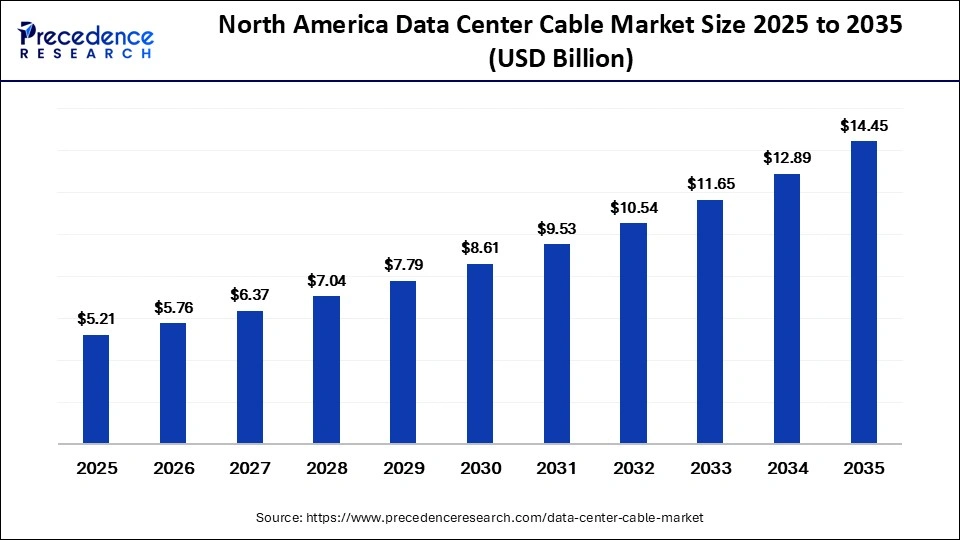
North America Dominated the Market With a 38% Share in 2025
North America led the data center cable market, capturing the largest revenue share of 38% in 2025. This dominance is primarily driven by high spending on digital infrastructure. Major players continue to invest in AI computing regions, enterprise colocation hubs, and cloud availability zones across the U.S., boosting demand for fiber trunks, copper assemblies, and high-density patching systems. As operators upgrade their systems, the shift towards 400G and 800G networks accelerates the replacement of old cabling infrastructure, further fueling market growth.
U.S. Data Center Cable Market Size and Growth 2026 to 2035
The U.S. data center cable market size is calculated at USD 3.90 billion in 2025 and is expected to reach nearly USD 10.91 billion in 2035, accelerating at a strong CAGR of 10.83% between 2026 and 2035.
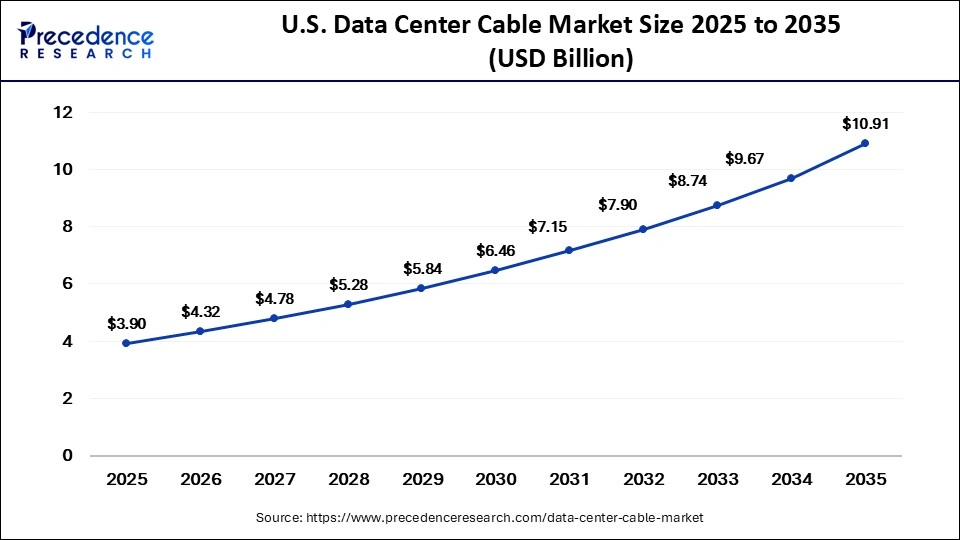
U.S Data Center Cable Market Trends
The U.S. leads the North American market due to the concentration of hyperscale data centers, with global giants like Amazon Web Services, Microsoft, Google, and Meta making significant investments in regions like Virginia, Texas, Arizona, and Ohio. These investments are driving an increased need for advanced connectivity solutions, contributing to the expansion of the data center cable market as the demand for high-performance infrastructure grows.
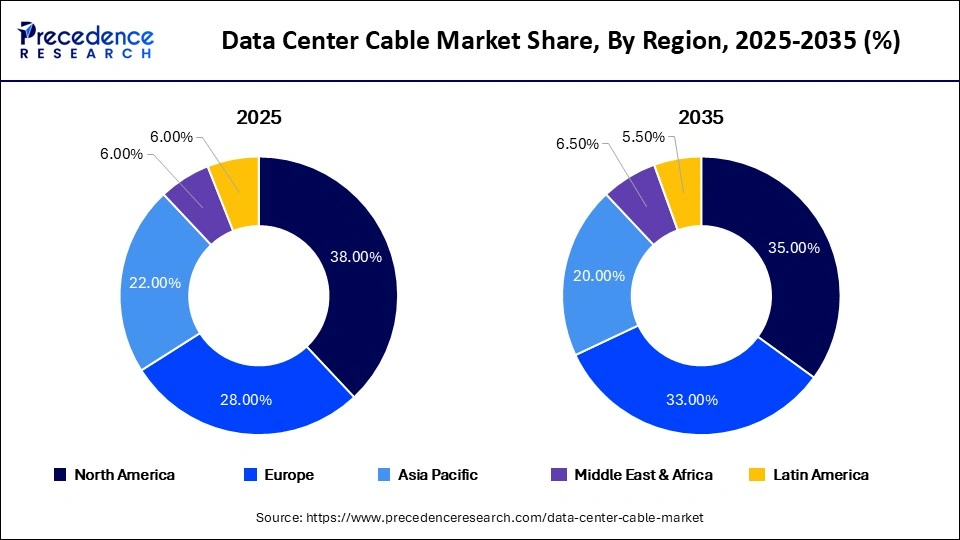
Asia Pacific: The Fastest-Growing Region
Asia Pacific held the second-largest market share of 28% in 2025 and is estimated to grow at the fastest CAGR of 13% over the projected period. The region's rapid growth is attributed to rising e-commerce traffic, mobile data usage, and enterprise cloud migration. As data centers expand under efficiency-focused frameworks, operators require high-capacity fiber backbones, copper patching, and modular cable systems, driving increased demand for data center cables in the region.
India Data Center Cable Market Trends
India is a major contributor to the market within Asia Pacific, owing to fast digitalization and significant investments in cloud-based infrastructure. Cities like Mumbai, Chennai, Hyderabad, Pune, and Noida are seeing the development of large data centers, with India's metro capacity reaching 1 GW in 2025. This expansion is creating substantial demand for fiber backbones and copper interconnection systems to support the growing data infrastructure.
How is the Opportunistic Rise of Europe in the Data Center Cable Market?
Europe held a 22% share of the market in 2025 and is expected to grow at a 9% CAGR between 2026 and 2035, driven by the expansion of connectivity ecosystems. Operators in the region are investing in secure campuses for enterprise hosting, cloud services, and financial workloads, which require specialized data center cables. Additionally, demand for fire-rated assemblies, low-smoke, zero-halogen cables, and effective pathway systems is growing as data centers focus on meeting stringent safety standards.
Germany Data Center Cable Market Trends
In Germany, the market is expanding due to a strong demand for enterprise digitalization, industrial automation, and secure local hosting is propelling the market. Cities like Frankfurt are becoming major hubs for mega colocation and cloud campuses, requiring increased investment in structured cabling and low-loss fiber systems to meet the region's growing data connectivity needs.
Data Center Cable Market Value Chain Analysis
- Raw Material Sourcing
Copper, aluminum, silica, and polymer compounds form the base materials that determine conductivity, durability, and optical performance in data center cables.
Key Players: Freeport-McMoRan, Rio Tinto, BHP Group, Sumitomo Metal Mining, BASF, Dow.
- Cable & Fiber Manufacturing
Manufacturers convert refined metals and glass into fiber optic cables, copper cables, DACs, and AOCs using precision extrusion and optical engineering processes.
Key Players: Corning Incorporated, Prysmian Group, Nexans, Furukawa Electric, Fujikura, LS Cable & System.
- Connectivity Component Integration
Cables are assembled with connectors, transceivers, patch panels, and structured cabling accessories to enable high-density, high-speed data center networking.
Key Players: CommScope, Belden, Panduit, Leviton, Amphenol, TE Connectivity.
- Distribution & Data Center Deployment
Finished systems move through distributors and integrators into hyperscale, colocation, and enterprise data centers for installation, upgrades, and lifecycle maintenance.
Key Players: Equinix, Digital Realty, NTT Global Data Centers, Vantage Data Centers, AWS, Microsoft.
Data Center Cable Market Companies
- Amphenol Corporation
- Belden Inc.
- CommScope Holding Company, Inc.
- Corning Incorporated
- Furukawa Electric Co., Ltd.
- Legrand SA
- LS Cable & System Ltd.
- Nexans S.A.
- Panduit Corp.
- Prysmian Group
- R&M (Reichle & De-Massari AG)
- Schneider Electric SE
- Siemon Company
- Sumitomo Electric Industries, Ltd.
- TE Connectivity Ltd.
Recent Developments
- In March 2026, STL launched India's first Hollow Core Fibre cable designed to support ultra-low latency and high bandwidth requirements in hyperscale data center networks.(Source: https://finance.yahoo.com)
- In March 2026, Mediatek microsoft and partners developed a microLED-based active optical cable for efficient data center transmission 2026. Researchers introduced a MicroLED-powered Active Optical Cable that improves energy efficiency and supports longer reach with high reliability in data center environments.(Source: https://www.prnewswire.com)
- In April 2026, STL launched Neuralis at Data Center World 2026 as a connectivity suite designed for AI workloads, hyperscale computing, and next-generation edge data infrastructure.(Source: https://www.engineering.com)
Segments Covered in the Report
By Cable Type
- Fiber Optic Cables (Single-mode, Multi-mode)
- Copper Cables (Twisted Pair, Coaxial)
- Active Optical Cables (AOC)
- Direct Attach Cables (DAC)
By Application
- Server-to-Switch Connectivity
- Switch-to-Switch Connectivity
- Storage Area Networks (SAN)
- Data Center Interconnect (DCI)
By Data Center Type
- Hyperscale Data Centers
- Colocation Data Centers
- Enterprise Data Centers
- Edge Data Centers
By End-Use Industry
- IT & Cloud Service Providers
- Telecommunications
- BFSI (Banking, Financial Services, Insurance)
- Healthcare & Life Sciences
- Government & Defense
- Retail & E-commerce
- Media & Entertainment
By Region
- North America
- Latin America
- Europe
- Asia-pacific
- Middle and East Africa
For inquiries regarding discounts, bulk purchases, or customization requests, please contact us at sales@precedenceresearch.com
Frequently Asked Questions





Ask For Sample
No cookie-cutter, only authentic analysis – take the 1st step to become a Precedence Research client
 Get a Sample




 sales@precedenceresearch.com
 Schedule a Meeting
