



Digital Laboratory Market Size, Key Companies, Company Market Share, Technology Adoption, Software and Hardware Demand, Regulatory Compliance, Competitive Positioning, and Growth Forecast
Digital Laboratory Market (By Application: Life Sciences, Pharmaceuticals, Pathology, Others; By Type: Software Solutions, Hardware Solutions) - Global Industry Analysis, Size, Trends, Leading Companies, Regional Outlook, and Forecast 2026 to 2035
Source: https://www.precedenceresearch.com/digital-laboratory-market
 Get a Sample
 Table Of Content
What is the Digital Laboratory Market Size?
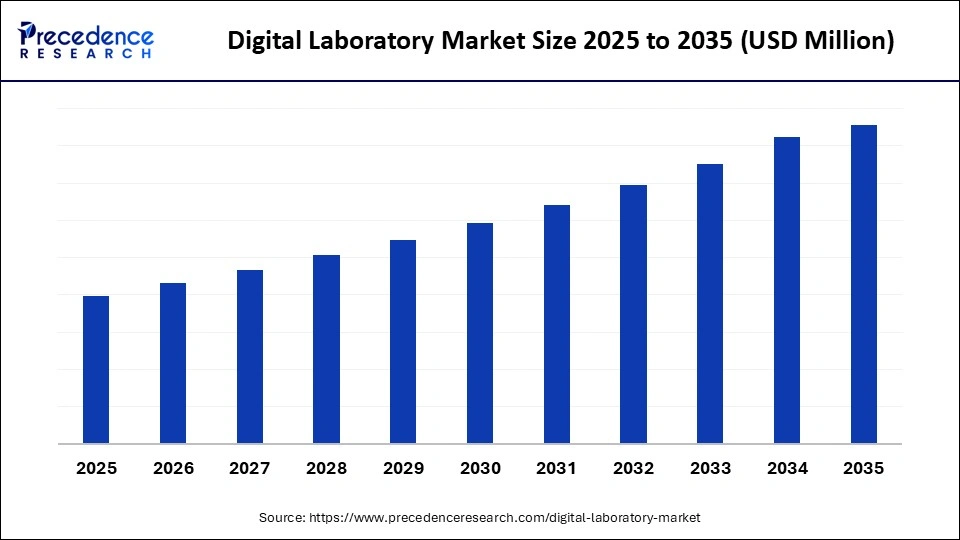
The global digital laboratory market refers to the adoption of digital technologies such as AI, cloud computing, laboratory information management systems (LIMS), and automation to modernize lab operations. The market is driven by automation, data integrity, and fragmented systems unified by platforms that integrate the systems across the globe in this market to always boost its high demand.
Market Highlights
- North America dominated the global market, holding the biggest market share in 2025.
- The Asia Pacific is expected to grow at a significant CAGR from 2026 to 2035.
- By application type, the life science segment led the market 2024.
- By application type, the pharmaceuticals segment is expected to grow at a notable CAGR from 202 6to 2035.
- By type, the software segment contributed the largest market share in 2025.
- By type, the hardware segment is growing at a significant CAGR from 202 6to 2035.
What is the Digital Laboratory Market?
The digital laboratory market is stepping up the ladder, driven by advanced automation techniques that are simplifying complex laboratory operations and reducing manual intervention. If closely observed, digital lab management systems are entering a phase where automation, data integrity, and real-time decision support are no longer optional but foundational capabilities. Digital laboratories are now central to operations across healthcare, biotechnology, chemicals, and advanced materials, as organizations move away from fragmented, patchwork systems toward integrated platforms that unify instruments, workflows, and compliance records with high accuracy.
Growing pressure to shorten R&D cycles is pushing laboratories to adopt digital tools that minimize human error, improve reproducibility, and enable faster experimentation, while cloud-native platforms and modular architectures are expanding access for both large enterprises and smaller research entities. The integration of AI-driven analytics and machine learning is further enhancing experimental design, data interpretation, and anomaly detection within digital laboratory environments. Increased regulatory scrutiny around data traceability and audit readiness is also accelerating adoption of systems that provide end-to-end visibility and secure data governance. In addition, remote collaboration capabilities are enabling distributed research teams to access laboratory data and control workflows in real time, supporting globalized R&D models.
Key Technological Shifts in the Digital Laboratory Market
The technological shift in the digital labs signifies the most vital shift, towards a cloud-based system that is distributed across the globe, making manual efforts less and robots on their toes more. These deployments are making the laboratories globally accessible and enabling the distributed teams to collaborate without compromising security. Instrument is also evolving, with next-generation systems supporting IoT-enabled lab equipment that streams live data into an integrated dashboard. The low-code and no-code arrangement has enabled scientists (non-IT) to enable a seamless workflow, providing repetitive automotive tasks.
Key Market Trends in the Digital Laboratory Market
- End-to-end encryption ensures that all data, ranging from sample tracking to compliance documentation, resides within a centralized system, safeguarding it from unauthorized access. A practical illustration of this can be seen in messaging applications like WhatsApp, which prominently display notifications about their end-to-end encryption protocols, confirming that only the intended recipients can access the transmitted information.
- Data democratization, with platforms offering intuitive dashboards so that non-technical users can interpret complex results without learning advanced analytics.
Digital Laboratory Market Outlook
- Industry Outlook: The digital laboratory market is set to experience significant growth from 2025 to 2034, driven by automation, which reduces the manual workflow for humans, promoting repetitive automation. Providing a streamlined workflow process integrates many digital tools, amalgamating the management workflows, data analysis, and resource ordering.
- Sustainability Trend: Factors driving sustainability in digital laboratories encompass environmental issues, the expectations of stakeholders, economic advantages, and the progress of technology itself. Major initiatives focus on utilizing digital tools to minimize resource usage, adopting more environmentally friendly chemicals and processes, and harnessing data and e-procurement for improved efficiency and waste minimization.
- Major Investment: A recent report indicates that two prominent investment firms, Thermo Fisher Scientific and Agilent Technologies, are significantly channeling resources into infrastructure development and the enhancement of information technology tools. These companies are focused on delivering innovative solutions for digital laboratories, thereby advancing the integration of technology in scientific research and laboratory operations.
Market Scope
| Report Coverage | Details |
| Dominating Region | North America |
| Fastest Growing Region | Asia Pacific |
| Base Year | 2025 |
| Forecast Period | 2026 to 2035 |
| Segments Covered | Application, Type, and Region |
| Regions Covered | North America, Europe, Asia-Pacific, Latin America, and Middle East & Africa |
Segment Insights
Application insights
Why Did Life Sciences Dominate the Digital Laboratory Market?
The life sciences segment dominates the digital laboratory market due to the focus of life sciences, as these are the labs that process a tremendously high quantity of experimental data requiring absolute accuracy and traceability. In most cases, research teams operate in a cross-disciplinary manner in genomics, proteomics, and molecular biology; thus, centralized data management becomes a necessity. Scientists employ digital platforms to record experiments in real time, to mechanize their workflows, and to lessen the possibility of manual errors. Given the rising collaboration among research groups worldwide, life science laboratories are becoming dependent on digital systems to ensure that the data sharing is done securely. Besides, these instruments facilitate the establishment of strict audit trails, which are necessary in regulated research environments. In short, the need for reproducible, top-quality science is what keeps life science labs leading the way in digital transformation.
The pharmaceutical companies are the fastest growing in the digital laboratory market, followed by the focus of life sciences, as these are the labs that process a tremendously high quantity of experimental data requiring absolute accuracy and traceability. In most cases, research teams operate in a cross-disciplinary manner in genomics, proteomics, and molecular biology; thus, centralized data management becomes a necessity. Scientists employ digital platforms to record experiments in real time, to mechanize their workflows, and to lessen the possibility of manual errors. Given the rising collaboration among research groups worldwide, life science laboratories are becoming dependent on digital systems to ensure that data sharing is done securely. Besides, these instruments facilitate the establishment of strict audit trails, which are necessary in regulated research environments. In short, the need for reproducible, top-quality science is what keeps life science labs leading the way in digital transformation.
Types Insights
Why Are Software Solutions Dominating the Digital Laboratory Market?
The software solutions are dominating the digital laboratory market, due to the single unit, software is still the main factor behind digital lab management. Current laboratories cannot work without a platform that automates operations, implements audit trails, and supports real-time collaboration. The increasing complexity of experiments resulting in large datasets leaves software as the only dependable way to store, analyze, and retrieve data instantly. It is also the software's feature that it can be cloud-based or on-premises that makes it possible for research labs of different sizes to accommodate their needs with no effort.
The hardware solution is the fastest-growing in the digital laboratory market, due to smart instruments, IoT-enabled sensors, and automated workstations that can be directly integrated with digital software platforms, hardware is becoming the fastest-growing segment. Such sophisticated devices are intended to alleviate the workload of the lab staff, to eliminate the risks of contamination, and to enhance the speed of the workflow. Technology is moving fast, and so hardware automation for high-throughput experimentation has already gone from being a luxury to a necessity.
Regional Insights
Why Does North America Continue to Dominate the Digital Laboratory Market?
North America is dominating the digital laboratory market due to its well-established scientific ecosystem and strong adoption readiness across research and regulated industries. Laboratories operating in biotechnology, pharmaceuticals, clinical diagnostics, and academic research are increasingly deploying automation to shorten process timelines, improve throughput, and ensure compliance with stringent quality requirements. The widespread availability of advanced cloud infrastructure, high-performance computing, and AI capabilities is enabling laboratories to transition rapidly toward digitized workflows that integrate data capture, analysis, and reporting within unified digital lab management systems.
Regulatory expectations play a critical role in accelerating adoption across the region. Oversight and compliance requirements enforced by institutions such as the U.S. Food and Drug Administration and funding and research standards promoted by the National Institutes of Health emphasize data integrity, traceability, and audit readiness. These requirements are driving a shift from paper-based laboratory notebooks toward electronic lab records, validated software platforms, and end-to-end digital documentation. At the same time, sustained public and private sector investment in life sciences innovation continues to support large-scale modernization of laboratory infrastructure across the region.
U.S. Digital Laboratory Market Analysis
The U.S. is the largest contributor of digital lab changes in North America. Its biotech and pharmaceutical companies are very active in searching for technologies that will make their R&D pipelines more efficient and reduce the operational bottlenecks. The labs in academic institutions and those funded by the government also have a considerable impact on the scene by embracing digital platforms for collaboration and data integrity. The presence of the big number of tech companies offering AI, cloud, and analytics integrations creates a very vibrant environment for innovation.
How Is Asia Pacific the Fastest-Growing in the Digital Laboratory Market?
Asia Pacific is the fastest-growing region in the digital laboratory market, driven by rapid expansion across biotechnology, pharmaceuticals, and clinical research. Many countries in the region are actively refurbishing and upgrading laboratory infrastructure to comply with international quality, data integrity, and accreditation standards, which is directly increasing demand for digital laboratory platforms. Automation adoption has been particularly strong in genomic research, bioinformatics, and contract research organization environments, where high sample volumes and data complexity require integrated digital systems to manage workflows, instruments, and datasets efficiently.
The availability of cost-effective and technically skilled labor is further encouraging global companies to establish research hubs or outsource R&D activities within the region, accelerating implementation of digital laboratory solutions at scale. At the same time, rising healthcare demand and expanding diagnostic testing capacity are pushing clinical laboratories to deploy scalable digital systems that support high-throughput operations, remote data access, and regulatory traceability. As laboratories continue to move from semi-manual processes to fully integrated digital environments, adoption is being reinforced by operational necessity rather than experimentation.
China Digital Laboratory Market Analysis
China is experiencing a boom in genomics research, pharmaceutical manufacturing, and AI-driven diagnostics, which makes digital lab systems a must-have for scale and standardization. Its government-backed innovation programs are creating a lot of energy for lab digitalization. On the contrary, India is swiftly upgrading CROs, pharmaceutical R&D centres, and diagnostic chains, which in turn are calling for integrated digital workflows. Both countries are leaving behind fragmented data practices and are adopting unified platforms for compliance and efficiency.
Why Is the Middle East Notably Growing in Digital Laboratory Market?
The Middle East and Africa region is emerging as a sleeper market in the digital laboratory landscape, gradually gaining relevance as governments increase investment in healthcare modernization and scientific research infrastructure. Several countries are prioritizing the development of advanced diagnostic and reference laboratories as part of national health transformation agendas, where digital laboratory systems are required to deliver precision, scalability, and standardized data management. In markets such as Saudi Arabia, the United Arab Emirates and South Africa, public-sector funding is supporting centralized diagnostic hubs, genomic testing facilities, and hospital-linked laboratories that depend on integrated digital platforms to manage instruments, samples, and regulatory records.
Growth is further supported by the expansion of specialty laboratories and cross-border clinical research collaborations, which require harmonized workflows and consistent data integrity across multiple sites. As regional public health programs place stronger emphasis on surveillance, disease monitoring, and quality assurance, demand is increasing for digital systems that ensure traceability, audit readiness, and standardized reporting. These requirements are accelerating adoption of laboratory information management systems and electronic laboratory records, particularly in environments where manual processes have historically limited scalability and compliance.
UAE Digital Laboratory Market Analysis
The UAE is quickly turning into a hub for medical technology and clinical innovation, thus leading to a higher utilization of digital lab management platforms. The money spent on smart hospitals and research parks is what makes digitization a natural step in the process. While South Africa is concentrating on developing its diagnostic and academic research sectors, thus creating a need for better data management and workflow automation. The two countries are both in the process of moving away from manual lab methods towards integrated digital ecosystems.
Digital Laboratory Market Value Chain
- Raw Material Sourcing
The raw material sourcing in the digital laboratory market includes using digital tools and platforms to rationalize the procurement process, develop traceability, and ensure compatibility by using high-end tools for digital laboratories.
Key players: Thermo Fisher Scientific, Agilent Technologies, Merck Group, and Danaher Corporation.
- R&D
A major investment has been made in the R&D for invading more digital tools and accelerating drug discovery and compound investigation.
Key players: LabWare and Agilent Technologies Inc
Top Digital Laboratory Market Companies
- Siemens Healthineers
- GE Healthcare
- Roche
- Danaher
- Quest Diagnostics
- Abbott Laboratories
- Philips Healthcare
- Becton-Dickinson and Company
- Thermo Fisher Scientific
- IDEXX Laboratories
- Canon
Recent Developments
- In December 2025, the Government of India announced plans to establish an additional 50,000 Atal Tinkering Labs (ATLs) across schools nationwide as part of the expansion of its flagship Atal Innovation Mission (AIM). During the Rajya Sabha's Question Hour, Union Education Minister Dharmendra Pradhan mentioned that over 10,000 ATLs have already been set up through AIM, creating a robust network that promotes creativity, experimentation, and problem-solving among youth. These labs, conceived by Prime Minister Narendra Modi, embody his vision to foster scientific curiosity in children and motivate them to pursue research and generate innovative ideas from a young age.
- In December 2025, Australia will essentially become a real-world technology testing ground. Starting from that time, individuals under 16 years old will be prohibited from accessing major social media platforms such as TikTok, Snapchat, Facebook, Instagram, YouTube, and others.
Segment Covered in Report
By Application
- Life Sciences
- Pharmaceuticals
- Pathology
- Others
By Type
- Software Solutions
- Hardware Solutions
By Region
- North America
- Europe
- Asia-Pacific
- Latin America
- Middle East & Africa
For inquiries regarding discounts, bulk purchases, or customization requests, please contact us at sales@precedenceresearch.com
Frequently Asked Questions
Tags





Ask For Sample
No cookie-cutter, only authentic analysis – take the 1st step to become a Precedence Research client
 Get a Sample
.webp)



 sales@precedenceresearch.com
 Schedule a Meeting
