



Direct Attached AI Storage System Market Trends, Companies, Revenue / Sales Performance, Subscriber Growth, Pricing Strategies, Cloud Adoption, Infrastructure Expansion, Competitive Landscape, and Industry Outlook
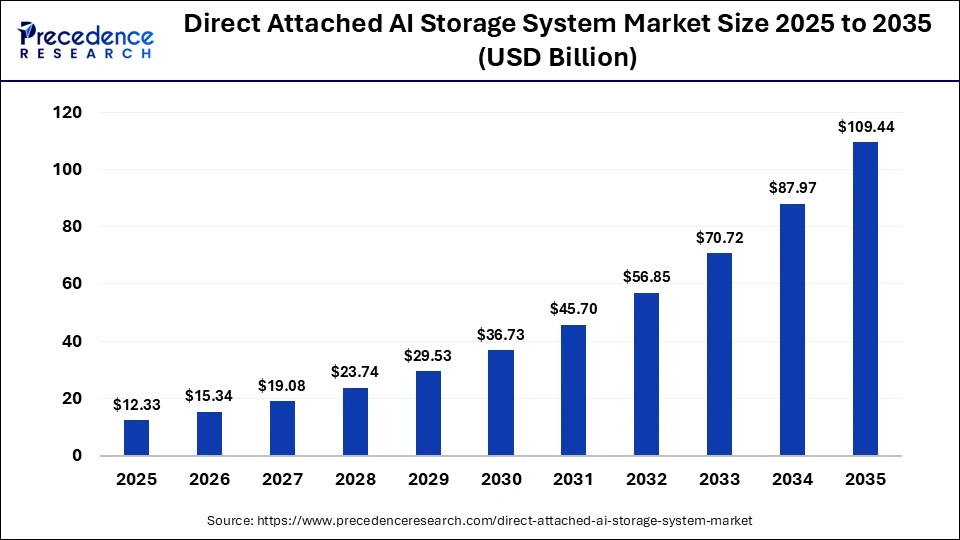
ICT industry specialist Shivani Zoting estimates the direct attached ai storage system market at USD 15.34 billion in 2026, with continued technology adoption expected to take the market to USD 109.44 billion by 2035 at a CAGR of 14.40%. Leading direct attached ai storage system market providers such as Dell Technologies, Hewlett-Packard Enterprise, NetApp, Micron Technology are expanding their capabilities across segments including By Capacity, By Type, By Application, By End User.
Source: https://www.precedenceresearch.com/direct-attached-ai-storage-system-market
 Get a Sample
 Table Of Content


What is the Direct Attached AI Storage System Market Size in 2026?
The global direct attached AI storage system market size accounted for USD 12.33 billion in 2025 and is predicted to increase from USD 15.34 billion in 2026 to approximately USD 109.44 billion by 2035, expanding at a CAGR of 14.40% from 2026 to 2035. This market is growing due to the imperative for ultra-low latency and high-throughput data access to prevent GPU starvation during AI training and inference.
Key Takeaways
- North America dominated the global direct attached AI storage system market with the largest market share of 35% in 2025.
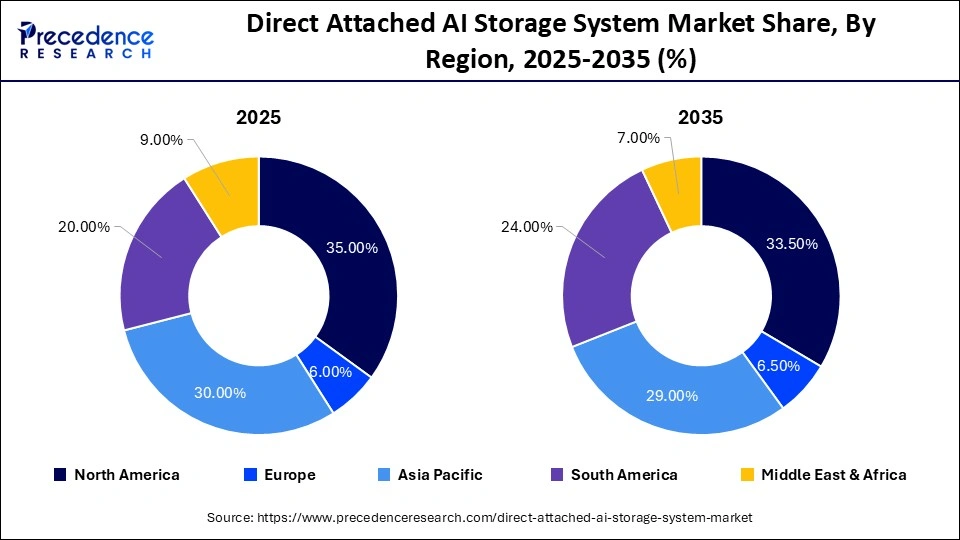
- Asia Pacific's market share is expected to grow from 20.00% in 2025 to 24.00% in 2035, indicating significant growth.
- By capacity, the 5TB to 20TB segment led the market while holding 30.50% of market share in 2025.
- By capacity, the below 5TB segment, with a share of 25.00% in 2025, is expected to grow at the fastest rate during this period.
- By storage type, the hard disk drive segment accounted for 40.00% of the market share in 2025.
- By storage type, the solid state drive segment, with a 30.00% share in 2025, is expected to grow rapidly during the forecast period.
- By application, the data analytics segment contributed the major market share of 28% in 2025.
- By application, the big data segment, with a 15.50% share in 2025, is expected to see the highest growth rate.
- By end user, the large enterprises segment, which had 50.00% of the market share in 2025, is expected to grow and capture a larger portion by 2035.
What Drives the Direct Attached AI Storage System Market?
The direct attached AI storage system industry is mainly driven by the demand for ultra-low latency, high-performance, and high-throughput data access, enabling GPUs to operate at maximum efficiency. The explosion of information from IoT, high-definition media, and AI applications demands efficient storage for real-time processing and analysis. The expansion of edge AI and 5G infrastructure is driving the need for compact, efficient, and low-latency storage at the edge.
How is AI Influencing Direct Attached AI Storage Systems?
AI is transforming direct-attached storage by demanding ultra-fast, low-latency, and high-capacity solutions to prevent GPU starvation, propelling a shift toward NVMe SSDs and PCIe Gen5 or 6 interfaces. AI is now embedded in storage software for proactive monitoring, identifying performance hotspots, and enabling self-healing, which decreases maintenance downtime. Technologies like ATTO's Direct2GPU enable direct data transfer from storage to GPU memory, thus bypassing the CPU to reduce latency.
What are the Key Trends Influencing the Direct Attached AI Storage System Market?
- Performance Bottleneck Reduction: To support high-performance computing together with GPU-accelerated workloads, there is a massive shift toward using NVMe SSDs to offer the high bandwidth and low latency demanded for rapid data ingestion.
- AI-Driven Management Tools: The use of AI to handle storage infrastructure is growing, improving data placement and also enhancing efficiency.
- Adoption of All-Flash Architectures: High-density, cost-effective SSDs are increasingly replacing short-stroke HDDs, removing the demand for tiered storage and enabling faster data preparation and analysis.
- Data Sovereignty and On-Premises Shift: Stringent data security regulations and the demand for data to remain in its country of origin are driving organizations back toward on-premises storage solutions, propelling the need for locally managed DAS.
- Edge AI Expansion: The growth of edge computing and AI-powered data centers is accelerating the need for localized, high-performance DAS.
Future Market Outlook
- Expansion in Emerging Markets: As these regions, e.g., China, India, are seeing rapid AI acceptance in finance and manufacturing, creating a high need for low-latency, high-performance data storage to handle massive, localized datasets. Direct attached storage (DAS) is thus favored for AI workloads because it provides superior, direct-to-host performance and minimal latency compared to networked storage, which is vital for real-time analysis.
- Infrastructure Development: It bridges the gap between huge AI computational requirements and storage performance bottlenecks. Future infrastructure incorporates AI-based storage controllers that automate data management, like intelligent data tiering, which moves "hot" data to faster storage automatically.
Market Scope
| Report Coverage | Details |
| Market Size in 2025 | USD 12.33 Billion |
| Market Size in 2026 | USD 15.34 Billion |
| Market Size by 2035 | USD 109.44 Billion |
| Market Growth Rate from 2026 to 2035 | CAGR of 24.40% |
| Dominating Region | North America |
| Fastest Growing Region | Asia-Pacific |
| Base Year | 2025 |
| Forecast Period | 2026 to 2035 |
| Segments Covered | Capacity, Type, Application, End User, and Region |
| Regions Covered | North America, Europe, Asia-Pacific, Latin America, and Middle East & Africa |
Segmental Insights
Capacity Insights
How the 5TB to 20TB Segment Led the Direct Attached AI Storage System Market?
The 5TB to 20TB segment led the direct attached AI storage system market with 30.50% market share in 2025, which is attributed to the optimal balance it offers between storage capacity, cost, and performance, making it suitable for a wide range of AI workloads. Organizations, particularly small and medium-sized enterprises, prefer this range for handling moderate datasets without incurring the high costs associated with larger storage systems. Additionally, the increasing adoption of edge AI applications and localized data processing is further driving demand for storage solutions within this capacity range.
The 20TB to 50TB segment held the market with 25% market share in 2025. This is due to its optimal balance of high-speed performance, cost-efficiency, and capacity, perfectly suiting the demands of intensive AI training and inference. This range funds the low-latency, high-throughput requirements, thus, for processing large datasets in AI workflows. The 20TB–50TB range efficiently manages the high-performance computing requirements for AI applications.
Direct Attached AI Storage System Market Share, By Capacity, 2025-2035 (%)
| Capacity | 2025 | 2035 |
| Below 5TB | 25.00% | 22.00% |
| 5TB to 20TB | 30.50% | 28.00% |
| 20TB to 50TB | 25.00% | 27.50% |
| Above 50TB | 19.50% | 22.50% |
The below 5TB segment held a significant market share of 25% in 2025, due to its agility, cost-effectiveness, and localized performance in specialized, edge-driven, and early-stage AI initiatives. Data scientists and developers usually require dedicated, high-performance, and even local storage to work on models without relying on network-attached storage. As the storage is physically connected to the AI compute node, it removes network bottlenecks, providing the lowest latency demanded for real-time inference.
The above 50TB segment held 19.50% share in 2025. Enterprises and research institutions are increasingly adopting high-capacity storage systems to manage vast volumes of structured and unstructured data. Additionally, the rise of data-intensive applications and the expansion of cloud and hybrid infrastructures are further contributing to the growth of this segment.
Storage Type Insights
Direct Attached AI Storage System Market Share, By Storage Type, 2025-2035 (%)
| Storage Type | 2025 | 2035 |
| Hard Disk Drive | 40.00% | 35.00% |
| Solid State Drive | 30.00% | 33.00% |
| Hybrid Storage | 15.00% | 17.50% |
| Network Attached Storage | 15.00% | 14.50% |
Which Storage Type Segment Dominated the Direct Attached AI Storage System Market?
The hard disk drive segment dominated the market with 40% market share in 2025 because of its unmatched cost-per-terabyte advantage, massive storage capacity, and ability to efficiently manage the vast, unstructured datasets needed for AI training. AI workloads, like Large Language Models, demand petabytes of storage. HDDs enable the necessary capacity and even density for storing these massive datasets, usually in 20TB+ configurations.
While holding 30% of market share in 2025, solid state drive segment is expected to expand rapidly in the market in the coming years, because of its superior ability to meet the extremely low-latency and high-IOPS requirements of AI training and inference. They allow faster data ingestion, reducing GPU idle time and even significantly boosting performance compared to conventional hard drives. Increased acceptance, along with decreasing flash prices and even improved endurance, thus makes SSDs more economical for active, performance-based AI data.
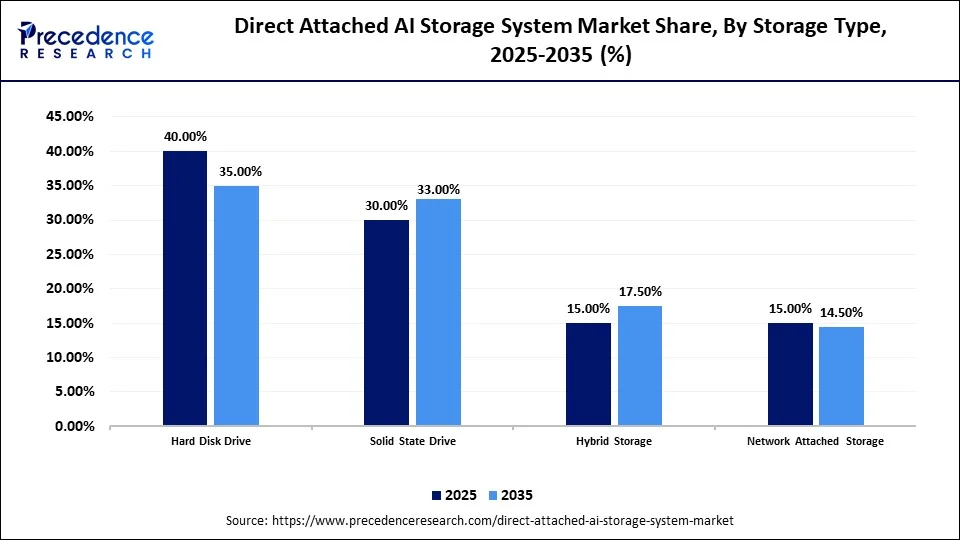
The hybrid storage segment held 15% of market share in 2025. This growth is driven by its ability to combine the speed of solid-state drives (SSDs) with the cost-efficiency of hard disk drives (HDDs), offering a balanced storage solution. Organizations are increasingly adopting hybrid storage to optimize performance for frequently accessed data while maintaining economical storage for less critical information. Additionally, its flexibility and scalability make it a preferred choice for businesses managing diverse workloads and evolving data requirements.
The network attached storage segment held 15% market share in 2025. This growth is driven by the increasing demand for centralized data storage solutions that enable easy access and sharing across multiple devices and users. Organizations are adopting these systems to improve collaboration, streamline data management, and enhance data security within networked environments. Additionally, the rising adoption of remote work and distributed teams is further boosting the demand for scalable and accessible storage solutions.
Application Insights
Why did the Data Analytics Segment Dominate the Direct Attached AI Storage System Market?
The data analytics segment held the largest market share of 28% in 2025 because of its critical demand for extremely low-latency, high-speed data access for ETL (Extract, Transform, Load) processes and real-time ad-hoc queries. Data analytics in AI usually involves massive, concurrent, high-throughput multi-threaded read operations, which are best managed by NVMe-based flash drives directly attached to the compute node.
While holding 15.50% share in 2025, big data segment is expected to grow with the highest CAGR in the market during the predicted years, because of the exponential expansion of unstructured data, necessitating high-throughput, low-latency storage directly combined with AI processing engines. As AI workloads, specifically training, demand immediate access to vast datasets, direct-attached storage offers the necessary speed and avoids network bottlenecks. Moreover, the explosion of AI-centric workloads, which includes IoT, machine learning, and deep learning, demands efficient, scalable, and high-performance storage to handle "big data".
The machine learning segment held 22% market share in 2025. Its growth is driven by the widespread adoption of predictive analytics, recommendation systems, and automation across industries such as finance, healthcare, and retail. Organizations are leveraging machine learning to extract actionable insights from large datasets, improve decision-making, and enhance operational efficiency. Furthermore, the availability of pre-trained models and cloud-based ML platforms is making it easier for businesses of all sizes to implement these solutions.
The artificial intelligence segment held 18.50% market share in 2025. This segment is expanding as businesses increasingly integrate AI technologies into applications such as chatbots, virtual assistants, and intelligent process automation. AI enables organizations to optimize workflows, reduce human error, and deliver more personalized customer experiences. Additionally, advancements in natural language processing and computer vision are fueling the adoption of AI solutions across multiple sectors.
The deep learning segment held 16% of market share in 2025. Its growth is fueled by the demand for advanced AI models capable of handling complex tasks such as image recognition, speech processing, and autonomous systems. Industries including healthcare, automotive, and robotics are leveraging deep learning to enhance accuracy, efficiency, and innovation in critical applications. Moreover, the increasing availability of high-performance computing resources and large annotated datasets is accelerating the development and deployment of deep learning models.
End User Insights
Direct Attached AI Storage System Market Share, By End User, 2025-2035 (%)
| End User | 2025 | 2035 |
| Small and Medium Enterprises | 40.00% | 36.00% |
| Large Enterprises | 50.00% | 54.00% |
| Government | 10.00% | 10.00% |
Which End User Segment Dominated the Direct Attached AI Storage System Market?
The large enterprises segment held dominated share of 50% in 2025 because these organizations possess the necessary budget, infrastructure, and technical expertise to manage the high-performance, low-latency demands of intensive AI workloads. Large enterprises generally deal with immense data volumes. They use DAS with NVMe-based flash storage to handle, store, and process this data efficiently for machine learning training and inference.
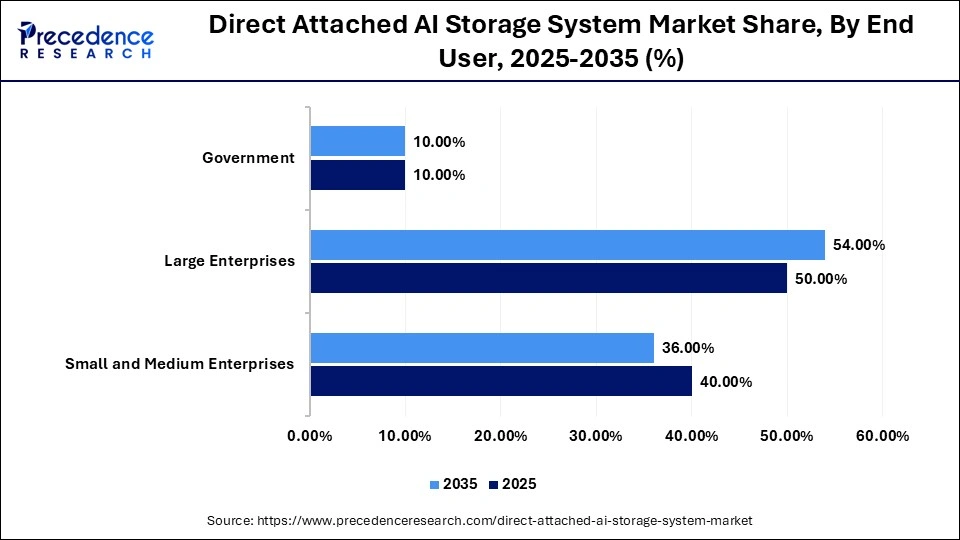
The small and medium enterprises segment accounted for the significant market share of 40% in 2025 because of the demand for simple, cost-effective, and high-performance storage, which facilitates rapid AI model training and even edge deployment. The demand for high-speed, low-latency access to data for AI, ML, and analytics applications drives the acceptance of DAS, particularly SSDs.
The government enterprises held 10% market share in 2025. This share is driven by increasing investments in digital infrastructure, data management, and smart city initiatives by government agencies. These organizations adopt advanced technologies to improve public services, enhance security, and streamline internal operations. Additionally, compliance requirements and the need for efficient data storage and processing solutions are further contributing to the growth of this segment.
Regional Insights
North America Direct Attached AI Storage System Market Size and Growth 2026 to 2035
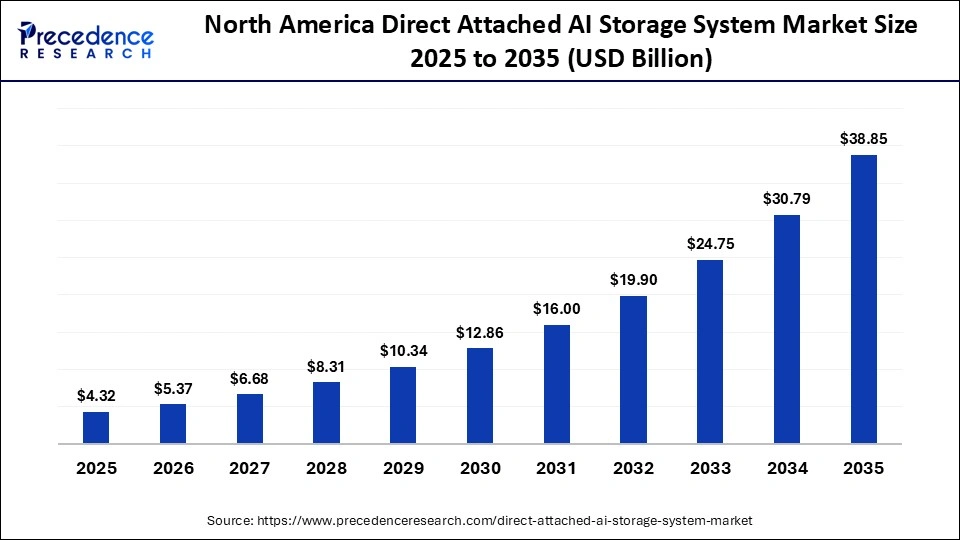
The North America direct attached AI storage system market size is estimated at USD 4.32 billion in 2025 and is projected to reach approximately USD 38.85 billion by 2035, with a 24.56% CAGR from 2026 to 2035.
Why North America Dominated the Direct Attached AI Storage System Market?
North America held a major market share of 35% in 2025. This is due to early AI acceptance, massive hyperscale data center expansion by companies like Microsoft and Amazon, and even high R&D investment. A strong ecosystem of AI startups, academic institutions, and federal labs, combined with the availability of skilled professionals, speeds up development.
U.S. Direct Attached AI Storage System Market Size and Growth 2026 to 2035
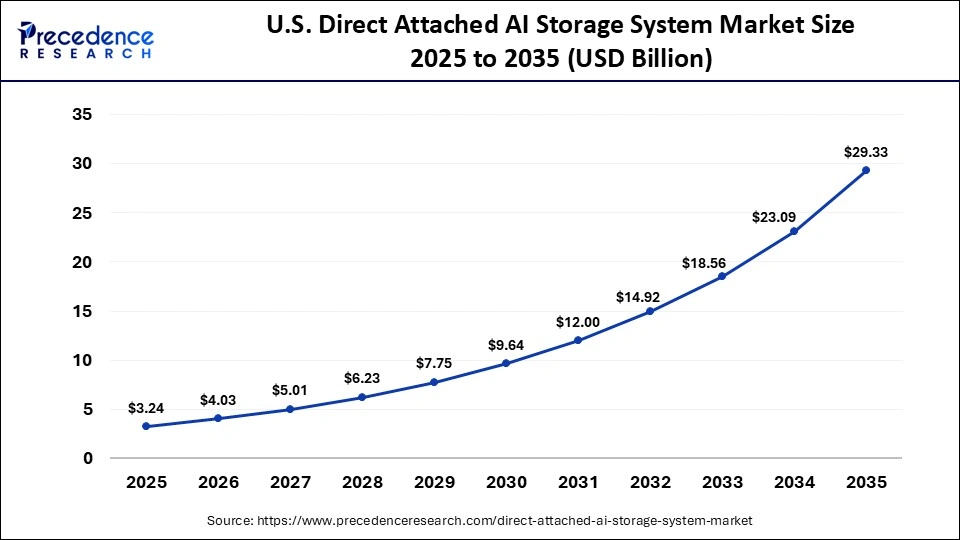
The U.S. direct attached AI storage system market size is calculated at USD 3.24 billion in 2025 and is expected to reach nearly USD 29.33 billion in 2035, accelerating at a strong CAGR of 24.65% between 2026 and 2035.
U.S. Market Trends
The U.S. leads the market due to the rise of on-device AI and edge computing, which is boosting the need for local, direct-attached storage solutions that can handle data processing at the source. The presence of a suitable infrastructure and favorable government support also contributes to market growth. The U.S. is home to numerous key players, such as IBM, Solidigm, and Lenovo, that develop advanced DAS systems.
How is Asia-Pacific Growing in the Direct Attached AI Storage System Market?
While holding 20% of market share in 2025, Asia-Pacific is expected to experience the fastest growth during the predicted timeframe, driven by high-volume industries such as automotive, retail, and healthcare, which are deploying machine learning to enhance efficiency in operations, logistics, and supply chains. Significant state-sponsored initiatives, such as China's $98 billion AI investment plan and even Japan's support for regional data centers, are accelerating the acceptance of advanced storage solutions.
China Market Trends
China's market is driven by massive AI, IoT, and high-performance computing (HPC) demands. The increase in AI model training demands high-performance, low-latency storage, boosting the acceptance of all-flash arrays and NVMe-driven systems. China aims to become a global hub in direct-attached AI storage systems. The increasing collaborations among intergovernmental organizations and rising investments across various sectors foster market growth.
What Makes Europe a Significant Region in the Direct Attached AI Storage System Market?
Europe is expected to grow at a significant CAGR throughout the forecast period. It is driven by rapid acceptance in the manufacturing sector, advancements in Industry 4.0, strict data sovereignty regulations, and high investment in AI factories. As data center energy needs rise, Europe is prioritizing and investing in energy-efficient storage technologies. The European Commission is investing in "AI factories" to drive competitiveness, creating a surge in need for high-capacity, high-density storage systems.
UK Market Trends
The UK market is driven by the increasing use of AI in storage systems for automatic information tiering, predictive maintenance, and improved security, reducing operational costs. With rising cyber threats, there is a strong drive for integrated security protocols, encryption, and even data management software.
What Makes Latin America a Notable Region in the Direct Attached AI Storage System Market?
Latin America is expected to grow at a notable CAGR throughout the forecast period. This is due to more than $2B investments in data centers, favorable tax incentives for technology, and the growth of regional hyperscale operators demanding NVMe and flash-based storage solutions. Countries such as Brazil are offering tax incentives, for example, the REDATA policy, to boost digital infrastructure and even attract investments in data centers and AI or IoT ecosystems
Brazil Market Trends
Brazil's market is driven by AI projects, moving from experimentation to production. There is a surge in need for storage solutions that provide low-latency data, making DAS a preferred choice for local, high-performance demands. Brazil is becoming a vast AI hub in Latin America, with significant investments from tech giants such as Microsoft in AI infrastructure.
Will the Middle East and Africa Grow in the Direct Attached AI Storage System Market?
The Middle East and Africa are expected to grow at a considerable CAGR in the upcoming period. This is driven by strategic national digital transformation initiatives, significant investments in AI infrastructure, and the urgent demand for high-performance, low-latency data storage solutions. The growth of AI, machine learning, and big data analytics in industries such as oil & gas, banking, and surveillance is creating the need for high-speed, direct-attached, NVMe-based flash storage to manage massive, unstructured datasets.
UAE Market Trends
The UAE market is driven by the rise in AI and machine learning workloads, demanding storage with faster processing speeds and massive throughput, boosting the acceptance of specialized, high-density, and even low-latency storage solutions.
Direct Attached AI Storage System Market Companies
- Dell Technologies
- Hewlett-Packard Enterprise
- NetApp
- Micron Technology
- IBM
- Toshiba
- Samsung Electronics
- Seagate Technology
- Western Digital
Recent Developments
- In March 2026, Ctera Networks Ltd. announced a better data foundation for AI systems, consisting of a new federated data architecture that eliminates the tradeoff between traditional file systems and object storage. Ctera Fusion Direct unifies the two standalone storage domains into a single, high-performance data fabric. (Source: https://siliconangle.com)
- In May 2025, Dell Technologies declared Dell AI Factory advancements, including powerful and energy-efficient AI infrastructure, integrated partner ecosystem solutions, and professional services to drive simpler and faster AI deployments. The Dell AI Factory approach helps organizations securely and easily deploy enterprise AI workloads at any scale. (Source: https://www.dell.com)
Segments Covered in the Report
By Capacity
- Below 5TB
- 5TB to 20TB
- 20TB to 50TB
- Above 50TB
By Type
- Hard Disk Drive
- Solid State Drive
- Hybrid Storage
- Network Attached Storage
By Application
- Data Analytics
- Machine Learning
- Artificial Intelligence
- Deep Learning
- Big Data
By End User
- Small and Medium Enterprises
- Large Enterprises
- Government
By Region
- North America
- Latin America
- Europe
- Asia-pacific
- Middle and East Africa
For inquiries regarding discounts, bulk purchases, or customization requests, please contact us at sales@precedenceresearch.com
Frequently Asked Questions





Ask For Sample
No cookie-cutter, only authentic analysis – take the 1st step to become a Precedence Research client
 Get a Sample




 sales@precedenceresearch.com
 Schedule a Meeting
