



E-Nose Market Trends, Companies, Revenue / Sales Performance, Supply Chain Analysis, Competitive Landscape, and Growth Forecast
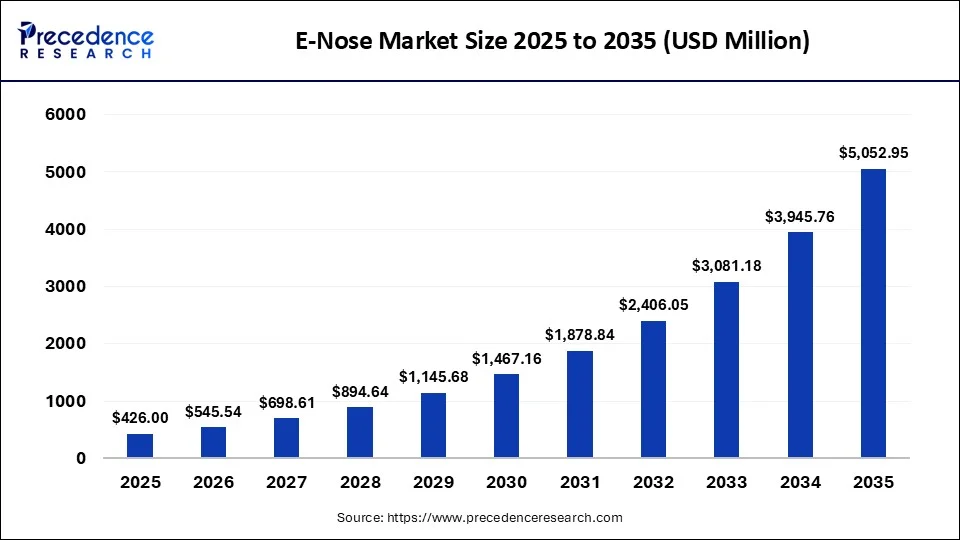
According to semiconductor and electronics specialist Laxmi Narayan, the e-nose market is valued at USD 545.54 million in 2026 and is forecast to reach USD 5,052.95 million by 2035, reflecting a CAGR of 28.06%. Leading e-nose market companies, including The eNose Co., Stratuscent Inc., and Sensigent LLC, are strengthening their presence across key segments such as technology type, component, sensor type, application, deployment, end user, distribution channel, and region.
Source: https://www.precedenceresearch.com/e-nose-market
 Get a Sample
 Table Of Content


E-Nose Market Size and Forecast 2026 to 2035
The global E-nose market size is predicted to increase from USD 545.54 million in 2026 to approximately USD 5,052.95 million by 2035, expanding at a CAGR of 28.06% from 2026 to 2035.
Key Takeaways
- By technology type, the metal oxide semiconductor (MOS) sensors segment contributed the highest market share of 42% in 2025.
- By technology type, the carbon nanotube-based sensors segment held a 9% share of the market in 2025 and is expected to grow at a significant CAGR of 35.4% between 2026 and 2035.
- By application, the healthcare & medical diagnostics segment held a major market share of 31% in 2025 and is expected to register significant growth of 34.8% CAGR during 2026 and 2035.
- Honeywell's March 2026 NDIR hydrocarbon gas sensor launch highlights continued innovation in adjacent industrial gas-sensing technologies.
- MSA Safety's acquisition of M&C TechGroup in May 2025 expanded its capabilities in gas analysis and process safety.
- Breath Diagnostics received FDA Breakthrough Device Designation for its OneBreath platform in February 2026, supporting further development of exhaled-VOC diagnostics.
- We are seeing more use of automated compliance across food-packaging QS following Bizerba's automation solution, LeakSecure, launch at Empack 2026.
- Ainos' growth and robotics investments now provide a wider roadmap for commercialization possibilities in the smart-sensing segment of the electronics industry.
Market Size Description
The rise of complex odor signatures and artificial intelligence is changing the way companies utilize electronic nose systems to detect, classify, and respond. In 2026, robot olfaction progress was summarized in a review article in npj Robotics. This outlines the vast progress of digital noses towards increased sensitivity and improved localization of odor sources. This improvement helps with search and rescue operations and quicker identification of gas leaks. E-nose systems use multiple sensor technologies, including metal-oxide, electrochemical, optical, conducting-polymer, QCM, SAW, and field-effect transistor-based sensors.
The miniaturisation of sensors is also moving at a fast pace. In September 2024, the UNIST team developed an ultra-small electronic nose. It can precisely detect and measure the type and concentration of gas. The small device components will reduce the cost of the device and improve its portability for use in mobile diagnostic solutions. The push to move forward continues with healthcare diagnostics. Requiring ultra-compact, low-power sensor array structures that are suitable for clinical and even wearable environments. The food quality monitoring process is more or less comparable. Manufacturers want real-time alerts about contamination, instead of waiting for laboratory testing. Furthermore, the collective efforts are bringing e-nose systems out of the research laboratory and into a wide array of practical applications.
The change at the materials level began to manifest itself in mid-2026. Researchers came up with a plan for a so-called artificial olfactory system. Under the guidance of Hyuk-Jun Kwon, a researcher at Daegu Gyeongbuk Institute of Technology (DGIST). The team systematically investigated the research trends of design methods for metal-organic framework materials, realization of sensors using MOFs, and AI-based odor pattern recognition using MOFs. This roadmap represents a trend towards e-noses capable of distinguishing many more odors. Than previous generations, which were based on metal oxides alone. Current research is increasingly focused on improving both sensing range and response speed.
On the other hand, long-standing companies such as MSA Safety, Owlstone Medical, SICK, Endress+Hauser and Sensirion are pushing on with commercial roll-outs in safety, healthcare, and process applications. The eNose Company has also expanded its clinical uses. Making the company more prominent in the field of medical diagnostics using breath. This combination of AI-powered pattern recognition, new sensing materials, and miniature equipment is moving e-nose use beyond its traditional industrial applications. They will likely shape the construction of the next generation of diagnostic and environmental monitoring devices through 2035.
Market Snapshot
This trend continued throughout 2025, as the E-Nose market's global value hit USD 426 million. They also note that analysts estimate a strong market will be realized by 2035, growing at a compound annual rate of 28.06% through the decade. Volume growth is parallel, as shipping volumes increase while the per-unit sensor costs continue to decrease. As a result of improvements in metal-oxide and MEMS manufacturing. Manufacturing prices remain in retreat, as chipmakers turn to an increasingly smaller sensor array for making semiconductors. Sales prices for clinical grade breath analyzers have yet to become competitive with industrial gas-monitoring units. Even a high-tech e-nose can cost over USD 50,000, a price too steep for smaller enterprises and consumers.
Metal-oxide semiconductor (MOS) sensors continue to be the technology of choice in the majority of food safety and industrial applications. Because of their high sensitivity and low production expense. The field-effect transistor and optical sensor type is showing the greatest growth. Driven in part by the need for smaller, wearable devices needed for diagnostics in health care. Exhaled breath analysis is an emerging, convenient, portable, safe diagnostic technique with high interest at the moment. On the other hand, Asia-Pacific is proving to be the most dynamic area with dense research output from institutions all over South Korea, China, and India region. This is paving the way for a wave of strategic developments to be analyzed in the coming years.
Strategic Market Insights
The introduction of artificial intelligence (AI) representation is at the heart of almost every strategic move to be seen during the e-nose development in 2026. The Daegu Gyeongbuk Institute of Technology researcher Hyuk-Jun Kwon has identified a roadmap. Integrating metal-organic framework with AI based on odor pattern recognition in a paper published in Progress in Materials Science. It's the combination of a novel sensing material and machine learning. This enables modern e-noses to identify larger odor libraries than those older single-sensor designs would have been able to in the past. The technology is expected to be adopted fastest in healthcare. Because diagnostic accuracy is strongly related to the ability of algorithms to interpret the noisy, real-world breath.
The technology of sensing is at the core of these individual breakthroughs. This is being connected to the Internet through IoT to form deployable networks. On the future outlook, the best investment opportunities are still in these projects that are being translated from the laboratory to the point-of-care. Laboratory prototypes of sensors are being developed into devices ready for use in both the clinic and industry. This will continue to influence funding priorities throughout the decade and beyond.
Market Overview
What is an Electronic Nose (E-Nose)?
This journey has returned the research teams to the question of what makes an electronic nose work. E-nose is a device that is designed to detect, analyze, and classify VOCs. By employing an array of chemical sensors instead of a single type of detector. Every sensor is selectively sensitive to a distinct chemical pattern. This creates a unique electrical signature that is subsequently recognized by a pattern-recognition algorithm. An artificial olfactory sensor detects the pattern transmitted by the olfactory receptor.
Progress in statistical and data processing techniques provides the ability to categorize the patterns for larger arrays of sensors. Odorant receptors are based on the technique of a sensor array. Utilizes a range of different types of electrochemical sensors such as devices based on metal oxides, surface acoustic wave devices, quartz crystal microbalances, conducting polymers, and optical sensors. This multiple sensing system is increasingly supplanting the more time-consuming gas chromatography-mass spectrometry (GC-MS) in applications. That require immediate on-site classification of odors.
Evolution of E-Nose Technology
This move from laboratory testing underscores the history of how long it has taken to move away from this type of analysis within the field itself. The early e-noses of the 1980s and 1990s used simple metal oxide arrays and simple statistical classifiers. Provided only coarse discrimination of odors. Since then, researchers have been encouraged to explore the idea of creating electronic noses based on the structure of a biological olfactory system.
This encodes the quick dynamics of scents and drives an organism's behavioural actions in real-time. The next step in evolution for these sensor boxes was IoT connectivity. This allows them to become network-connected devices. This can push the readings to a cloud-based dashboard for monitoring from any location.
Market Scope and Coverage
The field of the e-nose market itself has expanded with the introduction of several new technologies. Ranging from rigid circuits made up of metal-oxide materials to hybrid bio-electronic systems incorporating biological sensing elements. It covers various technologies such as metal-oxide semiconductors, conducting polymers, quartz crystal microbalances, and field-effect transistor based-sensors.
The fixed installations of this technology type are found in industrial plants. They perform the same functions as the handheld or wearable units found in hospitals. Supplied to end users through direct sales, specialized distributors, and increasing partnerships with regional research hubs throughout North America, Europe, and Asia-Pacific.
Market Trends
Integration of Artificial Intelligence and Machine Learning in E-Nose Systems
This trend across regions is also being enhanced by more intelligent algorithms placed in each sensor array. In 2026, research published by Nanoscale Advances featured a nanocomposite sensor (rGO/In2O3). This predictive mixed-gas detection sensor based on machine learning. Such models are taking the classification of odors, disease-pattern recognition, and automatic decision making to almost instantaneous levels of accuracy.
Growing Adoption of Non-Invasive Healthcare Diagnostics
This accuracy boost that drives the fast-moving trend towards breath-based screening instruments. Mobile e-nose prototype of eight graphene-based chemiresistive sensors. Identified respiratory disease cases from an online breath test of 401 patients with an accuracy. That breath analysis could be a valid screening method early in the disease's progress.
Expansion of IoT-Connected Electronic Nose Solutions
The success of clinical outcomes is driving commercial platforms into the cloud and always-on deployments. These devices are now connected and provide real-time data directly to distant dashboards, empowering hospitals and safety staff to work ahead of issues.
Miniaturization and Development of Portable E-Nose Devices
Connectivity goes only as far as it can get to the field with hardware that is small enough to carry. A silicon microneedle array atmospheric pressure plasma ionization source has been newly developed for real-time trace gas chemical analysis. This was published recently in the journal Microsystems & Nanoengineering. This field ready design helps to reduce lab-grade detection to something easy for a technician to carry in one hand.
Increasing Use in Food Safety and Quality Monitoring
Portable devices are proving to be equally useful in food supply chains in the nonclinical environment. Food Control, in a comprehensive review for 2026, explored the electronic nose applications in the field of grain storage and cereal products quality and freshness monitoring as well as detection of mycotoxins. This type of automated quality control, which takes less time than manual inspection. This is replacing manual checks in processing plants all over the world.
Growth of Nano-Sensor and Advanced Material Technologies
These improvements are backed by relentless efforts to improve sensing materials. In addition to carbon nanotube and hybrid sensor designs. The apparent use of these advanced materials is slowly increasing sensitivity and selectivity throughout the e-nose field.
Market Dynamics
Market Drivers
Rising Demand for Rapid and Non-Destructive Detection Technologies
That drive toward better sensing materials is pushing entire industries away from slow, sample-destructive lab testing. Traditional gas chromatography-mass spectrometry can produce accurate results. But requires skill training and preparation of samples and has hours turnaround time. E-noses have already been used to control industrial processes. Such as on manufacturing lines, for monitoring leaks, and for maintaining a uniform quality of products in pharmaceuticals. Resulting in the ability to instantly and on-site classify the smell of a gas, vapor, or liquid is the future. That is altering perceptions throughout regulated industries as they enter 2027.
Healthcare Industry Adoption of Breath-Based Diagnostics
Clinicians' approach to screening for disease is rapidly changing, in response to that same desire for the fast, just as much. That offers the ability to detect biomarkers directly in patients' exhaled breath. Previous applications in healthcare are coming on strong. Breath-based platforms can monitor a person's biomarker patterns over time, in contrast to snapshot testing. As more clinical data accumulates, increasingly hospitals are considering breath analysis as a viable frontline diagnostic tool.
Increasing Food Safety Regulations and Quality Requirements
The same shift is taking place on food manufacturing floors. Driven by regulatory issues. Bizerba's new LeakSecure is an in-line leak detection system designed for modified atmosphere packaging trays. They are used for fresh meat, poultry, seafood, cheese, and ready to eat foods in addition. LeakSecure measures leaks during package production itself, preventing defective products from entering the market as opposed to older off-line test methods. Tools like this are driving manufacturers to move away from "reactive" testing of each batch to "automatic" testing for contamination on the fly.
Growth of Industrial Automation and Predictive Monitoring
The same automation logic has been spreading to more safety and process monitoring in manufacturing plants. The electronic nose systems are now widespread in power plants. Also in oil and gas refineries and in pharmaceutical and chemical processing facilities. They are used to monitor air and gas quality at several points. The application of machine learning algorithms in these embedded systems is also becoming more prevalent. This allows them to achieve greater efficiency of odor pattern recognition, real-time data interpretation, and sensor drift compensation.
Market Restraints
High Cost of Advanced Sensor Technologies
The same broad challenge of cost still lurks in the way of that predictive momentum. There is a need for specialized equipment for fabrication, calibration, and quality testing of high precision sensor arrays before use. Smaller manufacturers and lab operations are wary about investment because of such manufacturing and maintenance requirements.
Limited Standardization Across E-Nose Platforms
Cost pressures are only exacerbated. There is a general shortfall in extensive design and verification standards throughout the field. Different manufacturers of gas sensors, especially in electrochemical types. They have their own documentation for calibration. There is no unified organization norm that validates the readings from the gas sensors on different platforms. The multi-system approach is not simplistic enough to allow for comparisons between different e-nose systems.
Sensor Drift and Calibration Challenges
There are deeper problems with drift that lie beneath gaps in cost and standardization. A study published in Sensors found that eNose sensor drift harms the reliability of the diagnostic process if the change is severe enough. As it did in a study of a real world cohort of inflammatory bowel disease patients, sensor drift is not routinely corrected. This ongoing signal drift has the potential to continue impacting long-term reliability for healthcare, food safety, and industrial applications.
Market Opportunities
AI-Based Diagnostic E-Nose Platforms
Drift correction research is paving the way for AI diagnostics to confidently enter clinics. The e-nose comprising a sensor array, signal conditioning unit, and pattern recognition algorithm is proving valuable in any application. They are helping in fast, non-invasive detection, which is most critical. Investor confidence and trust in AI-driven diagnostic solutions will continue to grow as additional clinical validation studies emerge through 2026.
Expansion into Smart Agriculture
The same diagnostic philosophy is spreading beyond hospital buildings into open farmland areas. Wireless nanosensors, as well as e-noses, installed in fields, are being employed. They collect real-time crop health, soil, and weather variability data. An electronic nose system was successfully demonstrated in 2025 to achieve complete accuracy in identifying soil contamination. By detecting petroleum hydrocarbons and distinguishes the type of organic pesticides. Capacity for precision farming operations can integrate these tools to focus efforts on an intervention. This will eliminate the unnecessary use of pesticides and fertilizers in entire farming seasons.
Integration with Industrial IoT Platforms
The effort achieved in agricultural deployments is echoed by a similar initiative in heavy industry. Also, a connected sensor footprint is finding its way. Honeywell is introducing a 4-Series NDIR Hydrocarbon Gas Sensor in March 2026. That further enhances industrial safety and hazardous gas monitoring with non-dispersive infrared technology. Furthermore, the merger of hardware technology and an interconnected software ecosystem. This is creating significant opportunities for expansion in the commercial market for those supplying sensors as well as platform and network designers.
Commercialization of Bio-Electronic Nose Systems
New and exciting options are developing for biological recognition itself, apart from using traditional hardware. These bio-hybrid platforms offer one of the most untapped avenues toward commercialization in the vast array of e-nose platforms that is presently available. As they evolve into one-day-away-from-reality manufacturable platforms, they will certainly become one of the most viable commercial routes available.
Market Challenges
Accuracy and Reliability Compared with Conventional Analytical Instruments
Accuracy problems with the e-nose are continually becoming more apparent in real-world clinical applications. In a 2026 study published in BMC Gastroenterology, researchers compared the 2026 platform with gas chromatography-mass spectrometry in the diagnosis of advanced hepatocellular carcinoma. Noting that the 2026 e-nose's accuracy was only moderate as compared with the analysis of blood and urine VOCs.
Data Privacy and Management Issues
Cloud connectivity is bringing an entirely new range of headaches with it for e-nose deployments in healthcare. Cybersecurity teams are now disclosing that 2026 medical device cybersecurity is not just an IT issue. But also a patient safety concern. Many connected medical devices have older software that is now unpatched by their software vendor. Breath-based diagnostic e-noses are inching onto the long list of connected devices. Manufacturers are increasingly subjected to the pressure of incorporating encryption and compliance protection features from the start.
E-Nose Market Ecosystem Analysis
E-Nose Industry Value Chain
These individual advances begin to dovetail together in the ecosystem-wide collaboration of a working supply chain. Sensor manufacturers like Sensirion and Bosch Sensortec provide the basic metal-oxide and MEMS devices that are the foundation of every device. Semiconductor manufacturers place these sensors into microchips that process the signals in real time. Having been developed by AI pioneer Ainos of San Diego. The company is introducing its AI Nose platform today under the Topco Scientific banner, a longtime Taiwan-based provider of semiconductor solutions. Moving closer to full commercialization as it enters 2026.
Key Stakeholders and Their Roles
Every player in that chain is responsible for a specific aspect and preserving the functioning of the system as a whole. Technology developers try to tweak the pattern-recognition algorithms and the odor chemistry sensitivity of sensors. They are able to produce a more accurate and rapid classification of odors. Distributors and service providers complete the picture. Serving to deploy, install, calibrate, and support them while also providing maintenance contracts for them continue to operate properly over time.
Partnership and Collaboration Landscape
The activity of the collaborative landscape over the past few years is already evident in the volume of deals that have occurred in 2025 and 2026. In June 2025, Ainos and Kenmec Mechanical Engineering announced a strategic partnership. Introducing Ainos' AI Nose platform in Kenmec's smart factory operations across Asia using Ainos' Smell Language Model technology. The intersection between the robotics and manufacturing communities and the clinical research community suggests the importance of forming collaborative groups. That is as vital to e-nose development as the science on which the sensor arrays are based.
Technology Landscape Analysis
Sensor Technology Assessment
The selection of the technology of the sensor ultimately depends on key factors such as sensitivity, cost, and response time. Compared to other sensors, such as conducting polymer, carbon nanofiber, and metal-oxide sensors. QCM and SAW sensors typically provide greater sensitivity and response time similar to conducting polymer sensors. Low cost and high cross-sensitivity to the majority of different gas types make Metal-oxide semiconductor sensors the most popular commercial product. Also, the sensors are relatively quick to respond.
AI and Machine Learning Capability Analysis
No matter what type of sensor is selected, its raw data results must be intelligently interpreted to be useful. Algorithms commonly used include principal component analysis (PCA) and linear discriminant analysis (LDA). Support vector machines (SVM) and k-nearest neighbour (kNN) classification, and newer deep learning techniques. Due to the different characteristics of these types of sensors. They usually have to be used in combination with a faster recognition technique, such as PCA, ANN, or SVM. Due to the larger response variation of the sensor. This predictive layer is what is going to really make the difference between a raw sensor reading and an actual disease or contamination alert.
Cloud-Based Analytics and Data Processing
Reliable connectivity is needed to get to this predictive output quickly to those who need it, and that's where cloud infrastructure can help. The increasingly large scale implementations are being put in place, as the one showcased here. Hybrid cloud-edge designs are likely to become the norm for monitoring networks with real-time needs.
Pricing Analysis
E-Nose System Pricing Structure
Despite the presence of software. The bulk of the price of an e-nose system is still associated with the cost of the sensor arrays, signal-conditioning circuits, and enclosures required for the manufacture of the complete system. A significant portion of that expense is covered by software. Machine learning models and/or pattern-recognition algorithms dictate how accurate the device is in the field. Calibration costs and support for firmware upgrades are taking the place of one-time fees. Single-use fees are becoming a regular revenue source directly within longer-term customer contracts.
Pricing Trends and Forecast (2026-2035)
The cost of production and deployment of these systems is also changing over time, with the adoption of manufacturing scale. Kepware's June 2026 price change is representative of how integration-layer software costs are continuing. They evolve in connected sensing ecosystems that utilize data protocol infrastructure similar to the one used by Kepware's e-nose platform. On the other hand, ultra-low-power MEMS technologies are being developed by Bosch Sensortec. They are increasingly targeted toward bolstering the efficiency of automation. This will further drive sensor-array pricing down over the coming five years and long into their future.
Cost Comparison by Deployment Type
Deployment format still separates budget-friendly options from premium clinical-grade systems. Portable, handheld e-noses typically are the cheapest type in the field. They use small MOS or SAW sensor arrays developed for the field, not laboratory precision. On the other hand, enterprise-class industrial IoT platforms allow larger costs associated with connectivity to be usage/scenario-based. Further providing some level of predictability to small industrial manufacturers.
Manufacturing and Supply Chain Analysis
E-Nose Hardware Manufacturing Landscape
The basic process of manufacturing an e-nose begins with the fabrication of the sensor array. Usually performed by a thin film deposition or a screen-printing process for the fabrication of metal-oxide elements. Then, a small circuit board for electronics manufacturing integrates signal conditioning electronics, microcontrollers, and power management components. Final assembly closes the sensor chambers and adjusts the gas-flow characteristics by calibration of each sensor before it is sent to groups. This allows the sensor to return to the same gas-flow characteristic each time.
Sensor Material Supply Chain
Sensor material availability is at the core of that Hardware pipeline, and 2026 has put it to the test time and time again. The unique sensing properties make rare earth metal oxide nanoparticles important materials for trace gas sensors. Their synthesis has been achieved by three techniques, including hydrothermal, solvothermal, and atomic layer deposition (ALD). The biological sensing elements of the system are also subject to their own supply limits, associated with specialist biotech manufacturing, rather than mineral extraction.
Software and Data Infrastructure Supply Chain
Software suppliers are as much a crucial supply chain link as bricks and mortar. Integration-layer software ownership has become more unpredictable as well. Licensed protocol drivers can change signaling economics in connected sensing platforms with little warning. As this software and database component continues to develop. Reliability will grow more significant for the devices' performance as it is becoming more critical than the physical sensor hardware.
Customer Buying Behavior Analysis
Key Purchasing Criteria
There are multiple considerations that buyers have to take into consideration before they allocate any budget to any e-nose system. Portability is a major consideration for field usage as devices are placed on the worksite. Accuracy and detection ability are still criteria that are essential with buyers in clinical settings. The food industry as they need results to match or generally approach conventional analytical instruments. Furthermore, buyers have more and more come to expect AI-capable self-correcting algorithms. That lessen the amount of manual calibration work over the device's working life.
Enterprise Adoption Preferences
There is significant variation in procurement patterns across the sectors. Depending on the sector that is purchasing. More than a simple clinical spec, hospitals seek vendors who have numerous clinical trial products in their pipeline and regulatory momentum. Companies generally opt to value speed and automation, in certain situations implementing technologies. Such as Bizerba's LeakSecure dynamic seal testing platform. This assesses seal integrity from the time the package is made, instead of the slower offline systems.
Healthcare Buyer Requirements
No other customer segment is as demanding as clinical buyers in this segment. In February 2026, the OneBreath platform was granted FDA Breakthrough Device Designation for the analysis of exhaled VOCs as a tool to be used pre-operatively to evaluate the risk of pneumonia in the adult population undergoing cardiac surgery. The system, as designated, however, is still in the developmental stages. They and has not been fully cleared/approved for commercial sale by the FDA. When it comes to selecting new e-nose platforms, hospitals that are weighing the options require solid clinical trial results before they place an order.
Regulatory and Compliance Landscape
Healthcare Diagnostic Regulations
Regulatory approval represents the largest obstacle for all entering the e-nose market for clinical use. Since 2017, the European in vitro diagnostic medical devices regulation, or Regulation 2017/746, has controlled diagnostic approvals. By shifting the majority of approvals away from self-declaration and toward independent CE certification.
Below are the FDA's most recent final guidance documents, published on January 6, 2026. Clinical Decision Support software and its General Wellness Policy for Low Risk Devices supersede their earlier 2019 and 2022 versions. For e-nose developers, that distinction is significant as there is a lighter regulatory roadmap for the former. Compared with the latter, which is set to earn an official diagnostic clearance.
Food Safety and Quality Regulations
Serious regulatory impetus for e-nose is coming from the food manufacturing industry. However, in a rather counterintuitive way. Regulators in both the EU and the US further stress digital quality records with the audit trail. This corresponds more with automated e-nose systems that can log all reads continuously. This regulatory guidance is unobtrusively putting the change from “good to have” to “must have” real-time odor monitoring on the table for all processed food products.
Environmental Monitoring Regulations
The federal government appears to be providing the strongest regulatory impetus for industrial e-nose implementation due to environmental regulations. The EPA's methane rule permits operators to use advanced leak detection technologies. This compliance with the leak detection requirement is pending EPA approval of a specific technology before use. These frameworks continue to develop over the next few years (2026), with sensor manufacturers that meet compliance criteria. This will enable them to deploy and gain legitimate access to large-scale industrial emissions monitoring contracts.
Investment and Funding Analysis
Investment Trends in Sensor Technologies
Capital investment in sensing technology is showing definite signs of increasing into the new year, 2026. Based on industry intelligence, VC investments in sensing technology are clearly booming for 2026. They are closely tied to the investor fascination for Physical AI applications. That includes robotics, self-driving cars, and industry automation, all areas requiring sensors as eyes and ears for connected machines. On the other hand, the current investor forecast includes gas sensors along with lidar, radar, and MEMS devices, and the e-nose technology.
Venture Capital and Startup Landscape
Specialized investors are focusing on individual startups creating next-gen e-nose platforms. Because of the serious consideration they have given meaningful early interest. In July 2026, researchers from Shanghai Jiao Tong University's Quantum Sensing Research Institute completed an angel round with Futeng Capital. Fuelling the company's expansion and development of gas monitoring and quantum sensing products. These current trends show the transnational nature of next generation e-nose innovations.
Strategic Investment Opportunities
From an investor's point of view. Four areas in this sector are most interesting. The health diagnostic market is the biggest bet to deliver the highest potential returns. This is a steady chain of breath-analysis research clearing both peer review and regulatory hurdles all year. Then, closely behind, comes AI based sensing, which is still one of the top investment priorities in the larger sensing technology field. A third promising opportunity affecting IoT integration is in the form of platforms. That connect industrial safety monitoring and cloud-powered analytics infrastructure. Continue to drive detection sensitivity closer and closer to what metals and oxides just can't deliver.
Patent and Innovation Analysis
Patent Activity in E-Nose Technology
There is a strong trend of innovation in sensors, algorithms, and applications. As evidenced by the series of new patent publications. In December 2024, Apple also submitted patent applications detailing a nasal breathing sensor that can be used in future products. Like the Apple Vision Pro, for measuring breathing patterns based on the audible wavelengths of sound. But smaller, specialist firms are developing large patent holdings as well. Further, Ainos says of its AI-driven digital nose technology that it has more than 50 patents.
Emerging Technology Developments
There are currently four big fronts in the e-nose research landscape. Carbon nanotube sensors remain one of the hot topics. Due to their tunable electrical characteristics, where the conductivity of the sensors is measurably changed upon interacting with different gases. This makes them very adaptable, chemically sensitive elements. Innovative Biosensor research is being extended into brain-computer interfaces (BCIs). Further, a study published in Biosensors and Bioelectronics last month reported an ultratrace approach to odor sensing using electrode arrays in the olfactory bulb of a mouse.
Market Segmentation Analysis
Technology Type Insights
Why Did Metal Oxide Semiconductor (MOS) Sensors Secure the Largest Share in the Global E-Nose Market?
The metal oxide semiconductor (MOS) sensors segment dominated the market with a share of 42% in 2025, due to their low manufacturing cost, high sensitivity for volatile organic compounds (VOCs), rapid response time, long operational lifespan, and use in several applications.
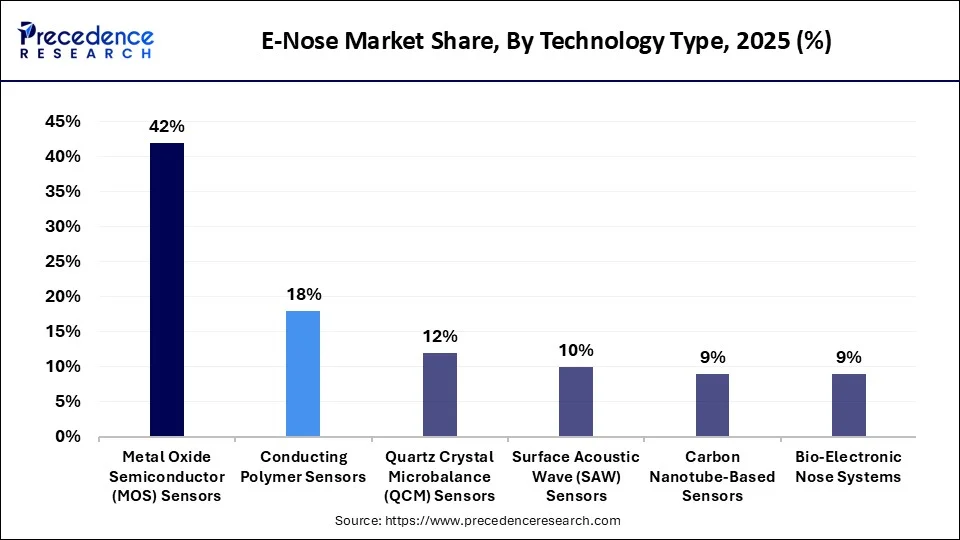
The carbon nanotube-based sensors segment held a 9% share of the market in 2025 and is expected to grow at the fastest CAGR of 35.4% between 2026 and 2035, driven by the significant advantages including greater sensitivity and ability to detect substances at the smallest levels possible, flexible designs, increasing research into next-generation nanomaterial-based sensing technologies, and others.
Component Insights
How Did Hardware Components Emerge as the Leading Segment in the Global E-Nose Market?
The hardware segment dominated the market with a share of 56% in 2025, as a result of the growing use of advanced sensor arrays and sampling systems, embedded processors, and data acquisition modules that are essential to the accurate detection and analysis of odours.
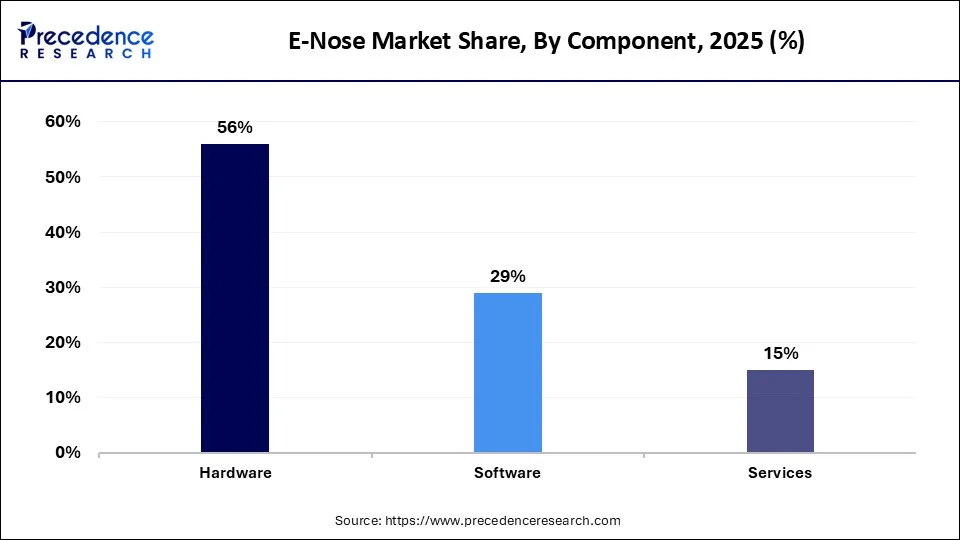
The software segment held a 29% share of the market in 2025 and is expected to grow at the fastest CAGR of 32.5% between 2026 and 2035, driven by ongoing improvements and enhancements in predictive data interpretation, coupled with AI tools that facilitate pattern recognition, cloud analytics, and machine learning algorithms.
Sensor Type Insights
What Made Chemical Sensors the Dominant Technology in the Global E-Nose Market?
The chemical sensors segment dominated the market with a share of 52% in 2025, due to their reliability, wide VOC detection capacity, cost-effective, and broad use in various applications such as food safety, medical, and industrial applications.
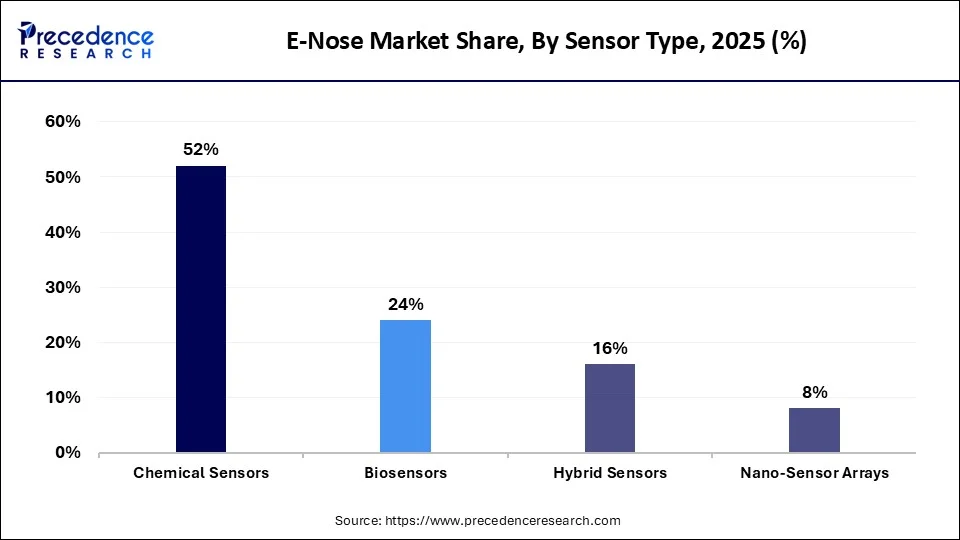
The biosensors segment held 24% of market share and is expected to grow at the highest CAGR of 33.8% between 2026 and 2035, owing to the growing importance of selecting biomolecules, diagnosing disease quickly, and precision healthcare applications.
Application Insights
Why Did Healthcare & Medical Diagnostics Become the Largest Application in the Global E-Nose Market?
The healthcare & medical diagnostics segment dominated the market with a share of 31% in 2025 and is expected to grow at a rapid CAGR of 34.8% between 2026 and 2035, as the utilisation of non-invasive disease screening, breath analysis technology, and AI aided diagnostic platforms is expected to proliferate.
E-Nose Market Share, By Application, 2025 (%)
| Application | Market Share (%) | CAGR (%) |
| Healthcare & Medical Diagnostics | 31.00% | 34.8% |
| Food & Beverage Quality Control | 24.00% |
27.5% |
| Environmental Monitoring | 15.00% | 25.9% |
| Agriculture | 10.00% | 28.7% |
| Defense & Security | 11.00% | 26.8% |
| Industrial Manufacturing | 9.00% | 27.9% |
Deployment Insights
How Did Portable E-Nose Systems Capture the Highest Share of the Global E-Nose Market?
The portable e-nose systems segment dominated the market with a share of 38% in 2025 and is expected to grow at the fastest CAGR of 31.6% between 2026 and 2035, owing to their compact size, portability, real-time monitoring, and growing applications in healthcare, agriculture, and environmental monitoring.
E-Nose Market Share, By Deployment, 2025 (%)
| Deployment | Market Share (%) | CAGR (%) |
| Portable E-Nose Systems | 38.00% | 31.6% |
| Benchtop E-Nose Systems | 34.00% |
25.9% |
| Embedded E-Nose Systems | 16.00% | 29.4% |
| IoT-Connected E-Nose Systems | 12.00% | 34.1% |
End User Insights
Why Did Hospitals & Healthcare Providers Remain the Preferred End Users in the Global E-Nose Market?
The hospitals & healthcare providers segment dominated the market with a share of 28% in 2025 and is expected to grow at the fastest CAGR of 35.2% between 2026 and 2035, as precision medicine programs, early disease detection technology, and breath-based diagnostics are also gaining traction in the hospitals & healthcare providers segment.
E-Nose Market Share, By End User, 2025 (%)
| End User | Market Share (%) | CAGR (%) |
| Hospitals & Healthcare Providers | 28.00% | 35.2% |
| Food Processing Companies | 22.00% | 27.3% |
| Pharmaceutical Companies | 12.00% | 30.5% |
| Environmental Agencies | 11.00% | 26.8% |
| Agricultural Companies | 10.00% | 29.2% |
| Defense Organizations | 9.00% | 27.6% |
| Industrial Manufacturers | 6.00% | 27.1% |
| Research Institutes & Universities | 2.00% | 28.5% |
Distribution Channel Insights
What Enabled Direct Sales to Lead the Global E-Nose Market?
The direct sales segment dominated the market with a share of 52% in 2025, due to customer customization requirements and an increasing number of cases of direct technical support, system integration services, and long-term enterprise procurement contracts.
E-Nose Market Share, By Distribution Channel, 2025 (%)
The system integrators segment held 15% of market share in 2025 and is expected to grow at the fastest CAGR of 32.4% between 2026 and 2035, owing to the industrial monitoring, IoT, automation, and AI integration that is expected to take place in many end-use industries shared by the segment.
| Distribution Channel | Market Share (%) | CAGR (%) |
| Direct Sales | 52.00% | 27.2% |
| Specialized Distributors | 26.00% | 27.8% |
| System Integrators | 15.00% | 32.4% |
| Online Procurement Platforms | 7.00% | 30.1% |
Regional Analysis
Why Did North America Account for the Largest Share of the Global E-Nose Market?
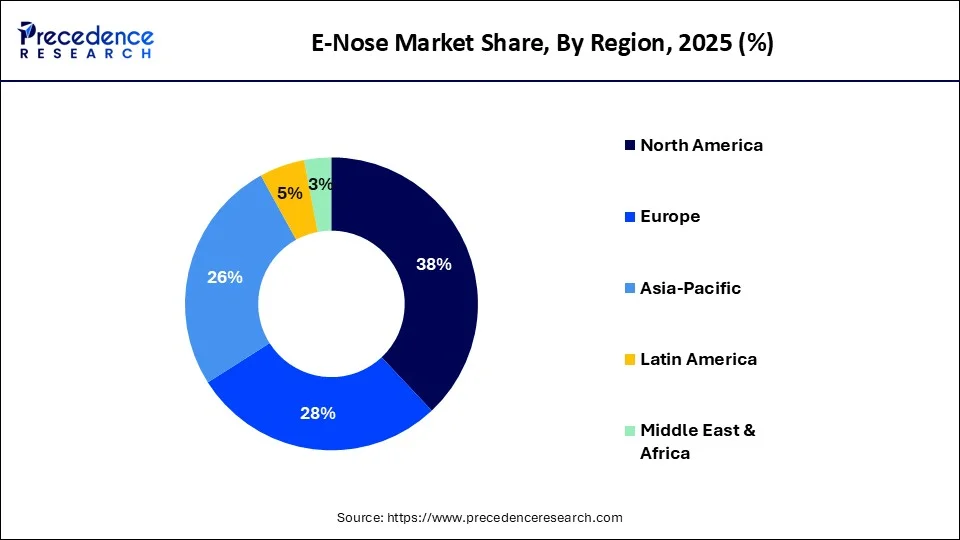
North America led the market, capturing the largest revenue share in 2025, accounting for an estimated 38%, due to significant investments in medical diagnostics, sophisticated sensor technologies, and analytical systems powered by artificial intelligence (AI) and the penetration of the region's food safety, defence, and environmental monitoring sectors.
U.S. E-Nose Market Size and Growth 2026 to 2035
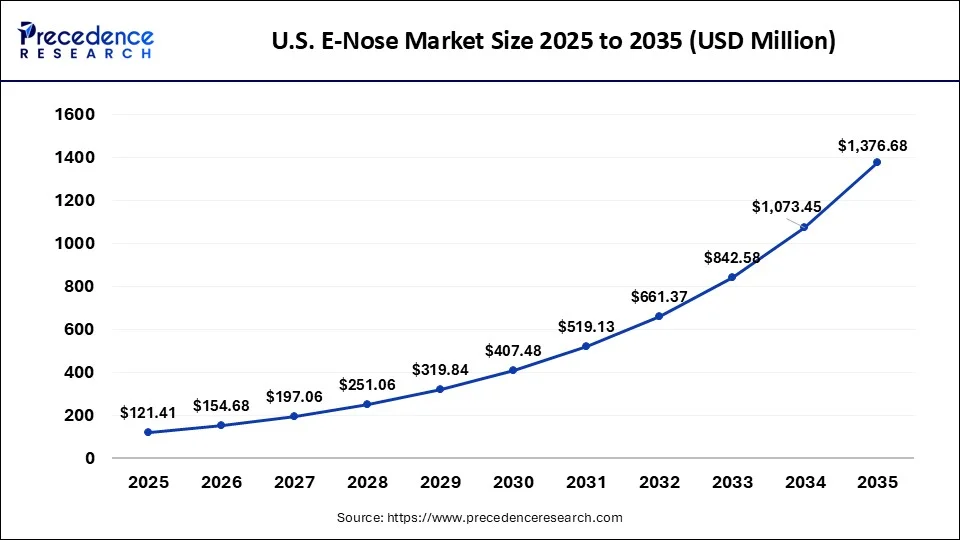
The U.S. E-nose market size was evaluated at USD 154.68 million in 2026 and is projected to reach around USD 1,376.68 million by 2035, growing at a CAGR of 27.48% from 2026 to 2035. The country is leading the way in the deployment of E-Nose systems, with the possibility of extending their use into hospitals, food processing, defence, and environmental monitoring programmes.
Canada
The technology of E-Nose is gaining in popularity in Canada due to the growing number of food safety research studies, investments in environmental monitoring programmes, and agricultural quality assessment programs.
Asia Pacific Expected to Held Fastest CAGR of 32.9% in 2025
Asia Pacific is expected to hold 26% of the market in 2025 and is estimated to grow at a strong CAGR of 32.9% over the projected period, supported by a rise in investment in sensor manufacturing and AI technologies, increasing food safety regulations, and a surge in industrial automation.
China (Dominant)
China is in the lead on the regional market due to its huge global and regional ecosystem of electronics manufacturing, growing healthcare capabilities, and investment in AI-powered sensor technologies.
Japan
The market is expected to grow steadily, with growing demand for the use of a high number of non-invasive diagnostic devices and the assessment of food quality.
India
The expanding pharmaceutical production in India, along with the development of healthcare facilities and subsequent investment increases in food safety monitoring, is bringing India to the forefront of the high growth market.
Europe Held Significant Market Share of 28% in 2025
The Europe region held a 28% share of the market in 2025 and is expected to grow at a 27.1% CAGR between 2026 and 2035, driven by strict environmental regulations, robust research efforts, cutting-edge manufacturing facilities, and rising investment in non-invasive diagnostic techniques.
Germany (Dominant)
Germany has a massive pharmaceutical manufacturing base, excellent industrial automation resources, and the constant capacity to invest in new precision sensors and sensor technologies, making it the leader in the European market.
United Kingdom
Biomedical research, diagnostic studies of breath, and food authenticity testing are driving the uptake of eNose systems in the UK.
Latin America Held Notable Market Share with 5% in 2025
The Latin America region is expected to grow at a notable CAGR of 26.8% between 2026 and 2035, due to the growing scope of food processing, medical infrastructure development, environmental monitoring programs, and investments in quality control systems.
Brazil (Dominant)
Brazil is the leading country in the region because of its food processing industry, export products, and the growing concern of the market for product quality verification.
Mexico
The market for E-Nose systems is being expanded in Mexico for applications in food manufacturing, beverage production, and industrial quality testing.
Middle East & Africa Held a Considerable Market Share of 3% in 2025
The Middle East & Africa region is expected to grow at a strong CAGR of 27.5% between 2026 and 2035, driven by growing healthcare modernization, rising food safety compliance, expanding oil and gas monitoring applications, and rising government investments in the development of the smart sensing industry.
Saudi Arabia (Dominant)
Saudi Arabia is charting new trends in the region with its major healthcare sector transformation initiatives, smart industrial initiatives, and state-of-the-art environmental monitoring technologies.
South Africa
Advanced E-Nose solutions are being developed and adopted with support from increased collaborations with research institutions and industrial organisations.
Competitive Landscape
Market Competition Structure
The market for e-nose is truly a fragmented market comprising big instrumentation houses and small specialized start-up companies. Smaller companies include Ainos, Aryballe, and Owlstone Medical. They are being pitched on the sophistication of their algorithms and their application-specific clinical or industrial skills. Established providers such as MSA Safety are acquiring niche technology, such as M&C TechGroup, a company in Germany which dates back to 1985. This has established a reputation as a specialist provider in gas analysis.
Competitive Benchmarking
Companies are compared in terms of technology portfolio and application coverage in the solutions. Dramatic differences are observed in terms of priorities. Companies begin to integrate AI, it becomes evident they are moving apart. Such as, Ainos is creating a language model-inspired odor classification system and including it directly in their product. European companies are also quite different from American or Asian companies, with European companies making more inroads into industrial gas analysis. American or Asian ones are gaining ground in product development for the healthcare diagnostics and semiconductor manufacturing fields.
Strategic Developments
There has been a succession of partnerships, launches, and technology partnerships in the sector. In April 2025, Ainos and ugo installed the world's first AI Nose olfaction module on a humanoid service robot in ugo's Japan facility. In the food packaging field, Bizerba presented its LeakSecure in-line leak detection system. It is directly used on the production line for the detection of leaks in the packaging of modified atmosphere food. These few examples of how the competitive environment is continuously evolving through 2026 and beyond.
Company Profiles
Owlstone Medical
Cambridge company Owlstone Medical is moving forward with its Breath Biopsy platform for the non-invasive diagnosis of disease. The company's proprietary technology features Field Asymmetric Ion Mobility Spectroscopy (FAIMS). Coupled with software that allows the company to identify the presence of markers of disease in the patient's breath. It is well placed in clinical diagnostics, given its line of products, which includes cancer-detecting, infectious disease screening, and metabolic condition monitoring. In March 2025, the CF Foundation invested USD 2.3 million in the company for an equity investment. That focuses on developing a breath test to detect Pseudomonas aeruginosa.
Ainos, Inc.
Ainos' AI Nose platform has made the company a pioneer in scent detection technology. Serving as a beacon of hope for the future in an industry that was previously reliant on human olfactory abilities. In an industry long dominated by the human sense of smell. Ainos has emerged as a leader through its AI-powered scent detection system. In June 2025, Ainos expanded its manufacturing footprint by launching its platform in Kenmec's smart factory manufacturing across Asia. The company also extended the distribution of its AI Nose platform, with Taiwan-based Topco Scientific, a leader in semiconductor solutions. As a partner, it will help to bring the platform to mass production by the end of 2026.
E-Nose Market Companies
- The eNose Co.
- Stratuscent Inc.
- Sensigent LLC
- Envirosuite Ltd.
- Electronic Nose Co. Ltd.
- Comon Invent BV
- CHROMATOTEC SARL
- Alpha MOS
- AIRSENSE Analytics GmbH
- AerNos Inc.
Future Market Outlook (2026-2035)
Short-Term Outlook (2026-2028)
The scale of commercialisation, particularly in the healthcare and industrial sectors, is evident already. The uptake of industrial safety is now advancing at a similar rate, with gas-leak detection now installed directly onto production lines. Instead of being pulled onto production lines for periodic manual checks. Clinical validation will remain the hallmark of this early stage in the years ahead, as clinical studies. This will continue to roll out steadily with early commercial implementation. Thus, growing the evidence base that larger HCUs will need to support broad-scale procurement.
Medium-Term Outlook (2028-2032)
This middle period should be characterised by AI integration and IoT expansion as the technology progresses and matures. By the early 2030s, the 2020s could be the baseline for the prevalence of hybrid cloud-edge architecture. That is merging into infrastructures with low latency, and appropriate for AI driven applications for e-nose deployments. Sensors should see broader enterprise adoption as manufacturers slowly migrate from pilot programs. They are deploying sensors across the entire fleet in various facilities.
Long-Term Outlook (2032-2035)
The market should be fully mature by the early 2030's, with the next generation of sensing platforms replacing today's early ones. This stage could see the development of biologically adapted technologies. Such as gas-sensitive electrodes that look and act like human OR cells transitioning into practical commercial devices. Opportunities in this later period will primarily be focused on companies. That have grown biological recognition elements and deployed neuromorphic processing, to scale to manufacturable, field deployable hardware.
Strategic Recommendations
Recommendations for Technology Providers
In the near term, the focus for technology providers is to increase their AI capabilities rather than making minor changes to hardware. It can be meaningfully enhanced further by investing in novel pattern recognition techniques. Instead of the traditional PCA and SVM methods, to discriminate odours of objects in a real environment with noise. The key to sensor innovation is that the sensor needs to be formed by the use of drift-resistant materials with material diversification. The use of rare earth-based nanoparticles and hybrid MOF materials, it keeps pushing the detection sensitivity forward.
Recommendations for Healthcare Organizations
The use and understanding of technology should not be rushed, especially for e-nose small- to medium enterprises. There is a need to have clinical evidence rather than being overly excited about it. Regulatory clearances are expected later this decade, building in-house expertise for synergy in interpreting data and calibrating sensors. This will help hospitals transition to more mature platforms. Given the increasing number of regulatory clearances later this decade, it's crucial hospitals cultivate their own expertise in interpreting data and synergy as they transition to more mature platforms.
Recommendations for Investors
Investors looking at this area should put their money in four specific areas that appear to have great potential. The use of biosensors is one promising opportunity since brain-computer interface (BCI) research continued into 2025. That shows high potential for the sensitivity of ultratrace odor detection. Another interesting prospect is carbon nanotube sensors. This has been the focus of lively new patent activity from both industry giants and startup companies. These devices gain in conductivity as a result of tuning, which makes them more and more appealing for new applications.
E-Nose Market Segments
By Technology Type
- Metal Oxide Semiconductor (MOS) Sensors
- Tin Oxide Sensors
- Zinc Oxide Sensors
- Titanium Oxide Sensors
- Conducting Polymer Sensors
- Quartz Crystal Microbalance (QCM) Sensors
- Surface Acoustic Wave (SAW) Sensors
- Carbon Nanotube-Based Sensors
- Bio-Electronic Nose Systems
By Component
- Hardware
- Sensor Array
- Signal Processing Unit
- Sampling System
- Data Acquisition System
- Software
- Pattern Recognition Software
- AI & Machine Learning Algorithms
- Cloud-Based Analytics
- Services
- Calibration Services
- Maintenance Services
- Data Analysis Services
By Sensor Type
- Chemical Sensors
- Biosensors
- Hybrid Sensors
- Nano-Sensor Arrays
By Application
- Healthcare & Medical Diagnostics
- Disease Detection
- Breath Analysis
- Cancer Screening
- Infection Detection
- Food & Beverage Quality Control
- Freshness Monitoring
- Contamination Detection
- Flavor Analysis
- Environmental Monitoring
- Air Quality Monitoring
- Pollution Detection
- Industrial Emission Monitoring
- Agriculture
- Crop Monitoring
- Soil Analysis
- Pest Detection
- Defense & Security
- Explosive Detection
- Chemical Agent Detection
- Security Screening
- Industrial Manufacturing
- Process Monitoring
- Leak Detection
- Quality Inspection
By Deployment
- Portable E-Nose Systems
- Benchtop E-Nose Systems
- Embedded E-Nose Systems
- IoT-Connected E-Nose Systems
By End User
- Hospitals & Healthcare Providers
- Food Processing Companies
- Pharmaceutical Companies
- Environmental Agencies
- Agricultural Companies
- Defense Organizations
- Industrial Manufacturers
- Research Institutes & Universities
By Distribution Channel
- Direct Sales
- Specialized Distributors
- System Integrators
- Online Procurement Platforms
By Region
- North America
- Latin America
- Europe
- Asia-Pacific
- Middle and East Africa
For inquiries regarding discounts, bulk purchases, or customization requests, please contact us at sales@precedenceresearch.com
Frequently Asked Questions
Tags





Ask For Sample
No cookie-cutter, only authentic analysis – take the 1st step to become a Precedence Research client
 Get a Sample




 sales@precedenceresearch.com
 Schedule a Meeting
