



Enterprise Labeling Software Market Trends, Companies, Revenue / Sales Performance, Subscriber Growth, Pricing Strategies, Cloud Adoption, Infrastructure Expansion, Competitive Landscape, and Industry Outlook
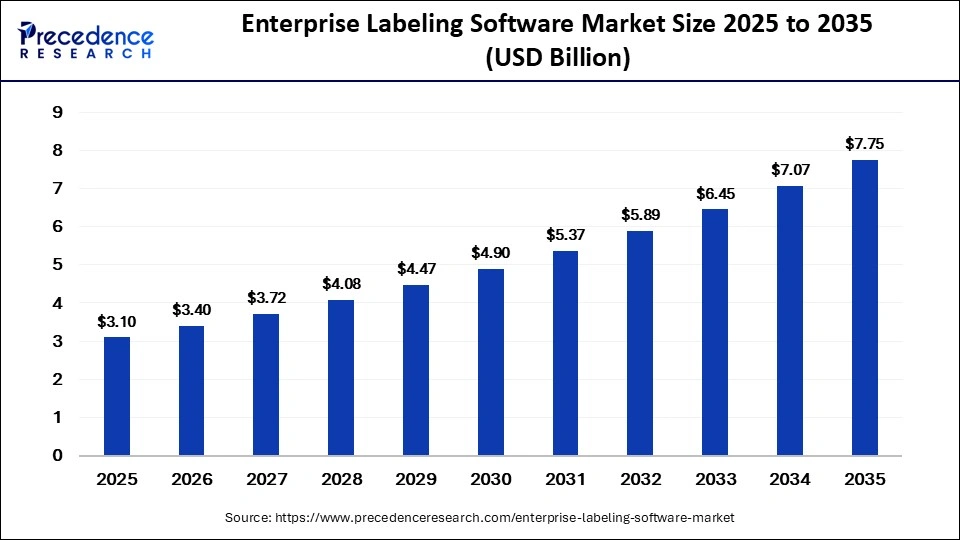
ICT industry specialist Gautam Mahajan estimates the enterprise labeling software market at USD 3.40 billion in 2026, with continued technology adoption expected to take the market to USD 7.75 billion by 2035 at a CAGR of 9.60%. Leading enterprise labeling software market providers such as Loftware, NiceLabel, Seagull Scientific, TEKLYNX, Zebra Technologies are expanding their capabilities across segments including By Deployment Model, By Component, By Label Type, By Application, By Organization Size, By End-Use Industry.
Source: https://www.precedenceresearch.com/enterprise-labeling-software-market
 Get a Sample
 Table Of Content


What is the Enterprise Labeling Software Market Size in 2026?
The global enterprise labeling software market size accounted for USD 3.10 billion in 2025 and is predicted to increase from USD 3.40 billion in 2026 to approximately USD 7.75 billion by 2035, expanding at a CAGR of 9.60% from 2026 to 2035. The enterprise labeling software market is driven by the urgent demand to ensure strict regulatory compliance as well as maintain product traceability across complex global supply chains.
Key Takeaways
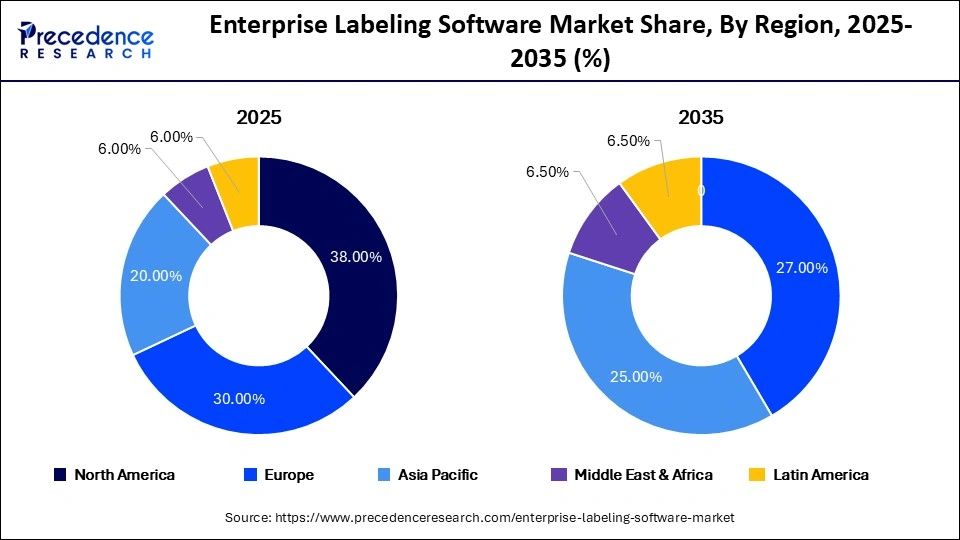
- North America dominated the market with a share of 38.00% in 2025.
- Asia Pacific is expected to grow at the fastest CAGR of 12.5% during the forecast period.
- By deployment model, the cloud-based segment held a major market share of 60.00% in 2025.
- By deployment model, the on-premise segment is expected to grow at a 6.5% CAGR between 2026 and 2035.
- By component, the software segment held the highest market share of 75.00% in 2025.
- By component, the services segment is expected to grow at a 8.0% CAGR between 2026 and 2035.
- By label type, the barcode labels segment led the global market with a share of 35.00% in 2025.
- By label type, the RFID labels segment is expected to grow at a 13.5% CAGR between 2026 and 2035.
- By application, the product identification segment accounted for a revenue share of 30.00 % in 2025.
- By application, the asset tracking segment is expected to grow at the fastest CAGR of 11.5% between 2026 and 2035.
- By end-use industry, the manufacturing segment led the global enterprise labeling software market with a share of 30.00% in 2025.
- By end-use industry, the healthcare & pharmaceuticals segment is the second-largest shareholder and is expected to grow at a 11.5% CAGR between 2026 and 2035.
Market Overview
The enterprise labeling software market refers to solutions that enable organizations to design, manage, and print labels across operations such as manufacturing, logistics, retail, and healthcare, ensuring accuracy, compliance, and consistency in product identification and tracking. These platforms integrate with enterprise systems like ERP and supply chain management tools to streamline labeling workflows and support real-time data updates. Market growth is driven by increasing supply chain complexity, stricter regulatory requirements, rising adoption of automation and cloud-based solutions, and the growing need for standardized, error-free labeling across global operations.
How is AI Influencing the Enterprise Labeling Software Market?
Artificial intelligence is fundamentally changing the enterprise labeling software market, shifting it from manual, rule-driven processes to intelligent, automated, and predictive systems. Moreover, AI tools can now automatically generate, update, and handle label formats and content, decreasing the time-consuming manual processes involved in prepress and even proofing. AI enables the generation of unique, personalized labels at scale, which is vital for modern e-commerce and marketing efforts.
Enterprise Labeling Software Market Trends
- The packaging industry is now moving away from on-premise systems toward cloud-driven platforms. These provide better scalability, flexibility, and even real-time updates for global operations, allowing firms to manage labeling remotely and cost-effectively.
- There is a rising adoption of AI and Intelligent Process Automation (IPA), mainly for automating workflows, limiting manual errors in data entry, and enhancing accuracy in fast-paced production environments.
- Strict regulatory requirements, such as those from the FDA, EU MDR, and GS1 standards, in sectors such as healthcare, food & beverages, and chemicals, are driving the demand for sophisticated software that guarantees accurate and compliant labeling across supply chains.
- Enterprises are increasingly integrating labeling software with core business systems, such as SAP, Oracle, and Microsoft Dynamics, to ensure data consistency and allow dynamic labeling, where labels are populated with real-time data from the ERP or WMS.
Market Scope
| Report Coverage | Details |
| Market Size in 2025 | USD 3.10 Billion |
| Market Size in 2026 | USD 3.40 Billion |
| Market Size by 2035 | USD 7.75 Billion |
| Market Growth Rate from 2026 to 2035 | CAGR of 9.60% |
| Dominating Region | North America |
| Fastest Growing Region | Asia Pacific |
| Base Year | 2025 |
| Forecast Period | 2026 to 2035 |
| Segments Covered | Deployment Model, Component, Label Type, Application, Organization Size, End-Use Industry, and Region |
| Regions Covered | North America, Europe, Asia-Pacific, Latin America, and Middle East & Africa |
Market Dynamics
Drivers
Integration with Enterprise Systems
The integration of labeling software with enterprise systems such as ERP, WMS, and SCM drives the market. This integration enables automated, real-time labeling processes that reduce manual errors and enhance operational efficiency. It also ensures data consistency across global supply chains, supports compliance with regulations such as UDI and GHS, and transforms labeling from a fragmented, localized activity into a centralized and strategic business function.
Restraint
In-house Skill Gaps
A major challenge in the market is the lack of skilled professionals required to implement and manage advanced labeling systems. As labeling evolves into AI-enabled and cloud-based platforms, organizations face an “implementation bottleneck” due to limited technical expertise. This skills gap can slow deployment, increase dependency on external vendors, and hinder full utilization of advanced capabilities.
Opportunity
Supply Chain Digitization & Compliance
The ongoing digitization of supply chains presents significant growth opportunities for the enterprise labeling software market. Organizations are shifting from manual, fragmented labeling processes to centralized, automated, and cloud-driven systems integrated with ERP, WMS, and MES platforms. Increasing demand for end-to-end visibility, faster operations, and compliance with global standards such as UDI, GHS, and GS1 is making advanced labeling solutions a critical component of modern business operations.
Segment Insights
Deployment Model Insights
Enterprise Labeling Software Market Share, By Deployment Model, 2025-2035 (%)
| Deployment Model | 2025 | 2035 | CAGR (%) |
| Cloud-based | 60.00% | 68.00% | 12.50% |
| On-premise | 40.00% | 32.00% | 6.50% |
The Cloud-based Segment Held a 60.00% Market Share in 2025
The cloud-based segment dominated the enterprise labeling software market with a 60.0% share in 2025, driven by the rising adoption of SaaS models and the need for scalability. Cloud solutions enable organizations to rapidly expand labeling operations, onboard new suppliers, and seamlessly integrate with enterprise systems such as ERP and WMS, capabilities that are often more complex with on-premise setups.
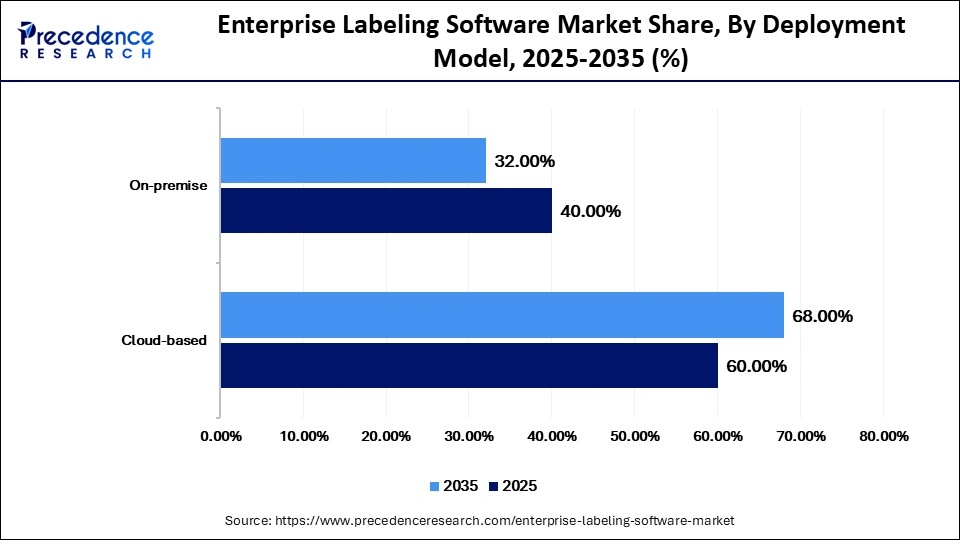
The on-premise segment held a 40.0% share in 2025 and is projected to grow at a CAGR of 6.5% during the forecast period, primarily due to data control and reliability requirements. These solutions offer faster printing speeds and greater reliability for high-volume manufacturing and warehouse environments, as they do not depend on internet connectivity and ensure uninterrupted operations.
Component Insights
Why Did the Software Segment Led the Market in 2025?
The software segment led the enterprise labeling software market with the highest share of 75.00 % in 2025, driven by the growing need for centralized platforms to manage complex, multi-regional labeling and regulatory compliance requirements. Organizations are increasingly replacing manual and fragmented systems with integrated digital solutions.
Enterprise Labeling Software Market Share, By Component, 2025-2035 (%)
| Component | 2025 | 2035 | CAGR (%) |
| Software | 75.00% | 78.00% | 10.50% |
| Services | 25.00% | 22.00% | 8.00% |
The services segment accounted for a 25.0% share in 2025 and is expected to grow at a CAGR of 8.0%, supported by rising demand for implementation, integration, and support services. These services are essential for aligning labeling systems with existing ERP and supply chain platforms, reducing operational errors and improving efficiency.
Label Type Insights
The Barcode Labels Segment Held a 35.00% Share of the Market in 2025
The barcode labels segment held a dominant position in the enterprise labeling software market with a share of 35.00% in 2025. This is because of their widespread use in product identification and tracking. Integration with ERP and WMS systems enables automated label generation, ensuring accuracy and reducing manual errors across global supply chains.
Enterprise Labeling Software Market Share, By Label Type, 2025-2035 (%)
| Label Type | 2025 | 2035 | CAGR (%) |
| Barcode Labels | 35.00% | 30.00% | 7.50% |
| RFID Labels | 25.00% | 30.00% | 13.50% |
| QR Code Labels | 20.00% | 22.00% | 11.0% |
| Regulatory Labels | 20.00% | 18.00% | 9.0% |
The RFID labels segment held a 25.00% share of the market in 2025 and is expected to grow at the fastest CAGR of 13.5 % during the projection period. This is mainly due to their increasing adoption in logistics, healthcare, and automotive industries. RFID-enabled labeling supports advanced tracking and supply chain visibility.
The QR code labels segment held a 20.00% market share in 2025 and is expected to grow at a CAGR of 11.0% in the upcoming period, driven by the need for digital tracking and marketing. The integration of QR codes with enterprise labeling software improves, digitizes, and automates workflows, which is essential for efficient, high-speed production environments.
Application Insights
Enterprise Labeling Software Market Share, By Application, 2025-2035 (%)
| Application | 2025 | 2035 | CAGR (%) |
| Product Identification | 30.00% | 28.00% | 8.5% |
| Inventory Management | 25.00% | 27.00% | 10.50% |
| Compliance Labeling | 25.00% | 23.00% | 9.5% |
| Asset Tracking | 20.00% | 22.00% | 11.5% |
What Made Product Identification the Dominant Segment in the Market in 2025?
The product identification segment dominated the enterprise labeling software market with a major share of 30.00% in 2025, as accurate labeling is a fundamental requirement across industries. Technologies such as barcodes and RFID, combined with enterprise system integration, enable real-time label updates and improved traceability.
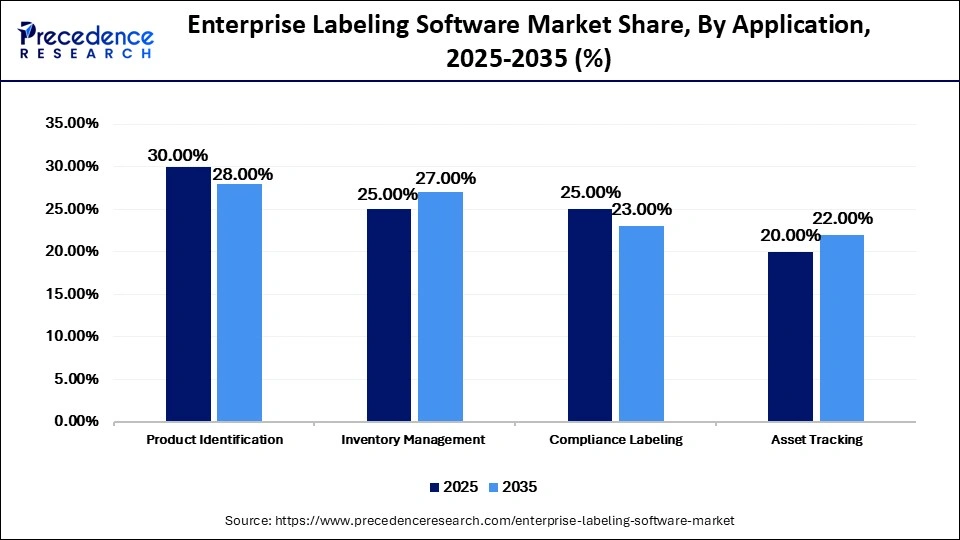
The inventory management segment held a 25.0% share of the market in 2025 and is projected to grow at a CAGR of 10.5%, driven by the need for efficient supply chain operations. The adoption of RFID and IoT technologies in warehousing is increasing the demand for advanced labeling systems that manage unique product identifiers.
The asset tracking segment accounted for a 20.0% share of the market in 2025 and is expected to grow at the fastest CAGR of 11.5%, supported by the need for real-time monitoring and improved operational visibility. Labeling technologies such as barcodes, QR codes, and RFID enable end-to-end asset tracking and reduce human error.
End-Use Industry Insights
The Manufacturing Segment Held a 30.00% Share of the Market in 2025
The manufacturing segment held a market share of 30.00% in 2025, driven by the integration of labeling directly into production workflows. Manufacturers are accepting automated labeling to connect directly with systems such as SAP, Oracle, and Microsoft Dynamics, limiting manual error and improving speed. This guarantees that labeling data is synchronized in real-time with production and inventory, mainly in high-volume settings.
Enterprise Labeling Software Market Share, By End-Use Industry, 2025-2035 (%)
| End-Use Industry | 2025 | 2035 | CAGR (%) |
| Manufacturing | 30.00% | 32.00% | 10.50% |
| Healthcare & Pharmaceuticals | 20.00% | 22.00% | 11.5% |
| Retail & E-commerce | 18.00% | 17.00% | 9.50% |
| Food & Beverage | 12.00% | 11.00% | 8.50% |
| Logistics & Transportation | 12.00% | 13.00% | 10.50% |
| Chemicals | 8.00% | 5.00% | 7.5% |
The healthcare & pharmaceuticals segment held a 20.00% share of the market in 2025 and is expected to grow at the fastest CAGR of 11.5 % during the projection period. This is mainly due to stringent compliance requirements, patient safety concerns, and the need for end-to-end traceability. Pharmaceutical firms must adhere to strict, evolving global regulations, such as the US Drug Supply Chain Security Act and EU Falsified Medicines Directive, demanding comprehensive serialization and tracking.
The logistics & transportation segment held a 12.00% share of the market in 2025 and is expected to grow at a CAGR of 10.5 % during the projection period, driven by increasing demand for traceability and high-volume shipping efficiency. Transportation, especially for pharma, food, and chemicals, must comply with strict international standards such as GHS, UDI, and GS1. Enterprises use labeling software to guarantee full traceability throughout the supply chain, enabling tracking of items from manufacturing to final delivery.
Regional Insights
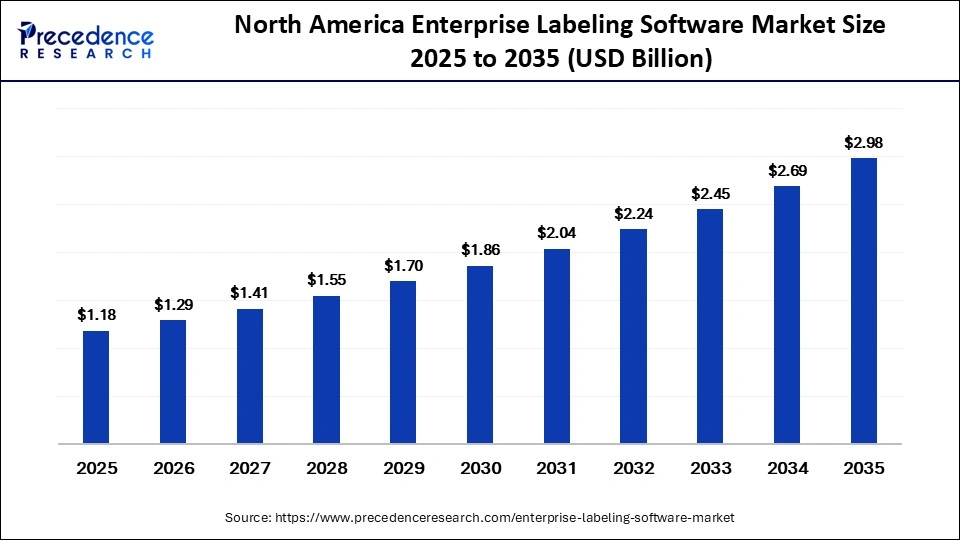
North America Enterprise Labeling Software Market Size and Growth 2026 to 2035
The North America enterprise labeling software market size is estimated at USD 1.18 billion in 2025 and is projected to reach approximately USD 2.98 billion by 2035, with a 9.71% CAGR from 2026 to 2035.
North America Led the Global Enterprise Labeling Software Market in 2025
North America led the enterprise labeling software market with a 38.0% share in 2025, driven by early adoption of cloud-native and SaaS-based labeling platforms. These solutions enable centralized label management, scalability, and real-time visibility across global supply chains, helping organizations reduce errors and improve consistency across multi-site operations. There is a rapid shift from decentralized, manual processes to integrated digital systems, which continues to strengthen the region's market leadership.
U.S. Enterprise Labeling Software Market Size and Growth 2026 to 2035
The U.S. enterprise labeling software market size is calculated at USD 883.50 million in 2025 and is expected to reach nearly USD 2,252.73 million in 2035, accelerating at a strong CAGR of 9.81% between 2026 and 2035.
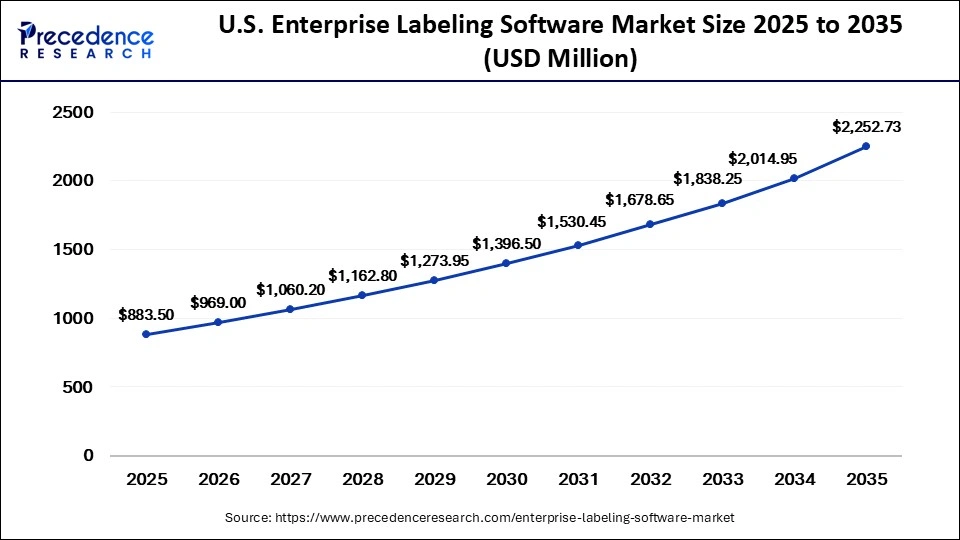
U.S. Market Analysis
The U.S. is a major contributor to the North American market, supported by the increasing adoption of real-time data-driven labeling systems to manage complex supply chains and regulatory requirements. Organizations are rapidly transitioning to cloud-based platforms, which offer greater flexibility, scalability, and lower upfront costs compared to traditional on-premise solutions. This shift is further accelerating the adoption of advanced enterprise labeling technologies across industries.
Europe: The Second-Largest Market
Europe held the second-largest share of 30.00% in 2025 and is expected to grow at a notable CAGR of 8.0 % during the projection period. This growth is primarily driven by stringent EU regulations governing labeling across the pharmaceutical, chemical, and food industries. These regulations require highly accurate, traceable, and compliant enterprise labeling solutions, encouraging widespread adoption of advanced systems across the region.
UK Market Analysis
The UK leads the European market due to the rapid adoption of smart labeling technologies, RFID systems, and integration with enterprise platforms such as SAP and Oracle. Strict regulatory requirements across manufacturing, food and beverage, and pharmaceutical sectors are driving the need for automated labeling systems that ensure accuracy, traceability, and compliance. This strong regulatory environment continues to accelerate digital transformation in labeling processes across UK industries.
Asia Pacific: The Fastest-Growing Region
Asia Pacific held a 20.0% share of the enterprise labeling software market in 2025 and is projected to grow at the fastest CAGR of 12.5% during the forecast period, driven by rapid manufacturing expansion and industrial digitization. China dominates the regional market due to its large-scale manufacturing base, which requires advanced labeling solutions for logistics, exports, and product traceability. Additionally, the rapid growth of e-commerce and retail across emerging economies is increasing demand for scalable and efficient labeling systems, particularly in packaging and distribution workflows.
China Market Analysis
The market in China is expected to grow significantly during the forecast period, supported by the government's “Intelligent Manufacturing” initiative. This initiative promotes the adoption of automated and centralized labeling systems across production, logistics, and retail operations. The push toward smart factories and digitally integrated supply chains is further accelerating demand for advanced enterprise labeling solutions in the country.
Enterprise Labeling Software Market Companies
- Loftware
- NiceLabel
- Seagull Scientific
- TEKLYNX
- Zebra Technologies
- SAP
- Microsoft
- Esko
- PRISYM ID
- CodeSoft
- Honeywell
- SATO Holdings
- Avery Dennison
- Bartender by Seagull Scientific
- Oracle
Recent Developments
- In April 2026, Loftware declared the launch of Loftware Connect, a transformative new platform that redefines how organizations manage product identification over global supply chains. Loftware Connect introduces the industry's first secure, scalable network, which connects companies with their trading partners, thus replacing fragmented coordination with a unified digital foundation designed to enhance resilience, compliance, and speed.(Source: (Source: https://www.loftware.com)
- In March 2026, Seagull Software declared the release of BarTender 12, a major evolution of its globally trusted labeling software utilized by more than 250,000 organizations. It is designed to understand increasing operational complexity, multi-site collaboration, and even globalized supply chains.(Source: https://www.bartendersoftware.com)
Segments Covered in the Report
By Deployment Model
- Cloud-based
- On-premise
By Component
- Software
- Services
By Label Type
- Barcode Labels
- RFID Labels
- QR Code Labels
- Regulatory Labels
By Application
- Product Identification
- Inventory Management
- Asset Tracking
- Compliance Labeling
By Organization Size
- Large Enterprises
- Small & Medium Enterprises (SMEs)
By End-Use Industry
- Manufacturing
- Healthcare & Pharmaceuticals
- Retail & E-commerce
- Food & Beverage
- Logistics & Transportation
- Chemicals
By Region
- North America
- Latin America
- Europe
- Asia-pacific
- Middle and East Africa
For inquiries regarding discounts, bulk purchases, or customization requests, please contact us at sales@precedenceresearch.com
Frequently Asked Questions





Ask For Sample
No cookie-cutter, only authentic analysis – take the 1st step to become a Precedence Research client
 Get a Sample




 sales@precedenceresearch.com
 Schedule a Meeting
