



EV Battery Cell and Pack Materials Market Revenue, Leading Companies, Company Product Portfolio, Production Output, Material Consumption, Sales Performance, Pricing Trends, Distribution Analysis, Company Market Share, and Forecast
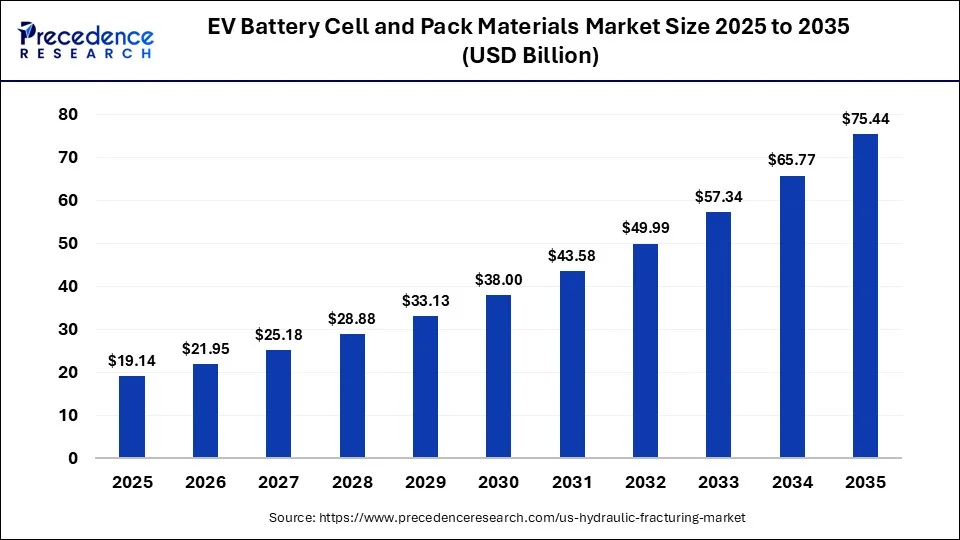
The EV battery cell and pack materials market was valued at USD 21.95 billion in 2026, expanding at a CAGR of 14.70% during the forecast period from 2026 to 2035. The driving factor for the market is the global scale-up of vehicle electrification and changing battery chemistries. Our healthcare research analyst, Vidyesh Swar, analysed this value. He must optimize supply chains, analyze material performance, and pioneer sustainable, next-generation chemistries.
Source: https://www.precedenceresearch.com/ev-battery-cell-and-pack-materials-market
 Get a Sample
 Table Of Content


EV Battery Cell and Pack Materials Market Size, Share, Trends, and Forecast Analysis 2035
The primary driving factor for the EV battery cell and pack materials market is the rising need for higher energy density, lower charging times, and even extended driving ranges, which drives advanced material innovation. The EV battery cell and pack materials market is forecasted to expand from USD 21.95 billion in 2026 to USD 75.44 billion by 2035, growing at a CAGR of 14.70% from 2026 to 2035. This market is basically driven by global EV adoption, which continues to climb past major milestones, fueled by user acceptance and mandatory fleet transitions. Every manufactured vehicle unit creates a compounding need for cathodes, anodes, electrolytes, along with separators. The rapid pivot toward lower-cost lithium iron phosphate battery (LFPB) formulations raises overall volume demand despite lower raw material costs.
Key Takeaways
- By cell material type, the cathode materials segment led the market with a 39.85% share in 2025.
- By battery pack material type, the battery casings & enclosures segment captured a major revenue share of 27.85% in 2025.
- By cell chemistry, the LFP segment captured the largest market share of 37.85% in 2025.
- By vehicle type, the passenger EVs segment led the market with a share of 78.65% in 2025.
- By cell & pack architecture, the cell-to-module-to-pack segment led the market with a share of 48.40% in 2025.
- By application, the battery electric vehicles segment led the market with a share of 69.85% in 2025.
- LG Chem plans to expand cathode production capacity to 360,000 tonnes annually by 2030.
- TAM with nearly ~USD 58.2B in 2025, with a broad EV battery-material ecosystem including major active and supporting materials.
- SAM is nearly ~USD 19.1B, with a narrower cell-and-pack material scope aligned with the defined market boundary.
- SOM is supplier-specific and depends on chemistry, geography, qualification status, capacity, and customer contracts.
Introduction
What is the Current Market Size, and What is Shaping the Next Decade of EV Battery Material Demand?
The global EV battery cell and pack materials market was valued at nearly USD 19.14 billion in 2025 and is anticipated to expand at a 14.70% CAGR from 2026 to 2035. The market includes materials incorporated into EV battery cells and packs, thus spanning cathode and anode materials, separators, electrolytes, current collectors, casings or enclosures, thermal-management materials, conductive additives, binders, and related engineered materials. A comparable 2025 industry estimate also places the broader EV battery materials market at a substantially larger level as it captures a wider definition of battery materials.
The underlying need is being reinforced by the rapid increase in EV battery deployment. Global EV battery deployment reached nearly 1.2 TWh in 2025, nearly 30% above 2024, while EVs accounted for more than 70% of total battery deployment. Moreover, light-duty vehicles represented more than 85% of EV battery deployment; thus, electric trucks recorded particularly rapid growth.
The materials opportunity is increasingly being shaped by localized supply chains, lower battery costs, chemistry diversification, cell-to-pack architectures, LFP expansion, thermal-management requirements, higher silicon utilization, and recycling. Cathode active materials remain mainly important economically: IEA estimates that CAM represented nearly 40-50% of NMC battery cell production cost and then 25–30% for LFP based on 2024 Chinese production economics.
Analyst View
The market is shifting from a simple volume-growth story toward a technology-and-localization story. Cathodes remain the largest value pool, but the strongest strategic opportunities are thus increasingly emerging around LFP materials, advanced anodes, separators, conductive additives, thermal-management materials, and materials compatible with cell-to-pack and next-generation architectures.
By Cell Material Type
Which Material Categories Capture the Largest Value, and Where is Growth Accelerating?
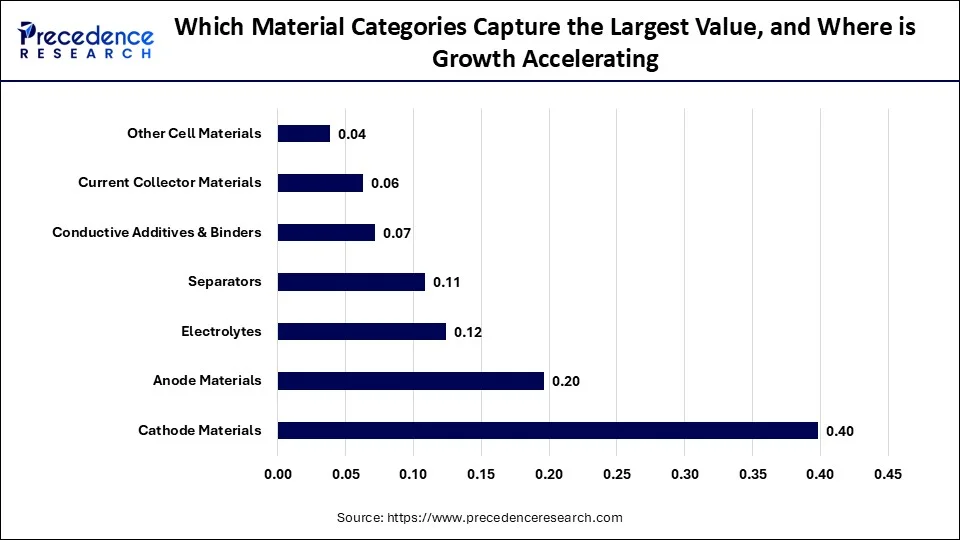
The cathode materials segment is dominated by a market share of 39.85% because they strongly influence energy density, voltage, cost, and battery chemistry. LFP and nickel-based cathode technologies are developing in parallel rather than following a single chemistry pathway. The separators segment is the fastest growing in the market, as safety-driven separator innovation, thinner membranes, ceramic coatings, and improved thermal resistance are supporting above-market growth. LG Chem, for instance, uses its SRS technology with ceramic particle coatings to enhance separator safety and high-temperature performance.
By Battery Pack Material Type
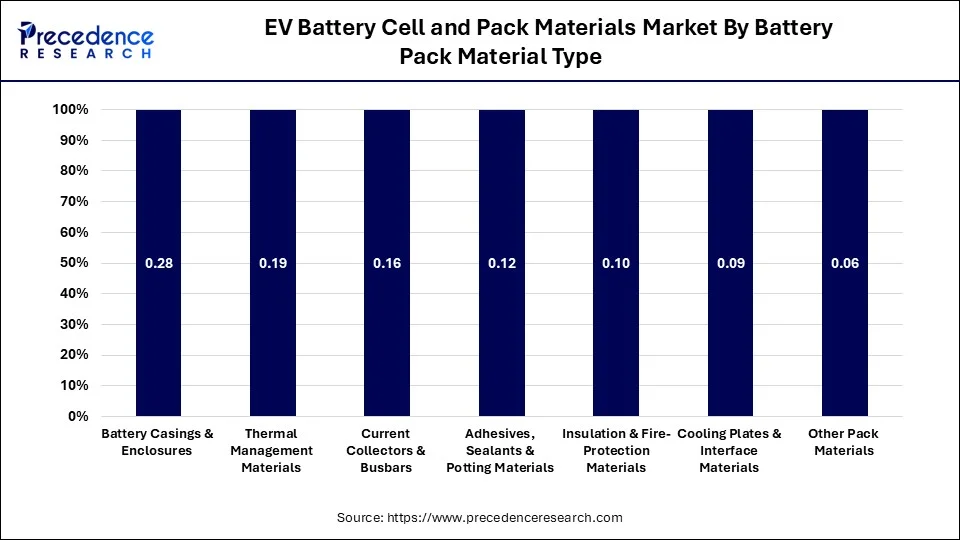
The battery sasings & enclosures segment dominated the market share of 27.85% as it remains fundamental because every battery architecture demands mechanical protection, electrical isolation, and environmental resistance.
The thermal management materials segment is the fastest growing as high-power charging and increasingly compact battery designs raise heat generation along with heat-dissipation requirements. Thermal-management materials therefore gain importance along with higher energy density.
By Cell Chemistry
Which Battery Chemistries are Creating the Strongest Material Opportunities?
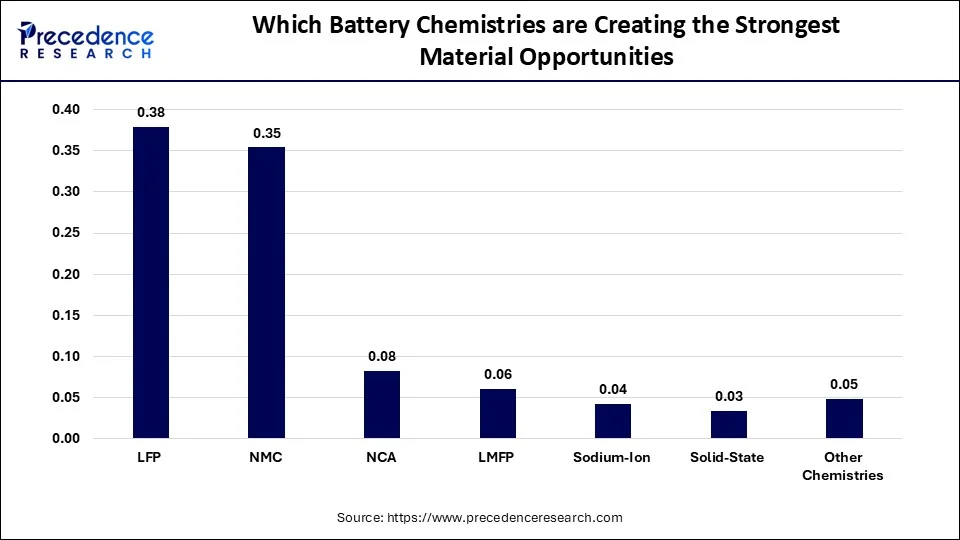
The LFP segment dominated in 2025 as LFP has become an important cost-focused chemistry, mainly in China and increasingly in other markets. In 2025, LFP packs were on average more than 40% cheaper per kWh than NMC packs; thus, application mix affects the comparison.
The solid-state segment is the fastest growing from a small base as automotive companies and battery producers pursue higher energy density and improved safety. Commercial adoption remains dependent on manufacturing scale, yield, and even cost.
By Vehicle Type
Which Vehicle Categories Generate the Largest Materials Demand?
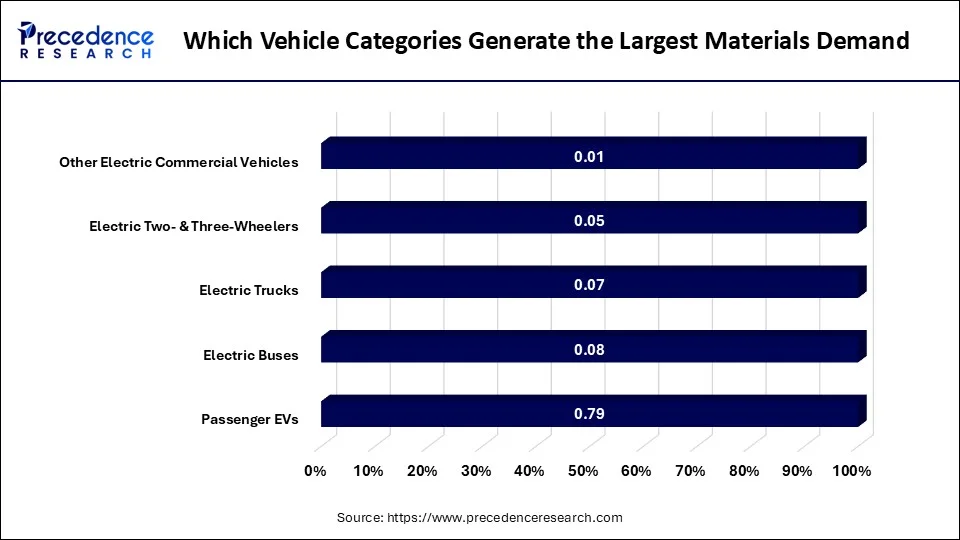
The passenger EVs segment dominated in 2025 with a market share of 78.65%, as Passenger vehicles continue to account for the majority of battery demand. IEA reports that light-duty vehicles thus represented more than 85% of EV battery deployment in 2025.
The electric trucks segment is the fastest growing as electric truck battery demand more than doubled in 2025, making commercial vehicles a mainly important future demand pool for high-capacity cells, thermal-management materials, along with durable pack structures.
By Cell and Pack Architecture
How are Battery Architectures Changing the Material Mix?
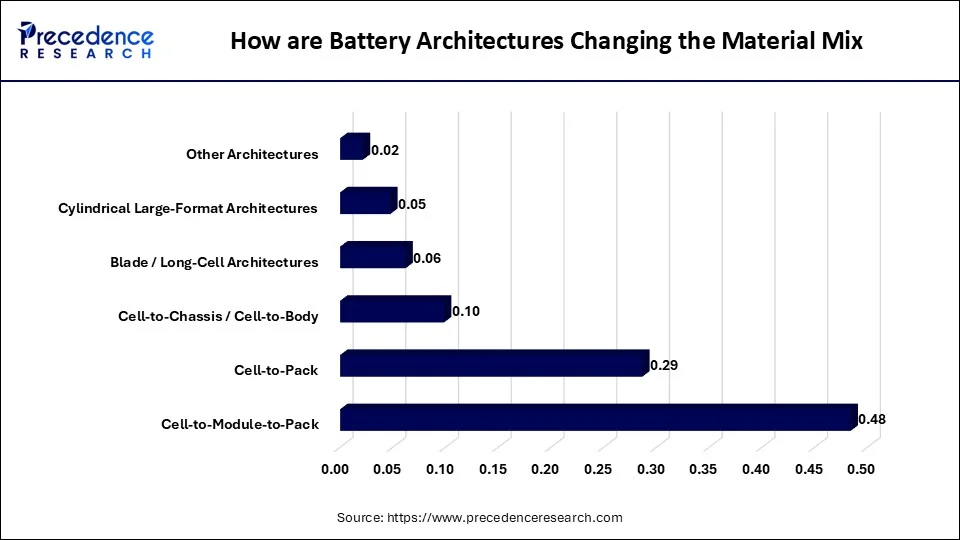
The cell-to-module-to-pack segment dominated with a market share of 48.40%, as Conventional architectures retain a large installed production base and remain widely used across multiple vehicle platforms. The cell-to-chassis or cell-to-body segment is the fastest-growing, as structural integration can decrease pack-level inactive mass and packaging requirements, although manufacturing, repairability, along with safety engineering remain important considerations.
By Application
Where is Battery-Material Demand Concentrated Across Applications?
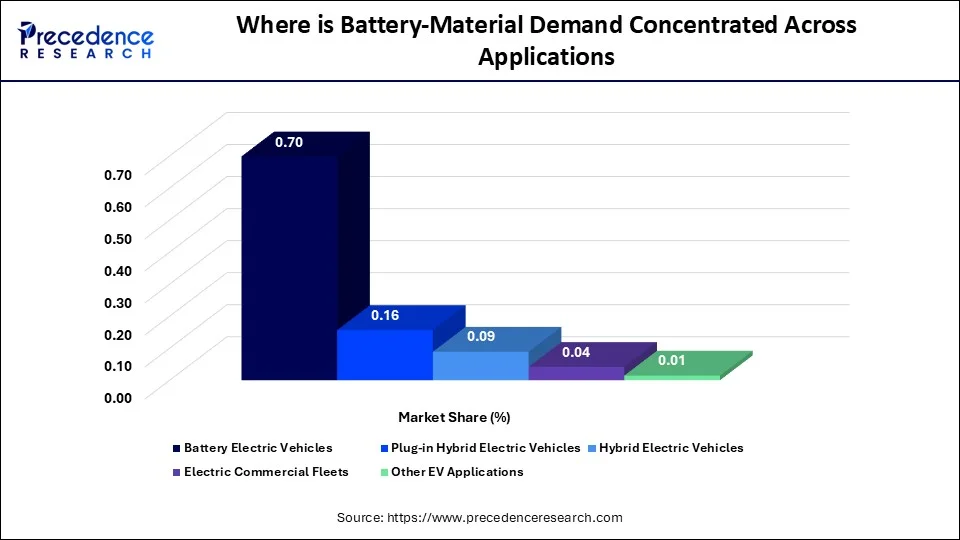
The battery electric vehicles segment dominated in 2025 as BEVs require substantially larger battery packs than conventional hybrids, producing greater need for active materials and pack-level components. The electric commercial fleets segment is the fastest growing because trucks and fleet vehicles are moving toward electrification while demanding larger battery capacities, increasing material intensity per vehicle.
Which Companies are Shaping the Competitive Supply Chain?
The competitive landscape spans battery-material specialists, integrated chemical companies, cell producers, metal processors, and recycling firms. The competitive advantage increasingly depends on qualifying material performance with OEMs, securing raw materials, localizing manufacturing, and even meeting traceability requirements.
CATL
CATL remains one of the largest global battery producers and then reported 661 GWh of lithium-ion battery sales in 2025, with global production capacity reaching 772 GWh at year-end. Its scale offers significant influence over chemistry, cell architecture, and also upstream material requirements.
LG Chem
LG Chem has a broad battery-material portfolio covering separators, binders, cathodes, and other advanced materials. Moreover, it plans to expand cathode production capacity to 360,000 tonnes annually by 2030, with production bases in Korea and the United States. The firm has also signed a cathode-material supply agreement with GM involving more than 500,000 tonnes through 2035, with material production planned at its Tennessee facility beginning in 2026.
POSCO Future M
POSCO Future M is positioned across cathode and anode materials, thus benefiting from South Korea's integrated battery-material ecosystem and its relationships with battery producers.
Umicore
Umicore functions across cathode materials, battery-material technologies along with recycling, positioning the firm around both primary material supply and circular material recovery.
BASF
BASF has developed cathode-active-material capabilities along with localized battery-material initiatives, mainly around Europe and North America, thus reflecting the industry's move toward regionalized supply chains.
Panasonic Energy
Panasonic Energy remains an important battery-cell producer as well as a technology partner for automotive customers, creating downstream need for high-performance cathode, anode, separator, and pack materials.
Analyst View
Competition is shifting from material volume alone toward chemistry flexibility, localized qualification, and supply-chain control. Companies that can provide multiple chemistries, local production, recycled feedstocks, along with long-term OEM qualification have increasing strategic relevance. CATL's scale and LG Chem's integrated material portfolio represent two different approaches to controlling battery-material value chains.
What do EV Battery-Material Buyers Prioritize When Selecting Suppliers?
Battery producers and automotive OEMs generally evaluate suppliers across cost, consistency, energy-density contribution, impurity control, safety, cycle life, production scalability, and supply security. Procurement is increasingly moving toward longer-term agreements and geographically diversified sourcing. This is mainly important because battery-material supply chains remain heavily concentrated in China. In 2025, China accounted for more than 80% of global battery-cell production, nearly 85% of cathode active-material production, and then more than 90% of anode active-material production.
Key Buyer Priorities
- Cathode: energy density, nickel or cobalt intensity, thermal stability, particle morphology, and cost.
- Anode: graphite purity, cycle life, silicon compatibility, and charging performance.
- Separator: puncture resistance, porosity, thermal stability, and coating consistency.
- Electrolyte: conductivity, low-temperature performance, high-voltage stability, and safety
- Pack materials: thermal conductivity, structural strength, flame resistance, weight, and recyclability.
- Procurement: local production, traceability, dual sourcing, and long-term price visibility.
The largest adoption barriers are qualification cycles, limited non-Chinese midstream capacity, material-price volatility, technology switching costs, and the demand to maintain identical performance across geographically distributed production sites.
Where is the Addressable Opportunity Across TAM, SAM and SOM?
A practical commercial framework can distinguish the wide battery-material opportunity from the addressable EV-specific material pool.
|
Opportunity Layer |
Indicative Scope | Strategic Interpretation |
| TAM | ~USD 58.2B in 2025 | Broad EV battery-material ecosystem including major active and supporting materials. |
| SAM | ~USD 19.1B | Narrower cell-and-pack material scope aligned with the defined market boundary. |
| SOM | Supplier-specific | Depends on chemistry, geography, qualification status, capacity, and customer contracts. |
For material producers, the most actionable SOM is usually not the entire battery-material market but a specific chemistry-material-region combination, like LFP cathode materials in North America, silicon-enhanced anodes in Europe, ceramic-coated separators in Asia-Pacific, or thermal-interface materials for high-voltage commercial-vehicle packs.
What Strategic Questions Should Companies Answer Before Investing or Entering?
- Which battery chemistry will generate the largest incremental material need through 2035?
- How quickly will LFP and LMFP displace nickel-based cathode need in different vehicle segments?
- What proportion of future cathode as well as anode demand can be served from non-Chinese production?
- Which material categories provide the strongest pricing power after qualification?
- How will cell-to-pack and cell-to-body architectures change the need for pack materials?
- Which thermal-management technologies will benefit from 800V and ultra-fast charging?
- Where will silicon-anode adoption become commercially meaningful?
- How rapidly can sodium-ion materials move from pilot production to automotive-scale volumes?
- Which countries offer the best combination of raw-material access, customer proximity, incentives, and manufacturing cost?
- How will recycling affect virgin lithium, cobalt, graphite, nickel, and copper demand?
- Which OEM and battery-cell contracts offer the most durable demand visibility?
- What material specifications are becoming qualification bottlenecks?
- How should suppliers structure pricing mechanisms around lithium, graphite, nickel, and other volatile inputs?
- Which local-content rules could change sourcing economics in North America and Europe?
By Region - Final Segment
Which Regions are Leading the Market, and Where is Manufacturing Capacity Moving?
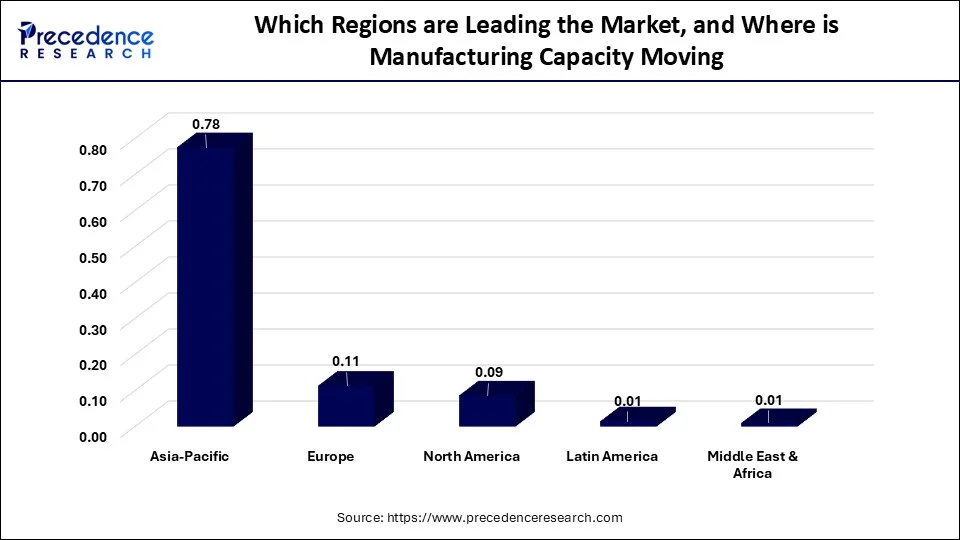
Asia-Pacific remains overwhelmingly dominant due to unprecedented local electric vehicle adoption, complete regional supply chain integration, and aggressive government policy support. Subsidies, production-linked incentives, along with aggressive emission reduction targets accelerate local manufacturing. Japan and South Korea advance next-generation innovations such as solid-state and high-density cells via leaders such as Panasonic. IEA estimates that China accounted for more than 80% of global battery-cell production in 2025 and thus, around 85% of cathode-active-material production.
Asia-Pacific - Country Structure
| Segment / Sub-segment Name | Market Share (%) | CAGR (%) | Growth Driver |
| China | 63.85% | 14.20% | Integrated mineral-processing, material, cell, and EV manufacturing ecosystem. |
| South Korea | 7.15% | 13.85% | Advanced cathode, separator, and cell-manufacturing capabilities. |
| Japan | 3.10% | 10.75% | High-performance battery materials and advanced cell technologies. |
| India | 1.85% | 0.24 | Emerging domestic cell manufacturing and accelerating EV ecosystem. |
| Southeast Asia & Others | 1.62% | 17.05% | Indonesia-led nickel integration and expanding battery supply chain. |
| Asia-Pacific Total | 77.57% | — | — |
China dominated the EV battery cell and pack materials market in 2025 as it combined battery-cell production, cathode or anode manufacturing, refining, and EV production at an unmatched scale. Meanwhile, local policies align mining and refining, along with manufacturing, seamlessly. Chinese manufacturing expenses run roughly 20% lower than Western alternatives.
India's battery manufacturing base is among the fastest-growing capacity additions, and EV adoption creates a high-growth starting point. IEA notes that India's first battery plants opened in 2024 and that additional manufacturing investment is being developed. Moreover, recent union budgets extended duty exemptions on raw material inputs for lithium-ion manufacturing and then subsidies totaling ₹18,000 crore incentivize greenfield advanced chemistry cell (ACC) manufacturing.
Europe - Country Structure
Germany dominated the market with a share of 3.95% in 2025, as Germany is Europe's largest automotive production center, has secure domestic supply chains, thus supporting its massive automotive manufacturing base, and meets strict European Union (EU) environmental regulations.
Hungary is the fastest growing market with a CAGR of 17.85%, as it positions itself as the central European manufacturing bridge between Asian battery giants as well as major European automakers.
| Segment / Sub-segment Name | Market Share (%) | CAGR (%) | Growth Driver |
| Germany | 3.95% | 13.25% | Large automotive manufacturing base and battery localization. |
| Hungary | 2.05% | 17.85% | Large-scale Asian battery investment and European EV supply-chain integration. |
| Poland | 1.55% | 15.20% | Battery-cell and component manufacturing ecosystem. |
| Sweden | 1.05% | 8.65% | Established battery investment base despite recent industry restructuring. |
| France & Other Europe | 2.75% | 12.90% | Expanding regional battery and automotive supply chains. |
| Europe Total | 11.35% | — | — |
United States dominated the market with a share of 7.45% due to strong federal funding, rising domestic electric vehicle adoption, and then regional supply-chain localization goals. Consumer adoption of electric passenger cars continues to scale up.
Canada is the fastest-growing, with a CAGR of 19.15% due to its abundant critical mineral reserves, strategic North American trade positioning, aggressive federal clean-energy policies, and shorter transport distances for heavy battery components.
North America - Country Structure
| Segment / Sub-segment Name | Market Share (%) | CAGR (%) | Growth Driver |
| United States | 7.45% | 15.95% | Large automotive market and battery-manufacturing investment. |
| Canada | 0.80% | 0.19 | Battery-material projects and North American supply-chain integration. |
| Mexico | 0.40% | 16.75% | Automotive manufacturing and nearshoring. |
| North America Total | 8.65% | — | — |
United States dominated the market with a share of 7.45% due to strong federal funding, rising domestic electric vehicle adoption, and then regional supply-chain localization goals. Consumer adoption of electric passenger cars continues to scale up.
Canada is the fastest-growing, with a CAGR of 19.15% due to its abundant critical mineral reserves, strategic North American trade positioning, aggressive federal clean-energy policies, and shorter transport distances for heavy battery components.
Latin America - Country Structure
| Segment / Sub-segment Name | Market Share (%) | CAGR (%) | Growth Driver |
| Brazil | 0.55% | 12.75% | Largest regional automotive and industrial base. |
| Chile | 0.45% | 13.40% | Lithium-resource position and downstream battery-material opportunity. |
| Argentina | 0.30% | 0.18 | Lithium-resource development and investment potential. |
| Other Latin America | 0.15% | 11.20% | Emerging EV and battery supply-chain activity. |
| Latin America Total | 1.45% | — | — |
Brazil dominated the market with a share of 0.55% due to surging local EV adoption, and re-introduced import tariffs forcing localized manufacturing, along with major infrastructure investments from global automakers. Argentina is the fastest-growing market, with a CAGR of 17.80% due to its massive natural lithium reserves and even new government investments.
Middle East & Africa - Country Structure
| Segment / Sub-segment Name | Market Share (%) | CAGR (%) | Growth Driver |
| Morocco | 0.55% | 0.19 | Phosphate resources, automotive manufacturing, and major battery-material investment. |
| South Africa | 0.16% | 12.85% | Automotive manufacturing and mineral resources. |
| UAE | 0.10% | 14.10% | Emerging clean-technology investment. |
| Saudi Arabia | 0.08% | 15.25% | Industrial diversification and battery investment. |
| Other Middle East & Africa | 0.09% | 11.30% | Early-stage battery ecosystem development. |
Morocco is mainly significant because its phosphate resources, along with its automotive-manufacturing base, have attracted substantial battery-related investment. IEA reported more than USD 15 billion of declared investments in Morocco covering lithium processing, battery components and even battery manufacturing, including a planned 100 GWh battery plant.
Analyst View
Asia-Pacific will remain the core supply center, but the strategic direction is toward geographic diversification. China thus continues to dominate upstream and midstream materials, while North America and Europe are attempting to now establish regional supply chains. IEA's analysis shows that China still supplies the overwhelming majority of global CAM along with AAM, thus making non-Chinese capacity a major investment theme.
Expert Insights
The EV battery cell and pack materials market covers the raw materials, chemical components, along with structural elements used to manufacture rechargeable batteries for electric vehicles. I believe this market is growing as global EV adoption is scaling up and driving massive demand for active chemical components and structural packaging, and as rapid buildouts of gigafactories increase localized material processing and consumption.
Our Experts
- The primary market research process was carried out by Vidyesh Swar, Senior Research Associate, who also designed the methodology and conducted market segmentation, competitive analysis, regional trend analysis, recycling technology analysis, and forecasts, laying the foundation for the analytical part of the report.
- Aman Singh, Head of Research, has gathered and checked regulatory policies, information on recycling capacity, company financial information, production information, commodity price information, and numerous other quantitative information sources, which are obtained independently, thereby increasing the quality of evidence supporting calculations of the market values.
- Aditi Shivarkar, VP Research, has validated and refined the research material, verified facts, corrected inconsistencies, and completed the research document, making it accurate and to the point.
EV Battery Cell and Pack Materials Market Segments Covered in This Report
By Cell Material Type
- Cathode Materials
- Anode Materials
- Electrolytes
- Separators
- Conductive Additives & Binders
- Current Collector Materials
- Other Cell Materials
By Battery Pack Material Type
- Battery Casings & Enclosures
- Thermal Management Materials
- Current Collectors & Busbars
- Adhesives, Sealants & Potting Materials
- Insulation & Fire-Protection Materials
- Cooling Plates & Interface Materials
- Other Pack Materials
By Cell Chemistry
- LFP
- NMC
- NCA
- LMFP
- Sodium-Ion
- Solid-State
- Other Chemistries
By Vehicle Type
- Passenger EVs
- Electric Buses
- Electric Trucks
- Electric Two- & Three-Wheelers
- Other Electric Commercial Vehicles
By Cell & Pack Architecture
- Cell-to-Module-to-Pack
- Cell-to-Pack
- Cell-to-Chassis / Cell-to-Body
- Blade / Long-Cell Architectures
- Cylindrical Large-Format Architectures
- Other Architectures
By Application
- Battery Electric Vehicles
- Plug-in Hybrid Electric Vehicles
- Hybrid Electric Vehicles
- Electric Commercial Fleets
- Other EV Applications
By Region
- North America
- United States
- Canada
- Mexico
- Europe
- Germany
- Hungary
- Poland
- Sweden
- France
- Other Europe
- Asia-Pacific
- China
- South Korea
- Japan
- India
- Southeast Asia & Others
- Latin America
- Brazil
- Chile
- Argentina
- Other Latin America
- Middle East & Africa
- Morocco
- South Africa
- UAE
- Saudi Arabia
- Other Middle East & Africa
Overall Market Analyst View
The EV battery cell and pack materials market is entering a period in which chemistry diversification, manufacturing localization, along with battery-architecture changes will be as important as EV volume growth. Moreover, cathode materials will remain the largest value category, but separators, advanced anodes, thermal-management materials, and safety materials are positioned for faster expansion.
The most significant structural change is the growing influence of LFP and a few lower-cost chemistries, alongside continued need for high-nickel materials in applications where energy density remains vital. At the same time, cell-to-pack as well as structural battery architectures are changing the quantity and specification of pack materials required per vehicle. Geographically, China thus remains the central battery-material manufacturing hub, while North America, Europe, India, Indonesia, along with Morocco, are developing alternative supply-chain centers. The resulting market opportunity is therefore not simply about supplying more material; it is about establishing qualified, traceable, localized, and chemistry-flexible material supply chains.
For material suppliers, the highest-value strategic opportunities are thus likely to sit at the intersection of advanced chemistry, localized manufacturing, safety, recycling, and long-term OEM or cell-maker qualification.
For inquiries regarding discounts, bulk purchases, or customization requests, please contact us at sales@precedenceresearch.com
Frequently Asked Questions





Ask For Sample
No cookie-cutter, only authentic analysis – take the 1st step to become a Precedence Research client
 Get a Sample




 sales@precedenceresearch.com
 Schedule a Meeting
